- 1SAP publishes two different customer counts on its own website, 320,000 and 400,000. Vendors selling SAP install-base files quote figures from 50,000 to over a million, so treat every precise number as an estimate.
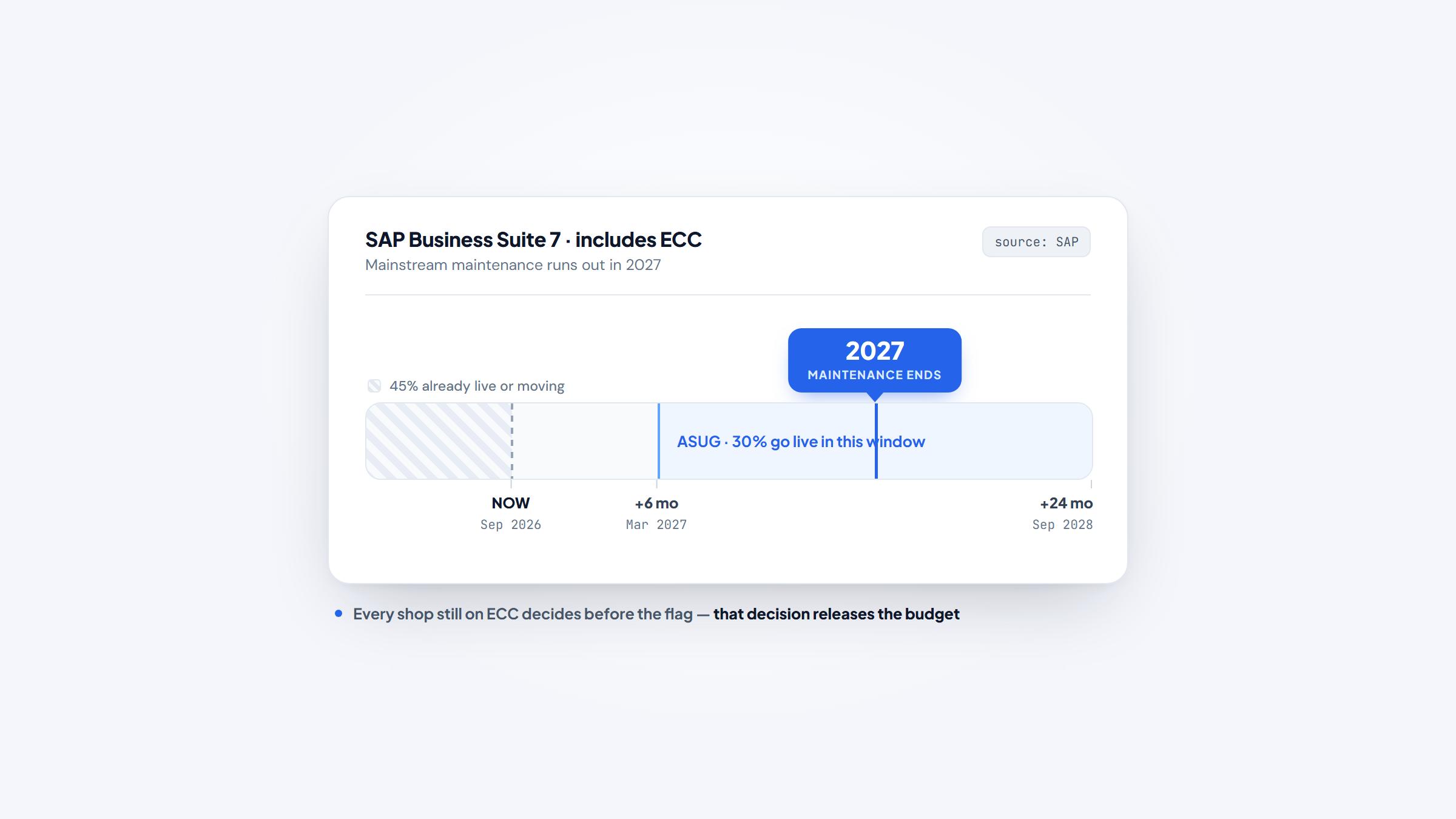
- 2A hard deadline drives this market: SAP ends mainstream ECC maintenance in 2027. ASUG research puts 30% of customers going live on S/4HANA inside the next six to 24 months.
- 3SAP's own ecosystem is the best free source there is. Customer stories, the partner directory, user-group rosters and community profiles name real SAP shops and often the people running them.
- 4Ecosystem research gets you an account and a name. Our free Gmail extension resolves the work address, and we do not sell install-base data.
Selling into SAP accounts is a different job from ordinary B2B prospecting, and buying an SAP users email list rarely makes it easier in the way people expect.
The accounts are large, the buying committees are wide, the cycles are long, and the deals are worth enough that a hundred well-researched accounts beats fifty thousand purchased records. That inverts the usual list-building logic entirely.
This guide covers what is actually knowable about the SAP install base, the 2027 deadline that determines when to reach these accounts, how to source them from SAP's own ecosystem for nothing, and what the install-base vendors charge. Name2Email is our own product, a Gmail extension that costs nothing and resolves a person's work address once you know their employer. Our part of this comes at the end, once you know who you want to reach.
Why SAP Accounts Get Their Own Playbook
Most technographic targeting is about finding companies that run a tool. SAP targeting is about finding companies mid-way through a program.
An SAP installation is not a subscription somebody can switch off. It is an integration of finance, procurement, supply chain, and often manufacturing, built over years and maintained by a dedicated internal team. Companies do not casually change it, which means the install base is unusually stable compared with the rest of the software market.
That stability cuts both ways for prospecting. The good news is a list of SAP accounts stays accurate for years, unlike a marketing-tool install base that turns over in months. The bad news is that stability means very little is happening at most of those accounts on most days. It is the opposite of the churn that governs a general technology users email list, where the stack turns over faster than any file can track.
So the question is not "who runs SAP." Nearly every large enterprise does, which is why a plain list of companies that use SAP is worth much less than it sounds. The question is which SAP accounts are doing something right now, and that is a timing problem rather than a data problem.
Nobody Agrees How Many SAP Customers There Are
Before evaluating any provider's coverage claim, notice that the vendor itself publishes two different answers.
SAP's customer stories page states the company is trusted by more than 320,000 businesses across 180 or more countries, and that over 90% of Fortune 500 companies use SAP solutions. SAP's company history page, on the same domain, describes the company as "more than 400,000 customers stronger."
Both are SAP's own numbers. The gap is 80,000 companies, which is larger than most vendors' entire claimed database.
Source | SAP customers claimed | What it appears to count |
|---|---|---|
SAP customer stories page | 320,000+ businesses, 180+ countries | Current customer relationships |
SAP company history page | 400,000+ | Cumulative across the company's history |
Data Marketers Group | 1,080,850 contacts | Individual people, not companies |
Avention Media | 195,000+ companies, 740,000 contacts | Accounts with any SAP product |
Span Global Services | 118,784 companies, 395,295 contacts | Accounts with a detected SAP environment |
TargetNXT | 50,000+ US companies | US-only subset |
Read down the company columns and the spread is roughly four to one between the largest and smallest supplier estimate, before you even reach SAP's own inconsistency. Nobody is necessarily wrong. "Customer" can mean an active subscription, a perpetual license, a subsidiary of a licensed parent, or a company that bought one SAP product a decade ago.
Before any reseller gets involved, the platform's own two pages already disagree.
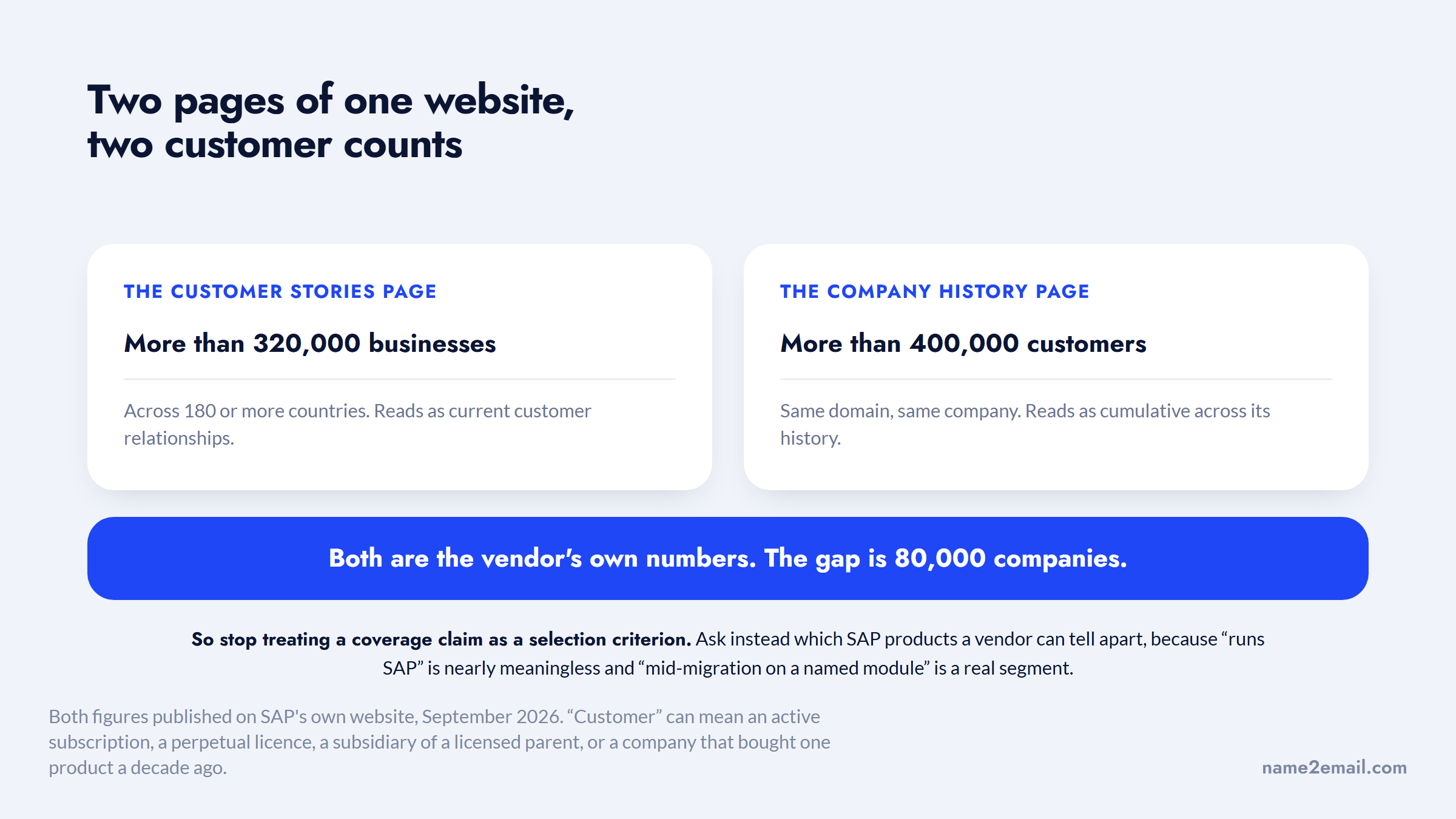
The practical takeaway is to stop treating coverage claims as a selection criterion. Ask instead which SAP products a vendor can distinguish, because "runs SAP" is nearly meaningless while "runs SAP S/4HANA in a private cloud, brownfield migration" is a real segment. An SAP ERP users email list and a broader SAP customers list are different products, and only one of them is useful for deadline-driven outreach.
The 2027 Deadline That Should Set Your Timing
This is the single most useful fact for anyone selling into SAP accounts, and it is public.
Mainstream maintenance for SAP Business Suite 7, which includes SAP ERP Central Component, runs out in 2027. Every SAP shop still on ECC has to decide what to do before then, and that decision releases budget for migration services, integration tooling, data cleansing, testing, training, and everything adjacent.
Research from ASUG, the Americas' SAP Users' Group, puts numbers on where customers sit. Nearly half of respondents, 45%, reported they were already live on SAP S/4HANA or had started to move. Another 30% expected to go live within six to 24 months, ahead of the deadline. Sixteen percent planned to go live more than two years out, and only 1% had no plans at all.
That distribution is your segmentation, and it is far more valuable than any install-base file.
Each group against the deadline is buying something different, and only one of them is buying now.
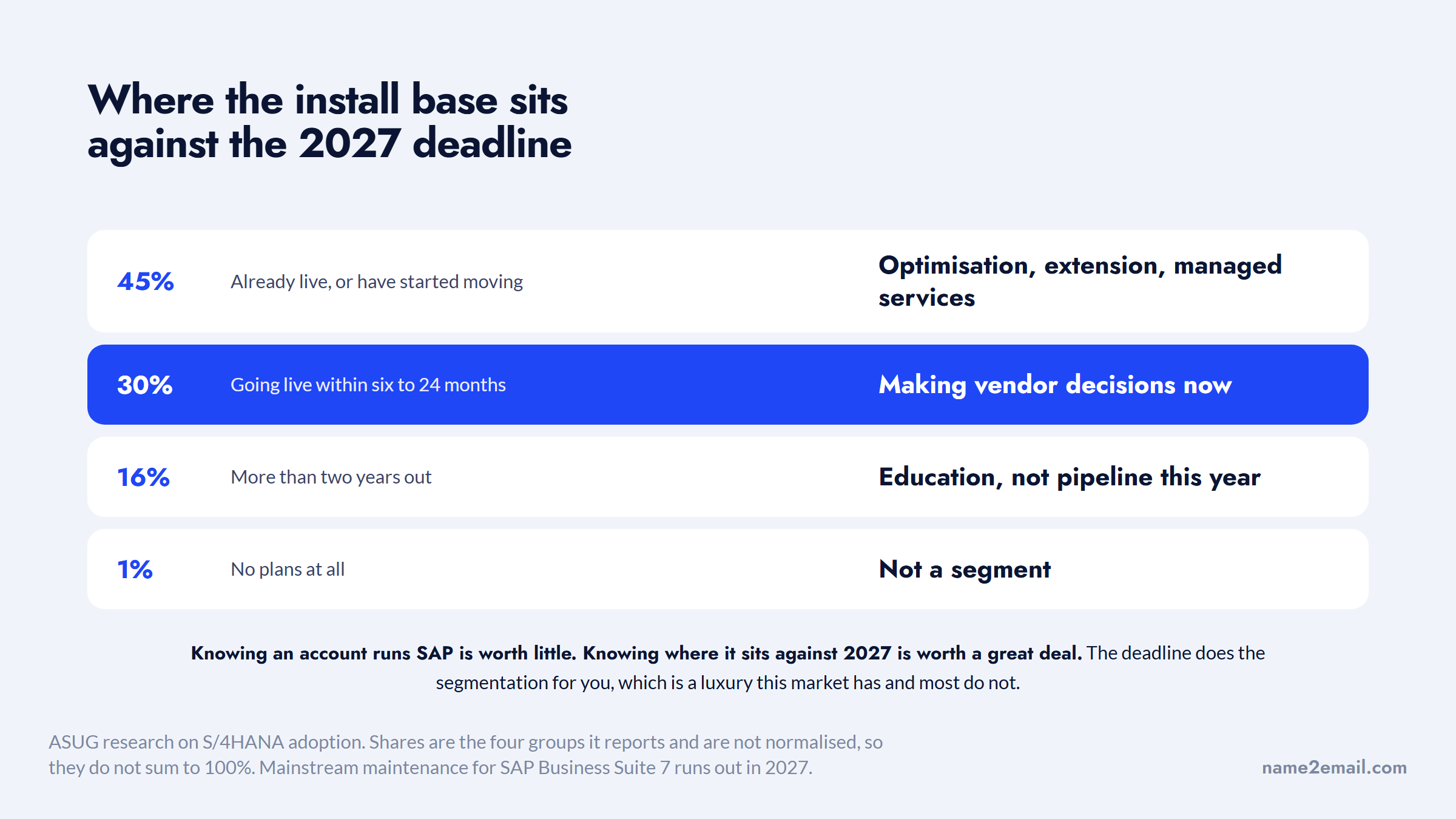
The 45% already live are buying optimization, extension, and managed services. The 30% in flight over the next two years are the active buying window for anything migration-adjacent, and they are making vendor decisions now. The 16% further out are education and relationship-building, not pipeline this year.
ASUG also found respondents split roughly evenly on approach, with 34% pursuing brownfield conversions, 33% greenfield rebuilds, and 20% hybrid. That matters because a brownfield conversion and a greenfield rebuild need almost completely different vendors, and a message written for one lands badly on the other.
Who Sits on an SAP Buying Committee
An SAP-adjacent purchase rarely has one owner, which is why single-contact records perform so poorly in this market.
The technical gatekeeper is usually a Basis administrator or an SAP enterprise architect. They decide whether something can connect to the SAP environment at all, and they can veto without escalating.
The functional owner is a module lead: finance and controlling, materials management, sales and distribution, or human capital management, depending on what your product touches. They own the business process and feel the pain your product addresses.
The program owner is whoever runs the S/4HANA program or the SAP center of excellence. During a migration window this person controls sequencing and, often, the budget.
The economic buyer is a CIO, IT director, or the CFO where the spend is large enough. They rarely evaluate, and they almost always sign.
Role on the committee | Typical title | What they decide | Where to find them |
|---|---|---|---|
Technical gatekeeper | SAP Basis administrator, enterprise architect | Whether it can connect | Job postings, community profiles, conference sessions |
Functional owner | FI/CO, MM, SD or HCM lead | Whether it solves the problem | LinkedIn, user-group rosters, customer stories |
Program owner | S/4HANA program lead, SAP center of excellence head | Sequencing and budget | Press releases, case studies, conference talks |
Economic buyer | CIO, IT director, CFO | Final approval | Company leadership pages, annual reports |
The install-base vendors segment by these same roles, which tells you the categories are real. What a purchased file will not tell you is which of them is currently blocking or championing your specific kind of purchase, and that is exactly what ecosystem research surfaces.
Ordered by when each one can stop you, rather than by seniority, the committee reads differently.

Naming all four at a single account is mostly a search problem, and the operator syntax for it, restricting a query to a company domain and a job title, is covered in Google search operators.
Sourcing SAP Accounts From SAP's Own Ecosystem
Because SAP runs a large, public, marketing-heavy ecosystem, its customers identify themselves constantly. This is the free route, and it is better than it sounds.
Five Sources That Name Real SAP Shops
Work these in order. The first two build the list of companies using SAP, and the last three give you the people inside them.
- SAP's own customer stories. Every published case study names a customer, the products deployed, and usually the business outcome. It is a self-declared, verified install-base list that SAP maintains as marketing, and it is free to browse and filter.
- The SAP partner directory. Implementation partners list the industries and modules they serve, and partner press releases routinely name the client. Following the partners is often faster than following the customers.
- SAP Community profiles and forum posts. Practitioners post under their real names with their employers visible, discussing specific modules and specific problems. Somebody troubleshooting an S/4HANA migration issue in public is a live account with a live project.
- User-group membership and events. ASUG in North America and its equivalents elsewhere publish speaker lists, chapter rosters, and session agendas. A person presenting on their S/4HANA rollout has told you the account, the project, the timing, and their role.
- Conference speaker and sponsor lists. SAP's own events and the partner-run circuit publish agendas months ahead, with names, titles, and employers attached.
None of this requires a subscription, and all of it is more current than an annually refreshed file, because it is generated by the projects themselves as they happen.
The limitation is coverage. This route finds the accounts that talk publicly, which skews toward larger companies, reference customers, and firms with active programs. Quiet mid-market SAP shops are genuinely hard to find this way, and that is where paying somebody earns its keep. Platforms covered in our roundup of sales intelligence tools fill in the accounts that never publish anything.
Reading Job Postings for Module and Migration Signals
Recruitment advertising is the most underrated SAP prospecting signal, because staffing a system is the one thing companies cannot do secretly.
A posting for an SAP Basis administrator tells you the system is being maintained in-house. A posting naming both ECC and S/4HANA tells you a migration is in progress, which is the single strongest buying signal in this market. A posting for a specific module names the functional area with the budget.
Contract and consulting postings are even sharper, because they carry durations. A twelve-month S/4HANA data migration contract starting in the spring tells you the program timeline more precisely than any vendor's intent data.
One posting carries the system, the stage and the timeline in its requirements list.
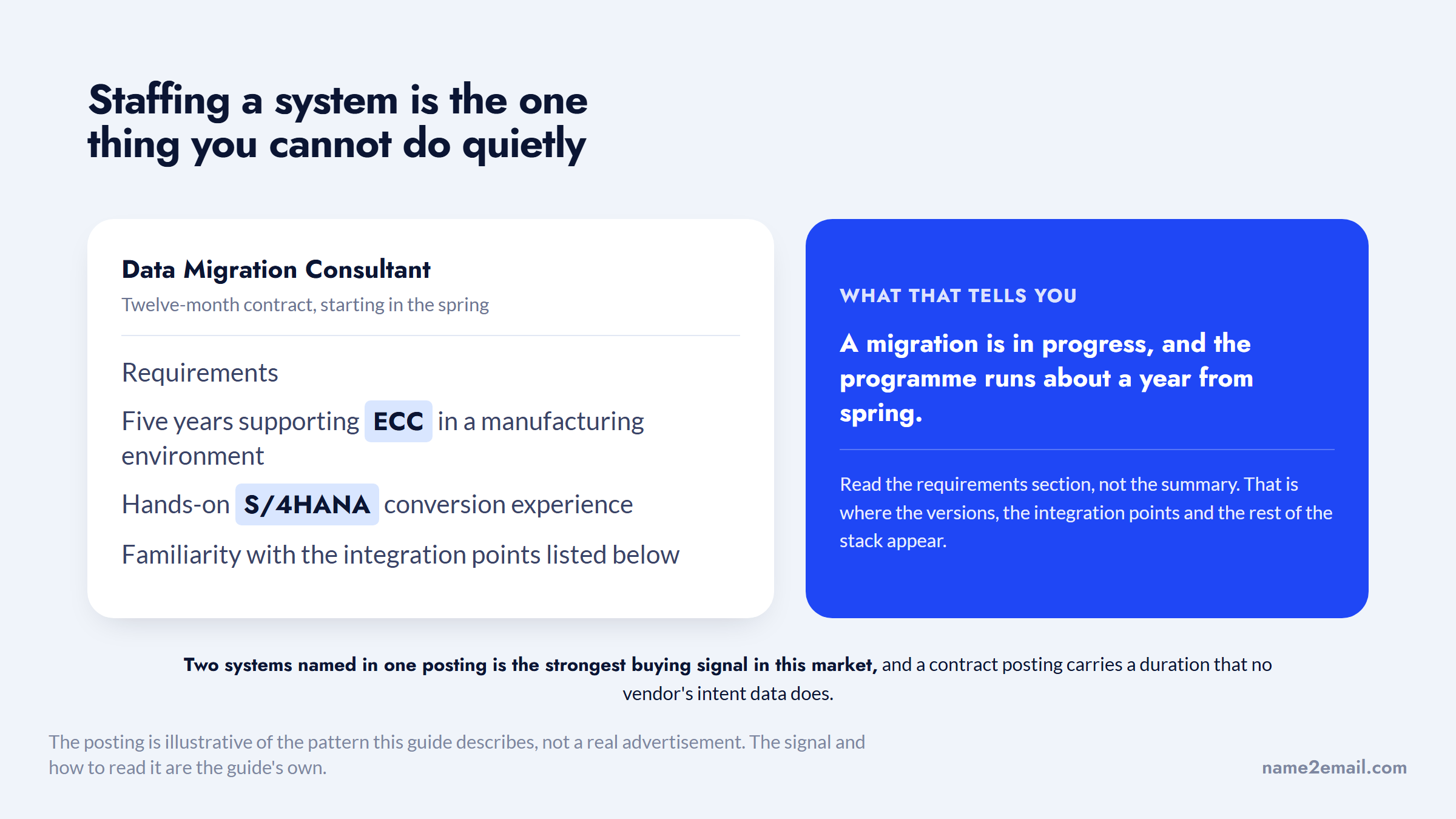
Read the requirements section rather than the summary. That is where the actual system versions, integration points, and adjacent tools appear, and it frequently reveals the whole stack around SAP rather than just SAP itself. Where a contact turns up on a posting or a profile without an address, our guide to finding email from LinkedIn covers the routes from a profile to a work inbox.
What an SAP Users Email List Costs to Buy
If you need coverage beyond the accounts that publish, this is the market for a bought SAP users email list, and it is quote-driven almost without exception.
Vendor | Coverage claimed | Published price | Notable segmentation |
|---|---|---|---|
Reply.io | 1B+ contacts, no SAP install-base field | From $59/user/mo, 14-day trial | Role, industry, size, intent |
Span Global Services | 118,784 companies, 395,295 contacts | None; quote and free sample | SAP environment, enterprise scale, buyer role |
Avention Media | 195,000+ companies, 740,000 contacts | None; quote and free sample | Deployment, seniority, revenue band, NAICS |
Data Marketers Group | 1,080,850 verified contacts | None; quote | Industry, title, company size, technology |
TargetNXT | 50,000+ US companies | None; quote, 25+ free samples | SAP product, buying signals, commercial fit |
InfoClutch | 2,007,426 contacts, 1,174,213 with email | None; quote | ERP product, industry, geography |
Data Maelumat | Not stated per product | None; quote, 10 free samples | SAP product, country-level adoption |
Reply.io sits at the top of that table as the platform alternative, and since it is the company that builds Name2Email, treat this as disclosure rather than a recommendation. Its database is bundled with an outreach subscription instead of sold as a file.
The database carries no SAP install-base attribute at all, which matters for this particular job. You could filter it to IT leadership at a company you already know runs SAP, but it will not tell you which companies those are.
Checked against every supplier's live page in September 2026. Not one of the six install-base specialists publishes a rate card, so any pricing comparison among them is a comparison of quotes you gather yourself.
Role-based files are priced and sourced differently again, so if your economic buyer is the finance chief rather than the CIO, a CFO email list starts from public filings instead of install-base detection.
Two questions separate a useful quote from a bad one. Ask which SAP products the vendor can distinguish, since a file that cannot tell ECC from S/4HANA is useless for deadline-driven targeting. Then ask when each record's technology field was last observed, not when the file was last delivered, because those are different dates and only the first one matters.
What the SAP Community Says About Buying This Data
There is a reason experienced practitioners are skeptical of these files, and they say so plainly.
When somebody asked r/SAP for a list of companies running SAP in Germany, the most upvoted answer from an in-house consultant was that they did not know many larger German companies that do not use SAP. The second most upvoted reply was blunter: there is no such list.
That is anecdotal and geographically specific, but it captures the central problem with any SAP users email list. In markets where SAP saturation is high, "uses SAP" carries almost no targeting information, and a file that segments on it is selling you the phone book. The segmentation that matters is product, version, migration stage, and module, which is precisely what the cheap files do not reliably contain.
That saturation also explains why the ecosystem route works so well. In a market where everyone runs SAP, the differentiator is knowing which accounts are mid-project, and that information lives in conference agendas and job postings rather than in databases.
Getting From an Account to a Named Person
At this point you have companies, projects, timing, and often names from a speaker list or a community profile. What you do not have is anyone's email address.
SAP accounts are unusually good for pattern-based discovery, because they are large enterprises with standardized identity systems. A company with 40,000 employees does not improvise email formats, and the convention that applies to one Basis administrator applies to every one of them.
That is the step our extension handles. Give it a person and an employer domain, and the plausible formats appear in the To field for you to hover over, with the recognized one carrying a photo. No account, no cap, no charge.
The honest caveats matter more in enterprise than anywhere else. We infer addresses from public naming conventions rather than holding a database of records, large corporate domains are where we perform best, and a proportion of addresses will not resolve. We are not an install-base vendor and we do not sell SAP customer data.
At a very large enterprise you may find several plausible formats in use across acquired subsidiaries, and the how it works walkthrough shows how the hover check separates them.
Timing the Approach Around the Migration
Knowing an account runs SAP is worth little. Knowing where it sits against 2027 is worth a great deal, and it should change the message entirely.
For accounts still on ECC with no announced program, the relevant conversation is the decision itself: assessment, business case, and risk. Selling migration tooling to a company that has not decided to migrate is premature by a year.
For accounts in flight, which ASUG's data suggests is 30% of the base over the next two years, the conversation is execution. Data quality, testing, integration, cutover, and training all have budget lines during this window and rarely outside it.
For accounts already live, the conversation is value realization and extension. Their pain is what the migration did not fix, and pitching them migration services reads as though you have not looked.
Each stage announces itself publicly through job postings, case studies, and conference talks. That is the whole argument for ecosystem sourcing over file buying: the file tells you the stage everyone was at when it was compiled, and the ecosystem tells you the stage they are at now. Keeping that account record current is ordinary list hygiene, and our guide to email list management software covers the tooling for it.
Verifying Before You Send to an Enterprise Domain
Large corporate domains are the least forgiving place to guess wrong.
Enterprise mail systems frequently reject unknown recipients outright rather than accepting and bouncing, and repeated failed deliveries to a single large domain will get your sending reputation flagged there specifically. Losing deliverability at a 40,000-person company you have spent months researching is an expensive way to learn this.
The loss is not the addresses that bounced, it is every contact at the account.
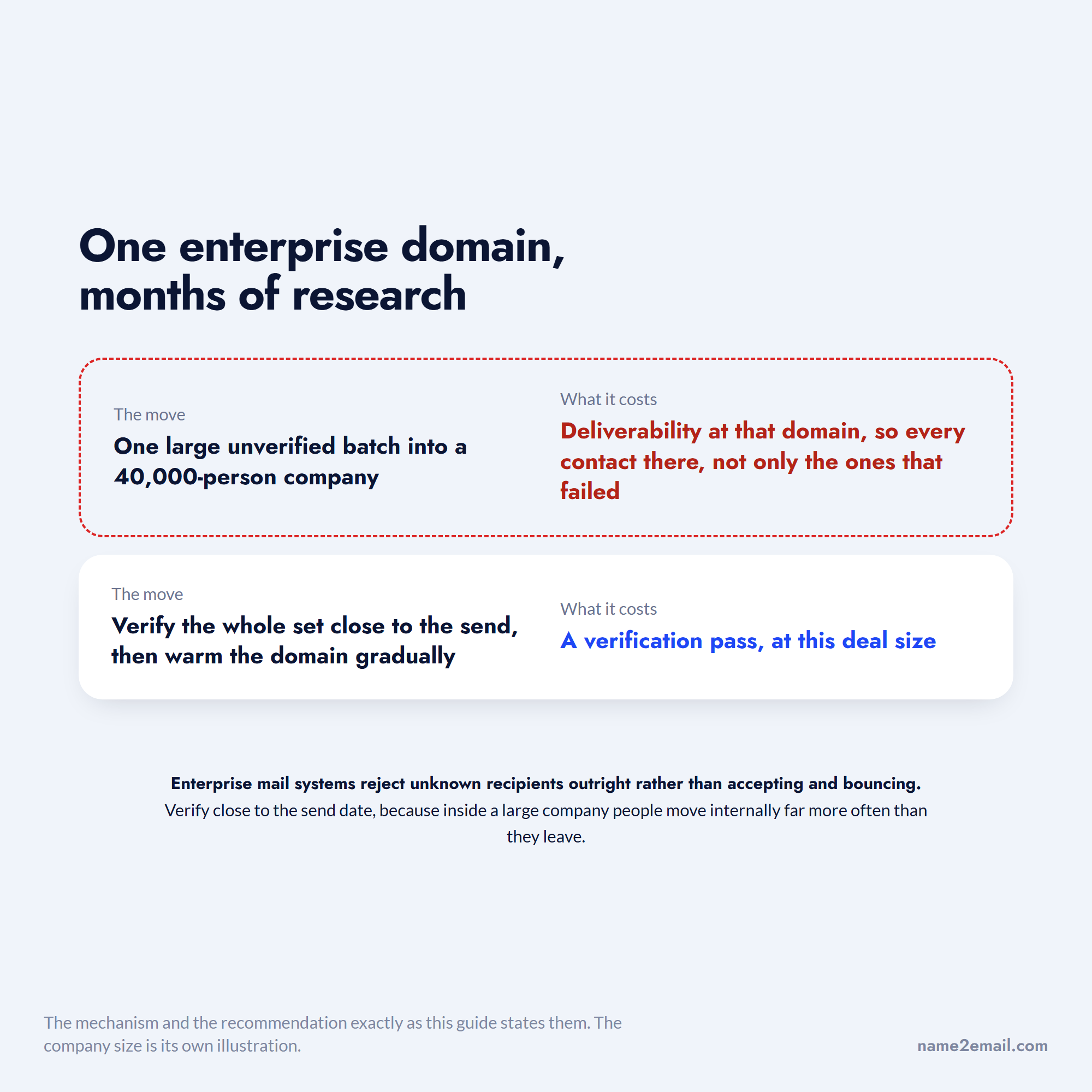
Verify the whole set before the first send rather than sampling. Enterprises also run aggressive filtering, so a technically valid address can still be quarantined, which means warming the domain gradually beats a single large batch.
A dedicated verification pass is worth the cost at this deal size, and we compare the options in our roundup of email verification tools. Whatever you use, verify close to the send date, because at enterprises people move internally far more often than they leave.
Work the Calendar, Not the Database
The best SAP prospecting list in 2026 is short, specific, and organized by migration stage rather than by install base.
Fifty accounts where you know the SAP products, the program stage, the committee members, and the timing will outperform a purchased file of fifty thousand, and you can assemble those fifty from public sources in a week. The deadline does the segmentation for you, which is a luxury this market has and most do not.
Start with SAP's published customer stories in your industry, add the partner press releases, check the job postings for migration language, and name the four committee roles at each account. Then install Name2Email in Chrome and let the compose window handle the last step, or weigh the free route against paid finders on our comparison page.
Frequently asked questions
SAP publishes its own customer stories, which name the company and the products deployed, and its partner directory leads to implementation case studies that name clients directly. Add SAP Community profiles, user-group speaker lists, and conference agendas, and you can assemble several hundred confirmed SAP accounts without paying anything. The gap is mid-market companies that never publish, which is the main argument for a commercial file.
There is no single reliable figure, and SAP itself gives two. Its customer stories page says more than 320,000 businesses across 180 or more countries, while its company history page says more than 400,000 customers. Data vendors quote anywhere from 50,000 US companies to 195,000 globally, depending on whether they count licensed parents, subsidiaries, or detected environments.
An SAP users list covers any SAP product, which spans ERP, SuccessFactors, Ariba, Concur, Business Technology Platform and more. An SAP ERP users list is narrower, covering the core finance and operations system, usually ECC or S/4HANA. The distinction matters commercially, because someone running Concur for expenses is not an ERP prospect and will not recognize themselves in ERP messaging.
Mainstream maintenance for SAP Business Suite 7, which includes ECC, ends in 2027, so every customer still running it must decide whether to convert, rebuild, or extend support. ASUG research found 45% already live on or moving to S/4HANA and another 30% planning to go live within six to 24 months. That concentrates a lot of buying decisions into a short window, which is the best timing signal this market offers.
Vendors sell files segmented by SAP role, including Basis administrators and module leads, though none publishes a price and coverage claims vary widely. The free alternative is to identify people through community posts, user-group sessions and job postings, then resolve the address from their name and the company domain. Enterprise domains use consistent naming conventions, which makes that last step more reliable at large SAP customers than almost anywhere else.

We build Name2Email, the free Chrome extension that finds work emails inside Gmail. We write about outreach, prospecting, and getting more replies.
Connect →