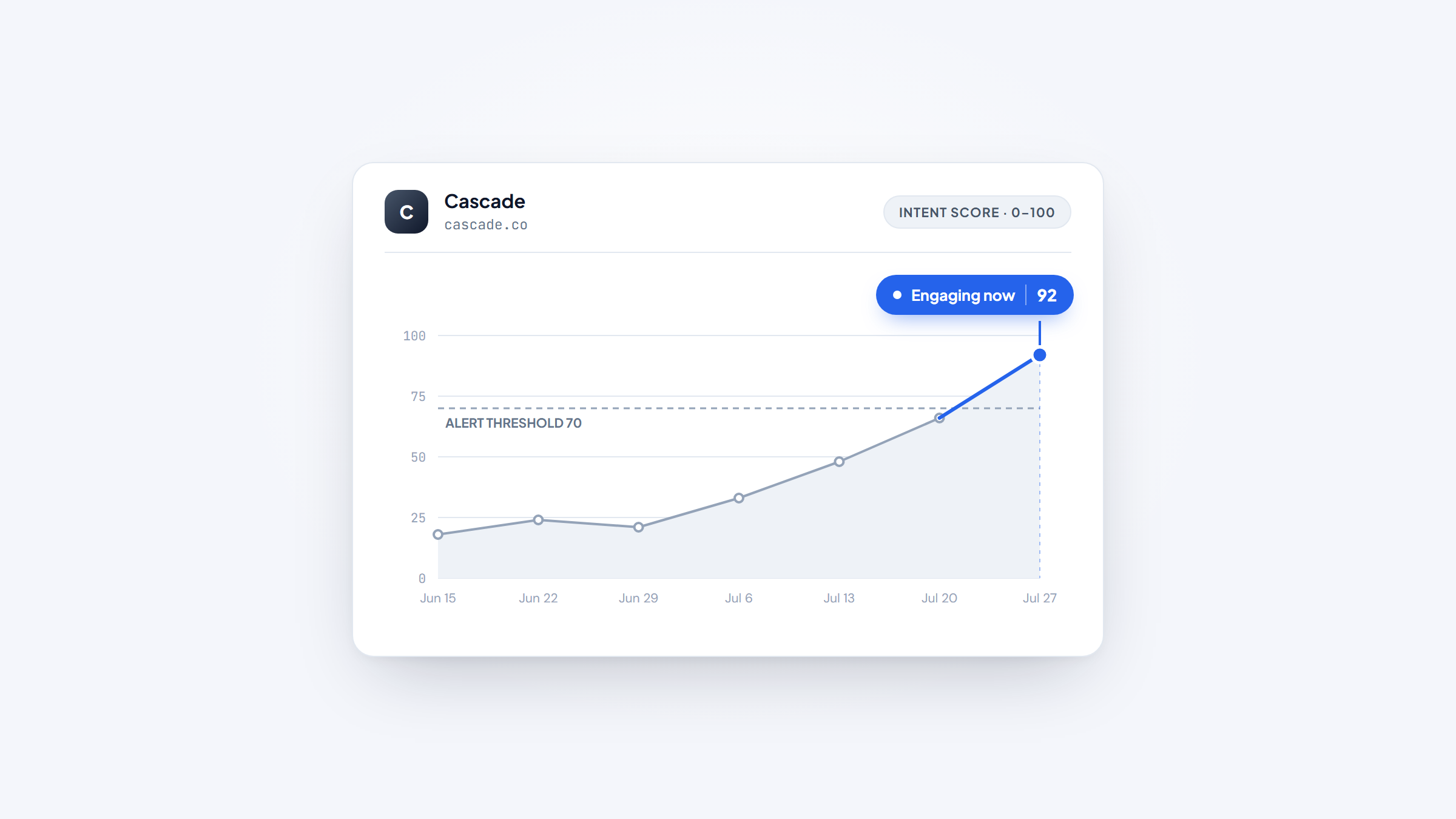
- 1Sales intelligence covers two different purchases: contact data (who to call) and intent data (when to call). Buying the wrong one is the most expensive mistake in this category.
- 2Self-serve contact tools start at $49 per month with Apollo and Lead411. Intent and account platforms like 6sense, Demandbase, and Warmly start in the tens of thousands per year.
- 3Gartner predicts AI agents will outnumber human sellers 10 to 1 by 2028, yet fewer than 40% of sellers will say those agents improved productivity.
- 4Every platform here meters contact reveals by credits. Name2Email finds work emails in Gmail free and unlimited, with no credit counter at all.
Buying sales intelligence usually starts with the wrong question. Teams ask which database is biggest, when the question that actually determines value is whether they need to know who to contact or when to contact them.
Those are separate products at wildly different prices. A contact database costs $49 a month. An intent platform costs $30,000 a year. Both get marketed as "sales intelligence," and plenty of teams buy the expensive one to solve the cheap one's problem.
This list of the top sales intelligence tools covers eleven products across both halves, with pricing verified in August 2026 and clear labels on which job each one does. We make Name2Email, a free Gmail extension for finding work emails, so we are not neutral. We are also not on this list, because a pattern-based email finder is not a sales intelligence platform.
What Are Sales Intelligence Tools?
The simplest sales intelligence tools definition is this: software that supplies the data a seller needs to decide who to approach, when, and with what context. The category splits three ways.
Contact data platforms, the backbone of most B2B sales intelligence tools, store records on people and companies: names, titles, verified work emails, direct dials, and firmographics. Apollo, Cognism, Seamless.AI, Lead411, and UpLead sit here. You search, filter to an ideal customer profile, and export.
Intent and signal platforms watch for buying behavior instead of storing contacts. Bombora tracks content consumption across a publisher network, 6sense and Demandbase model account-level buying stages, Warmly identifies website visitors, and UserGems follows job changes among people who already know you.
Engagement platforms with embedded data blur the line by bundling a database inside an outreach tool, which is where Reply.io fits. Vendors increasingly market these as AI sales intelligence software, since the filtering and scoring now run on models rather than static rules.
The practical definition is simpler: if it tells you who exists, it is contact data. If it tells you something changed, it is intent.
Contact Data or Intent Data: The Split That Decides Your Budget
Get this decision right and the rest of the buying process is straightforward.
Contact data is what you need when you have a clear ideal customer profile and simply cannot reach enough of them. The bottleneck is coverage and accuracy, the fix costs $49 to $150 per user per month, and results show up within days.
Intent data is what you need when you already reach plenty of people but waste effort on accounts with no active buying interest. The bottleneck is timing, the fix costs $10,000 to $120,000 per year, and it only pays off if you have enough pipeline volume for prioritization to matter.
Teams under roughly ten reps almost always need contact data. Teams selling six-figure deals into a defined account list are the ones who genuinely benefit from intent.
Buying intent before you have a repeatable outbound motion is the classic way to spend $30,000 on dashboards nobody opens.
The 11 Best Sales Intelligence Tools in 2026
Reply.io leads this list because it is the only option that pairs a large contact database with the engagement layer that acts on it, at a published price. Figures below were verified in August 2026.
Tool | Best for | Key features | Main limitation | Pricing (from) | Rating |
|---|---|---|---|---|---|
Reply.io | Data plus outreach in one platform | 1B+ contacts, intent signals, sequences, AI SDR | Data is not sold standalone | $49/user/month | ★★★★★ |
Apollo.io | Best value contact database | 210M+ contacts, sequences, real free tier | Deliverability weaker than dedicated tools | Free; $49/user/month | ★★★★☆ |
Cognism | GDPR-compliant EMEA direct dials | Phone-verified mobiles, EU coverage | Quote only, no monthly billing | Quote only | ★★★★☆ |
Seamless.AI | High-volume AI prospect discovery | 1.3B+ contacts, real-time search, extension | Credits burn on failed lookups | Free; quote for Pro | ★★★☆☆ |
Lead411 | Unlimited exports on a budget | Verified emails, direct dials, intent | Smaller database than rivals | $49/month | ★★★★☆ |
UpLead | Verified data with accuracy guarantee | Real-time verification, technographics | Low credit counts at entry | $74/month annually | ★★★★☆ |
6sense | Predictive account targeting | Buying-stage models, intent, ad targeting | Custom pricing, enterprise scale | Quote only | ★★★★☆ |
Bombora | Third-party intent across the web | Content consumption data, topic tracking | No published pricing anywhere | Quote only | ★★★★☆ |
Demandbase | Enterprise account-based GTM | Account intelligence, advertising, buying groups | Platform fee plus per-user fee | Quote only | ★★★★☆ |
UserGems | Tracking champions who switch jobs | Job-change alerts, relationship mapping | Starts at $33,000/year | $2,750/month | ★★★★☆ |
Warmly | Identifying warm website visitors | Visitor de-anonymization, chat, alerts | Annual contracts from $10,000 | $10,000/year | ★★★☆☆ |
Ratings reflect how reliably each tool delivers its own category of intelligence, so a $49 contact tool and a $30,000 intent platform can both score well.
Reply.io
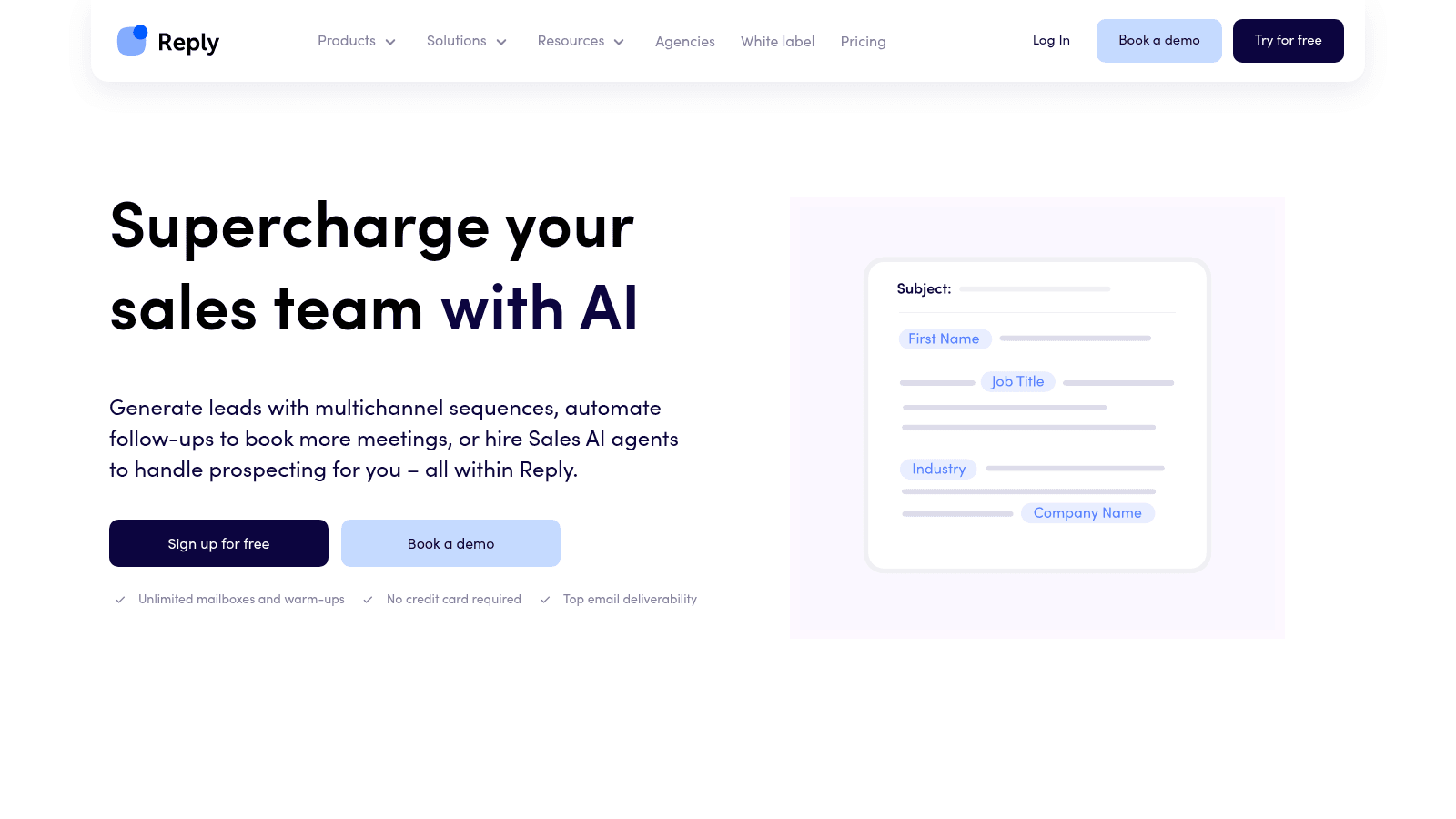
Best for: acting on contact data without exporting it
Overview: Most sales intelligence purchases create a second problem. You buy a database, export a list, then move it into whatever tool actually sends the messages, and the two systems drift apart.
Reply.io removes that handoff. A B2B contact database of more than a billion records, with intent signals attached, sits inside the same platform that runs the sequences. You filter to an ICP and the resulting contacts flow straight into a multichannel campaign.
Around that sits the infrastructure that makes contact data usable: mailbox warmup on every tier, deliverability checks, a unified inbox, and native CRM sync.
Jason, Reply's AI SDR, takes the same data and works it autonomously, sourcing prospects against your criteria and handling replies without a rep touching each one.
Key features:
- B2B contact database exceeding one billion records with attached intent signals
- ICP filtering that feeds directly into multichannel sequences with no export step
- Mailbox warmup and deliverability tooling bundled at every pricing tier
- Jason, an AI SDR that sources and works the database autonomously
- Unified inbox with AI categorization of incoming replies
- Native HubSpot and Salesforce sync plus a built-in meeting scheduler
Pricing: Email Volume begins at $49 per user per month billed annually ($59 monthly), scaling by contact tier to $899. Multichannel is $89 per user per month annually ($99 monthly) with unlimited active contacts. The Jason AI SDR tier runs from $500 per month and agency plans from $210. A 14-day trial is available, and there is no free plan.
Pros: removes the export step between data and outreach, intent signals included rather than sold as a separate subscription, warmup bundled at every tier, transparent published pricing in a category dominated by quotes, a genuine AI SDR path on the same data.
Cons: the contact database is bundled inside the platform and is not available as a standalone data product, so it will not serve teams that just want records for their own systems, and the platform's delivery and bounce figures are self-reported rather than independently audited.
How to start using it:
- Open the 14-day trial and connect the mailbox you plan to send from.
- Define your ICP filters inside the built-in database and save the segment.
- Let warmup run before pushing meaningful volume through a new mailbox.
- Route the saved segment into a short multichannel sequence.
- Track reply quality by segment, then tighten the ICP filters based on what converts.
Why it's a good sales intelligence tool: intelligence only pays off when it reaches a message, and Reply is the shortest path from a filtered list to a sent sequence. Bundling intent signals with the contact data means you can prioritize without buying a second platform.
Final verdict: the strongest pick when you want data and the machinery to use it under one subscription. It is not the right answer if you need a raw data feed for your warehouse, since the database is not sold on its own. For teams whose real problem is turning records into replies, that limitation rarely bites.
CTA: Compare Reply.io's plans against your current list size and channel mix.
Apollo.io
Apollo pairs a large contact database with sequencing at a self-serve price, and it is the most common answer when someone asks for a cheaper alternative to enterprise data vendors.
Its free tier is unusually real, which is why so many teams start here.
Key features:
- Database of 210 million or more contacts with filtering by role and firmographics
- Built-in sequencing and multichannel campaigns
- Chrome extension for pulling contacts from LinkedIn
Pricing: the free plan includes a limited monthly credit allowance. Basic is $49 per user per month, Professional is $79, and Organization is $119, all billed annually, with credit allotments rising by tier.
Pros: genuine free tier, transparent per-seat pricing, huge database, data and outreach in one place, strong Chrome extension.
Cons: email deliverability is weaker than dedicated sending tools, credit caps on exports and phone reveals, data accuracy varies noticeably by region.
Why it's a good sales intelligence tool: it delivers most of the enterprise capability at roughly a tenth of the enterprise price.
Final verdict: the sensible default for teams buying their first database.
Cognism
Cognism's reputation rests on phone-verified mobile numbers and genuine GDPR compliance, which makes it the standard choice for teams selling into Europe.
Its data is notably stronger in EMEA than the US-centric alternatives.
Key features:
- Phone-verified mobile numbers with human verification
- GDPR-compliant European coverage including notified contacts
- CRM enrichment and a data-as-a-service option for bulk delivery
Pricing: Cognism is quote-only, sold as an annual platform fee plus per-seat licenses, prepaid with no monthly billing. Reported figures put the entry tier near $15,000 platform plus roughly $1,500 per user per year, with a higher tier around $25,000 plus $2,500 per user. There is no free plan beyond a 25-lead sample.
Pros: best European coverage available, phone-verified mobiles cut wasted dials, strong compliance posture, credits usable across the team.
Cons: quote-only with annual prepayment, expensive for small teams, published figures come from third-party procurement rather than Cognism.
Why it's a good sales intelligence tool: for EMEA outbound, its compliance and mobile accuracy are hard to match.
Final verdict: worth the contract if Europe is your primary market.
Seamless.AI
Seamless.AI searches for contact data in real time rather than serving records from a fixed store, which helps with freshness but creates a specific billing quirk.
That quirk is worth understanding before you commit.
Key features:
- Real-time contact search across 1.3 billion contacts and 121 million companies
- Chrome extension with list building and CRM export
- Buyer intent and enrichment on higher tiers
Pricing: the free plan gives one user 50 credits with no card required. Pro is sold as custom annual credit packages, with third-party sources reporting figures around $147 per user per month and a common five-seat minimum. Enterprise is custom.
Pros: very large contact pool, real-time lookups, usable free tier, strong LinkedIn extension, integrations included at entry.
Cons: credits are deducted even when a lookup returns nothing, Pro pricing is not published, users widely report accuracy below the advertised claims.
Why it's a good sales intelligence tool: the real-time approach surfaces contacts that static databases have not indexed yet.
Final verdict: test the credit burn rate carefully during the free tier.
Lead411
Lead411 competes on export economics. Where most vendors meter every record, its higher tier offers unlimited exports, which changes the math for high-volume teams.
It also bundles intent data at a price where competitors treat it as an upsell.
Key features:
- Verified emails and direct dials with growth-signal triggers
- Intent data included rather than sold as a separate module
- Chrome extension and AI search assistant across all plans
Pricing: Pilot Light is a free 7-day trial with 50 exports. Spark is $49 per month or $490 per year, Ignite starts at $150 per month or $1,500 per year, and Blaze is custom with unlimited annual exports.
Pros: aggressive pricing against enterprise vendors, intent included, unlimited export option, transparent published tiers, no seat minimum at entry.
Cons: smaller database than Apollo or Seamless, interface feels dated, international coverage is thinner than Cognism.
Why it's a good sales intelligence tool: it delivers verified contacts and intent at roughly a tenth of an enterprise contract.
Final verdict: the value pick when export volume drives your costs.
UpLead
UpLead's pitch is accuracy over volume. It verifies emails at the moment of export rather than serving a stored record, and credits you back for anything that fails.
That model suits teams whose bounce rate is the pressing problem.
Key features:
- Real-time email verification at the point of export
- Technographic filtering alongside standard firmographics
- Chrome extension with mobile direct dials on paid plans
Pricing: a 7-day free trial provides 5 credits. Essentials is $99 per month or $74 monthly billed annually with 2,040 credits per year, Plus is $199 or $149 annually, and Professional is custom with annual billing. Extra credits run $0.50 to $0.60 each.
Pros: verification at export cuts bounces, technographic filters are genuinely useful, transparent pricing, published accuracy commitment.
Cons: credit allowances are small relative to price, single-user accounts on lower tiers, database smaller than the volume players.
Why it's a good sales intelligence tool: paying for verified records beats paying for volume you then have to clean.
Final verdict: the right trade if deliverability matters more than list size.
6sense
6sense predicts which accounts are actively in a buying cycle, using intent signals and modeling rather than storing contacts for you to dial.
It is an account-based platform, and it assumes you already have a defined target list.
Key features:
- Predictive models scoring accounts by buying stage
- Intent data aggregated across web and third-party sources
- Advertising and sales alerts triggered by account behavior
Pricing: 6sense does not publish pricing. The platform is quoted per organization based on scope, account volume, and modules, on an annual contract.
Pros: genuinely predictive rather than descriptive, strong ABM execution, good sales alerting, mature integrations.
Cons: no published pricing, requires meaningful pipeline volume to justify, long implementation.
Why it's a good sales intelligence tool: it answers the timing question better than any contact database can.
Final verdict: an enterprise investment that needs a mature motion behind it.
Bombora
Bombora is the intent layer other platforms buy from. It measures content consumption across a cooperative of B2B publishers and reports which companies are researching which topics.
Many tools that advertise "intent data" are reselling Bombora underneath.
Key features:
- Topic-level intent scoring drawn from a publisher data cooperative
- Company Surge reporting on unusual research activity
- Delivery into CRM, ABM, and advertising platforms
Pricing: Bombora publishes no pricing anywhere, and it is sold through integration partners and direct contracts rather than self-serve. Expect an annual agreement scoped by topics and volume.
Pros: the reference source for third-party intent, wide publisher coverage, integrates into most ABM stacks, topic granularity.
Cons: no pricing transparency at all, not a standalone workflow tool, requires another platform to act on it.
Why it's a good sales intelligence tool: it supplies the underlying signal that timing-based selling depends on.
Final verdict: buy it as a data feed, not as a destination.
Demandbase
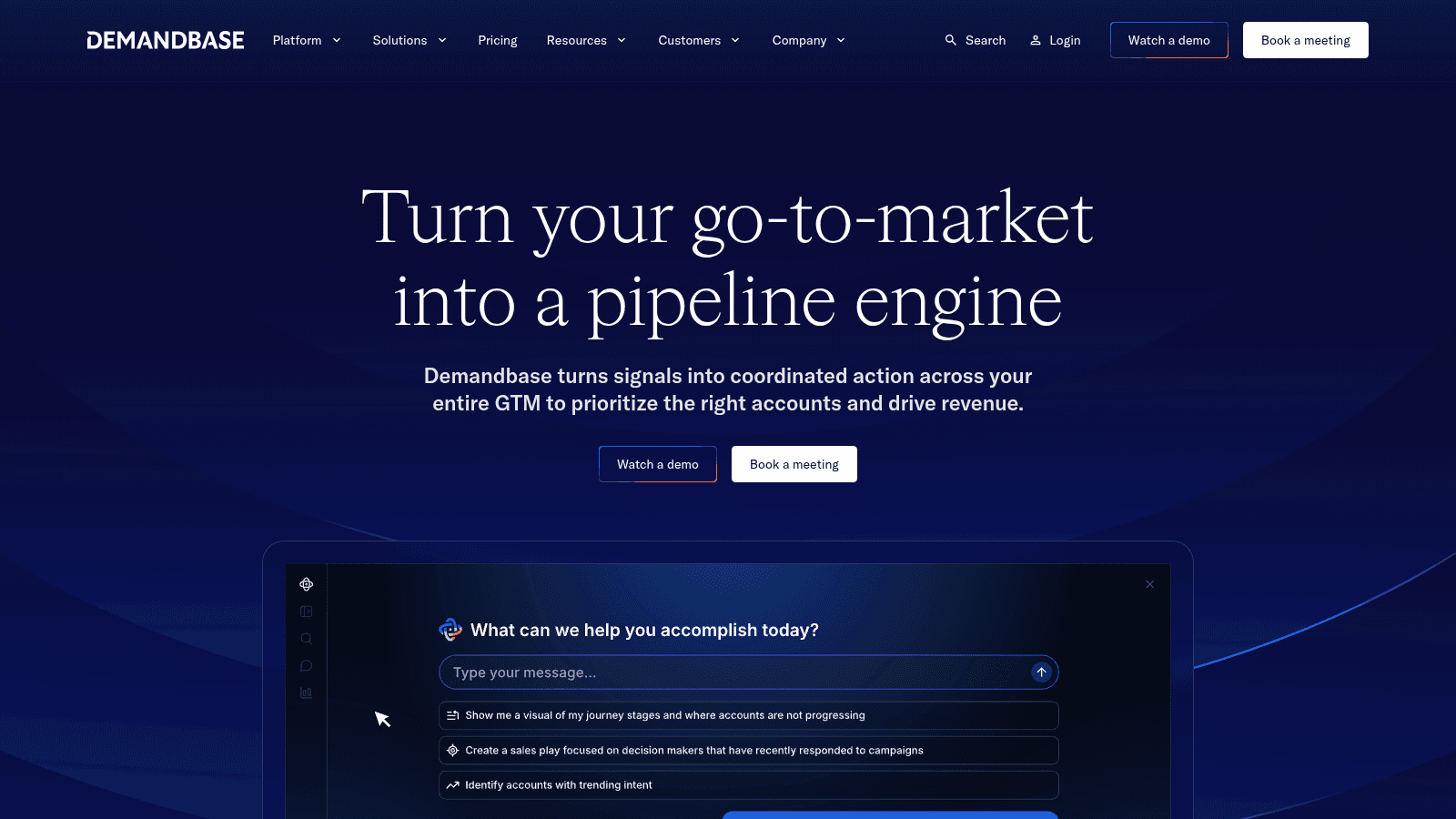
Demandbase runs account-based go-to-market across sales and marketing together, combining account intelligence, advertising, and buying-group mapping in one platform.
It competes directly with 6sense at the enterprise end.
Key features:
- Account intelligence unifying data, intent, and engagement
- Buying-group identification across a target account
- Integrated B2B advertising tied to account selection
Pricing: Demandbase is custom-quoted, structured as a platform fee plus a flat per-user fee. Data and advertising are separate purchase paths within Demandbase One.
Pros: sales and marketing on shared account data, strong advertising integration, buying-group mapping, enterprise-grade governance.
Cons: platform fee plus per-user pricing gets expensive, custom quotes only, heavy implementation.
Why it's a good sales intelligence tool: it aligns two teams around one definition of an active account.
Final verdict: a fit for enterprises running formal ABM programs.
UserGems
UserGems tracks the people who already know you. When a former customer or champion changes jobs, it flags the move so you can reach them at the new company.
That single signal produces some of the warmest outbound available.
Key features:
- Job-change alerts across past customers, champions, and buyers
- Relationship mapping showing who in your company knows whom
- Automated CRM workflows triggered by tracked moves
Pricing: Core is $2,750 per month, which is $33,000 annually. Advanced is $5,750 per month ($69,000 a year) and Elite is $10,000 per month ($120,000 a year).
Pros: the warmest signal in outbound, clear and published pricing unlike most intent tools, straightforward CRM automation, easy to attribute results.
Cons: expensive entry point, value depends entirely on having a sizable customer history, single-purpose tool.
Why it's a good sales intelligence tool: a champion who moves is a qualified opportunity that no database can surface.
Final verdict: excellent if you have years of customer relationships to mine.
Warmly
Warmly identifies the companies and, in some cases, the individuals browsing your website, then routes that signal to sales in real time through alerts and chat.
It converts anonymous traffic into a working prospect list.
Key features:
- Website visitor de-anonymization with ICP filtering
- Real-time alerts and routing into Slack and CRM
- AI chat and inbound autopilot on higher tiers
Pricing: AI Web-Deanonymization starts at $10,000 per year or $4,875 quarterly. Inbound Chat starts at $20,000 annually and AI Inbound Autopilot at $30,000, with add-on packages for GTM signals priced separately.
Pros: turns existing traffic into pipeline, real-time routing, strong Slack workflow, ICP filtering reduces noise.
Cons: annual contracts starting at $10,000, value scales with existing traffic volume, individual-level identification is limited by region.
Why it's a good sales intelligence tool: the visitor already showed interest, which beats any cold signal.
Final verdict: worth it only if your site already gets meaningful qualified traffic.
How We Chose These Sales Intelligence Tools
Three well-known names are missing, and the reason is consistent rather than editorial.
ZoomInfo and Lusha both block the independent verification we run on every vendor, so we could not confirm their live pricing or capture their pages ourselves. We will not write a ranked review of a page we could not open. ZoomInfo publishes no pricing in any case, and the widely quoted figures near $15,000 to $45,000 a year come from procurement databases like Vendr rather than from ZoomInfo.
That gap is worth naming honestly, because ZoomInfo remains widely used and frequently criticized. A thread in r/sales titled "Does ZoomInfo ever work properly?" collected complaints about its Chrome extension breaking, with the top reply confirming the extension was down and another simply suggesting Apollo instead. You can read the thread on Reddit for the unfiltered version, treating it as anecdote rather than benchmark data.
Beyond verification, we required that each tool supply intelligence rather than process it. Tools that complete records you already own went to our data enrichment tools roundup, and tools that research accounts without contact data went to company research tools.
What Separates Good Sales Intelligence Software from Bad
Database size is the least useful number in this category, and vendors lead with it precisely because it is easy to inflate.
- Test accuracy on 50 contacts you can independently verify, not on the vendor's demo list
- Check regional coverage specifically, since US-strong databases are routinely thin in EMEA and APAC
- Find out whether credits are consumed on failed lookups, which Seamless.AI does and many buyers miss
- Confirm whether phone reveals cost more credits than emails, because they usually do
- Ask how often records refresh, as job changes are the main driver of decay
- Read the export terms, since some contracts restrict what you may do with data after cancellation
That last point catches teams at renewal. Data you exported under an annual contract is not always yours to keep once the contract lapses.
Choosing by Team Size and Sales Motion
For a founder or a team under five reps, Apollo's free tier is the correct starting point, and $49 per user per month if it works. Nothing else here justifies its cost at that scale.
For a growing outbound team of five to twenty, the decision is between Apollo, Lead411 at $49 per month, and Reply.io at $49 per user if you want the sequencing layer included rather than stitched on.
For teams selling into Europe, Cognism's compliance and phone-verified mobiles are worth the annual contract that its US-focused competitors do not require.
For high-bounce environments where deliverability is the pain, UpLead's verify-at-export model addresses the actual problem.
For enterprise ABM with a defined account list and real pipeline volume, 6sense or Demandbase, with Bombora underneath if you need the raw intent feed.
For companies with a long customer history, UserGems produces warmer conversations than any cold database, provided you can absorb $33,000 a year.
What Sales Intelligence Tools Cost in 2026
The price spread here is wider than in almost any software category, so grouping by model is more useful than listing figures.
Tier | Annual cost | Tools | What you are buying |
|---|---|---|---|
Free | $0 | Apollo, Seamless.AI, Lead411 trial, UpLead trial | Small credit allowances to test data quality |
Self-serve contact data | $490 to $2,400 | Lead411, Apollo, UpLead, Reply.io | Verified contacts, exports, usually sequencing too |
Mid-market quoted | Roughly $22,000 to $37,000 | Cognism, Seamless.AI Pro | Compliance, verified mobiles, seat-based licenses |
Intent and signals | $10,000 to $120,000 | Warmly, UserGems, 6sense, Bombora | Timing signals rather than contact records |
Enterprise ABM | Custom | Demandbase, 6sense | Platform fees, advertising, buying-group mapping |
The jump between the second and fourth rows is roughly twentyfold, and it buys a different thing rather than more of the same thing. That is the single most important cost fact in this category.
Is Free Sales Intelligence Software Worth It?
The free tiers are useful for one purpose: testing data accuracy before you pay.
Apollo's free plan is the most generous and can genuinely support early prospecting. Seamless.AI gives 50 credits to a single user. Lead411 and UpLead both run 7-day trials, with 50 exports and 5 credits respectively.
None of them sustain a working outbound motion. Credit ceilings arrive quickly, and the useful filters tend to sit on paid tiers.
The right way to use them is comparative. Take the same 50 target companies, run them through two or three free tiers, and count how many verified emails each returns and how many bounce. That test is worth more than any vendor accuracy claim, all of which are self-reported.
What the Data Still Does Not Give You
Every tool above meters contact reveals. That is the business model, and it creates a specific friction: you pay before you know whether the contact is worth anything.
In practice you burn credits on people you never email. You pull a list of 200, qualify it down to 30, and the other 170 reveals were spent finding out they were not a fit.
Name2Email removes the meter for the one-at-a-time case. It is a free Chrome extension that generates likely email formats from a name and company domain directly in Gmail's compose window, populates the "To" field, and lets you confirm by hovering, since Gmail surfaces the person's name and photo when it recognizes an address.
No credits, no monthly cap, no account, and no card. When you have already researched a company and just need to reach one named person, that is the whole job.
We are clear about what it is not. It generates patterns from public naming conventions rather than serving a scraped database, so it will not build a 5,000-row list, it works best on corporate domains, and it cannot guarantee every address. Where a paid database earns its money is exactly the bulk case we do not cover, which is why our guide to the best email finding tools compares those options fairly.
Two Gartner findings frame where this is heading. Gartner predicts that AI agents will outnumber sellers 10 to 1 by 2028, while fewer than 40% of sellers will report those agents improved their productivity. Separately, Gartner has found that 61% of B2B buyers prefer a rep-free buying experience.
Together those say the volume of automated outreach is about to rise sharply while buyer tolerance for it falls. Precision beats volume, and precision starts with reaching the right person rather than the most people.
Your First 30 Days With Sales Intelligence
Spend the first week testing rather than buying. Pick 50 accounts you know well, run them through Apollo's free tier and one competitor's trial, and record the verified-email hit rate and the bounce rate. Vendor accuracy claims are all self-reported, so your own test is the only honest number.
In week two, decide which half of the category you actually need. If you cannot reach enough of the right people, buy contact data. If you reach plenty of people at the wrong moment, look at intent, and be honest about whether your pipeline volume justifies a five-figure contract.
In week three, connect whatever you bought to the tool that sends the messages. Data sitting in a separate system is where most of the value leaks out, and it is the reason platforms with sequencing built in tend to outperform standalone databases in practice. Our sales automation tools roundup covers that layer.
In week four, clean up what you send. Verified data still bounces if the record has aged, and our guides to verifying an email address and the best email verification tools cover the check that protects your domain.
Throughout all of it, stop paying credits for lookups you can do free. Add Name2Email to Chrome and handle one-off finds inside Gmail, and see what it costs if you want the short answer first. For turning those addresses into sequences, the best cold email software is the next step, and finding an email address covers the manual method behind it.
Frequently asked questions
Sales intelligence tools are software that supplies the data behind targeting decisions: who to contact, when to contact them, and what context to use. The category divides into contact data platforms that store people and company records, intent platforms that detect buying behavior, and engagement tools with a database built in. Contact data answers "who exists," while intent data answers "what changed." Knowing which of those you need is the difference between a $49 monthly subscription and a $30,000 annual contract.
Sales intelligence finds new contacts and accounts you did not previously have, while data enrichment fills in missing fields on records you already own. If you are building a prospect list from scratch, that is intelligence. If you have 5,000 CRM records with no phone numbers, that is enrichment. The tool sets overlap, since many vendors sell both, but the buying trigger differs and so does the pricing model, with enrichment usually billed per record completed.
Among b2b sales intelligence tools, for most teams under twenty reps Apollo.io at $49 per user per month or Lead411 at $49 per month give the best coverage-to-cost ratio, and both have free access to test first. Reply.io at $49 per user is the strongest option if you want the database and the outreach in one platform. Teams selling into Europe should look at Cognism for its GDPR compliance and phone-verified mobiles, and enterprise ABM programs are better served by 6sense or Demandbase.
Apollo.io has the most usable free plan in the category, with a monthly credit allowance that supports genuine early prospecting. Seamless.AI offers 50 free credits to a single user, and Lead411 and UpLead run 7-day trials with 50 exports and 5 credits respectively. None of these sustain ongoing outbound, and the useful filters generally sit behind paid tiers. Use them to compare data accuracy across vendors on the same target list before committing.
Accuracy claims across b2b sales intelligence software are self-reported and should be treated as marketing rather than measurement. Real-world results vary heavily by region, company size, and seniority, with data on smaller companies and non-US markets typically weaker. The main cause of decay is job changes, which age a contact record continuously. The only reliable approach is to test a sample of 50 records you can independently confirm, then measure the actual bounce rate rather than trusting a published percentage.

We build Name2Email, the free Chrome extension that finds work emails inside Gmail. We write about outreach, prospecting, and getting more replies.
Connect →