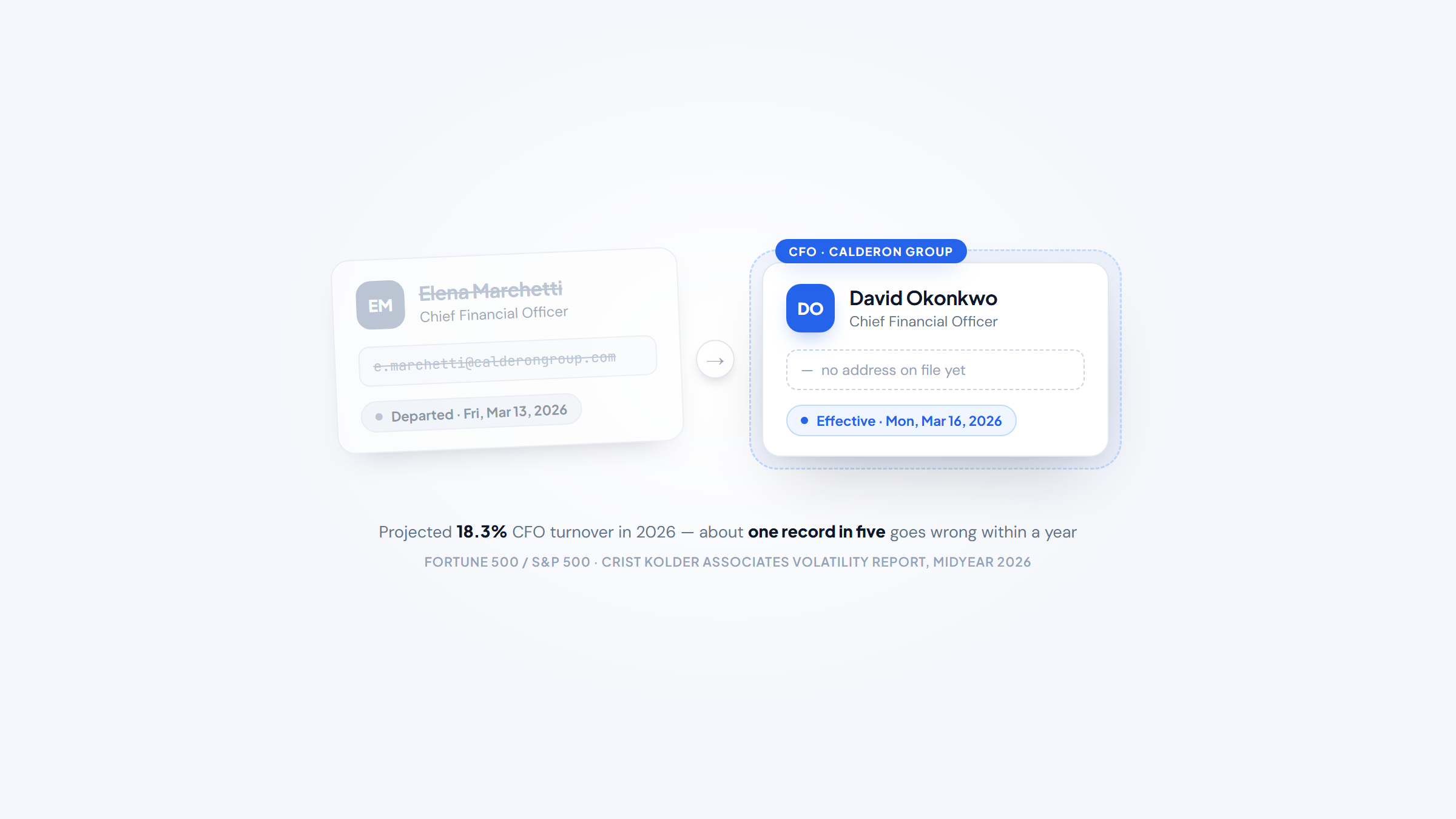
- 1CFO turnover at Fortune 500 and S&P 500 companies is projected at 18.3% for 2026, the highest since before the pandemic. Roughly one CFO record in five goes wrong within a year.
- 2For public companies the name is free and authoritative. SEC filings and investor-relations pages name the finance chief and update within days of a change.
- 3Vendors that publish a CFO-specific count claim between 18,339 and 322,151 contacts. Where a price is published at all, platform access runs about $34 to $199 a month, with extra records at $0.50 to $0.60 each.
- 4Filings give you a name and a company. Our free Gmail extension turns that into a work address, and we sell no contact data of any kind.
A CFO email list is the most perishable contact file in B2B, and the reason is measurable rather than anecdotal.
Finance leadership changes hands faster than almost any other executive seat, and unlike most roles, the change is announced publicly and immediately. That combination makes buying a static CFO file a strange decision: the data expires quickly, and the replacement is published for free.
This guide covers how fast CFO data decays, where finance leaders are named at no cost, what the vendors claim and charge, and what actually gets a reply from someone in that seat. We publish Name2Email, a browser tool that costs nothing and turns a name plus a domain into a deliverable address. Our stake here is that last step rather than the file.
Why Anyone Wants a CFO Email List
The appeal is authority. The chief financial officer signs off on spending above the departmental limit, which makes them the shortest path to a decision for anything expensive.
Four kinds of seller genuinely need a cfo email address list. Software vendors selling above an approval threshold need the person who approves. Finance and back-office software sells to the CFO as the direct user. Professional services, meaning banking, audit, insurance and advisory, sell to the office of the CFO as their core market. Executive recruiters need finance leadership as both client and candidate.
If you are none of those, the CFO is probably the wrong entry point, and a list of them will underperform a list of the people who actually own the problem you solve. The CFO approves; they rarely evaluate. Selling into hospitals is the clearest case, where the clinical and operational buyers reached through a healthcare email list matter more than the finance chief who signs.
That distinction matters for how you build the list. If your buyer is the finance director or the controller and the CFO is only the signer, you want both, and most files sold as CFO lists cover only the top title.
The Turnover Problem Nobody Prices In
Here is the number that should govern every decision below.
The midyear Crist Kolder Associates Volatility Report, reported by the Journal of Accountancy, projects an 18.3% CFO turnover rate at Fortune 500 and S&P 500 companies across 2026, a level last exceeded in 2019. The 2025 rate was 18.1%. There were 72 CFO hires in the first half of 2026 alone, at an average age of 48.2 years, down sharply from 51.9 for 2025 hires.
Turn 18.3% into list arithmetic and the case for buying weakens considerably.
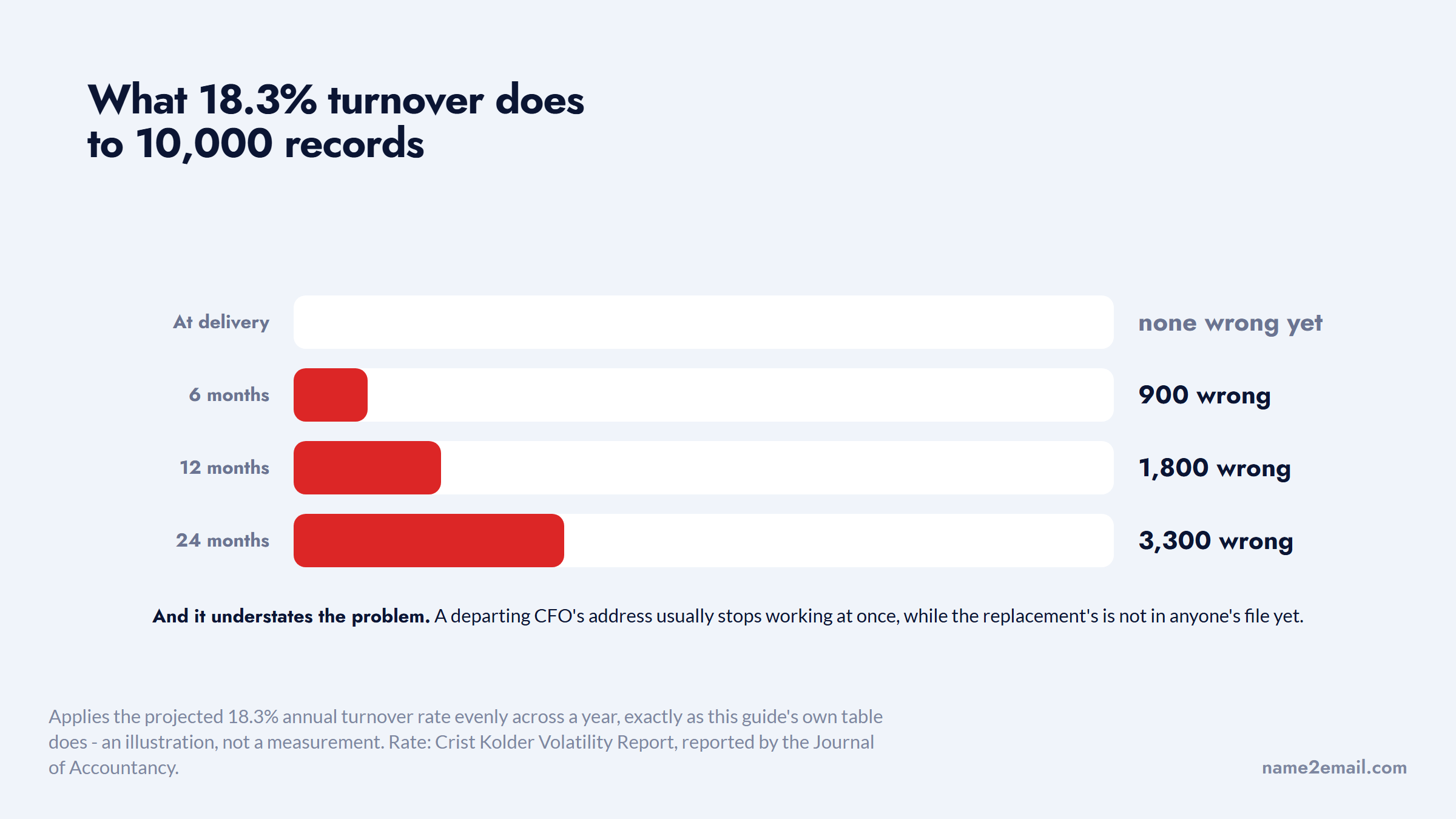
Time since the file was compiled | Share of CFO records still correct | What that means for 10,000 records |
|---|---|---|
At delivery | About 100% | 10,000 usable |
6 months | About 91% | 900 wrong |
12 months | About 82% | 1,800 wrong |
24 months | About 67% | 3,300 wrong |
The table applies the reported annual turnover rate evenly across a year, so read it as an illustration rather than a measurement. It also understates the problem, because a departing CFO's address usually stops working immediately while the replacement's is not in anyone's file yet.
Read the same arithmetic the other way round and it is the wrong records that pile up.
One more finding from the same report is worth holding onto: 62.5% of 2026 CFO hires were internal promotions, above the 61% ten-year average. That is good news for list building, because an internally promoted CFO usually keeps the same email address they had as controller or finance director. The company's naming convention did not change, only their title.
Where CFO Names Are Published for Free
For public companies this is not a data problem at all. It is a disclosure requirement.
Four Free Sources That Name the Finance Chief
Work these in order of authority. The first is the most reliable contact source in this entire guide.
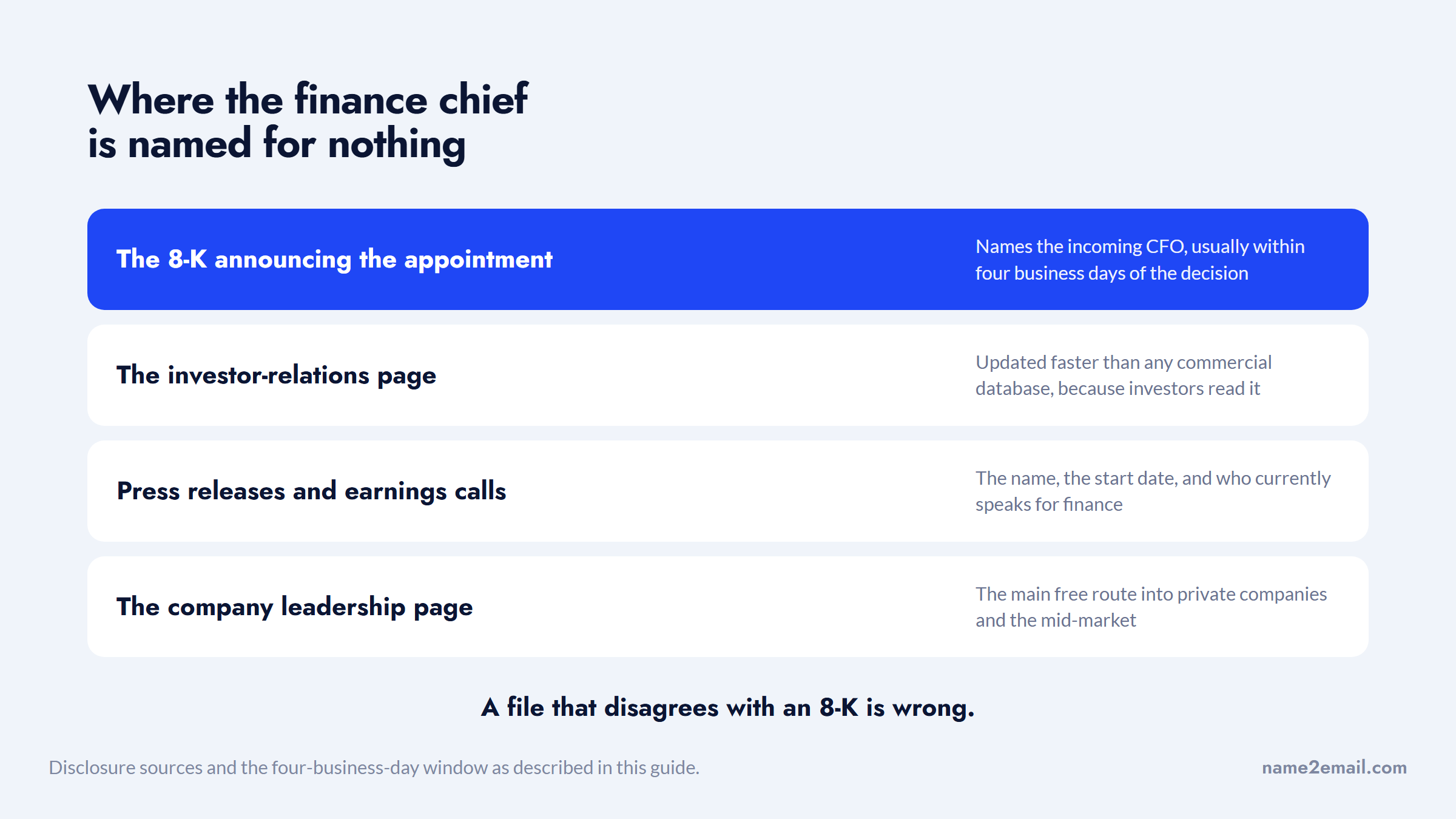
- SEC filings. The 8-K announcing an executive appointment names the incoming CFO, usually within four business days of the decision. The annual 10-K and the proxy statement name and describe current officers. All of it is free and full-text searchable through EDGAR.
- Investor-relations pages. Every public company maintains a leadership page, and it is updated faster than any commercial database because investors read it.
- Press releases and earnings calls. Appointment announcements name the person, their start date, and their background. Call transcripts confirm who currently speaks for finance.
- Company leadership and about pages. For private companies this replaces the filings, and it is the main free route into the mid-market.
Between them, these cover every public company in the United States and a good share of large private ones, at zero cost and with an authority no vendor can match. A file that disagrees with an 8-K is wrong.
The four sources are worth working in that order, because they do not carry equal authority.
The gap is private and mid-market companies, which is most of the economy by count. Smaller firms often publish no leadership page, may not use the CFO title at all, and change finance leadership without announcing it. That is where paying somebody starts to make sense, and where an offer of a free cfo email list usually means a small sample rather than a usable file.
Public and Private Need Different Methods
Splitting your target set on this axis before you start saves a lot of wasted effort, because the two halves have almost nothing in common.
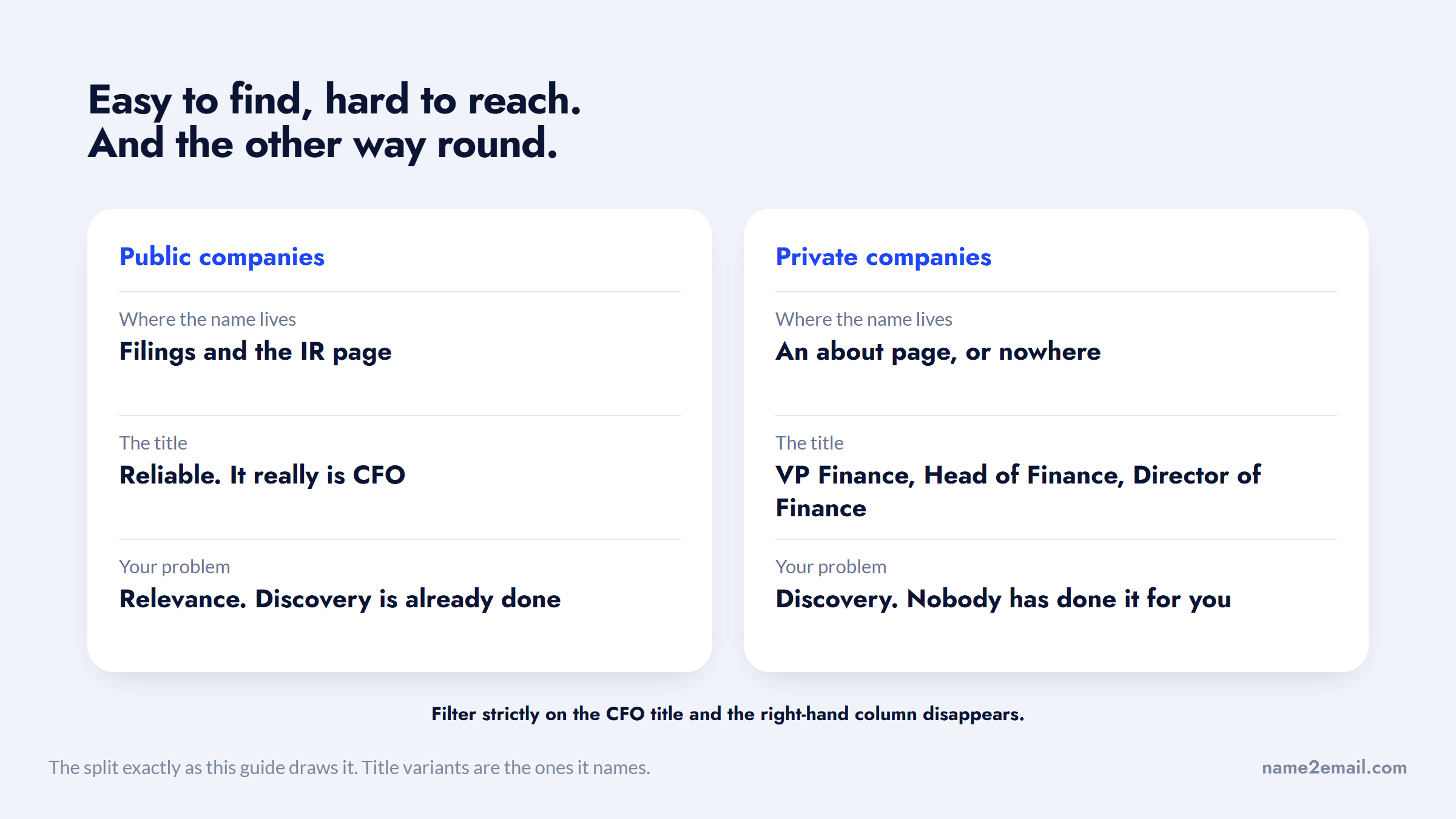
Public companies are fully documented and slow to reach. The name is certain, the tenure is short, and the person receives enormous volumes of vendor outreach. Your differentiator has to be relevance, because it will not be discovery.
Private companies are poorly documented and easier to reach. The title may be "VP Finance," "Head of Finance," or "Director of Finance" rather than CFO, and a title-filtered file will miss them entirely. Search on function rather than title here.
Segment | Where the name lives | Title reliability | Realistic sourcing route |
|---|---|---|---|
Public, large cap | SEC filings, IR pages | High, CFO used consistently | EDGAR full-text search |
Public, small cap | 8-K and proxy filings | High | EDGAR plus IR page |
Private, PE or VC backed | Press releases, investor portfolios | Medium, varies by stage | Investor sites, funding announcements |
Private, owner-operated | Company about page, LinkedIn | Low, often VP Finance | Function search, not title search |
Nonprofit and public sector | Form 990, published budgets | Medium, often "finance director" | Regulator and agency filings |
Build the title variants into your search from the start. A hospital cfo email list, for instance, will contain a mix of CFO, VP Finance and Chief Financial and Administrative Officer titles, and filtering strictly on one of them silently discards a third of the market.
The two halves invert each other: whichever one is easy to find is the hard one to reach.
Regulated professions are the exception, since a licensing body fixes the title. That is why a lawyers email list can be filtered on credential in a way a finance list never can.
What the Vendors Claim and Charge
The CFO list market is one of the more transparent corners of the data business, in that several vendors do publish rates.
Vendor | CFO records claimed | Published price | Model |
|---|---|---|---|
Reply.io | 1B+ contacts, no published CFO count | From $59/user/mo, 14-day trial | Platform subscription, database bundled |
UpLead | 18,339 verified CFO contacts | $99/mo, or $74/mo annual; Plus $199/mo | Subscription with credits, $0.50 to $0.60 extra |
Hunter.io | 7,000,000 professionals across all roles | Free 50 credits/mo; $49/mo, $34 annual | Free filtered CFO list builder, paid reveals |
ListKit | 977M+ contacts, all roles | From $47/mo | Priced by sending volume |
Avention Media | 302,000 CFO contacts | None; quote and free sample | Custom file |
InfoClutch | 322,151 CFO contacts | None; quote | Custom file |
Cognism | Not stated for CFOs | None; quote | Platform subscription |
ReachStream | 302K+ ESP-verified CFO contacts | Not readable; renders in-app | Free sample of 100 addresses |
Reply.io leads the table, and the disclosure belongs here rather than in a footnote: Reply.io builds Name2Email.
Reply.io is listed first because it is the clearest example of the subscription model, where the 1B+ database arrives bundled with sequencing and deliverability rather than as a file you own. It publishes no CFO-specific count, there is no free plan behind the trial, and its own delivery and bounce figures are self-reported.
All figures read from the suppliers' own sites in September 2026. ReachStream's pricing page renders its numbers only in the browser application, so no tier is quoted here rather than guessing at one.
Look at the spread in the records column. UpLead advertises 18,339 CFO contacts while InfoClutch advertises 322,151, a difference of roughly 17 times for the same job title in the same economy. The likeliest explanation is definition: one is counting verified individuals at companies above a size threshold, the other is counting every record that has ever carried a finance-chief title. Ask which before comparing prices, because the per-record cost is meaningless without it.
Put another way, an email list of CFO contacts priced at $0.50 a record is only cheap if the records are the ones you actually wanted.
All of these sit above zero, which is the comparison we hear about most often in our own user reviews: for one-at-a-time lookups the paid tiers buy convenience rather than access.
Turning a Filing Into a Work Address
Filings, IR pages and press releases all give you the same thing: a full name and a company. None of them gives you an email address, and public companies never publish executive addresses directly.
Large companies are the easiest place to solve this, because their email conventions are rigid. A company with a formal IT function assigned the CFO an address from the same template as everyone else, and it is almost always one of a handful of predictable formats.
Our extension is built for exactly that moment. Give it the executive's name and the corporate domain, and the candidate formats populate the To field; hovering over them lets Gmail identify which one belongs to a real person. No account, no credits, no monthly limit.
Where we stop is worth stating plainly. We produce candidate addresses from public naming conventions and confirm them through Gmail's recognition rather than holding records about anybody, corporate domains are our strongest case, and some addresses will never resolve. We are not a data vendor and we hold no CFO list to sell you.
There is one wrinkle specific to this audience. Many finance chiefs route external mail through an executive assistant, so a technically correct address can still never be read by the person. That is a reason to write something an assistant will forward, not a reason to distrust the address, and our how it works page shows the confirmation step in full.
What CFOs Are Actually Buying in 2026
Getting the address right and the message wrong wastes the whole exercise, and this audience has published its priorities.
Deloitte's Q4 2025 CFO Signals survey of North American finance chiefs found 50% naming digital transformation of the finance function as their top priority for 2026, and 49% naming automation that frees staff for higher-value work as their leading talent priority. Fully 87% expected artificial intelligence to be extremely or very important to finance operations in 2026, with only 2% saying it would not matter.
The survey also caught a shift in appetite. Nearly six in ten, 59%, said it was a good time to take greater risks, up from 36% the previous quarter.
Read practically, that says three things about your message. Efficiency framing works on a cfo email marketing list, because half the audience has explicitly prioritized it. AI capability is worth naming concretely rather than generically, since nearly everyone considers it important and almost nobody is impressed by the word alone. And the risk appetite means a proposal that would have been deferred a year ago may get a hearing now.
None of that survives a message that does not name a number. This is the one audience where a specific, defensible figure in the first three lines is not optional, and our guide to writing a good email works through building that opening.
How Not to Write to a CFO
There is an instructive public example of getting everything right except the format.
A seller posted their cold email to r/sales after a CFO called it sleazy. The email was genuinely well researched: it cited the company's own Form 5500 filing, quantified their recordkeeping fees at roughly 20 basis points against a market rate closer to 5 or 6, and included a regulatory registration number so the recipient could verify the sender.
The most upvoted response was not about the research. It was that the CFO almost certainly did not read it, because it was far too long. Other commenters said the same in different words, adding that the framing came across as telling the recipient they had made a bad decision.
Three things went right in that email and one went wrong, and the one thing won.
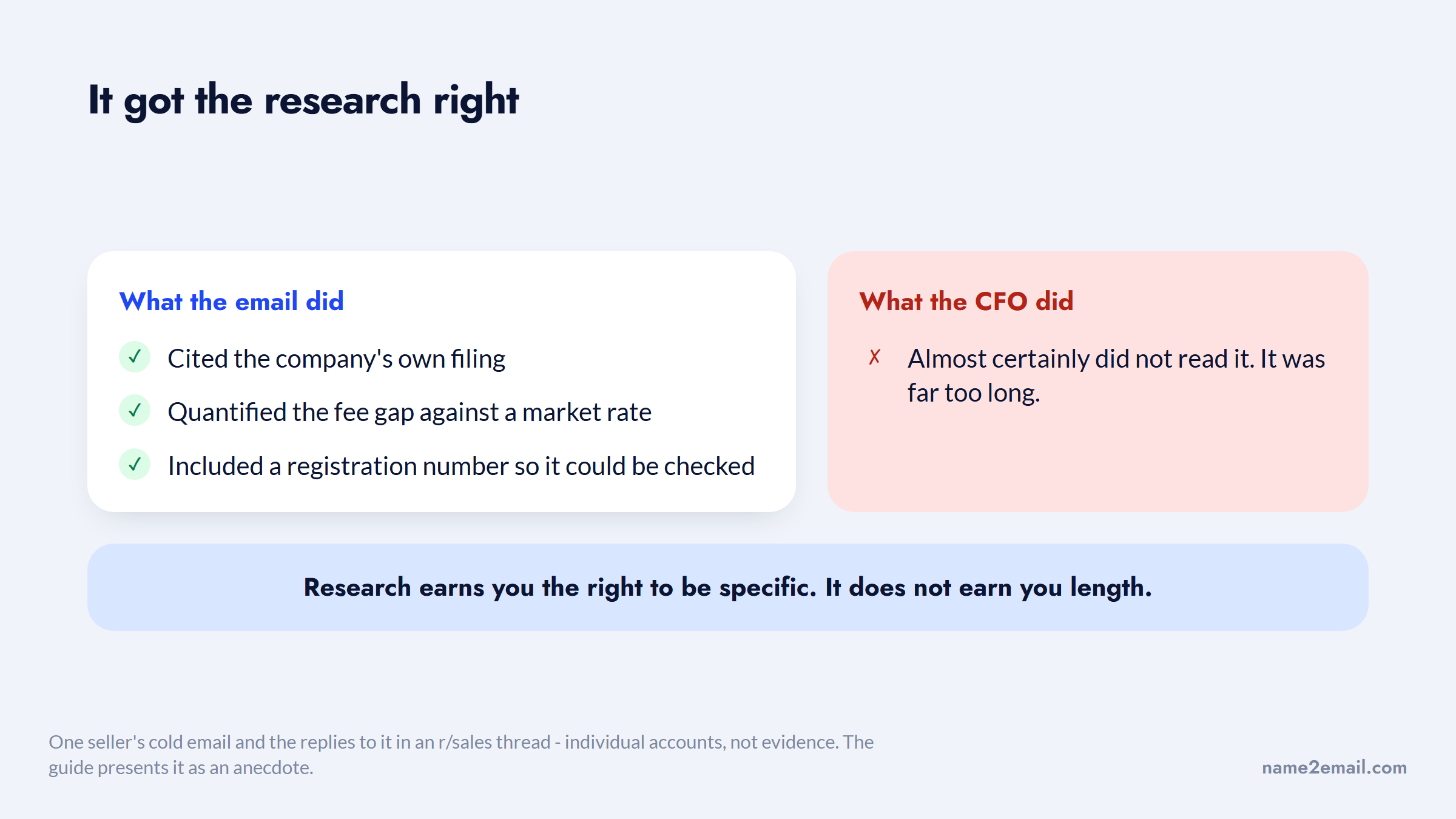
That thread is one anecdote rather than evidence, but the lesson generalizes cleanly. Research earns you the right to be specific; it does not earn you length. The same email at four sentences, naming the fee gap and asking one question, would likely have worked. Sequencing matters as much as the first message, which is covered in our guide to the cold email follow up.
Verifying and Refreshing on a Turnover Cycle
Given an 18.3% annual turnover rate, refresh cadence is the whole game for this audience.
Re-verify the name before every campaign, not just the address. The address may be perfectly deliverable and belong to someone who left in March, which is worse than a bounce because it produces no signal at all. For public companies this check is a single search of recent filings.
Watch for the announcement rather than the departure. An 8-K naming a new CFO is both an alert that your record is stale and a genuine outreach trigger, since incoming finance chiefs review vendor relationships in their first two quarters. That makes turnover a prospecting opportunity rather than only a data problem.
Run a deliverability pass on the addresses themselves before any send, particularly if you assembled them by pattern. Executive mailboxes sit behind aggressive filtering, and a batch with a high failure rate at one corporate domain will affect everything you send there afterward. Our roundup of email validation tools covers doing this at list scale.
Segmenting So the Message Fits the Seat
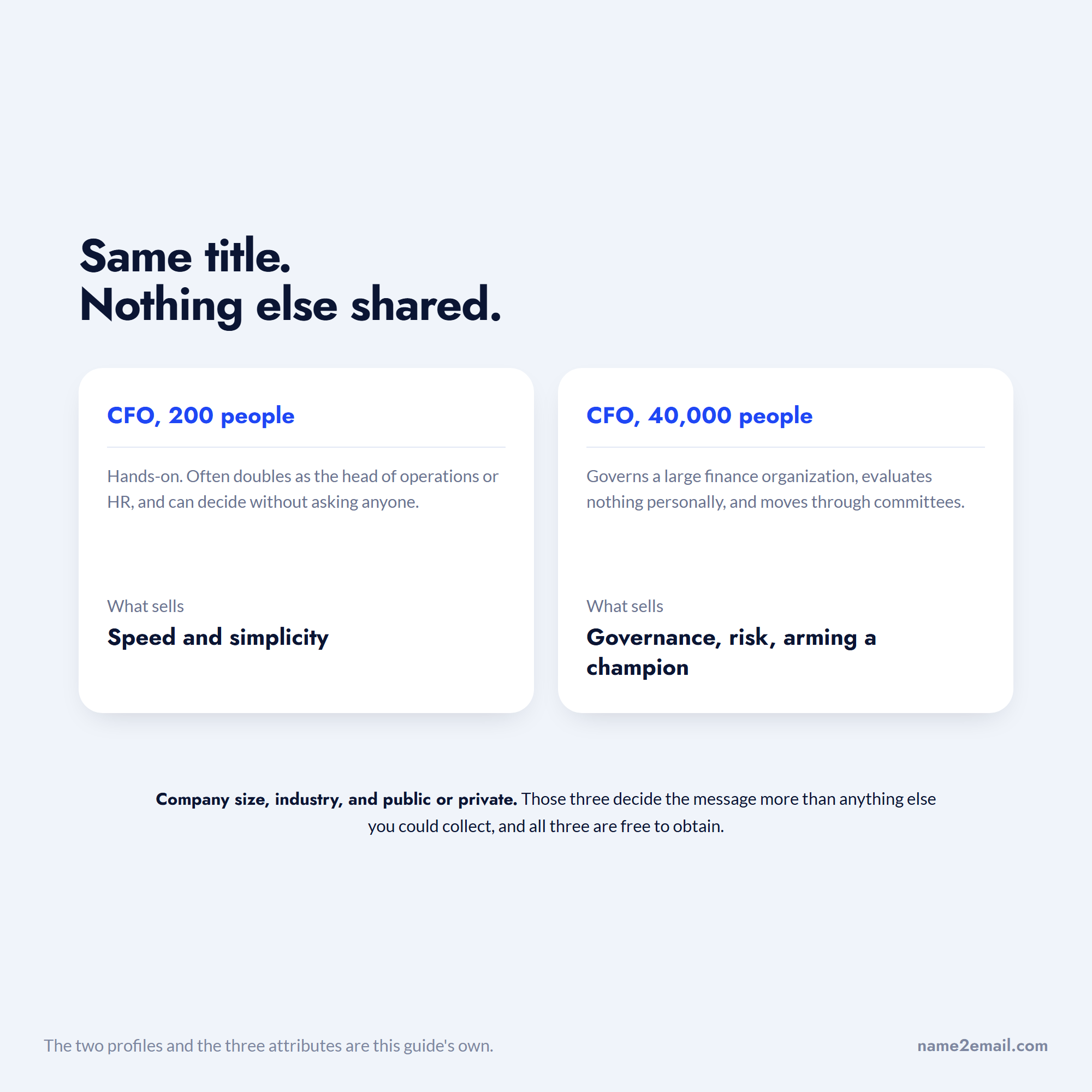
A CFO at a 200-person company and a CFO at a 40,000-person company share a title and nothing else.
The small-company CFO is hands-on, often doubles as the head of operations or HR, and can decide quickly. Speed and simplicity sell. The enterprise CFO governs a large finance organization, evaluates nothing personally, and moves through committees. Governance, risk, and internal-champion enablement sell.
Side by side, the two seats share the title and nothing that decides a message.
Industry matters almost as much. A usa cfo email list spanning healthcare, manufacturing and software contains three audiences with different regulatory pressure, different cost structures, and different definitions of a good quarter. Segment on it before you write, not after the reply rates disappoint.
The practical minimum is three attributes on every record: company size band, industry, and public or private status. Those three determine the message more than anything else you could collect, and all three are free to obtain.
Once the segments exist, routing each one to a different sequence is a tooling question, and the platforms that handle it are covered in our roundup of sales automation tools.
Build From the Filings Out
The strongest CFO list in 2026 is not the largest one. It is the one where every record was confirmed against a public source recently enough to still be true.
For public companies you have an authoritative, free, continuously updated register and no real excuse for a stale record. For private companies you have more work and less competition, since most purchased files cover them poorly.
Start with 100 target accounts rather than 10,000 records. Confirm the finance chief from a filing or a leadership page, note the date you checked, resolve the address, and write something four sentences long that names a number. For that final step, put Name2Email in your browser and let Gmail confirm the address for you, then push the confirmed contacts into whichever of the cold email tools you already run.
Frequently asked questions
Confirm the current CFO first, using an SEC filing or the company's investor-relations page for public companies and the leadership page for private ones. Then take the name and the company domain and work out the address format, which large companies apply consistently across every employee. Our extension builds those candidates for you as you compose, and hovering over each one lets Gmail identify the executive by photo and name.
No complete free file of deliverable CFO addresses exists, and offers of one are almost always a sample designed to collect your details. Hunter publishes a free filtered CFO list builder and ReachStream offers 100 free addresses, both of which are real but limited. The genuinely free resource is the underlying identity data: SEC filings and IR pages name every public-company finance chief at no cost.
Less accurate than the vendor claims, mostly because of turnover rather than sloppiness. With CFO turnover projected at 18.3% for 2026, a file that was perfect on the day it was compiled has meaningful decay within months. Ask for a trial segment and check it against the filings before you pay for the full file, since a stale name is the failure mode here rather than a dead address.
Vendors upsell a cfo email and phone number list, but the phone number is rarely the constraint. Three fields matter more: company size band, industry, and whether the company is public or private. Those determine the message far more than seniority does, since a 200-person company's finance chief and a 40,000-person company's finance chief buy in completely different ways. Add the date you last confirmed the person is still in the seat, which no purchased file will give you.
Target the CFO when your purchase genuinely exceeds a departmental approval limit, when you sell finance software they will personally use, or when you sell professional services to the finance function. In most other cases the CFO approves rather than evaluates, and the person who owns the problem will get you further. Building both into the same list, with the owner as the entry point and the CFO as the signer, works better than either alone.

We build Name2Email, the free Chrome extension that finds work emails inside Gmail. We write about outreach, prospecting, and getting more replies.
Connect →