- 1Every licensed attorney in the United States already sits in a free public register. State bar directories are mandatory, searchable, and more current than most files you can buy.
- 2Read vendor counts against the real population and against their own fine print. One advertises "140,000+ lawyers" and discloses that only 32,000 have an email address; another's million-plus total turns out to carry no stated geography.
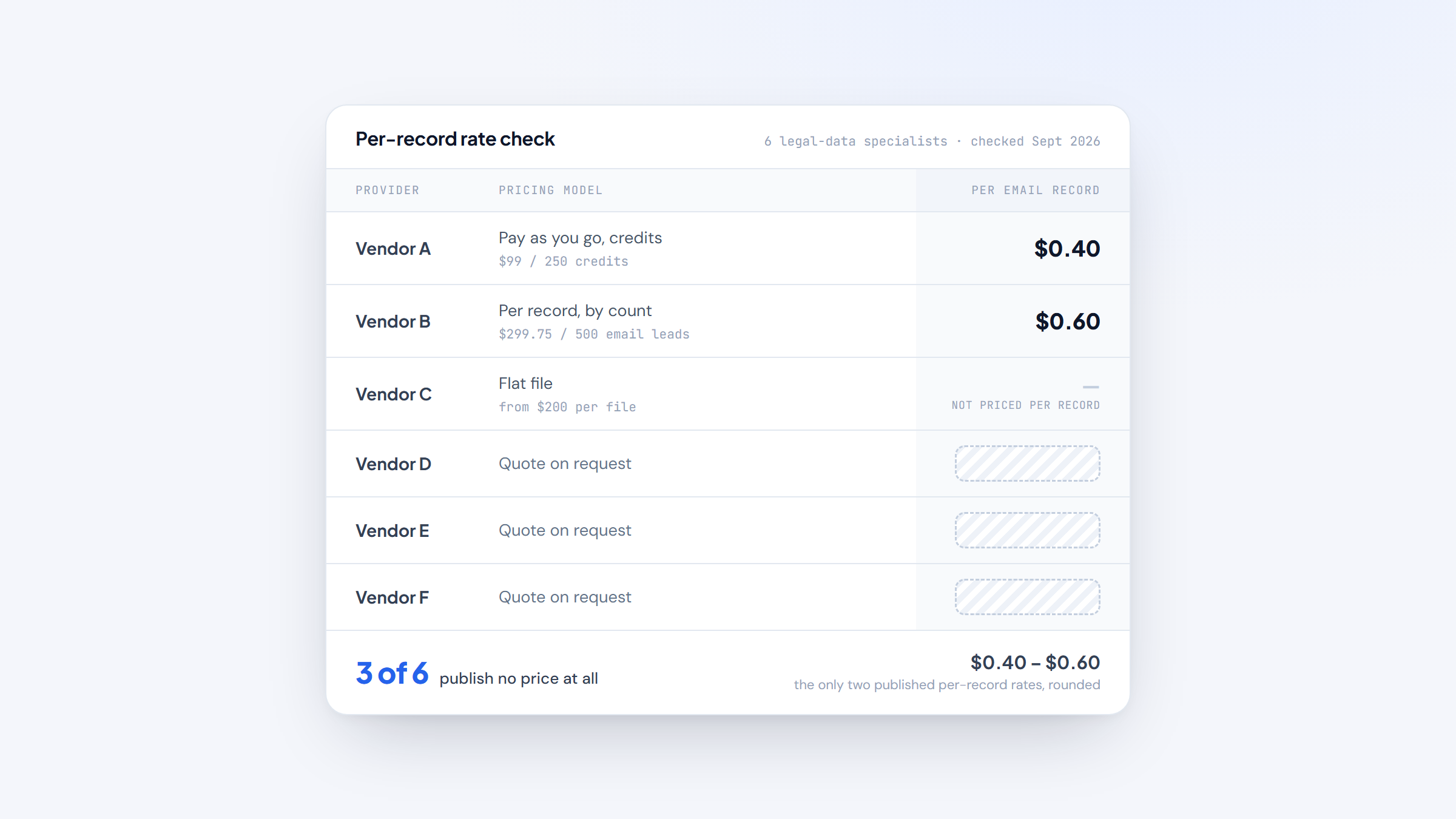
- 3Published list prices run about $0.40 to $0.60 per email record. Half the legal-data specialists we checked publish no price at all and quote on request.
- 4Bar directories give you names and firms, not work addresses. That last step is what our free Gmail extension handles, and we are not a list source.
Search "lawyers email list" and you will get two dozen vendors promising verified attorney contacts, and almost nothing explaining where legal contact data comes from in the first place.
That gap matters here more than in most industries, because law is one of the few professions where a complete, authoritative, free register of every practitioner already exists. Attorneys cannot practice without a license, licenses are issued by state bars, and state bars publish their membership. The list you are being sold is, in most cases, a scrape of a public record with a markup applied.
This guide covers how to build a lawyers email list yourself from those public registers, what the vendor market charges when you would rather buy, and the professional-conduct rules that make emailing attorneys different from emailing anyone else. We build Name2Email, a free Chrome extension that finds work emails inside Gmail, so our interest is in the contact step rather than the list business.
What a Lawyers Email List Actually Contains
Strip away the marketing and an attorney contact file holds four things: identity, credential, affiliation, and contact route.
What vendors label a lawyers email addresses list is really those four fields bundled together. Identity is the name and, sometimes, a photo. Credential is the bar number, admission date, and standing, which is the part unique to legal data and the part that makes it verifiable. Affiliation is the firm, its size, and its address. Contact route is the email address, phone number, and mailing address.
Only the last of those is genuinely hard to source. The first three are published by state bars as a matter of public protection, because a client needs to be able to check whether the person advising them is actually licensed and in good standing.
Split into its four parts, only one of them is anything you could not have got for nothing.
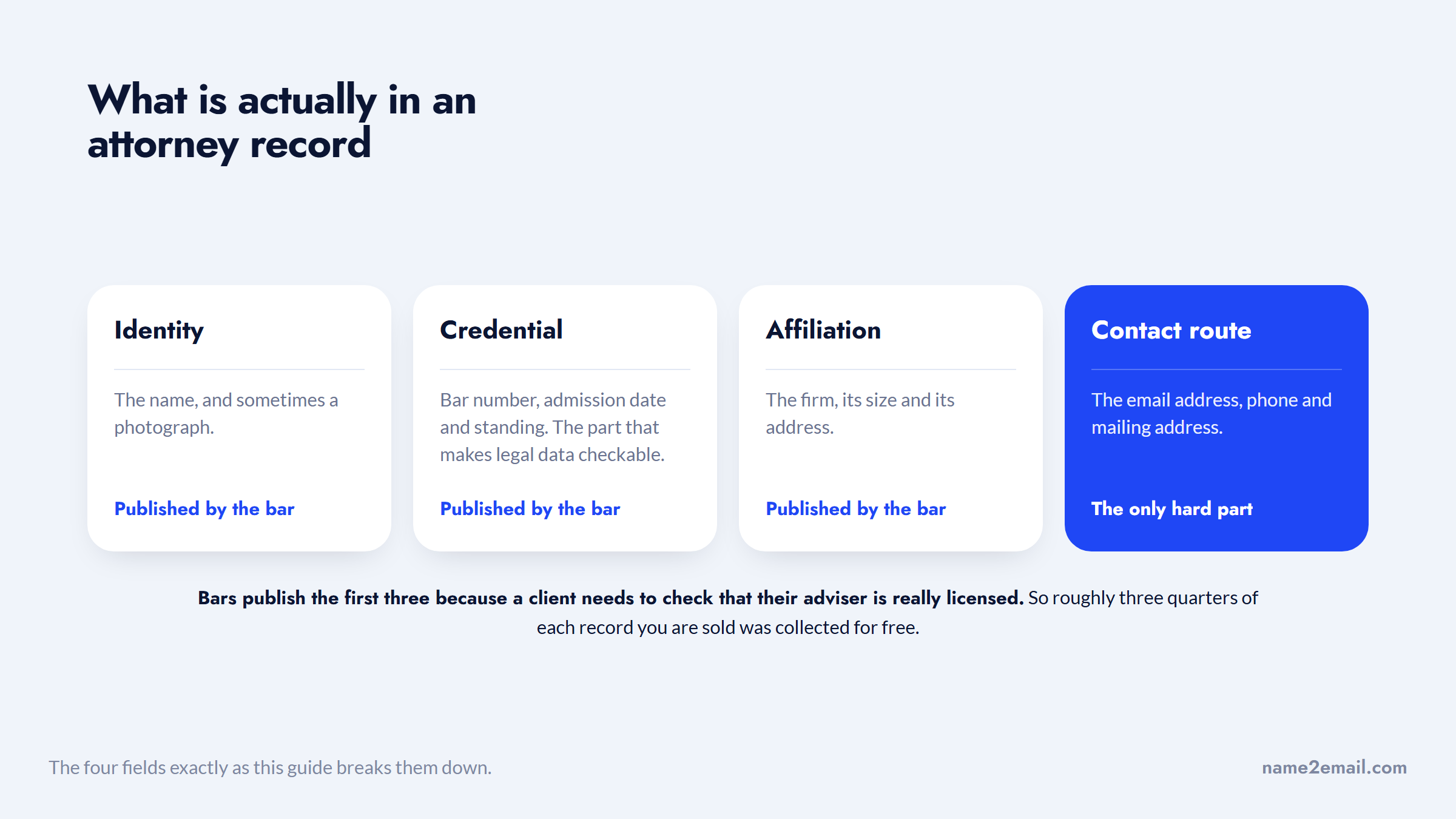
That asymmetry shapes everything else in this guide. When a vendor sells you an email list of lawyers, roughly three quarters of each record is public information they collected for free.
The Vendor Numbers Do Not Reconcile
Before you evaluate any provider, get the size of the real population in your head, because the claims fall apart against it quickly.
The American Bar Association reported 1.37 million licensed lawyers in the United States in 2025, up from 1.35 million the year before, in its 2025 Profile of the Legal Profession. That is the ceiling: every attorney with an active license, including those who are retired from practice, working in-house, teaching, or sitting on a bench.
The employment figure is considerably lower. The Bureau of Labor Statistics counted about 863,700 lawyer jobs in 2025 in its Occupational Outlook Handbook, with a median wage of $159,670. The gap between the two is real people: licensed attorneys who no longer practice.
Now set the vendor claims beside those two numbers.
Source | Attorney records claimed | What the number is measuring |
|---|---|---|
American Bar Association | 1,370,000 | Licensed lawyers, all statuses |
Bureau of Labor Statistics | 863,700 | People employed as lawyers |
InfoCleanse | 1,000,000+ | Marketable email records, no geography stated |
Blue Mail Media | 589,000+ | Attorneys across 50 states and 25 countries |
LeadsPlease | 544,587 | Verified lawyer contacts, USA |
BookYourData | 373,122 | Verified attorney records, worldwide |
DMDatabases | 32,000 | In-house counsel with email, from 140,000+ profiled |
Read the bottom five rows against the top two and two things jump out that no vendor page will tell you.
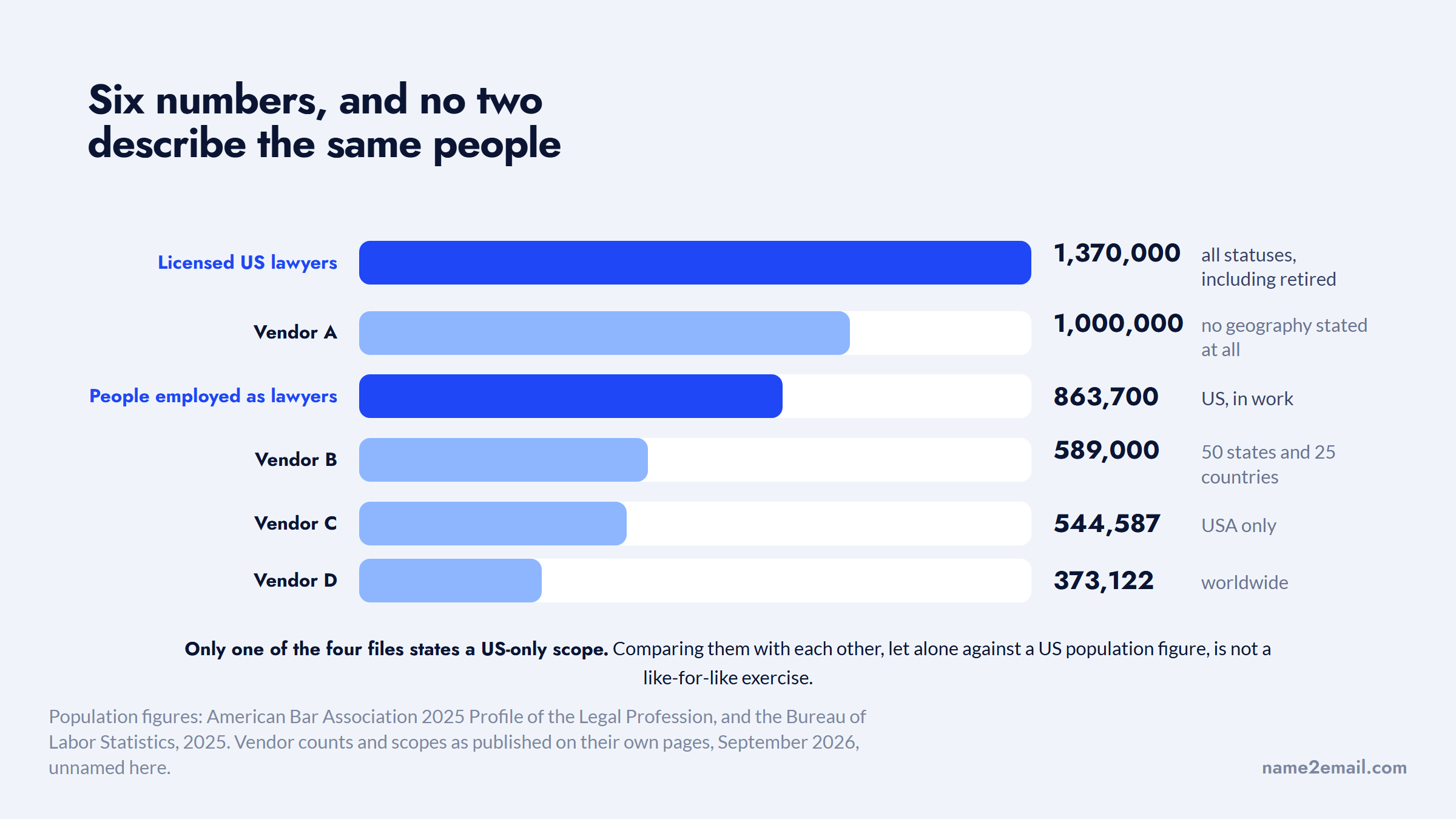
The first is that the counts measure different populations. LeadsPlease is explicitly US-only, BookYourData's total is worldwide, Blue Mail Media spans 25 countries alongside the 50 states, and InfoCleanse states no geography at all. Comparing them to each other, let alone to a US population figure, is not a like-for-like exercise.
Tagged with the scope each one claims, the six numbers stop being comparable at all.
The second is what happens when you read the fine print. DMDatabases advertises 140,000+ lawyers, but its own page describes them as counsel working inside non-legal firms and says only 32,000 of those records carry an email address. That is a perfectly respectable in-house-counsel file; it is just not what "140,000 lawyers" sounds like.
InfoCleanse is the other end of the range. If its million-plus records are US-focused, as its marketing implies, the file would hold a deliverable address for more people than the Bureau of Labor Statistics says are employed as lawyers at all. The company does not publish a geographic breakdown, so the charitable reading is that the total is global.
None of this is necessarily dishonest. "Records" often includes duplicates, retired licensees, non-US practitioners, and firm switchboard addresses. But if you buy on volume alone you will pay for the difference, a trap we work through in more detail on buying email lists.
Every Lawyer Is Already in a Free Public Register
This is the part the vendor pages leave out. All 50 states and the District of Columbia run an attorney lookup, and most of them are free, unauthenticated, and searchable by name, city, practice area, or admission status.
How to Pull Attorney Records From a State Bar
The mechanics are similar across jurisdictions, and the whole route takes an afternoon per state rather than a project.
- Open the licensing body's member search. In California that is the State Bar of California attorney search, in New York the Unified Court System's attorney directory, in Texas the State Bar of Texas "Find a Lawyer" tool.
- Filter to active status only. Inactive, suspended, and resigned licensees are in the same database, and including them is the fastest way to build a list full of people who no longer practice.
- Add your geography. Most searches accept county or city, which matters because attorney density is wildly uneven.
- Add practice area if the register carries one. Several states record a self-reported specialty, which is how you get from a general roster to a family lawyers email list or an immigration lawyers email list without buying a segmented file.
- Export or record the name, bar number, firm, and firm address. Bar numbers are the useful part: they are unique, permanent, and let you deduplicate cleanly later.
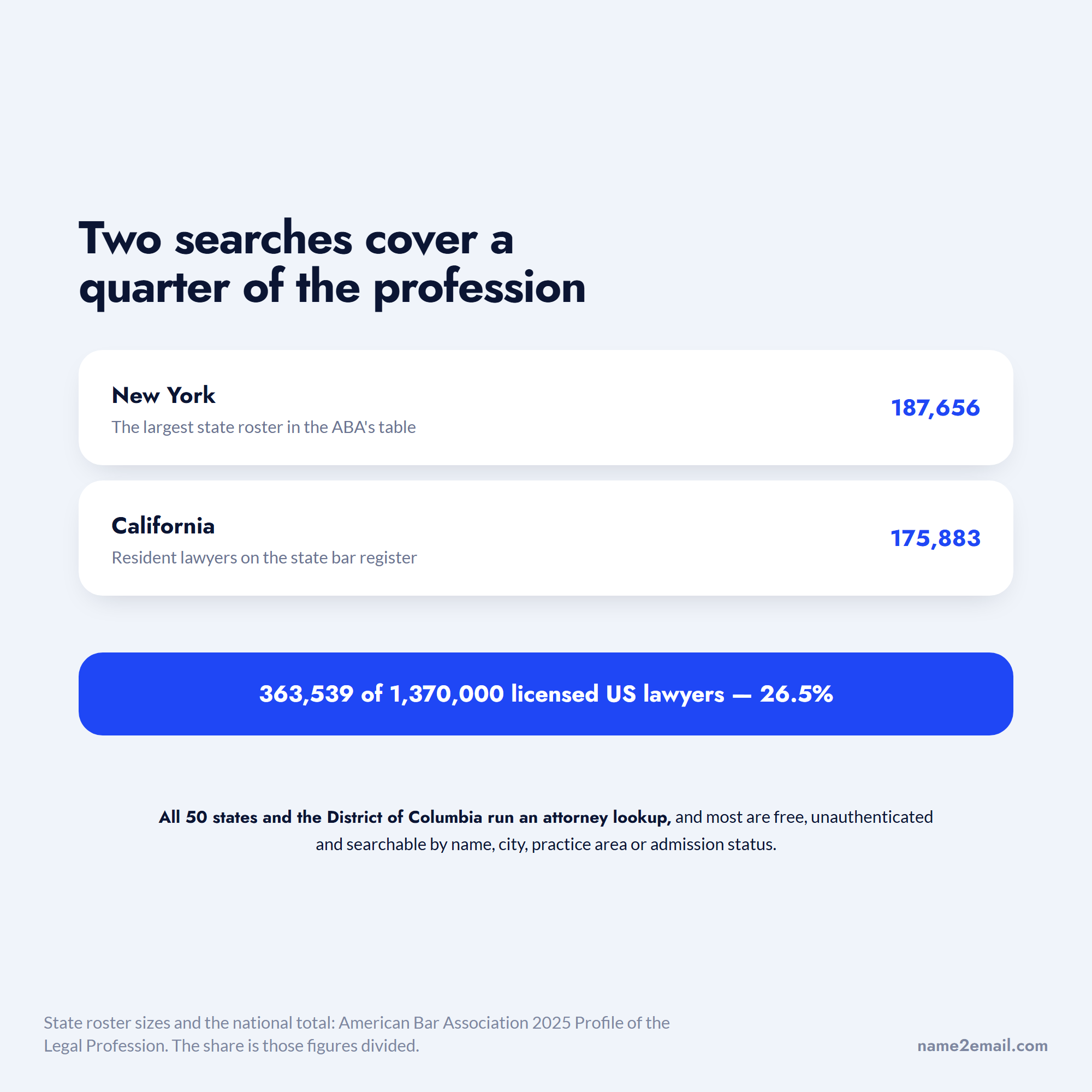
Two states are worth knowing about specifically. New York's directory covers roughly 187,656 resident lawyers, the largest of any state in the ABA's table, and California's covers about 175,883. Between them they hold more than a quarter of the profession, so if your market is national those two searches alone build most of your list.
Two registers, and a quarter of every licensed attorney in the country is already in hand.
What you will not get from any bar register is an email address. Bar associations publish the information a client needs to verify a license, and a direct work email is not part of that. The reverse problem, starting from an address you already have and working out who owns it, needs a different method entirely and is covered in looking up an email address.
The Free Directories Worth Adding
Bar registers give you completeness. Commercial directories give you the practice-area detail and firm context that bar registers usually lack.
Justia's lawyer directory is free to search and organizes attorneys by state and practice area, which makes it a fast route to a personal injury lawyers email list or a criminal lawyers email list where the bar register records no specialty. Building an email list for divorce lawyers works the same way, since family-law practitioners are among the most consistently self-categorized.
Martindale-Hubbell adds peer ratings and a longer firm history. Avvo layers on client reviews and a self-built profile that often names the attorney's focus more precisely than their firm bio does.
Firm websites are the highest-value source and the one people skip. A mid-size firm publishes an attorney roster with photos, practice groups, bar admissions, and frequently the email format itself in a "contact" link. One firm page can give you twenty accurately segmented contacts and the naming convention for all of them.
Court filings are the last resort and the most current source there is. Attorneys of record are named on every filing, so a PACER search on a case type in your jurisdiction surfaces the lawyers actively doing that work right now, which is a much stronger signal than a directory listing.
Sweeping four directories by hand is fine for a few hundred attorneys and miserable at ten thousand, which is the point at which dedicated email finding tools start to earn their subscription.
How to Segment Without Buying a Segmented File
Vendors charge a premium for segmentation, and segmentation is mostly a filtering problem you can solve on data you already have.
Practice area is the axis that matters most, because the pitch to a divorce attorney and the pitch to a securities litigator have nothing in common. Firm size is the second axis: a solo practitioner buys software on a credit card, a 400-lawyer firm runs a procurement process, and treating them the same wastes both lists.
The third axis is seniority. Partner, associate, of counsel, and managing partner are different buyers with different authority, and firm websites label this explicitly where directories often do not.
Segment axis | Free source that carries it | Typical use |
|---|---|---|
Practice area | Justia, Avvo, firm practice-group pages | Matching the offer to the work |
Firm size | Firm attorney roster, headcount page | Deal size and sales motion |
Seniority | Firm bio pages, partner listings | Authority to sign |
Jurisdiction | State bar register, admission records | Territory assignment |
Activity | PACER filings, recent case coverage | Timing and relevance |
Build those four or five attributes into your file as you collect it rather than afterward. Retrofitting practice area onto ten thousand names you already gathered is the single most tedious job in this whole process, and it is entirely avoidable.
One axis that works in other industries does not work here. Segmenting by the software a company runs, the approach behind a technology users email list, tells you very little about a law firm, because legal practice management software is near-universal and says nothing about what the firm needs.
Turning a Name and a Firm Into a Work Email
At this point you have names, firms, practice areas, and firm domains, and no addresses. This is the step where most people give up and buy a list.
Law firms are unusually good targets for pattern-based email discovery, because legal email conventions are conservative and consistent. A firm that uses `first.last@` uses it for every attorney, including the ones who joined last week and are in nobody's database yet.
That is the job our extension does. You type the attorney's name and the firm's domain into Gmail's compose window, we generate the likely patterns, and Gmail's own contact recognition shows you the person's name and photo when you hover over the address that resolves. It is free, unlimited, and needs no account, which matters when you are working through a roster of forty attorneys at one firm.
Be clear about what this is and is not. We generate likely addresses from public naming conventions rather than selling you stored records, we work best on corporate domains, and we cannot guarantee every address.
We are not a list builder and not a database. What we do is close the gap between a public register that gives you a name and an outreach tool that needs an address.
Attorneys at very small firms often sit behind a generic `info@` mailbox, where the pattern approach has less to work with, and the other routes worth trying are covered in finding an email address.
What the Vendor Market Charges
Buying is a legitimate choice, particularly at volume or when you need a segment you cannot easily assemble. The market splits cleanly into vendors that publish a price and vendors that do not.
Vendor | Pricing model | Published price | Records claimed |
|---|---|---|---|
Reply.io | Platform subscription, database bundled | From $59/user/mo, 14-day trial | 1B+ contacts, not attorney-specific |
BookYourData | Pay as you go, credits | $99 for 250 credits, $0.40 per contact, 10 free | 373,122 attorneys |
LeadsPlease | Per record, by count | $299.75 per 500 email leads, $124.95 per 500 mailing leads | 544,587 attorneys |
BizProspex | Flat file | From $200 | Not specified per file |
Blue Mail Media | Quote on request | None published | 589,000+ attorneys |
InfoCleanse | Quote on request | None published | 1,000,000+ |
DMDatabases | Quote on request | None published | 140,000+ with email |
Reply.io heads the table because it represents the other model entirely, and we should disclose that the same team builds Name2Email. You are not buying an attorney file from it. You are subscribing to an outreach platform whose 1B+ contact database comes bundled, filtering that database down to the lawyers you want, and exporting within your credit allowance. There is no free tier, only a 14-day trial with 50 verified credits, and no legal-specific product.
Prices verified on each vendor's own page in September 2026. Three of the six legal-data specialists quote rather than publish, which is worth registering in itself: a vendor confident in its per-record quality tends to be willing to put a per-record number on it.
Only two rows price by the record, and they land close together at roughly $0.40 to $0.60 per email address. That is the number to hold in your head when someone quotes you a project fee, because a "custom file of 5,000 attorneys" should land somewhere near $2,000 to $3,000 at market rate, and quotes well above that are pricing the segmentation work rather than the data.
A Reddit thread in r/b2bmarketing asking about the state of purchased lists drew a reply worth weighing before you buy: lists get resold to multiple buyers, and building your own from the same underlying databases is usually cheaper and fresher. That is one practitioner's anecdotal view rather than a study, but it matches what the pricing above implies.
Against any of these numbers, the arithmetic that made us build a free tool is simple enough to check on our own pricing page: we charge nothing per lookup, so the comparison is between a per-record fee and zero.
The Conduct Rules That Make Legal Outreach Different
Emailing lawyers carries a wrinkle that emailing chief financial officers does not, and it catches people out.
If you are selling to attorneys, ordinary commercial email rules apply: CAN-SPAM, accurate headers, a working opt-out honored within 10 business days, a physical postal address. Nothing special.
If you are a lawyer or a law firm emailing other people to solicit work, you are additionally bound by your state's rules of professional conduct on advertising and solicitation, which are modeled on ABA Model Rules 7.1 through 7.3 and vary meaningfully by state. Some jurisdictions require advertising labels on solicitation emails, some require filing copies with the bar, and some restrict contact with prospective clients known to need legal services in a specific matter.
The two situations look alike from the inbox and are governed very differently.
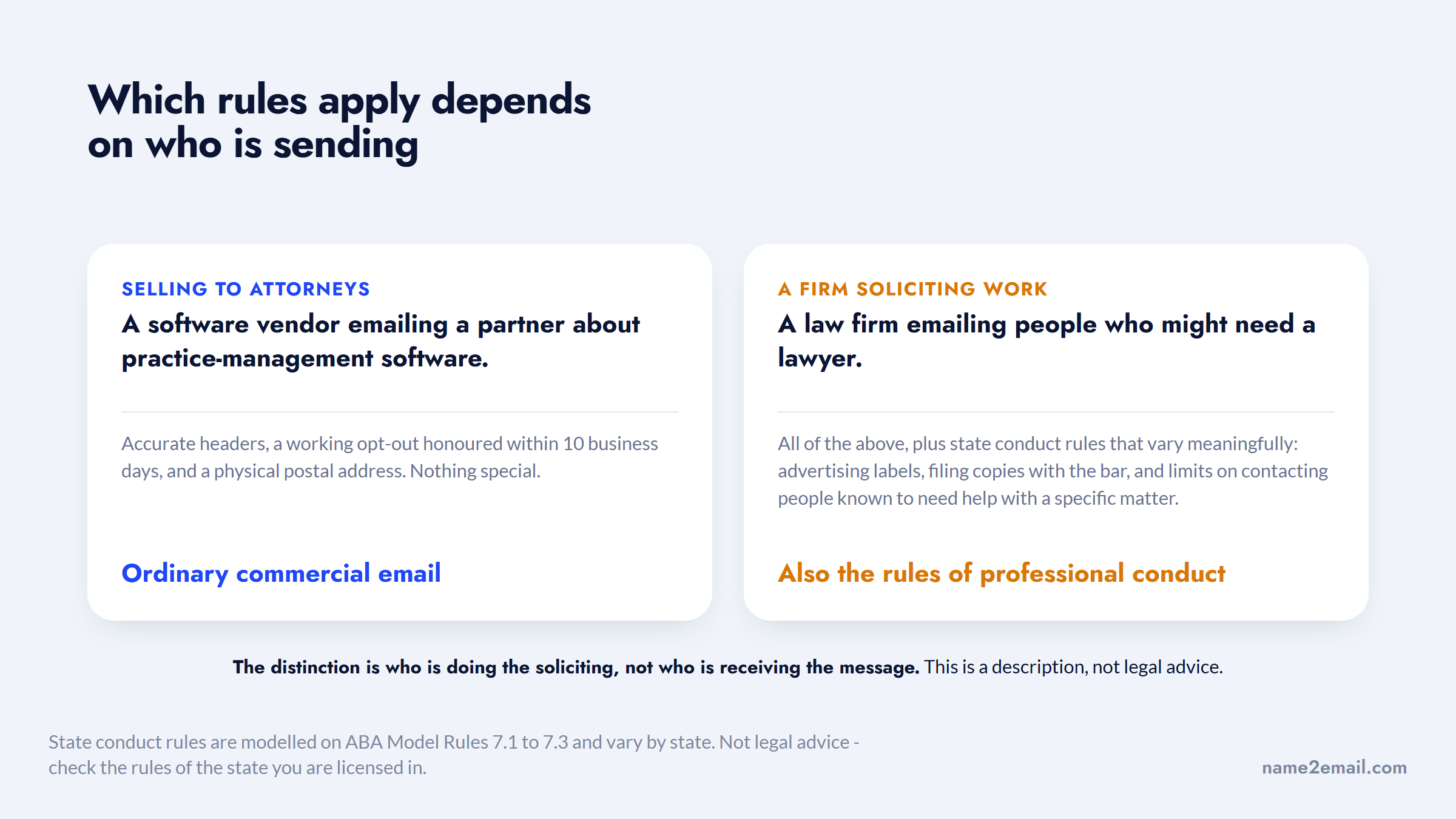
The distinction is who is doing the soliciting, not who is receiving the message. A software vendor emailing a partner about practice-management software is in ordinary commercial territory. A firm emailing accident victims is in regulated territory. Check the rules of the state you are licensed in before you send anything in the second category.
Verifying Before You Send
Attorney data has a specific decay pattern. Lawyers move firms often, particularly at the associate level, and when they do, the old address usually stops resolving immediately rather than forwarding.
Bar registers help here in a way that is unique to this profession. Because a licensed attorney must keep a current address of record with the bar, the register tells you where someone practices now even when every commercial file still has them at their previous firm. Cross-checking your file against the register before a send catches the moves for free.
Run a verification pass on the addresses themselves as well. Anything you assembled by pattern is a hypothesis until something confirms it, and sending to a firm domain with a high bounce rate does real damage to your sending reputation.
Doing that check inside Gmail before you send is the cheapest version of it, and the mechanics are in verifying an email address. Whichever route you take, run it on the whole file rather than a sample, because bounce damage is cumulative rather than proportional.
Writing to Attorneys Who Bill by the Hour
The economics of the recipient's day should shape the message, and for attorneys the economics are unusually explicit.
A lawyer billing at $400 an hour is spending roughly $6.67 of billable time per minute reading your email. That is not a metaphor for busyness, it is how their compensation is calculated, and it is why long, discursive cold emails perform badly with this audience specifically.
Worked out per minute, the cost of reading you is a number the recipient already knows.
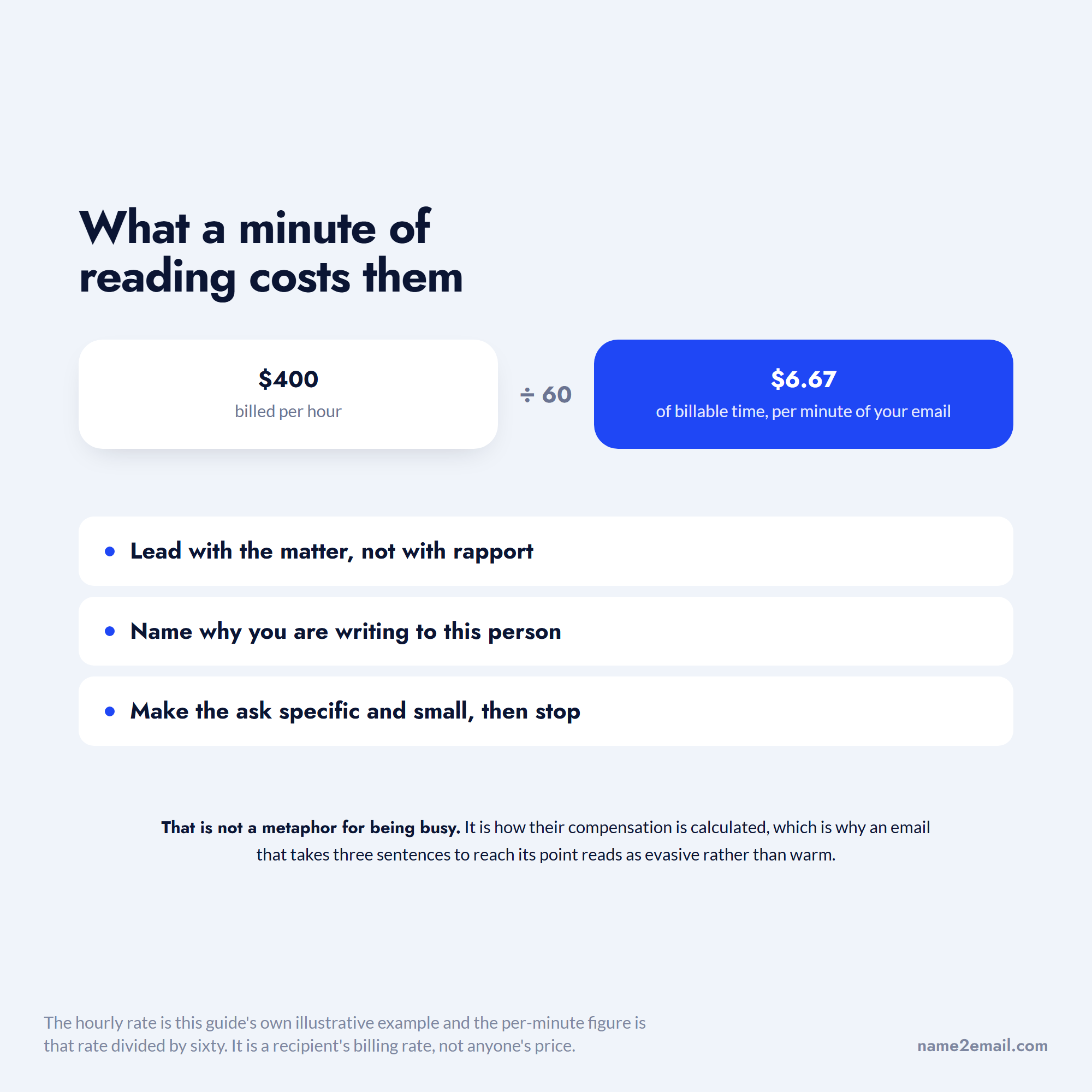
Lead with the matter. Attorneys are trained to identify the issue first, and an email that opens with three sentences of rapport before naming its purpose reads as evasive rather than warm. Name what you do, name why you are writing to this person in particular, and make the ask specific and small.
Reference something real. Practice area, a recent case, a firm expansion, a new office. The public sources above give you all of this for free, and it is the difference between a message that reads as targeted and one that reads as a blast to every immigration lawyer in a purchased file.
Keep it short enough to read on a phone between hearings. Then stop.
Brevity matters with every senior buyer, and the same discipline applies when you build a CFO email list, where the recipient's time is priced just as explicitly.
Build It Once, Maintain It Continuously
The advantage of building an attorney list yourself is not mainly the money you save on the file. It is that you end up understanding your own data.
You know which states you covered, which practice areas you filtered for, when you pulled it, and which addresses were confirmed rather than guessed. None of that is true of a purchased file, and all of it determines whether your outreach works.
Start with one state bar register and one practice area rather than trying to assemble the whole profession. Add firm rosters for the twenty firms you most want to reach, resolve the addresses, verify them, and send. A list of 200 attorneys you built and checked will outperform 50,000 you bought, and you can see the teams that work this way across recruiting, software sales, and business development.
When you are ready to close the gap between a name on a bar register and a message in an inbox, add Name2Email to Chrome and find the address without leaving Gmail.
Frequently asked questions
No genuinely free file of deliverable attorney email addresses exists, and offers of one are usually lead magnets that collect your details. What is free is the underlying data: every state bar publishes an active-member register with names, bar numbers, and firm affiliations, and Justia's directory is free to search by practice area. You assemble the names for nothing, then resolve the addresses yourself.
Buying a B2B contact file is legal in the United States, and attorneys have no special protection as recipients of commercial email. CAN-SPAM governs what you send: accurate headers and sender identity, a functioning opt-out honored within 10 business days, and a valid physical postal address. The separate advertising and solicitation rules in each state's rules of professional conduct apply to lawyers doing the soliciting, not to vendors emailing lawyers.
Accuracy varies enough that vendor claims are close to meaningless without a test. Providers advertise 95% to 98% deliverability, but those figures are self-reported and usually measured at the point of collection rather than at the point you send. Request a sample segment and check the bar numbers in it against the state register, which tells you the file's real currency faster than any send test.
A lawyers email list targets individuals, so each record is a named attorney with a personal work address, a practice area, and a seniority level. A law firms email list targets organizations, so each record is a firm with a general inbox, a headquarters address, and a headcount. Individual records cost more and perform better, because a message to a named partner about their practice area lands very differently than one to a shared reception mailbox.
Start with the firm's website, since many firms publish attorney emails directly on bio pages or make the format obvious in a contact link. If the address is not published, take the attorney's name and the firm's domain and generate the likely patterns, then confirm which one resolves. Our extension does this inside Gmail's compose window and shows you the person's name and photo on the address that Gmail recognizes.

We build Name2Email, the free Chrome extension that finds work emails inside Gmail. We write about outreach, prospecting, and getting more replies.
Connect →