- 1"Buying an email list" now usually means subscribing to a B2B data platform and exporting filtered contacts, not receiving a CSV from a broker. The two models carry very different risk.
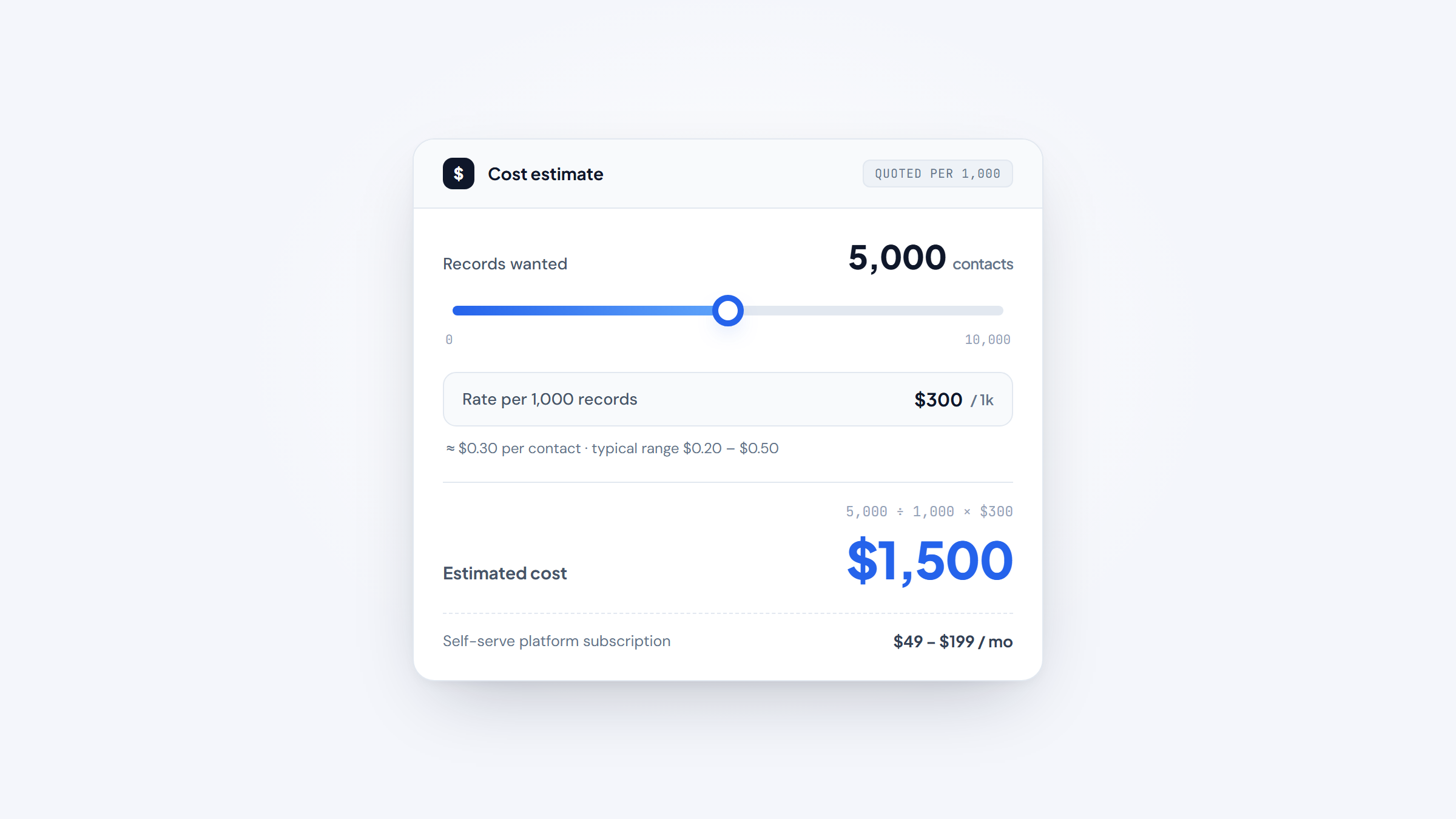
- 2Platform pricing runs roughly $49 to $199 per month for self-serve tiers. Broker lists are typically quoted per thousand records and vary enormously in quality.
- 3Under CAN-SPAM, every non-compliant email carries penalties of up to $53,088, and you must honor opt-outs within 10 business days.
- 4Buying contacts is one route. Finding them yourself is the other, and for one-off outreach our free Gmail extension does it without a list at all.
Ask ten marketers about buying email lists and you will get ten strong opinions and very little procedure.
The practical reality sits between the extremes. There is a real market, it has legitimate vendors and disreputable ones, and the difference between a purchase that works and one that damages your domain comes down to what you buy, from whom, and what you do with it afterward.
This guide covers how to buy email lists for marketing: what the market actually looks like in 2026, where to buy email lists, what it costs, how to evaluate a vendor, and the risks you take on. We make Name2Email, a free Chrome extension for finding work emails inside Gmail, so we are in the contacts business rather than the list business, and we are not a list source. We will be clear about where buying fits and where it does not.
What "Buying an Email List" Means Now
The phrase covers two different transactions, and conflating them is the root of most bad outcomes.
The first is the traditional model: a list broker sells you a file, usually a CSV, of contacts matching criteria you specify. You own the file. The vendor's involvement ends at delivery.
The second is the modern one: you subscribe to a B2B data platform, filter its database to an ideal customer profile, and export contacts within the credit allowance your plan provides. You are licensing access rather than buying a file outright, and the data refreshes continuously.
Side by side, the three deals behind that one phrase are not close to equivalent.
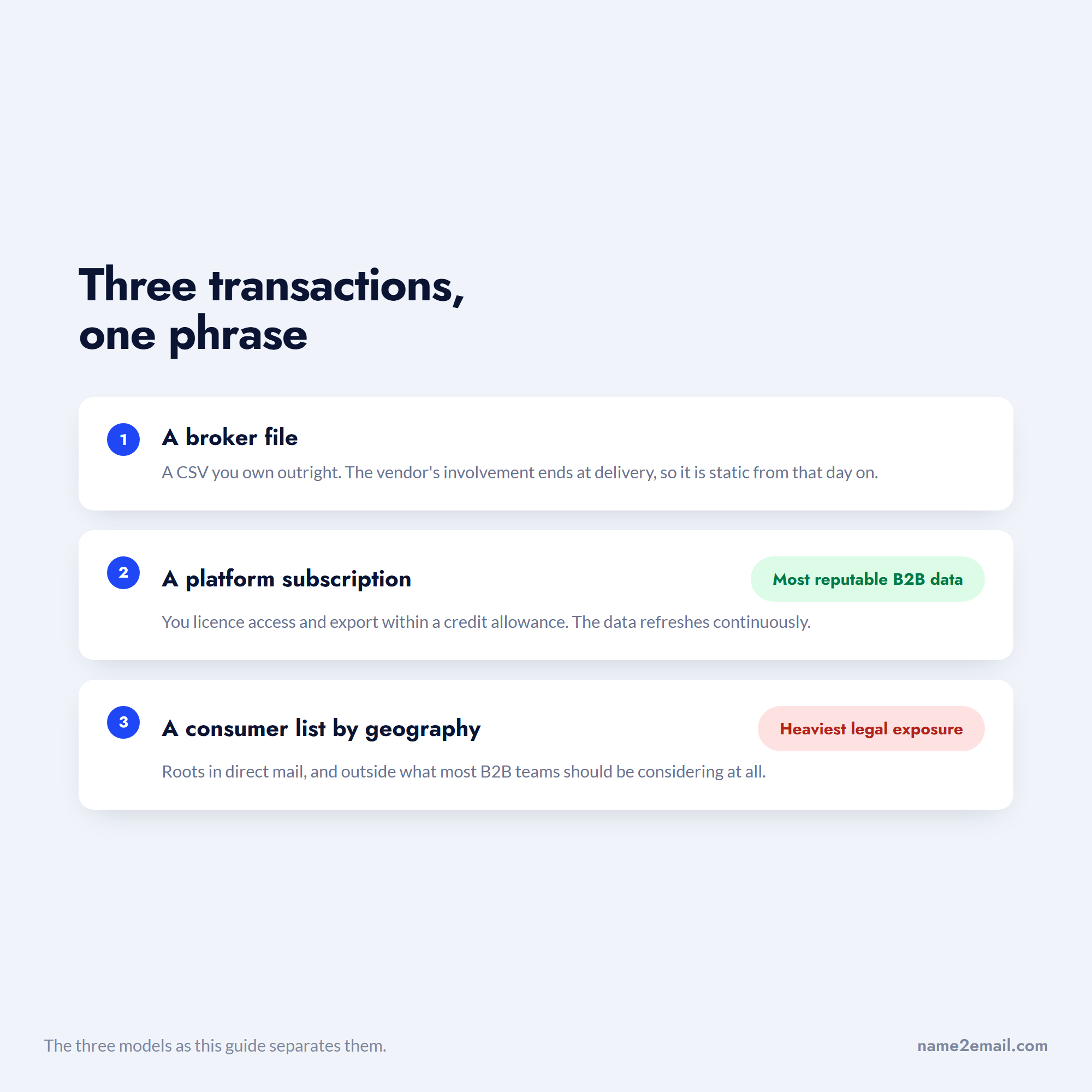
Most reputable B2B contact data now moves through the second model. It is more expensive per month, considerably better maintained, and it gives you a vendor with a reputation to protect. When people describe a purchased list catastrophe, they are almost always describing the first model.
There is a third category worth separating out: consumer lists sold by geography or demographics, which have their roots in direct mail. Those carry the heaviest legal exposure and are outside what most B2B teams should be considering at all.
Where to Buy Email Lists for B2B Marketing
If you want to buy B2B email lists, these are the mainstream platforms, with pricing verified from their live pricing pages in 2026. The same vendors serve teams looking to buy business email lists or buy targeted email lists by role.
Provider | Model | Entry price | Coverage claim | Notes |
|---|---|---|---|---|
Apollo.io | Subscription plus credits | Free tier; $49/user/month | 210M+ contacts | Real free tier, self-serve, exports capped by credits |
Lead411 | Subscription | $49/month | Verified emails plus intent | Unlimited exports on its top tier |
UpLead | Subscription plus credits | $74/month billed annually | Verified at export | Credits refunded on failed verification |
Cognism | Annual contract | Quote only | Strong EMEA coverage | Phone-verified mobiles, GDPR-focused |
Seamless.AI | Credits | Free tier; quote for Pro | 1.3B+ contacts | Credits deducted even on failed lookups |
Coresignal | API or bulk datasets | $49/month API; $1,000+/month datasets | 895M+ employee records | Closest thing to buying raw data at scale |
People Data Labs | API | Free 100 records; $98/month | Person and company records | Contact fields obfuscated on the free tier |
Coverage figures above are vendor-published and self-reported, which is true across this entire category. Treat them as marketing claims rather than audited numbers, and test a sample before committing.
Our roundup of sales intelligence tools compares these platforms in more depth, including the intent-data providers that sit alongside them.
What Buying a List Actually Costs
Pricing splits cleanly by model, and the per-contact math is where the two diverge.
Route | Typical cost | What you get | Data freshness |
|---|---|---|---|
Self-serve platform | $49 to $199/month | Filtered exports within a credit allowance | Continuously refreshed |
Enterprise data contract | $15,000 to $45,000+/year | Large seat counts, API access, bulk export | Continuously refreshed |
Bulk dataset license | From $1,000/month | Raw records delivered as CSV or JSON | Monthly refresh typical |
List broker file | Often quoted per thousand records | A one-time file you keep | Static from the day you buy |
Consumer list by geography | Varies widely | Household or local records | Often stale, heaviest legal risk |
The line that matters is the last column. A platform subscription costs more per month but the data is maintained; a broker file is cheaper up front and starts decaying the moment it is delivered, because people change jobs continuously.
Put the two on the same twelve months and the difference is maintenance, not price.
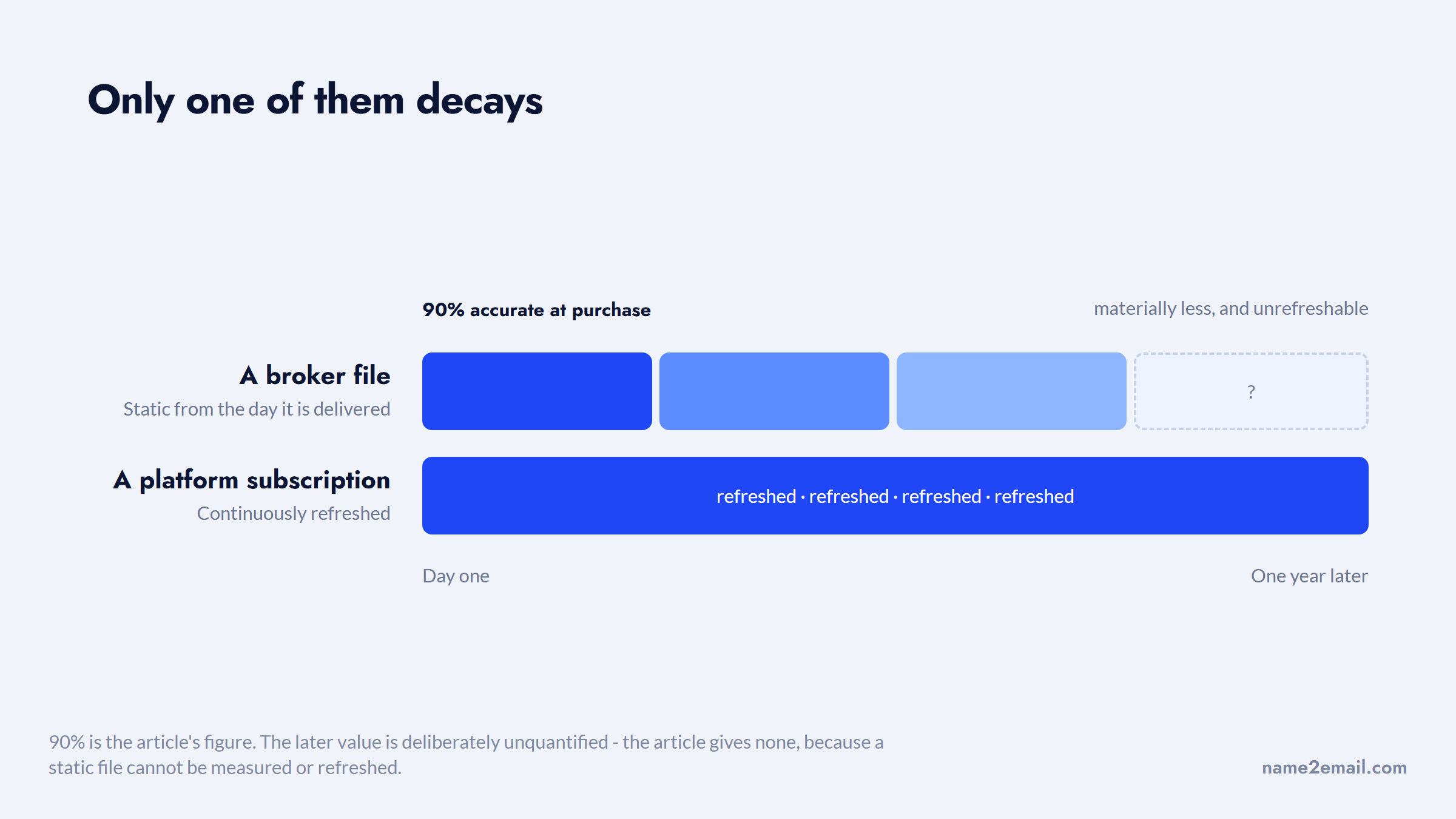
That decay is the hidden cost. A file that was 90% accurate at purchase is materially less accurate a year later, and you have no way to refresh it.
How to Evaluate a Vendor Before You Pay
Most of the difference between a good and bad purchase is visible before money changes hands, if you ask the right questions.
- Ask exactly where the data came from and how consent or legitimate interest was established.
- Request a free sample of 50 to 100 records in your actual target segment, not a curated demo.
- Verify that sample independently and measure the real bounce rate before buying anything larger.
- Ask how often records are refreshed and what happens to contacts who change jobs.
- Confirm in writing whether you may email the contacts, and in which jurisdictions.
- Check whether suppression of opt-outs is handled, and who is responsible for it.
- Read what happens at cancellation, since some contracts restrict use of exported data afterward.
A vendor that will not provide a testable sample, or is vague about sourcing, has answered the important question already.
Run the sample test properly. Take 100 records, verify them, and send nothing until you know the bounce rate. A list that bounces above 3% will damage your domain before it produces a single reply.
Buying Email Lists by Industry, Role, or Zip Code
If your plan is to buy email lists by industry, filtering is where platform subscriptions clearly beat broker files.
Industry and role filtering is well supported everywhere, usually through standard classification codes plus job-title matching. This is the most reliable segmentation available and the one worth paying for.
Company size, technology stack, funding stage, and hiring signals are available on the stronger platforms, and they are far better predictors of fit than industry alone. Filtering by a technology a company runs will usually outperform filtering by their sector.
Geographic filtering by country and region is reliable. Filtering by zip code is where things get shakier: it is a consumer-marketing convention, the B2B data behind it is often a company headquarters address that says nothing about where the individual works, and remote work has made that mapping considerably less meaningful than it was a decade ago.
If local targeting genuinely matters to your business, filter by company location and verify against the company's own site rather than trusting a postal field in a purchased file.
The Risks You Take On
Buying a list transfers a set of problems onto your domain, and they are worth stating plainly before you spend.
Deliverability is the immediate one. Purchased lists carry invalid addresses, role accounts, and spam traps, which are addresses deliberately planted to catch senders mailing lists they did not build. Hitting a trap can get your domain blocklisted outright.
Sender reputation is the compounding one. Complaint rates above roughly 0.3% put you in trouble with major inbox providers, and reputation damage affects every message you send afterward, including transactional email your customers actually need.
Platform terms are the practical one. Most mainstream email service providers prohibit purchased lists in their acceptable use policies, and uploading one can get your account suspended without warning.
A widely-read thread in r/Emailmarketing shows how this plays out. A marketer described their CEO returning from a founder retreat with a CSV of 50,000 purchased "verified B2B contacts" and instructing them to load it into the company's main Klaviyo account. They explained the 0.3% complaint threshold and were overruled. The thread title records the outcome: the domain was, in their words, cooked. The most useful replies suggested negotiating a small test batch instead of a full blast, and separating transactional email onto a different subdomain so a marketing mistake cannot take down customer receipts. You can read the thread on Reddit, bearing in mind it is one team's experience.
The split costs nothing to set up and decides what a bad send can reach.
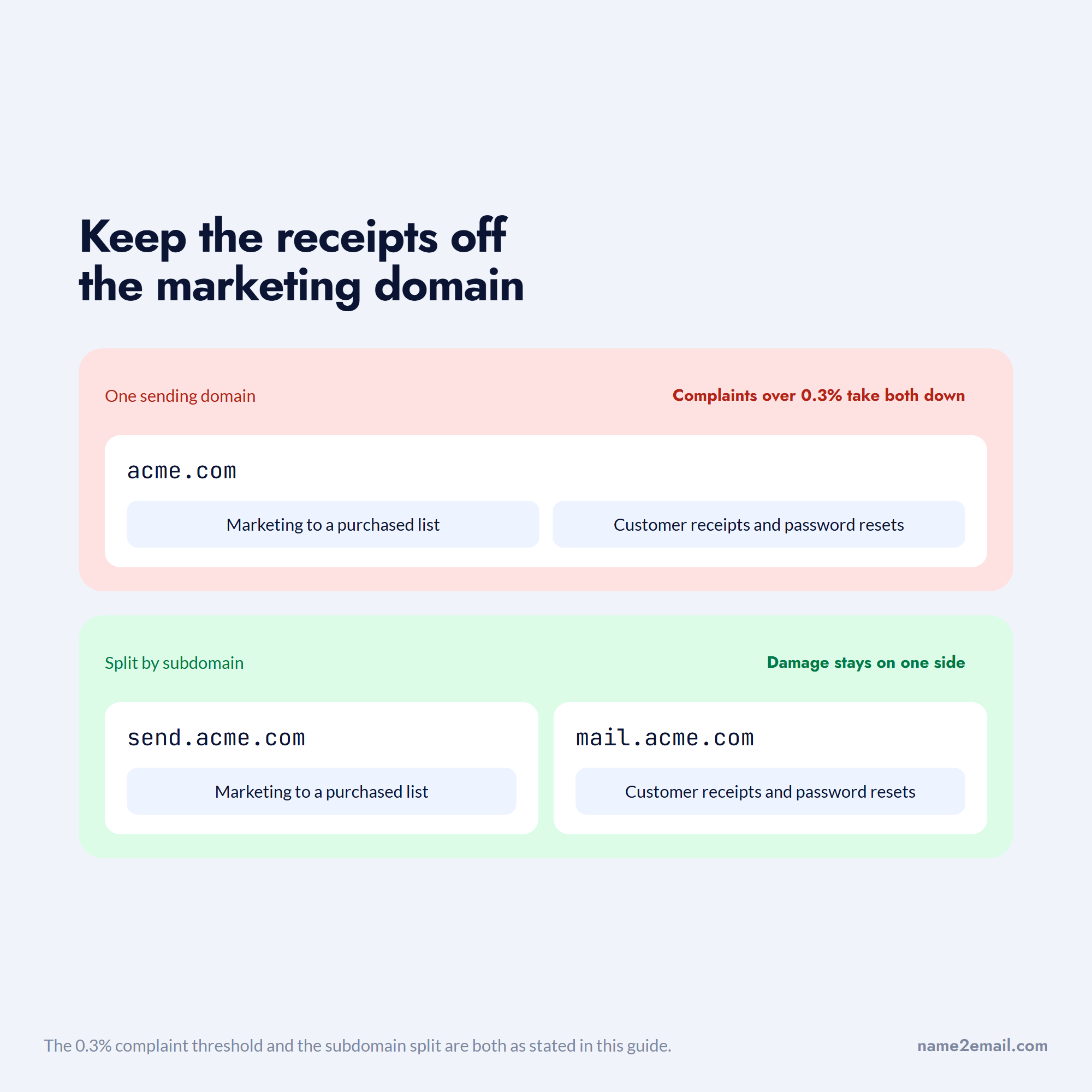
That last piece of advice is worth acting on regardless of whether you ever buy a list.
The Legal Position, Briefly
This is not legal advice, and the rules differ by jurisdiction more than most guides admit.
In the United States, the FTC's CAN-SPAM compliance guide sets an opt-out regime rather than an opt-in one, so a purchased list is not automatically unlawful under federal law. The requirements are concrete: accurate header and subject information, a valid physical postal address, a clear opt-out mechanism that stays live for at least 30 days, and opt-out requests honored within 10 business days. Each separate violating email carries penalties of up to $53,088, and both the sender and the company being promoted can be held responsible.
One provision matters specifically for list buyers: once someone opts out, you may not sell or transfer their address, even as part of a mailing list.
The EU and UK are stricter, and consent-based. UK guidance from the ICO on B2B marketing notes that while PECR's electronic-mail marketing rules do not apply to corporate subscribers, processing personal data for B2B marketing still falls under UK GDPR, including an individual's right to object to direct marketing. A named person at a company is personal data regardless of the address being a work one.
The two regimes ask for different things, and one file rarely satisfies both.
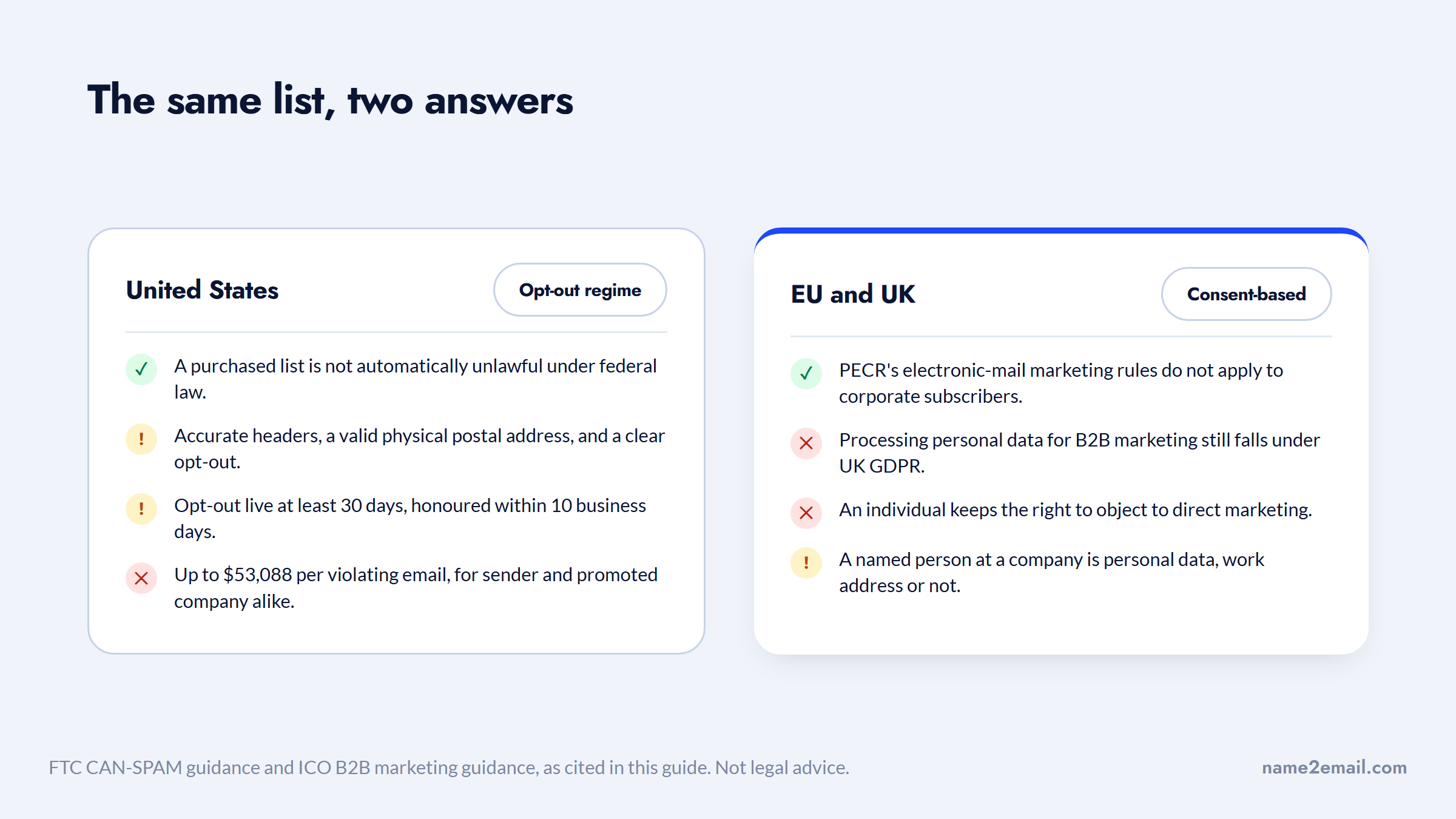
The practical consequence is that a list which is workable for US outreach may not be usable for the same contacts in Europe. If you sell into both, take proper advice rather than applying one standard to both.
Buying Versus Finding
The alternative to buying is building, and the right answer depends entirely on volume.
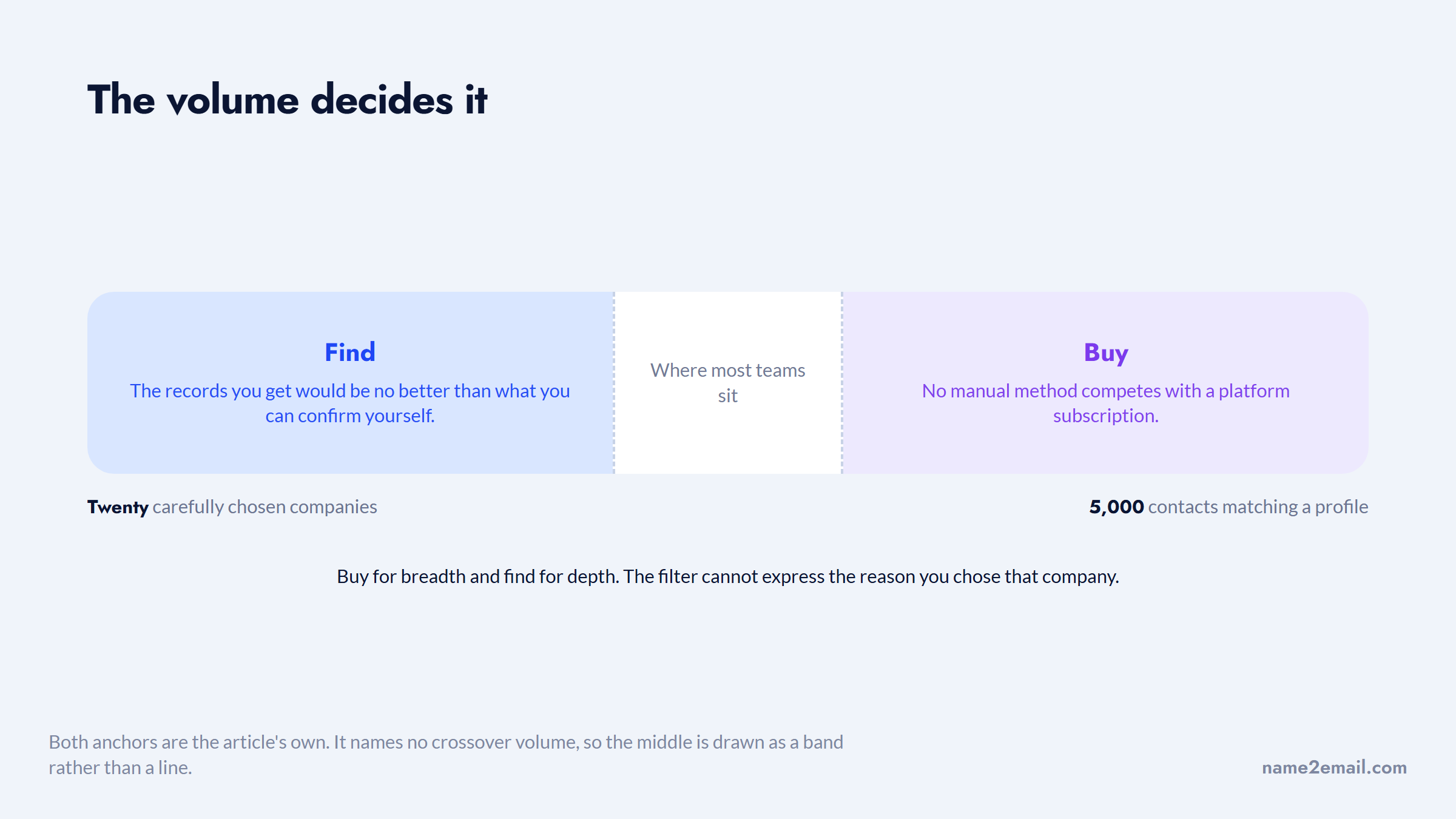
At scale, buying wins. If you need 5,000 contacts matching a specific profile this quarter, no manual method competes with a platform subscription, and the credit cost is lower than the labor cost of finding them one at a time.
At low volume, buying is poor value. If you are contacting twenty carefully chosen companies, a $49 monthly subscription to export twenty records is expensive, and the records you get will be no better than what you can confirm yourself.
There is also a quality difference that rarely shows up in vendor comparisons. Contacts you find deliberately, because you researched the company and identified the specific person, convert better than contacts pulled from a filter, simply because the targeting was better.
A useful way to decide is to price your own time. If a purchased contact costs roughly $0.20 to $0.50 through a platform subscription, and finding one manually takes two minutes, buying wins the moment your time is worth more than about $15 an hour, which it is. But that calculation assumes the purchased contact is as good as the found one, and for tightly-defined targets it usually is not, because the filter cannot express the reason you chose that company.
The split most teams land on is buying for breadth and finding for depth: a purchased list to cover a broad segment, and manual research for the twenty accounts that actually matter this quarter. Our guide on the best cold email software covers sending to the first group, and finding an email address covers building the second.
The two ends of that range are far enough apart that the choice makes itself.
For that low-volume case, Name2Email is free and unlimited. Type a name and company domain in Gmail's compose window, we generate the likely address formats, populate the "To" field, and you confirm by hovering, since Gmail shows the person's name and photo when it recognizes an address. No credits, no account, no card.
We are precise about what we are not. We are not a list source and not a bulk tool. We generate patterns from public naming conventions rather than selling records, we work best on corporate domains, and we cannot guarantee every address. If you need a list, buy one from the platforms above; if you need to reach a person you have already identified, that is our job. Our guides on finding an email address and the best email finding tools cover both routes.
If You Are Going to Buy, Do It This Way
The purchase itself is less important than the sequence around it.
Start with a sample rather than a volume. Take 100 records in your real target segment, verify them independently, and measure the bounce rate before spending anything substantial.
Warm the sending domain before it touches purchased contacts, and never send a first campaign to a purchased list from the domain that carries your customer email. Put marketing on a subdomain and keep transactional mail separate.
Send to a small batch first and watch complaint and bounce rates rather than opens. If bounces exceed roughly 3% or complaints approach 0.3%, stop and re-verify the rest of the file before continuing.
Verify before every send, not just at purchase, because records decay continuously. Our guides to verifying an address, email verification tools and email validation tools cover the tooling, and data enrichment tools covers repairing incomplete records you already hold.
And keep the list clean afterward rather than treating the purchase as the finish line, which is what email list management software is for. If you would rather skip the purchase for low-volume outreach, add Name2Email to Chrome and find addresses free, or see what it costs.
Frequently asked questions
In the United States, yes, with conditions. CAN-SPAM operates on an opt-out basis rather than requiring prior consent, so emailing a purchased list is not automatically unlawful, provided you use accurate headers and subject lines, include a valid postal address, offer a working opt-out, and honor opt-out requests within 10 business days. Penalties reach $53,088 per violating email. In the EU and UK the position is stricter, since individuals' data is protected regardless of a work address, so take jurisdiction-specific advice.
The best place to buy email lists is an established data platform rather than a list broker, because the data is continuously refreshed and the vendor has a reputation to protect. Apollo.io and Lead411 start at $49 per month, UpLead at $74 billed annually, and Cognism sells annual contracts with stronger European coverage. For raw data at scale, Coresignal sells API access from $49 per month and bulk datasets from $1,000. Whichever you choose, test a sample of 100 records before committing.
Self-serve platform subscriptions run roughly $49 to $199 per month with export volumes capped by credits, while enterprise data contracts typically run $15,000 to $45,000 or more per year. Bulk dataset licenses start around $1,000 per month. Broker files are usually quoted per thousand records and vary widely. Compare on cost per usable contact after verification rather than headline price, since a cheap file with a 20% bounce rate is more expensive than it looks.
Industry and job-role filtering is well supported by every major platform and is reliable. The option to buy email lists by zip code is available but weaker for B2B, because the postal field usually reflects a company headquarters rather than where an individual actually works, and remote work has made that mapping less meaningful. If location genuinely matters, filter by company location and confirm against the company's own site rather than trusting a purchased postal field.
Three main ones. Deliverability suffers because purchased lists contain invalid addresses and spam traps, which can get a domain blocklisted. Sender reputation degrades once complaint rates approach 0.3%, and that damage affects every future send including transactional mail. And most email service providers prohibit purchased lists in their terms, so uploading one risks account suspension. Verify a sample, warm the domain, keep marketing on a separate subdomain, and start with a small batch.

We build Name2Email, the free Chrome extension that finds work emails inside Gmail. We write about outreach, prospecting, and getting more replies.
Connect →