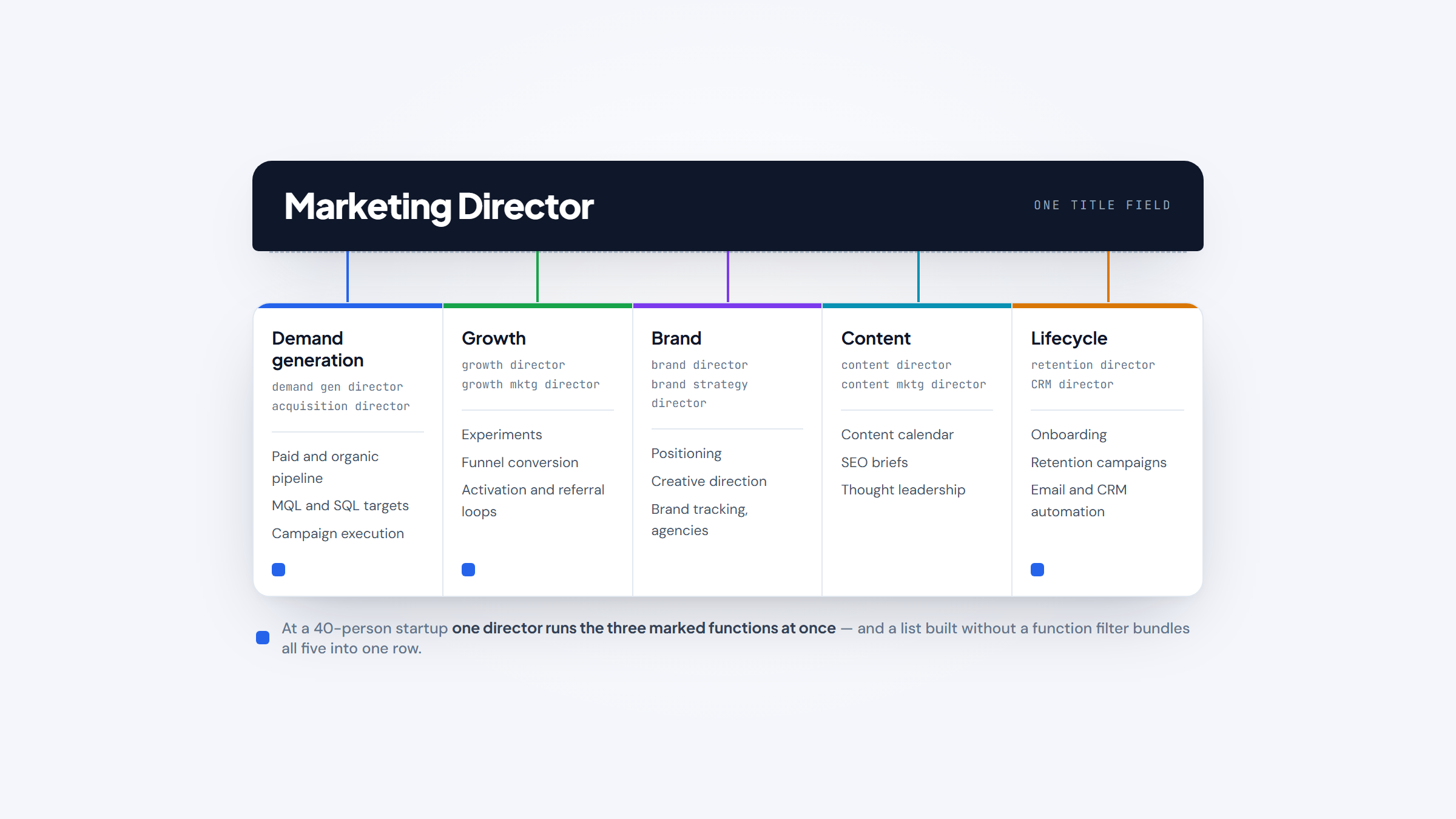
- 1"Marketing director" is not one job. It covers demand generation, growth, brand, content and lifecycle leaders, and each one is reached through a different source.
- 2The director usually runs the work while someone above signs the budget, so identify both the doer and the decision-maker before you write.
- 3You can build the list for free from leadership pages, press, job posts and event agendas, then confirm each address before it goes into a sequence.
- 4Only one vendor in this set publishes a marketing-director count, and any file starts aging the day it is exported. Treat every number as a sample to test.
A marketing directors email list sounds like one product you buy. The title actually splits into at least five jobs, and the person who owns demand generation has almost nothing in common with the director who owns brand.
That matters because the sourcing route changes with the function. A demand-gen director appears in campaign case studies and job posts. A lifecycle director appears in retention and CRM case studies. A brand director appears in agency and award announcements. One list that treats them as a single audience reaches none of them well.
This guide shows how to build the list yourself, function by function. It covers what each kind of director owns, who really controls the budget, where the names are published, and what the vendor market sells when you would rather buy.
You can start for free from the company's own pages, and our extension covers the last step where you already work.
Why "Marketing Director" Is Five Jobs Wearing One Title
Marketing titles drifted away from the work a long time ago. The same seniority appears as demand generation director, growth director, brand director, content director and lifecycle director, and the day-to-day of each is different enough that one email cannot serve them all.
The whole profession is smaller than the vendor market implies. The Bureau of Labor Statistics counts 454,800 advertising, promotions and marketing manager jobs in 2025, with a median wage of $165,780. That is every marketing manager in the country at every level, so no single job title inside it can be as large as the biggest vendor claim suggests.
The fragmentation is real to the people living it. One widely read Reddit thread asked marketers what their title was and what they actually did, and the answers share almost no pattern. A marketing specialist described owning "entire marketing strategy and execution," from tradeshows and paid search to CRM and packaging, while others at the same seniority ran a single channel.
That mismatch is why a title filter alone gives you a noisy list. You want to know which function the person owns, and that detail rarely sits in the job-title field. If you need the executive who owns the whole function instead, that is a different search, one we set out in the CMO list guide.
What Each Kind of Marketing Director Owns
The fix is to sort the market by function before you collect a single address. Each function has its own title variants, its own work, and its own budget line, and knowing them tells you where to look and what to say.
Function | Common title variants | What this director owns | Who signs the budget |
|---|---|---|---|
Demand generation | Demand gen director, acquisition director | Paid and organic pipeline, MQL and SQL targets, campaign execution | VP of Marketing, CMO |
Growth | Growth director, growth marketing director | Experiments, funnel conversion, activation and referral loops | VP of Growth, CMO |
Brand | Brand director, brand strategy director | Positioning, creative direction, brand tracking, agency relationships | CMO, VP of Brand |
Content | Content director, content marketing director | Content calendar, SEO briefs, thought leadership, freelancer bench | VP of Content, CMO |
Lifecycle | Lifecycle director, retention director, CRM director | Onboarding, retention campaigns, email and CRM automation | VP of Lifecycle, CMO |
Read the fourth column carefully, because it decides how you write. The director owns delivery and the plan, and the title one or two rungs above owns the money, which changes the pitch you send and the person you address.
Smaller companies blur the lines. At a 40-person startup one director may run demand generation, growth and lifecycle at once, and the table becomes a guide to what they are juggling rather than a clean division of labor. Ask which of the five the person actually spends their week on before you write; a list built without a function filter bundles all five into one row.
The Director Runs the Work, Not the Budget
The gap between running the work and holding the budget is the most useful thing to understand about this audience. A director can champion your product, run the pilot, and still have no authority to sign the contract.
The evidence sits in who the profession surveys. The CMO Survey, run by Duke University's Fuqua School of Business, sampled 260 marketing leaders and found that 97% of respondents hold a position at VP level or higher, which is the level where budget decisions live. The same survey found marketing spending grew 5.8% in a year, so the money is moving, just not through a director's approval.
That is why a director-focused list fits some messages and not others. A director is the right contact for a tool that makes their weekly work faster, a content collaboration, or an event invitation they can act on themselves. They are the wrong sole contact for a six-figure platform deal that needs a VP or a CMO to sign.
The practical reading: target the director to start the conversation, and expect to be handed upward for the signature. If your offer needs a budget holder from the first email, the executive list is the better list, and the CEO list guide covers how that person is found from public disclosures.
Source by Function, Not by Title
Once you know which functions you are targeting, the sourcing gets specific. Instead of filtering a database by the word "director," you go to the places where each function shows its work and read the name off the source.
Start with the function's public fingerprints:
- Demand-gen directors appear in ad-library entries, webinar panels and campaign case studies, named as the person who ran the program.
- Growth directors appear in experiment write-ups, pricing changelogs and conference talks about funnel tests.
- Brand directors appear in award shortlists, agency press releases and rebrand announcements.
- Content directors appear as bylines, podcast guests, editorial contributors and conference speakers.
- Lifecycle directors appear in retention and CRM case studies, plus webinar panels about email and onboarding.
Each entry on that list hands you a person, a company and a domain in one move, which is exactly the three things you need to build an address. The sourcing is slower than a filter, and it is also the only route that tells you which function the person owns.
Two shortcuts make it faster. A company's own case-study page usually names the marketing contact who ran the project, and a speaker list from a function-specific conference is a cross-section of titles in that niche. Both are public and free, and both beat a guessed list.
Let the Team Structure Tell You Who to Target
The same function sits in a different place depending on how the marketing team is built. Reading the team structure tells you who to contact and, often, how many people share the work.
Three structures cover most companies.
An in-house team with a VP over several directors is the clean case. Each function has an owner, the titles map to the table above, and the director is your entry point.
An agency-led team pushes execution outside the company, so the in-house director is often a reviewer and strategist while the agency holds the detail. A one-person marketing team collapses every function into a single person whose title may be manager rather than director.
For the one-person team, the title tells you almost nothing, so drop it as a filter. A company with 25 employees and a lone marketer is worth including if that person owns the budget for their own tools, and a company with 2,000 employees and one marketing director is almost certainly not.
Reading a team's shape from the outside is easier than it sounds. A careers page that is hiring a demand-gen manager reports the reporting line up to the director of demand generation. A LinkedIn company page lists the whole marketing team by title. Two minutes on those pages tells you whether the director is a doer with a team or a doer alone.
Where the Names Are Published
Most marketing director names are already public. They appear in a few predictable places, and knowing those places saves you from buying a list to rediscover what is free.
Source | What it gives you | How current | Cost |
|---|---|---|---|
Leadership or team page | Current marketing leaders and their reporting lines | Updated with the site | Free |
Case studies and customer stories | The named marketer who ran a project | As current as the story | Free |
Conference and webinar speaker lists | Titles, companies and functions in one place | Tied to the event | Free |
Job posts | The team's structure and who the role reports to | Live while posted | Free |
Press releases and awards | Appointments, promotions and rebrands | Same week as the news | Free |
LinkedIn company People tab | The team by title today | As current as profiles | Free |
Agency and partner pages | The in-house client contact on joint work | As current as the page | Free |
Treat the surfaces as a stack you check in order rather than a single lookup, and read them the way you would read any company profile, a practice we break down in company research tools. The company's own pages are the most reliable, and the event and award lists are the fastest way to see several directors at once.
One caveat sits under all of them. A team page shows who is listed today, not who holds the seat, so confirm the person is still in the role before you commit to an address.
Turn a Name and a Domain into a Confirmed Address
With a name and a company domain, you can build a strong candidate address from the pattern most companies use. The pattern is a convention rather than a rule, so treat every result as a guess until you confirm it.
Try the formats in this order, stopping when one confirms:
- first@domain.com, the most common format at smaller companies.
- first.last@domain.com, common at larger firms.
- f.last@domain.com, frequent in finance and consulting.
- firstlast@domain.com, no separator, still widely used.
- last@domain.com, seen at small and owner-led firms.
Borrow the shape from any address you can confirm at the domain, then apply it to your person. One known employee at the company gives you the pattern for the marketing team. When the standard patterns miss, the wider set of email finding tools is where most people widen the search.
Confirming the winner is the step people skip, and it is the one that keeps a guess out of your sequence. This is where our extension earns its place.
Name2Email is our free Chrome extension, built by the team at Reply.io, and it generates the likely patterns inside the Gmail compose window you are already using. Enter the name and domain, hover each suggestion, and a recognized contact fills the card with a photo and the person's name. The how it works walkthrough runs the whole thing in about a minute.
We are honest about where we help less. Our suggestions come from public naming conventions rather than a stored record, so a corporate domain is our best case and a personal mailbox is not. Lifecycle directors who work from a role inbox such as retention@ or lifecycle@ are also a weaker fit, because pattern-based finding needs a named person on a company domain.
What a Ready-Made Marketing Directors List Costs
A ready-made list is a real product, and the market splits between vendors that publish a marketing-director count and vendors that hide it behind a quote. The pricing models matter more than the row counts, so the table lists what each charges and what it actually publishes about this title.
Vendor | Model | Price (from) | Publishes a marketing-director count? |
|---|---|---|---|
Reply.io | Platform with a bundled database | $59/user/mo | No; 1B+ contacts bundled in the platform |
UpLead | Pre-built file plus contact database | $9,999 one-time for 216,548 directors (plans from $99/mo) | Yes: 216,548 verified directors |
ListKit | All-in-one cold email platform | $97/mo | No; claims triple-verified business contacts |
Cognism | Sales intelligence platform | Quote-only | No |
ZoomInfo | Enterprise B2B database | Quote-only | No published count |
Reply.io builds Name2Email, so we disclose that here rather than rank it first in silence. Its contact database sits inside the platform and is not sold as a standalone file, it has no free plan, only a 14-day trial, and its delivery figures are self-reported.
The counts also fail to reconcile neatly. UpLead is the only vendor in this set publishing a hard US number, and its 216,548 marketing directors against the BLS figure of 454,800 marketing managers is roughly half the category, which is at least plausible. No other vendor here publishes a marketing-director count, so a quote gives you volume on faith.
If a vendor advertises a free marketing directors email list, treat the sample as the only honest part of the claim. We are not a list builder, and Name2Email is not a database, so nothing here is a shortcut around a vendor file you would still have to check.
Check a File Before You Trust It
A bought file is not a finished list, and a short check before you send saves your domain reputation. Run this sample test on any file or export before it joins a live campaign.
- Pull a random sample of 100 rows and check each name against the company's current team page.
- Note how many people have left the role, and divide by the sample to estimate the file's real accuracy.
- Send the sample through a verifier and record the bounce rate.
- Check for the wrong executives, since director files often arrive padded with managers, VPs and coordinators.
- Look for missing domains, personal addresses and role inboxes before you trust the format.
The sample test is the only honest way to judge a count you cannot see the inside of. A file that loses a quarter of its rows on the first check is not a discount, and the check costs a few minutes rather than a budget. The methods in how to verify an address pick up where a manual test stops.
Refresh cadence is the second question to ask. A director who changed jobs in June sits in a September file with no outward signal, so ask the vendor how it learns about a change, not how many rows the file holds.
A Repeatable Workflow from Function to Inbox
Here is the whole method in the order it pays off, from a target account to an address you can trust.
- Pick the account and decide which function you are going after: demand generation, growth, brand, content or lifecycle.
- Read the team page and the company's case studies to find the director who owns that function.
- Confirm the person holds the seat today with the newsroom and their LinkedIn profile.
- Note who signs the budget above the director, so you know where the conversation will be handed.
- Find one known address at the domain, infer the pattern and build two or three candidates for your person.
- Hover each candidate in Gmail's To: field, and keep the one that shows a name and photo.
- Write to the director with one specific reason tied to their function, and keep the decision-maker in view for the second step.
The sequence matters more than any single trick. Deciding the function in step one is what keeps the list from filling with directors who have nothing to do with your offer.
When a Marketing Directors List Is the Wrong Tool
Not every campaign needs this list, and the honest answer depends on the offer. A director list is worth building when your message maps to one function's weekly work and the deal is small enough for a director to act on.
It is the wrong list for a large platform deal that needs a budget holder at the first touch, and it is the wrong list if you intend to send at volume. A stale record wastes the send and dents the domain, and bought data carries its own legal questions.
The market and legal picture for purchased contact data is its own decision, one we lay out in buying email lists. Where this method earns its keep is the middle: a few hundred accounts where you can name the right function owner, filtered to the team structures that act, and confirmed before you send. That beats a thousand unverified rows every time.
Build a Marketing Directors Email List from Names You Can Confirm
A usable list is not a file you download and send. It is a function you have chosen, a name confirmed from public sources, an address tested before you write, and a note about who signs above the director.
Do those steps in order and the list stays small and accurate. The function decides where you look, the team structure decides who you contact, and a confirmation step keeps a guess from becoming a bounce.
Name2Email handles that last step where you already work. Confirm the function owner from the company's own pages, then let our extension settle the address without leaving the draft. It is free, it needs no signup, and it favors a corporate domain over a personal one. Add to Chrome and check the next name you are about to write to.
Frequently asked questions
It is either a contact file sold by a data vendor or a list you assemble yourself. Either way it covers the leaders who run a marketing function: demand gen, growth, brand, content or lifecycle. The useful version names the function each person owns, because a list filtered only by a title field mixes five different jobs into one file.
There is no free and complete list of marketing director emails, and a vendor that claims one is selling a sample. The free route is to build it: the company's team page gives you the name, its case studies and job posts show which function the person owns, and a pattern guess plus a confirmation step gives you the address at no cost.
Start with each company's own team page and customer stories, then cross-check event speaker lists and press releases. For a ready-made option, UpLead publishes 216,548 verified marketing directors for $9,999, the only hard national figure in the set we checked. A US marketing directors email list is otherwise assembled company by company.
A sales marketing director runs the marketing that supports sales: enablement content, ABM programs and pipeline campaigns. That is a sixth function alongside demand generation, so a sales marketing directors email list is sourced from sales-enablement case studies and revenue-team pages rather than the demand-gen material most people start with. Building a sales marketing directors email list starts with the sales-marketing function owner, not the general marketing team.
Only when a director can act on the deal without a signature above them, and you plan to work a few hundred accounts rather than a mass send. A marketing directors email list database starts aging at export, so pull a hundred-row sample, check the names against current team pages and verify the sample before you send. Building from public sources avoids the decay entirely.

We build Name2Email, the free Chrome extension that finds work emails inside Gmail. We write about outreach, prospecting, and getting more replies.
Connect →