- 1Every company names its CEO somewhere public, which makes the person easy to find and their inbox unusually hard to reach.
- 2You can name the right CEO for free from the company's own pages, its press coverage, and its filings, but you have to confirm who holds the seat today.
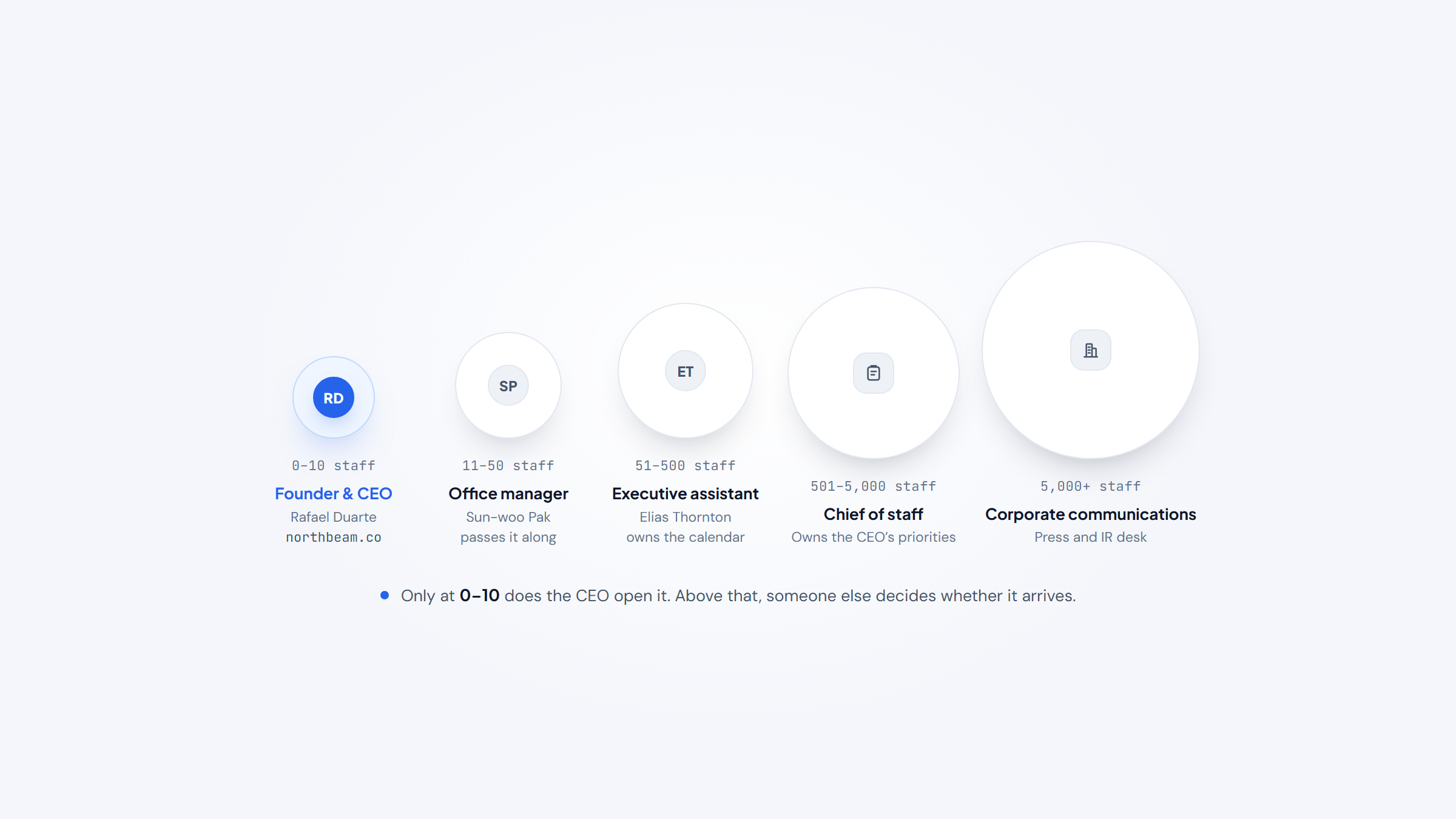
- 3Company size decides the route: at a 12-person firm the CEO answers the email, and at a 12,000-person firm an executive assistant decides whether it arrives.
- 4A pattern guess is a hypothesis. Confirm it before you send, because a bounce costs more than a missed message.
A CEO email list sounds like something you download. In practice it is a short research habit repeated for each company you care about, because the CEO is the executive whose name is almost always public and whose address is almost always filtered.
You can start for free. The company's leadership page names the person, a press release confirms the appointment, and the domain's pattern gives you a candidate address. The real work is deciding which source to trust, matching your method to the size of the company, and confirming the address before the message leaves your outbox.
This guide walks that order. It covers where CEOs are published, how the company's size changes who actually reads your email, what the vendor market charges for a ready-made file, and where our extension fits as a finder rather than a list.
Why the CEO Is Both the Most Public and the Most Guarded Executive
Two facts sit on top of each other, and the tension between them is the whole problem. The CEO is the most publicly identified executive at nearly every company, and once the company gets large, the most shielded from cold outreach.
The population is smaller than the vendor market suggests. The U.S. Bureau of Labor Statistics puts the median chief executive wage at $213,990, and O*NET counts about 309,400 chief executives nationwide. That is the whole country, not one industry, and it is worth holding in mind when a vendor offers you a million CEO contacts.
Response rates fall as the company grows. In Belkins' 2026 study of 7.5 million cold emails, C-level executives replied at 0.42%, against 0.57% from founders and owners. Split by company size, firms with 10 or fewer staff replied at 0.72%, while firms with 10,000 or more replied at 0.22%.
Other seats behave differently, and so does the source of their names. A chief financial officer is named in filings on a fixed schedule, a distinction we work through in the CFO list guide, while a private company's CEO may never appear in a public document at all.
Confirm Who Holds the CEO Title Today
Before you research an address, confirm that the person is still in the seat. A CEO email address list starts with the name, not the address, because CEO turnover is constant and much of it never reaches a public filing.
Challenger's 2025 turnover report tracked 2,032 CEO departures across U.S. companies, down 9% from 2,221 the year before. Publicly traded companies set a record with 446 exits, and government and non-profit organizations led all sectors with 427.
The seat also changes names. The BLS notes that chief executives are also titled executive director, managing director, or president, and that school districts, universities and government bodies have CEOs of their own. Search those synonyms before concluding a company has no CEO.
Three sources settle the question fastest. Open the company's leadership or About page first, then read its newsroom for an appointment or departure release, then check the CEO's LinkedIn profile for a current employer line. When all three agree, you can move on to the address.
Where a CEO's Name Is Published Before You Look Anywhere Else
Most of what you need is already public, and knowing the surfaces saves you from guessing. A CEO's name appears in a handful of predictable places, and each one tells you something slightly different about how current it is.
Source | What it gives you | How current | Cost |
|---|---|---|---|
Leadership or About page | The current CEO's name, and often the rest of the team | Updated with the site | Free |
Newsroom or press releases | Appointment, departure, and interim announcements | Same week as the change | Free |
Annual report or proxy filing | The CEO who signed, at public companies | Tied to the filing date | Free |
LinkedIn company People tab | The person listing the title today | As current as the profile | Free |
Conference agenda or trade press | The CEO speaking, plus the employer | Event-dependent | Free |
Local business journal or awards list | Small and mid-market CEOs | Monthly | Free |
Private companies are the harder half, because no rule forces them to announce a leadership change. One widely upvoted comment in an r/salestechniques thread put it plainly: public companies have to name their leadership, so the correct name is usually findable, while "the harder version is private mid-market where there's no public record of who actually runs what function."
Treat those sources as a stack you check in order, not a single lookup. Reading a company's own pages is its own discipline, one we break down in company research tools, and it is the step that keeps the rest of the list honest.
Match the Route to the Size of the Company
The same job title means a different kind of target depending on headcount. A 12-person firm and a 12,000-person firm both have a CEO, but the person, the gatekeeper and the working method change completely.
Company size | Who the CEO is | Who stands in the way | Route that works |
|---|---|---|---|
0-10 employees | Often the owner or founder, and the buyer | No one, usually | Write directly to the person |
11-50 employees | Founder or a first professional CEO | A shared inbox or office manager | Person's address, or a role inbox |
51-500 employees | A hired CEO with an assistant | An executive assistant | Assistant first, or a routed ask |
501-5,000 employees | A CEO with a chief of staff | Chief of staff or EA | Multi-threaded, with a warm detail |
5,000+ employees | A CEO with a press and IR desk | Corporate communications | Referral or a routed message |
At the small end, this is close to a warm market. A company of 0 to 10 employees replies at more than three times the rate of one with 10,000 or more, in the Belkins data, so a straight, specific email to a small firm is a reasonable opening move rather than a long shot.
At the large end, plan for a gatekeeper and for a longer sequence. The same data shows enterprise reply rates around 0.22%, which is not a reason to skip big accounts, only a reason to expect that one email will not do the job.
Read the Gatekeeper Before You Write
The gatekeeper is not an obstacle to defeat. They are a reader you have to convince. An executive assistant decides what reaches the CEO's calendar, and at many large companies the assistant also owns the inbox filter.
Write to the assistant as a peer, with a one-line reason the message is relevant. Name the CEO and the specific business trigger you noticed, such as a new funding round or a plant opening, and ask whether they are the right person to route it to. That question costs nothing and often gets a direct answer.
Inside larger firms there is a second layer. A chief of staff owns the CEO's priorities, and corporate communications owns anything that looks like a pitch to the press. If your message is about a partnership or an investment, the chief of staff is the more useful first contact than the CEO's direct line.
One practical route sidesteps the guessing entirely. Many companies publish a role address on the contact page, and a short, well-labeled note to it, with the CEO's name in the subject line, gets forwarded by the person who reads that inbox.
Turn a Name Into an Address with the Domain Pattern
With a confirmed name and a company domain, you can build a strong candidate address from the pattern most companies use. The pattern is a convention, not a rule, so treat every result as a guess until you confirm it.
Try the formats in this order, stopping when one confirms.
- first@domain.com, the single most common format at smaller firms.
- first.last@domain.com, common at larger companies.
- f.last@domain.com, common in finance, law and consulting.
- firstlast@domain.com, no separator, still frequent.
- last@domain.com, seen at small and owner-led firms.
Borrow the shape from any address you can confirm at the domain, then apply it to the CEO's name. One known employee gives you the format for everyone else at the company.
That shortcut has a real failure mode, and it hits executives hardest. In the same Reddit discussion, another practitioner warned that companies often have at least one exec whose address is firstname@domain rather than the first.last format the rest of the org uses, and that it is "always the one you most need to reach."
A borrowed pattern is a strong hint, never a fact. When the standard patterns fail, the wider set of email finding tools is where most people widen the search.
Confirm the Address Before the Message Leaves
A candidate is not a confirmed address, and the difference is worth a minute of your time. A wrong guess bounces, and a run of bounces tells the mailbox providers that you send to addresses nobody owns.
Gmail does the confirming for you. Add the candidate to a new message's To: field and rest the pointer on it: a recognized contact fills the card with a photo and the person's name, while an empty card means the format is wrong and the next pattern is worth a try.
Run this short check before anything leaves your outbox.
- Hover the address and confirm a name and photo appear.
- Check that the name matches the person you meant, not a namesake.
- Confirm the domain is the company's, not a personal mailbox.
- Try the next pattern if the hover card stays empty.
- Verify at scale with a dedicated tool rather than one hover at a time.
One message at a time, that check covers you. Once several addresses are in play, a bulk check is the better use of your time, and the methods in how to verify an address pick up where a manual hover stops.
What a CEO Email List Actually Costs
A ready-made CEO email list is a real product, and prices are published for some vendors and hidden for others. Every vendor below sells a CEO email address list on a different model, and those differences matter more than the row counts. The table lists what each one charges and, more usefully, what it actually publishes about CEOs.
Vendor | Model | Price (from) | Publishes a CEO count? |
|---|---|---|---|
Reply.io | Platform with a bundled database | $59/user/mo | No CEO count; 1B+ contacts bundled in the platform |
Hunter.io | Free list builder plus database | $0, then $49/mo ($34 annual) | No published CEO total |
ReachStream | Contact database | $0, then $29/mo annual ($39 monthly) | 1M+ CEO contacts, 675K+ US |
Apollo | Contact database plus outreach | Free, then paid tiers | No published CEO total |
Lusha | Contact database | Free, then paid tiers | No published CEO total |
Saleshandy | Lead finder plus sequencing | Free trial, 50 credits | 2M+ CEO contacts, 42M+ companies |
Reply.io builds Name2Email, so we disclose that here rather than rank it silently. Its 1B+ contact database sits inside the platform and is not sold as a standalone file, it has no free plan, only a 14-day trial, and its delivery figures are self-reported.
If a vendor advertises a free list of CEO email addresses, treat the sample as the only honest part of the claim.
The counts also do not reconcile neatly. ReachStream publishes 675K+ U.S. CEO contacts, against the roughly 309,400 chief executives O*NET counts, and Saleshandy's 2M+ figure is global. Titles and occupations are counted differently, so treat any vendor count as a marketing number to test with a sample, not a fact to plan around.
Why a File You Buy Today Is Wrong by Spring
A purchased CEO file starts aging the moment it is exported, because leadership changes without a public clock. Challenger recorded 446 CEO exits at public companies in 2025, but the other 1,586 exits, at private and non-profit organizations, were under no obligation to announce anything.
That is the difference between a CEO record and most other B2B records. A license expires on a known date and the file tells on itself, while a CEO record gives no such signal. A contact who left in March can sit in a list sold in September with no outward sign at all.
Refresh cadence is where the vendors differ. ReachStream says it refreshes records every 45 days, Hunter verifies an address against the mail server at the moment you reveal it, and a static CSV has no refresh date beyond its export. When you compare two files, ask how the vendor learns about a change, not how many rows it has.
Build It Yourself: A Step-by-Step Route from Name to Inbox
Here is the whole method in the order it pays off, from a company you want to reach to an address you can trust.
- Pick the company, then read its leadership page to get the CEO's name and current title.
- Confirm the seat by checking the newsroom and the CEO's LinkedIn profile against the page.
- Read the company's size, and note whether an assistant, a chief of staff or a communications desk stands in the way.
- Find one known address at the domain, then infer the pattern and build two or three candidates for your person.
- Hover each candidate in Gmail's To: field, and keep the one that shows a name and photo.
- Write to the gatekeeper or the person, whichever the size table pointed to, with one specific reason you are writing.
The sequence matters more than any single trick. Doing steps one through three before you guess at an address is what keeps a CEO email list from filling up with people who left last quarter.
Find the CEO's Address Without Leaving Gmail
The address is the one thing left to get right, and that is where we help. Name2Email is our free Chrome extension, built by the team at Reply.io, and it finds a work email inside the compose window you are already typing in.
The flow matches the method above. Enter the name and the company's domain, and our suggestions appear in the To: field as likely formats. Rest on each one, and the correct address announces itself with the person's name and photo, which means no research tab and no broken concentration.
We are honest about where we help less. Our guesses come from public naming conventions, not a stored record, so a corporate domain is our best case and a personal mailbox is not. Some executives use a format no pattern predicts, and for those the company's own pages remain the better bet.
We are also not a list builder, and Name2Email is not a database. It finds one person at a time, the one whose name you just confirmed, with no account and no credits to burn. The how it works walkthrough shows the whole thing in about a minute.
Should You Build One at All
Not every campaign needs a CEO list, and the honest answer depends on deal size. A short list of named CEOs at companies you genuinely fit is worth the research, because the value per conversation is high and the population is small enough to work by hand.
A long CEO email list is a different bet. At enterprise scale the reply rate in the Belkins data is 0.22%, and a stale record wastes the send and dents your domain.
If your plan is volume, the research habits in this guide will not rescue it, and the market and legal picture for bought data is its own decision we lay out in buying email lists.
Where the method earns its keep is the middle. A hundred companies you can name the CEO for, filtered to the sizes that actually reply, and confirmed before you send, beats a thousand unverified rows every time.
Build the List from Names You Can Confirm
A CEO email list is not a file you buy and send. It is a name confirmed from public sources, an address tested before you write, and a route that respects who actually reads the inbox at that company.
Do those three things in order and the list stays small and accurate. The company's own pages and press do the discovery, the size of the company tells you who to address, and a confirmation step keeps a guess from becoming a bounce.
Name2Email handles that last step where you already work. Confirm the name on the leadership page, then let our extension settle the address without leaving the draft. It is free, it needs no signup, and it favors a corporate domain over a personal one. Add to Chrome and check the next name you are about to write to.
Frequently asked questions
It ranges from free to a few hundred dollars a month. Hunter, ReachStream and Lusha all have free tiers, then paid plans from roughly $29 to $49 a month for a single seat. A pre-built CEO data file is usually priced on request, and quote-only vendors will not show a number until you ask. Building your own from public sources costs nothing but time.
There is no free, complete list of CEO email addresses that anyone can hand you, and you should distrust one that claims to be. The free path is to assemble the names yourself from leadership pages, press releases and filings, then find each address. Hunter's CEO tool is free to start at 50 credits a month, and our own extension generates and confirms addresses in Gmail at no cost.
Start with the company's leadership page for the name, its newsroom for a current appointment, and a public filing for a public company. A list of company CEO email addresses is built company by company rather than downloaded, because no register lists every CEO. Once you have the name, the rest is a confirmation job rather than a discovery job, and LinkedIn's company People tab is the fastest cross-check that the title is still current.
Yes, with one adjustment. Hospitals name their leadership on the system's website and in trade press, and hospital CEOs have their own turnover pattern, with Challenger counting 111 hospital CEO exits in 2025. Health systems also group under a parent organization, so confirm whether you want the hospital's CEO or the system's CEO before you start.
The sourcing differs more than the outreach. A public company must name its CFO in filings on a schedule, so a CEO and CFO email list built for the same account reaches the CFO through documents and the CEO through the website and press. Both then meet the same last mile: a named person whose actual address still has to be confirmed before you send.

We build Name2Email, the free Chrome extension that finds work emails inside Gmail. We write about outreach, prospecting, and getting more replies.
Connect →