- 1Roughly 31% of S&P 500 companies have no chief marketing officer at all, so a third of your target accounts cannot appear in a CMO list no matter how good the data is.
- 2One provider publishes its own title breakdown and shows that only 492,118 of its 984,234 "CMO contacts" actually carry the title. The rest are VPs, directors and heads of marketing.
- 3"CMO" means chief medical officer to a large part of the market, and a chief medical officer list ranks on the first page for this exact search.
- 4Published counts across four vendors run from 41,673 to 984,234, a 24x spread, and one vendor's page title overstates its own on-page number by a factor of a thousand.
Buying a CMO email list assumes two things that are often false: that the companies you want have a CMO, and that everyone selling you one means the same job. Neither holds, and the gap between them explains why campaigns aimed at this title underperform so consistently.
This guide covers what the acronym actually refers to, how to check whether a target company has the role before you go looking for the person, and how to build a list around the marketing leader who exists rather than the title you hoped for.
Two Different Jobs, One Acronym
Search "cmo email list" and among the marketing-data vendors you will find ReachStream ranking a chief medical officer email list on the same first page. That is not a mistake on their part. CMO is a standard abbreviation for chief medical officer across healthcare, and a hospital system uses it that way exclusively.
The practical consequence arrives when you buy. A vendor that scraped title strings without disambiguating will hand you a CMO email address list mixing marketing executives with hospital clinical leadership, and the tell is usually a suspiciously high proportion of healthcare organizations in a list you expected to be full of consumer brands.
Ask any provider selling a CMO email address list which CMO they mean, in writing, before money moves. It is a fair question and the answer tells you a lot about how the file was built.
A Third of Large Companies Do Not Have One
The single most useful fact about this market comes from Spencer Stuart, which has tracked the role for more than twenty years. Its CMO tenure research found that roughly 31% of S&P 500 companies do not have a chief marketing officer, in line with historical averages.
The gap is not evenly spread. Only 53% of industrial companies have a CMO, and 56% of healthcare companies, which Spencer Stuart attributes to business-unit-driven commercial models in one case and regulatory constraints in the other.
By industry the hole is much bigger than the headline third suggests.
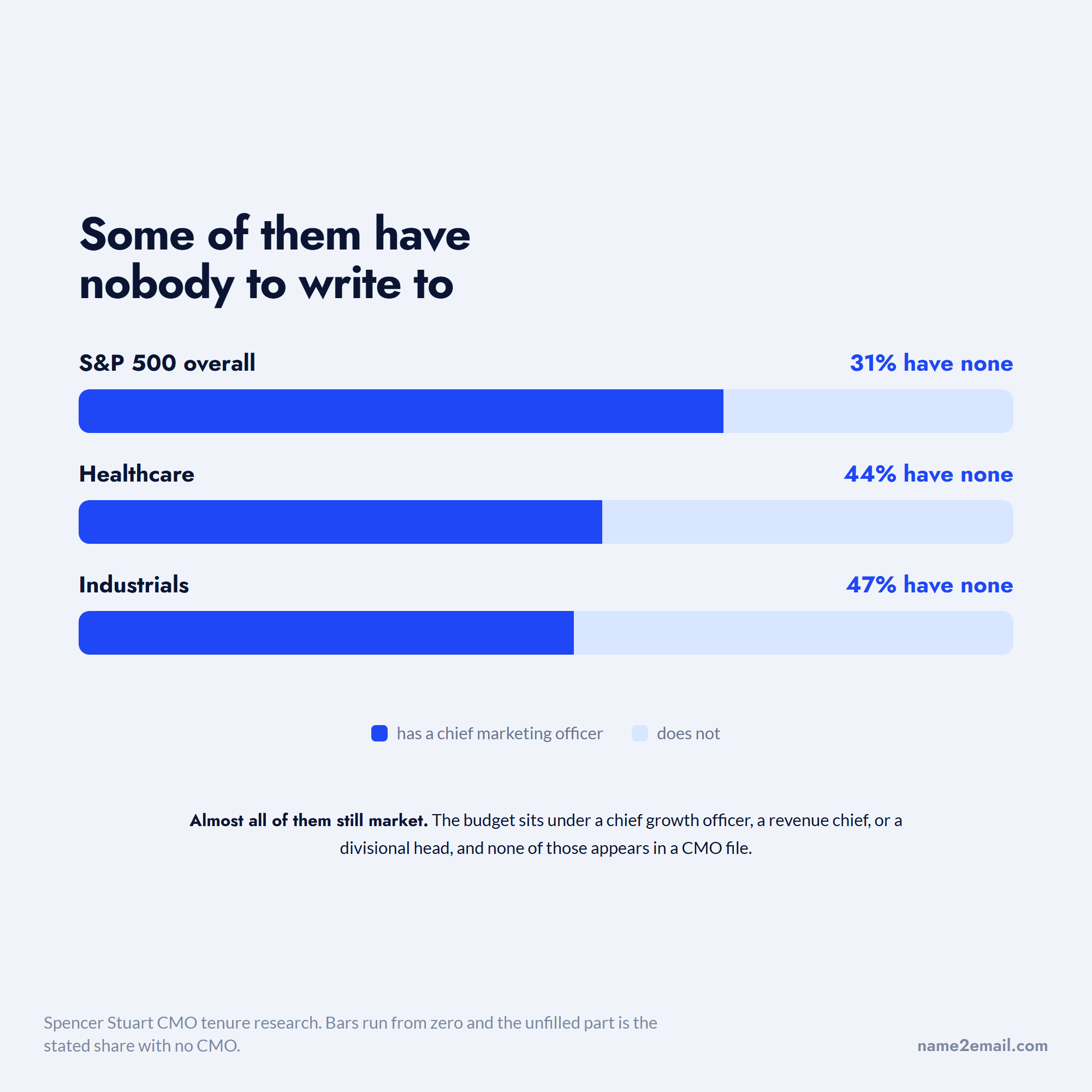
Most of those companies still market. The responsibility simply sits elsewhere, under a chief growth officer, a chief revenue officer, a divisional marketing head, or split across business units with no single owner. None of those people appear in a file filtered on CMO, and all of them control marketing budget.
What the Vendors Count
Here is what each provider publishes, taken from the page itself rather than the search result, which matters more here than in most categories.
Provider | Published CMO count | Scope | Published price | Worth knowing |
|---|---|---|---|---|
Reply.io | None for CMOs | Global, all industries | From $59/user/mo | Its 1B+ database is bundled inside the outreach platform, not sold as a standalone CMO file |
ELP Data | 984,234 | Global, with a regional split published | Quote only | Publishes a title breakdown showing 50% carry the CMO title |
DMValid | 80,000+ on the page | Not stated | Quote only | Its page title advertises "80,436K+", a thousandfold overstatement of its own on-page figure |
AverickMedia | 41,673 | Not stated | Quote only | The count renders only in JavaScript and is invisible to text scraping |
eSalesClub | 74,000 global, 60,000 US | Global and US stated separately | Quote only | Also sells CFO, COO, CRO and CISO files at similar scale |
Data Maelumat | None published | Not stated | Quote only | Claims 150+ industries served and 7,000 data projects delivered |
The four providers that publish a number range from 41,673 to 984,234, a spread of about 24 times for the same job title in overlapping markets. eSalesClub's 60,000 US figure and AverickMedia's 41,673 are at least the right order of magnitude for people literally titled CMO in America. ELP Data's 984,234 is a much broader definition, and to its credit the company says so.
Not one of the five list specialists publishes a price, which is normal for managed list building and worth planning around, since a quote-only market means you cannot compare cost until you have already handed a vendor your requirements and your contact details. The questions worth asking in that call are in our guide to buying email lists.
Reply.io sits at the top of the table because it is the company that built our extension, and it is one of two rows here that publish no CMO count at all, alongside Data Maelumat. In our case the reason is that it sells outreach software rather than a marketing-leadership file. We would rather disclose that relationship than let a bundled database size read as a CMO count.
One Vendor Shows Its Work
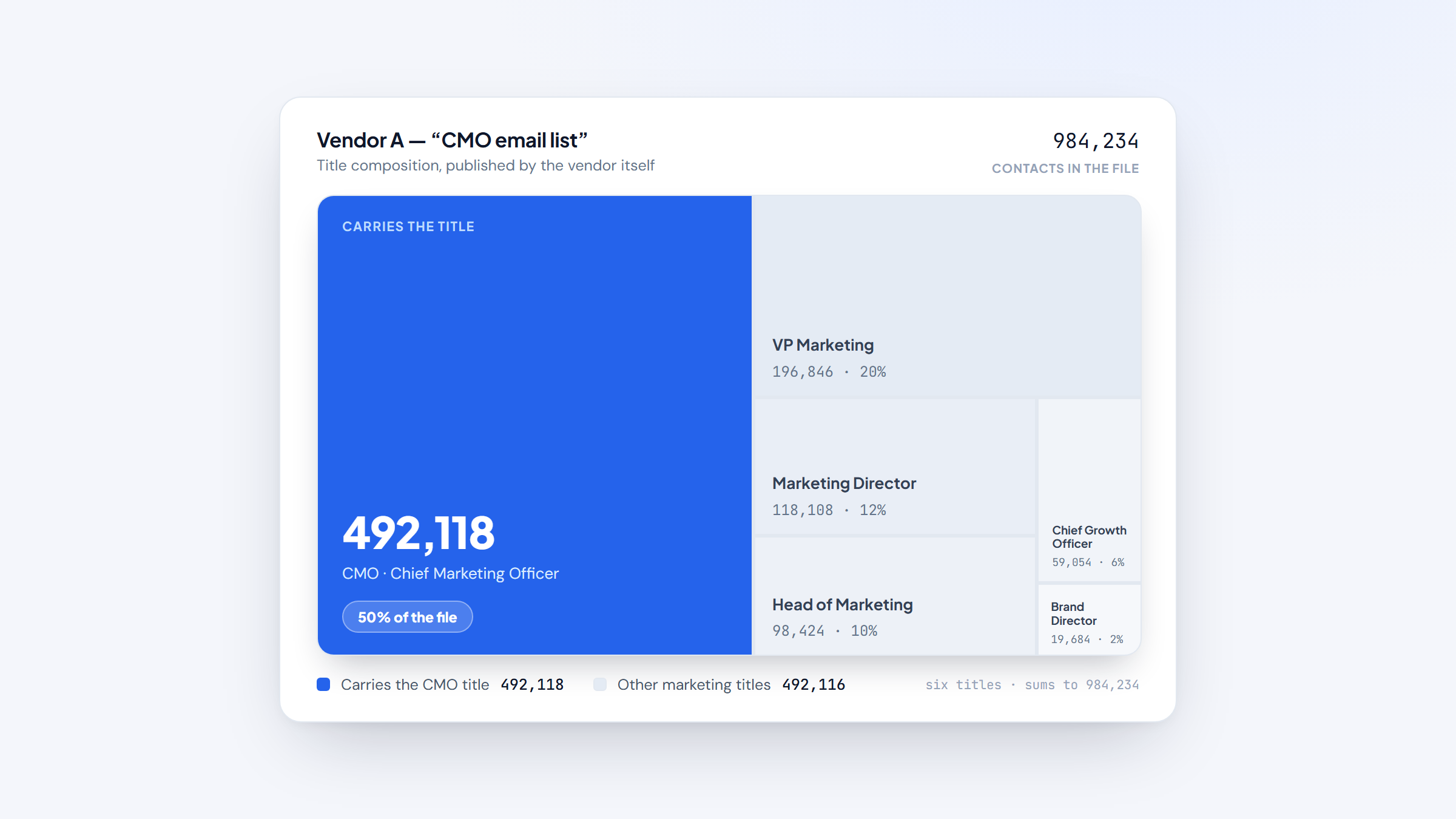
ELP Data does something no other provider in this category does: it publishes the title composition of its own CMO list. The result is the clearest argument in this guide.
Title in ELP Data's "CMO email list" | Contacts | Share |
|---|---|---|
CMO or Chief Marketing Officer | 492,118 | 50% |
VP Marketing or Vice President of Marketing | 196,846 | 20% |
Marketing Director or Director of Marketing | 118,108 | 12% |
Head of Marketing or Global Head of Marketing | 98,424 | 10% |
Chief Growth Officer or Chief Revenue and Marketing Officer | 59,054 | 6% |
Brand Director or Marketing and Communications Director | 19,684 | 2% |
Half of a file sold as a CMO list is not CMOs. That is not a criticism of ELP Data, which disclosed it voluntarily while its competitors publish a single blended number and say nothing. It is a description of what every file in this category almost certainly looks like underneath.
Drawn as one bar, the half that carries the title stops being a statistic.
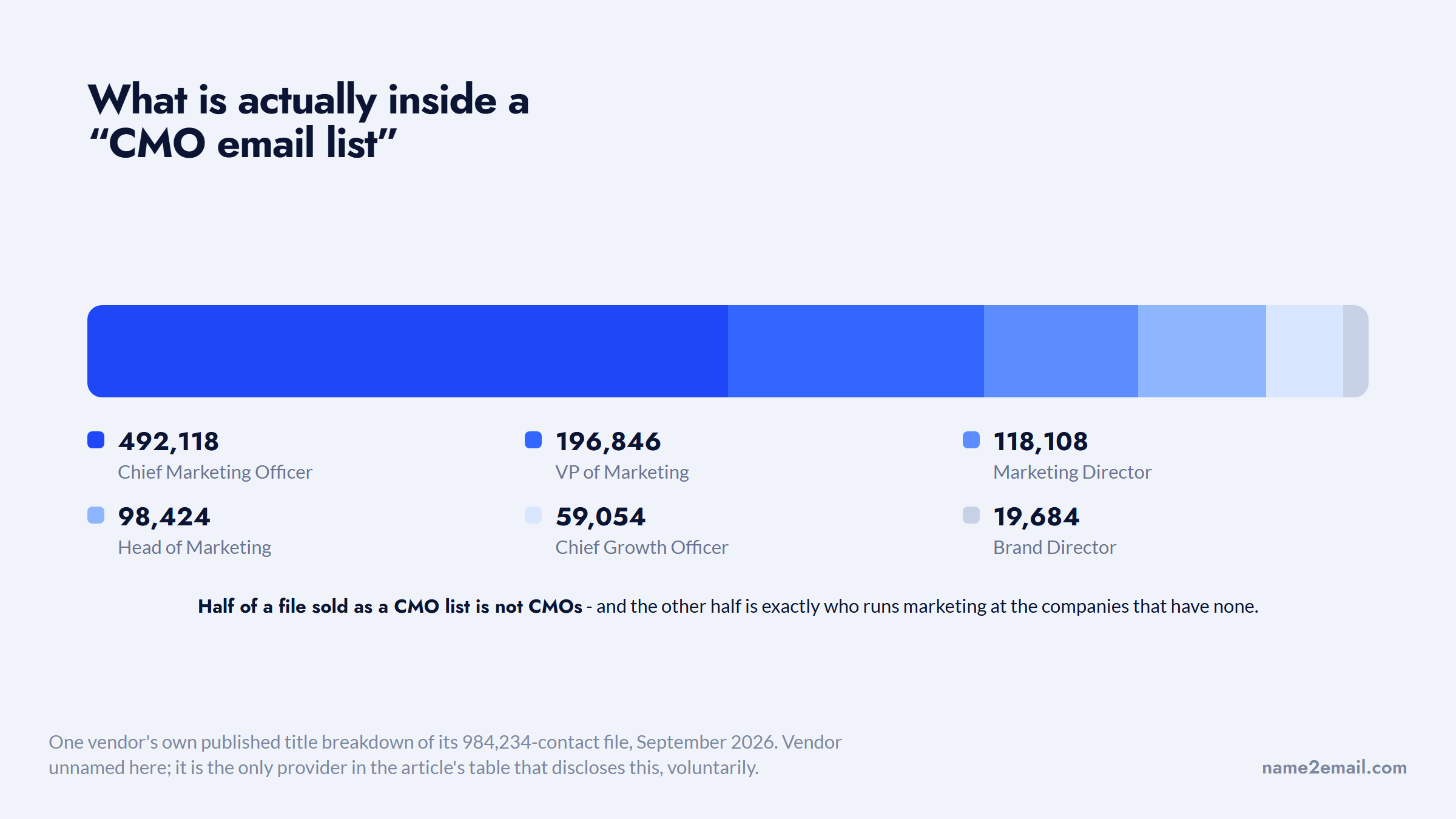
Read it as good news rather than bad. The half who are not CMOs include exactly the VPs, directors and heads of marketing who run marketing at the companies with no CMO, which makes the broader file more useful than a pure one, provided you know what you are sending to.
The geographic split matters just as much. ELP Data reports 393,694 contacts in North America, 40% of its total, so a file bought without a region filter is 60% international, and that is the sort of detail that turns a US campaign into a deliverability problem.
The Seat Moves Faster Than Your File
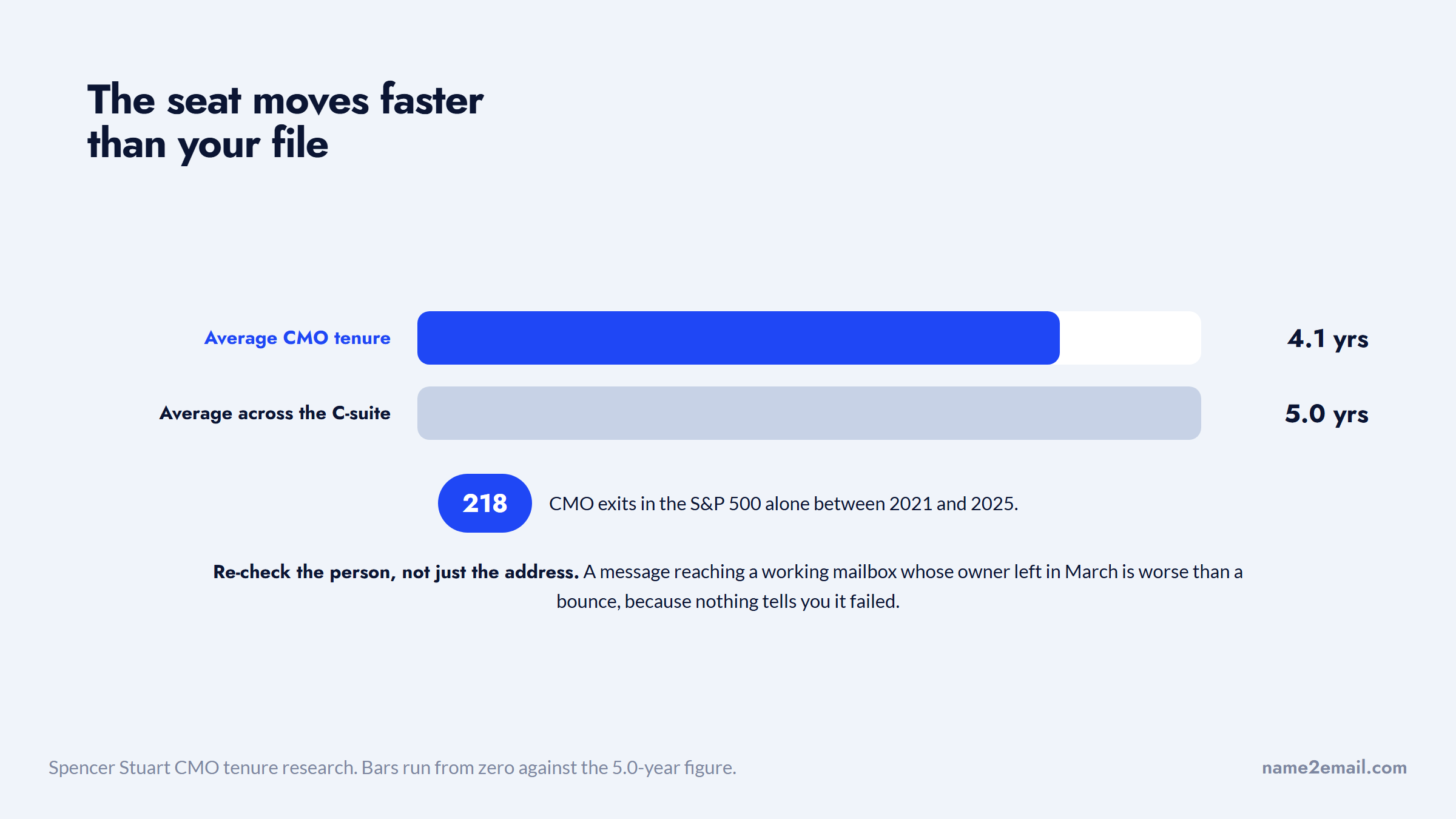
Marketing leadership turns over faster than the rest of the C-suite. Spencer Stuart puts average CMO tenure in the S&P 500 at 4.1 years against a C-suite average of 5.0, and counted 218 CMO exits between 2021 and 2025 in that group alone.
Against the rest of the C-suite the gap is real but modest, and the exits are what bite.
One marketer on r/marketing, asked about the path to the role, replied in a thread that CMO is a title that will likely not exist in the near future, because the definition keeps changing and CMOs have the shortest tenures of any executive. That is one practitioner's opinion rather than a forecast, but it lines up with what the tenure data shows.
Turnover also changes who your recipient is rather than simply invalidating the address. Spencer Stuart found 62% of CMOs appointed from within and 38% hired externally, and among external hires 43% came from a different industry. A new CMO six months into the job is a genuinely different prospect from one four years in, and an outsider brought in from another sector is more likely to be reviewing the whole stack.
What a CMO Owns Has Changed
Targeting the person is only half of it. The role's remit has moved, which changes what a message should be about.
The 35th edition of The CMO Survey, covering 308 marketing leaders at US for-profit companies of whom 97% are VP-level or above, found marketing budgets at 9.0% of company revenues and 9.6% of overall budgets, their lowest share in several years, with total spending up just 1.7% year on year.
Keeping segments clean matters more under that kind of pressure, since a marketing leader defending a shrinking budget share notices an email that was obviously blasted, and separating your list by role and seniority rather than merging it is what our roundup of email list management software is built for.
At the same time the job got bigger. The survey records marketing taking on more formal responsibility for revenue growth, public relations and customer insight, and marketing leaders appearing more often in board meetings, while the CMO-to-CFO working relationship rated only 4.5 on a seven-point scale for building a business case.
Set the new responsibilities beside the budget that carries them and the pitch writes itself.
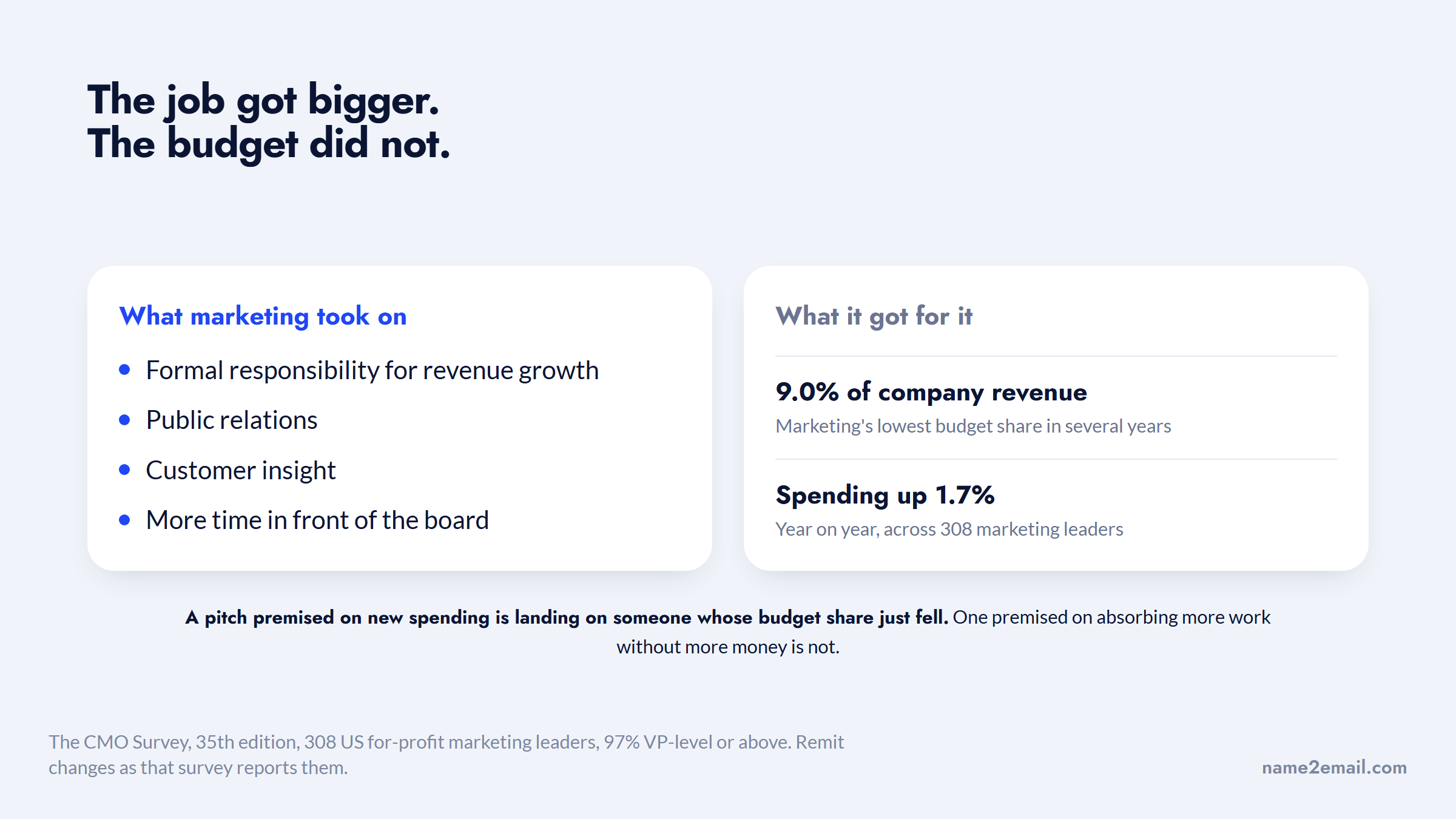
That combination, wider remit and flatter budget, is the single most useful thing to know before writing. A pitch premised on new spending is arriving at someone whose budget share fell; a pitch premised on doing more with the same money is arriving at someone whose responsibilities just expanded.
Checking Whether the Role Exists
Before spending anything on data, confirm the seat exists at your target accounts. It takes a minute per company and it is the step that saves the campaign.
- Open the company's own leadership, about or team page, which is where the role is confirmed or conspicuously absent.
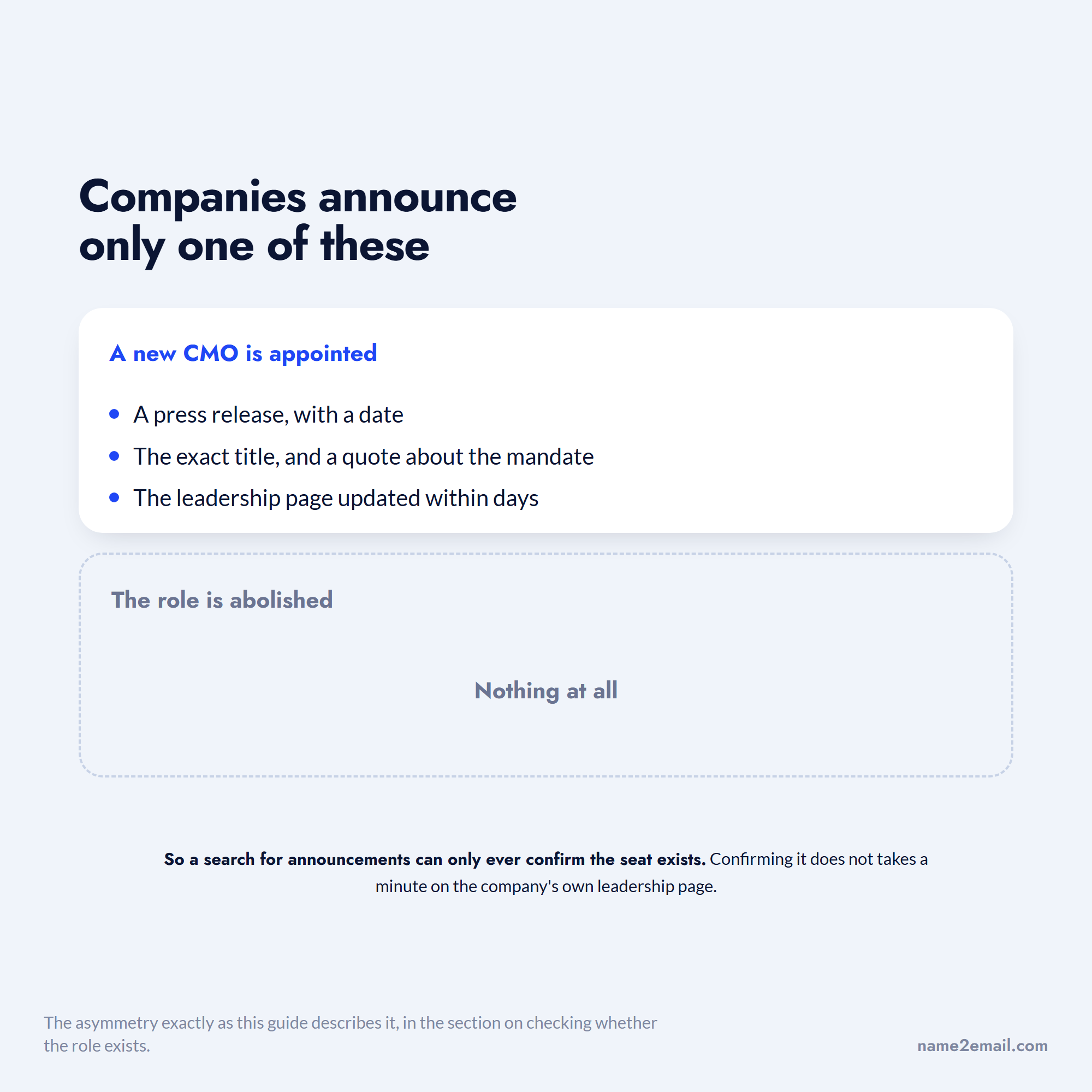
- Search recent press releases for marketing appointments, since companies announce a new CMO and quietly say nothing when they abolish the role.
- Check the careers page for open marketing leadership roles, which tells you the seat is vacant rather than nonexistent.
- Look for adjacent titles, particularly chief growth officer, chief revenue officer and chief customer officer, which are the usual replacements.
- Note the exact title you found, since that is what you will address them by.
Run this across twenty target accounts and the pattern for your segment will be obvious. If a third of them have no CMO, which is what the S&P 500 rate predicts, then a third of your list needs a different recipient rather than better data.
Building From Leadership Pages
For the companies that do have the role, their own website is more current than any file. Leadership pages are maintained by communications teams who update them when someone starts, which is months ahead of any compiled CMO email and mailing list.
Press releases are the other high-value source, and they are better than a directory entry because they carry a date. An appointment announcement gives you the name, the exact title, the start date and usually a quote that tells you the mandate, which is enough to write a message that could not have come from a list.
Announcements only ever run one way, which limits what a search of them can prove.
Conference speaker rosters and industry award shortlists round it out. Marketing leaders speak publicly far more than most executives, so the people running marketing at your target accounts are unusually visible, and the right search operators surface most of it, which is the technique our guide to searching Google for an address works through.
From a Name to a Work Address
At this point you have a company, a confirmed role, a person and a domain, and none of that came from a purchased file. The remaining piece is the address.
Name2Email is a free Chrome extension, and it works where you already write. Once you have the marketing leader's name and the company's domain, it populates Gmail's To field with the formats that domain is most likely to use, and a hover over each candidate surfaces the contact card Gmail holds for the real one.
In this category the distinction is worth stating twice: we are not a list source. No CMO records sit behind the extension, no file is for sale, and nothing about it is a database. Probable addresses are inferred from published naming conventions, one person at a time, on corporate domains, and a share of them will be wrong.
The reason this fits the CMO problem specifically is that checking a role costs you attempts. If a third of your accounts have no CMO and you have to try two or three people at each, a metered finder bills you for the misses. Nothing is metered here and nothing needs registering, which is the contrast we set out on our comparison page.
Verifying on a Tenure Cycle
A 4.1-year average tenure means roughly a quarter of any CMO list changes hands every year, and the change is invisible from the outside because the company keeps the address alive.
Re-verify quarterly and re-check the person, not just the address. A message reaching a working mailbox whose owner left in March is worse than a bounce, because nothing tells you it failed. Watching whether anyone opened it is the cheapest signal available, which is what our guide to email tracking is about.
Segment by tenure where you can. New appointments are worth a different message and a faster follow-up than someone three years into the seat, and running them as one undifferentiated list wastes the best window you get with this audience.
Writing to a Marketing Leader
Marketing executives receive more cold email than almost anyone, and they evaluate it professionally, which means a generic sequence is not just ignored but judged.
Address them by the title they actually hold. Calling a VP of Marketing a CMO, or a chief growth officer a CMO, is the clearest possible signal that they came out of a file. Reference something they published, said on stage or announced, since this audience leaves an unusually public trail.
Pitch against the budget reality rather than around it. Marketing spending grew 1.7% last year while the remit expanded, so the message that lands is about absorbing more responsibility without more money. Our roundup of email outreach tools covers running that at scale without it reading like scale.
Target the Person, Not the Acronym
The honest summary of this category is that "CMO email list" describes a job title that a third of large companies have abolished, that means something else entirely in healthcare, and that changes hands every four years. Files built on that title inherit all three problems.
Work from your target accounts instead. Confirm whether the role exists, find whoever owns marketing under whatever title they use, take the exact wording from the company's own page, and find the address yourself.
You end up with fewer names and a much higher hit rate, and you are not writing to someone who left in the spring. Prospecting across many domains without a per-lead cost is one of the use cases we built the extension around.
Add Name2Email to Chrome and confirm a marketing leader's address before your sequence has to. It is free and there is no account to create.
Frequently asked questions
Confirm the person and the exact title on the company's own leadership page or a recent press release first, because CMO turnover is fast enough that databases lag badly. Given the name and the company's domain, only a handful of address formats are plausible, and Gmail identifies the live one as soon as you hover over the candidates. Starting from the company rather than from a title search also tells you whether the role exists at all.
Both, and the ambiguity is real enough that a chief medical officer email list ranks on the first page for this search. In marketing contexts the letters mean chief marketing officer; in healthcare they almost always mean chief medical officer. Ask any vendor to state which population its file covers before you buy, and treat an unexpectedly high share of hospitals and health systems in a marketing list as the warning sign it is.
Nobody publishes a definitive count, and the vendor numbers are not it. Advertised file sizes span roughly 42,000 to 984,000, a 24-fold gap, and the biggest of them is only half chief marketing officers on the seller's own accounting. The more useful frame is Spencer Stuart's finding that roughly a third of the S&P 500 has nobody in the seat at all, which tells you the role is less common than the market for lists implies.
No, and be careful with anything advertised as a free CMO email and mailing list, since it is normally a lead capture for a paid file. What is genuinely free is the underlying information: company leadership pages, appointment press releases, conference speaker rosters and award shortlists all name marketing leaders publicly, and marketing executives are more visible than most because their job involves being visible.
Usually both, and often the person below first. The CMO Survey found marketing leaders taking on more formal responsibility while budget share fell to 9.0% of revenue, which means senior marketers are stretched and their VPs and directors do the evaluating. In the roughly one company in three with no CMO, the VP or head of marketing is not a secondary contact at all, they are the decision maker.

We build Name2Email, the free Chrome extension that finds work emails inside Gmail. We write about outreach, prospecting, and getting more replies.
Connect →