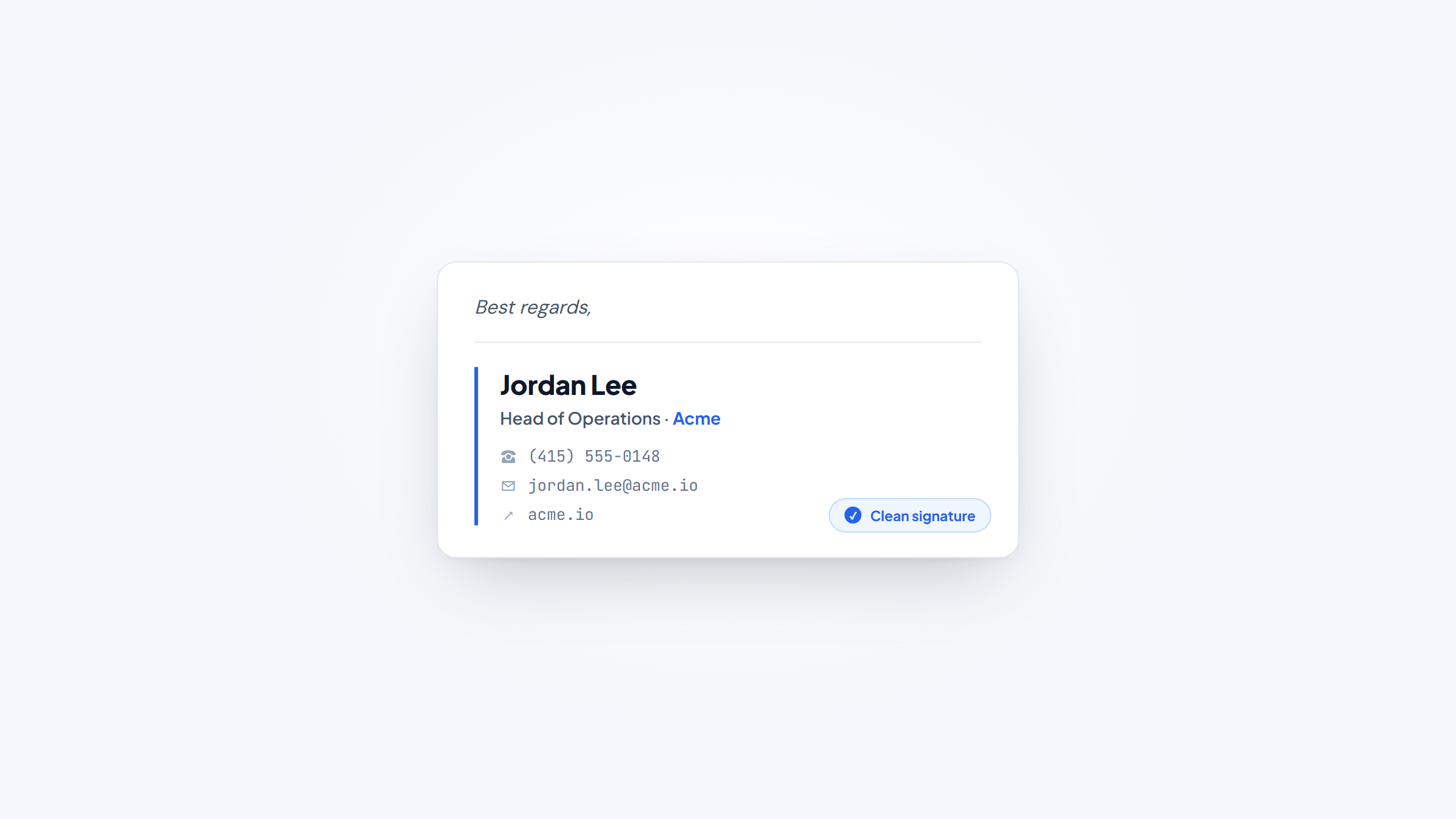
- 1A strong email ending is a system of three parts, the closing line (your ask), the sign-off, and the signature, and most people only think about the sign-off.
- 2The closing line does the heavy lifting: make one clear ask, give a short reason for it, and name the next step, because a vague "let me know" rarely earns a reply.
- 3Match the sign-off and tone to the relationship, keep the signature clean, and cut the reply-killers: no CTA, mixed tone, or a wall of logos and links.
- 4None of it matters if the email doesn't reach the right person, so our free Name2Email extension surfaces work emails inside Gmail before you write the ending that gets an answer.
Most advice about ending an email stops at the sign-off, as if "Best" versus "Sincerely" were the whole decision. It isn't. The part that actually gets you a reply is the line right before your name: the ask.
Readers skim, decide, and move on in seconds, and the ending is where they either see a clear next step or don't. This guide treats the ending as a system built to earn an answer: how to write a closing line that prompts action, how to pick a sign-off that fits, how to keep your signature out of the way, and the templates and mistakes that decide whether your email gets a reply or gets ignored.
Name2Email, our free Gmail extension, exists to get your message to the right inbox in the first place, so we pay close attention to what happens after you hit send. An ending that gets answers is a big part of it.
Why Your Email Ending Decides Whether You Get a Reply
The ending carries more weight than its length suggests, for a simple reason: it's where the ask lives, and it's the last thing the reader sees before deciding what to do. Get it wrong and even a well-argued email trails off into silence.
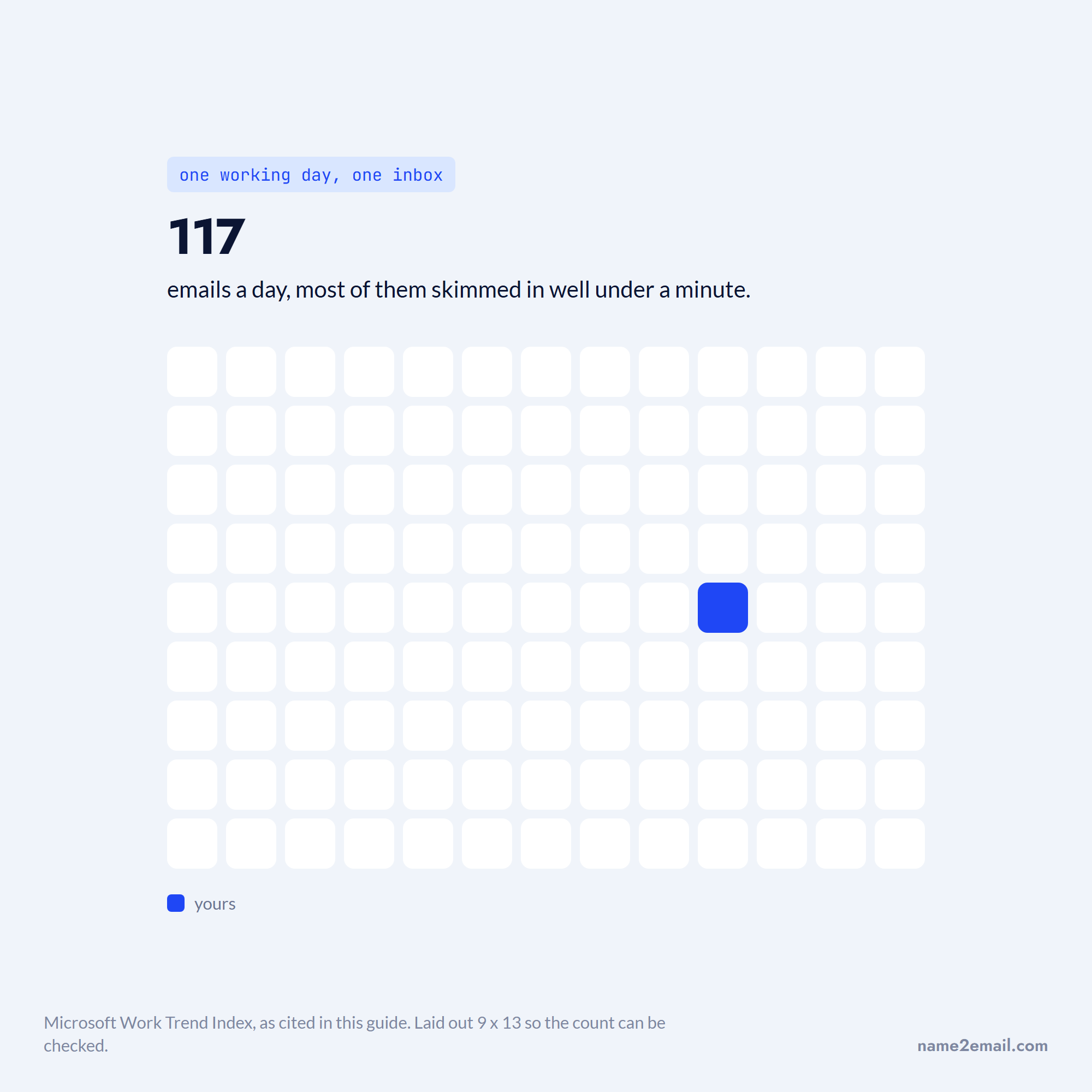
Attention is the constraint. Microsoft's Work Trend Index puts the typical knowledge worker at 117 emails a day, most of them skimmed in well under a minute. Your reader isn't studying your message; they're scanning it for what you need and whether it's easy to give. The ending is where that lands or gets lost.
Yours is one square in that grid, and it gets a few seconds at most.
Psychology backs this up. We recall how an exchange ended more vividly than its middle, so a sharp, action-oriented close pays off well beyond its few words. A reader who reaches a specific ask with an obvious next step knows exactly how to respond; a reader who hits a limp "let me know your thoughts" has to figure out what you actually want, and busy people rarely bother.
So the goal of an ending isn't to sound polished. It's to make replying the path of least resistance.
The Three Parts of a Strong Email Ending
Every effective ending has three parts, and treating them as one blurry "closing" is why so many emails fizzle. Separate them and each can do its job.
Part | Its job | Example |
|---|---|---|
Closing line (CTA) | Tell the reader exactly what to do next | "Could you confirm the date by Thursday?" |
Sign-off | Set the tone and close politely | "Best regards," |
Signature | Say who you are and how to reach you | Name, title, company, phone |
The closing line is where replies are won or lost, so it deserves the most thought. The sign-off sets tone but rarely makes or breaks a response. The signature just needs to be clean and complete. Most senders invert this, agonizing over the sign-off and throwing away the closing line, which is exactly backward. The rest of this guide fixes that order, starting with the line that matters most.
Write a Closing Line That Prompts Action
The closing line is your call to action, and the difference between a vague one and a sharp one is the difference between silence and a reply. Two moves make the biggest difference: ask for one specific thing, and give a short reason for it.
Specificity removes the reader's work. "Let me know if you have any questions" asks for nothing, so it gets nothing. "Could you approve the final draft by Thursday?" names the action, the object, and the deadline, so the reader can answer in one line.
Reasons matter more than they seem. In a classic experiment by Langer and colleagues, people asking to cut a copier line got 60% compliance with a bare request, but 93% when they added a reason, even a nearly meaningless one ("because I have to make copies").
The gap between those two numbers is a single clause.
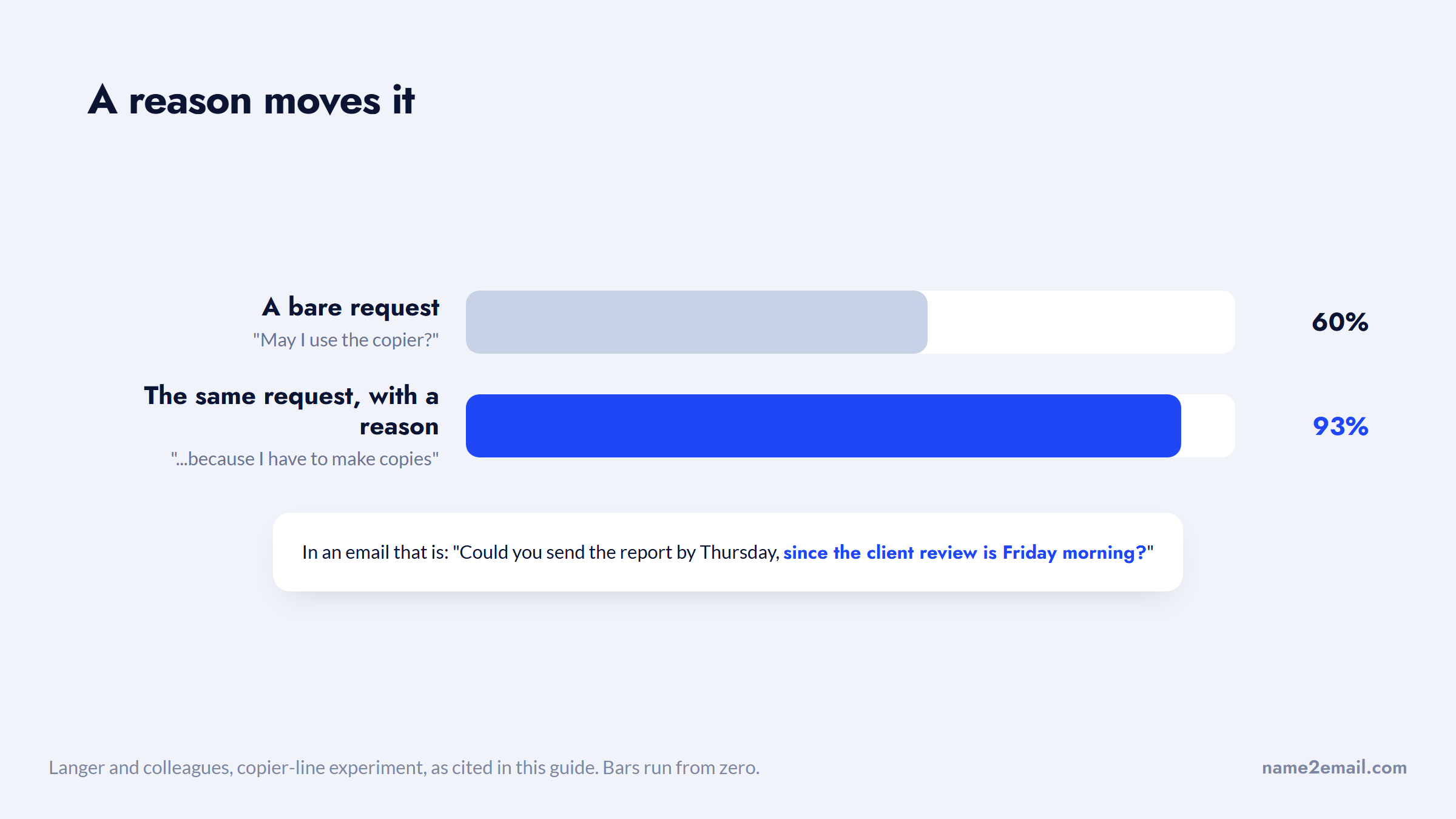
The lesson for email is to attach a "because" to your ask, which makes it easier to say yes to. "Could you send the report by Thursday, since the client review is Friday morning?" outperforms the same request with no reason. The reason gives the reader a why, and a why is what turns a request into an easy yes.
Here's how weak closing lines turn into strong ones.
Weak closing line | Stronger version |
|---|---|
Let me know your thoughts. | Which of these two options works better for you? |
Looking forward to hearing from you. | Can we lock a 15-minute call Tuesday or Wednesday? |
Feel free to reach out. | Reply "yes" and I'll send the onboarding doc today. |
Hope to connect soon. | Is improving reply rates a priority this quarter? |
Notice what the stronger versions share: one ask, a low-friction way to answer (a yes, a pick between two options, a short reply), and a clear reason or benefit. That's the entire craft of a closing line that gets answers.
Choose a Sign-Off That Fits the Ending
The sign-off comes after the ask, and its main job is not to clash. A crisp, action-oriented closing line undercut by an overly casual "Cheers" or an oddly stiff "Yours faithfully" creates a small dissonance the reader feels. Match the sign-off's formality to both the email and the relationship.
Hold the ask steady and swap only the sign-off, and the mismatch is easy to hear.
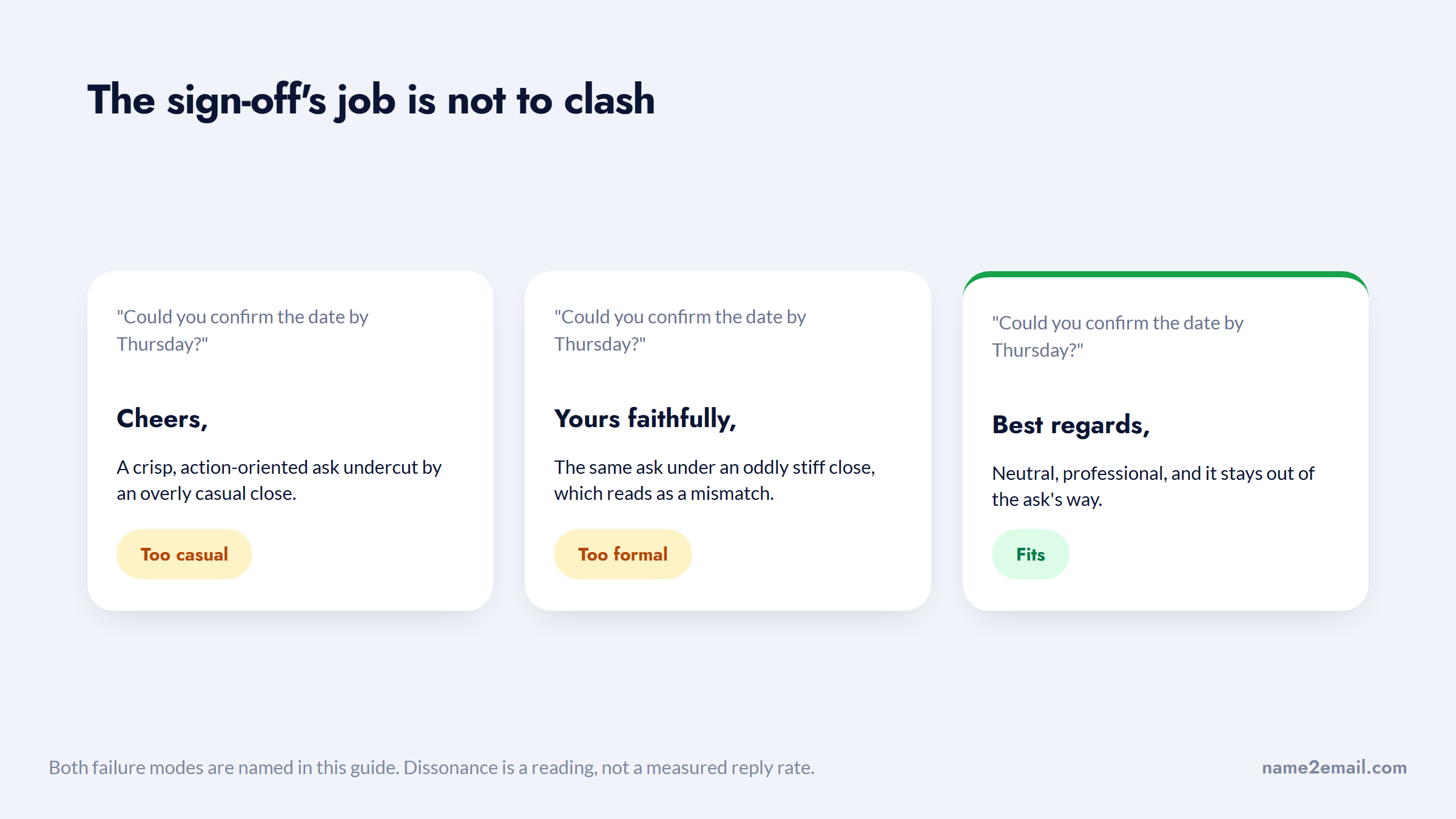
Ending an email with regards, "Best regards" or "Kind regards," is the safe, neutral choice for most professional email; for warmer notes, "Thanks" or "Warmly" fits; for a genuinely formal first contact, "Sincerely" carries more weight. The one rule that never fails is to mirror the register your recipient uses.
There's more nuance to each phrase than a closing line needs to carry, and two sibling guides cover it in full: our deep dive on the best regards email explains that specific sign-off, and our guide to email closing salutations lays out the whole menu by register. For the purposes of getting a reply, pick one that fits and move on; the closing line above it is doing the real work.
Build a Signature That Doesn't Get in the Way
The signature exists to answer "who is this and how do I reach them," and its main failure mode is clutter. A wall of logos, social icons, quotes, and legal disclaimers buries the reply and makes an email look like marketing, not a message from a person.
Keep it to what a reply actually needs:
- Your full name, and your pronouns if you include them.
- Your title and company, so the reader knows your role.
- One reliable contact method beyond email, usually a phone number.
- A single relevant link at most, such as your booking page or company site.
- Nothing else: no multiple logos, no inspirational quotes, no five-line disclaimer on routine mail.
A clean signature reads as confident and makes the whole ending feel intentional. When the message is casual or mid-thread, you can trim even further to a first name, since a full corporate block on a quick reply looks stiff. The test is simple: every line in your signature should earn its place by helping the reader respond or reach you.
Email Ending Templates by Scenario
Different emails need different endings, and having a template for the common ones saves you from reinventing the close each time. The email ending examples below each pair a specific closing line with a fitting sign-off.
For a follow-up on a stalled thread: "Just checking whether the proposal still fits your timeline, should I hold your Q3 slot or release it? Best regards,". It gives a binary choice, which is easy to answer.
For a meeting request: "Does Tuesday at 2pm or Wednesday at 10am work for a 20-minute call? Happy to send an invite either way. Thanks,". Two options plus a low-friction offer beat an open-ended "when are you free."
For a thank-you that keeps momentum: "Thanks again for the intro to Priya, I'll follow up with her this week and keep you posted. Warmly,". It closes warmly and signals the next step without asking for anything.
For a request that's gone quiet, name a default action so silence still moves things forward: "If I don't hear back by Friday, I'll assume the current scope works and start Monday. Best regards,". A stated next step often prompts the reply a plain reminder wouldn't.
Underneath the wording, each of these is a different device for making a reply cheap.
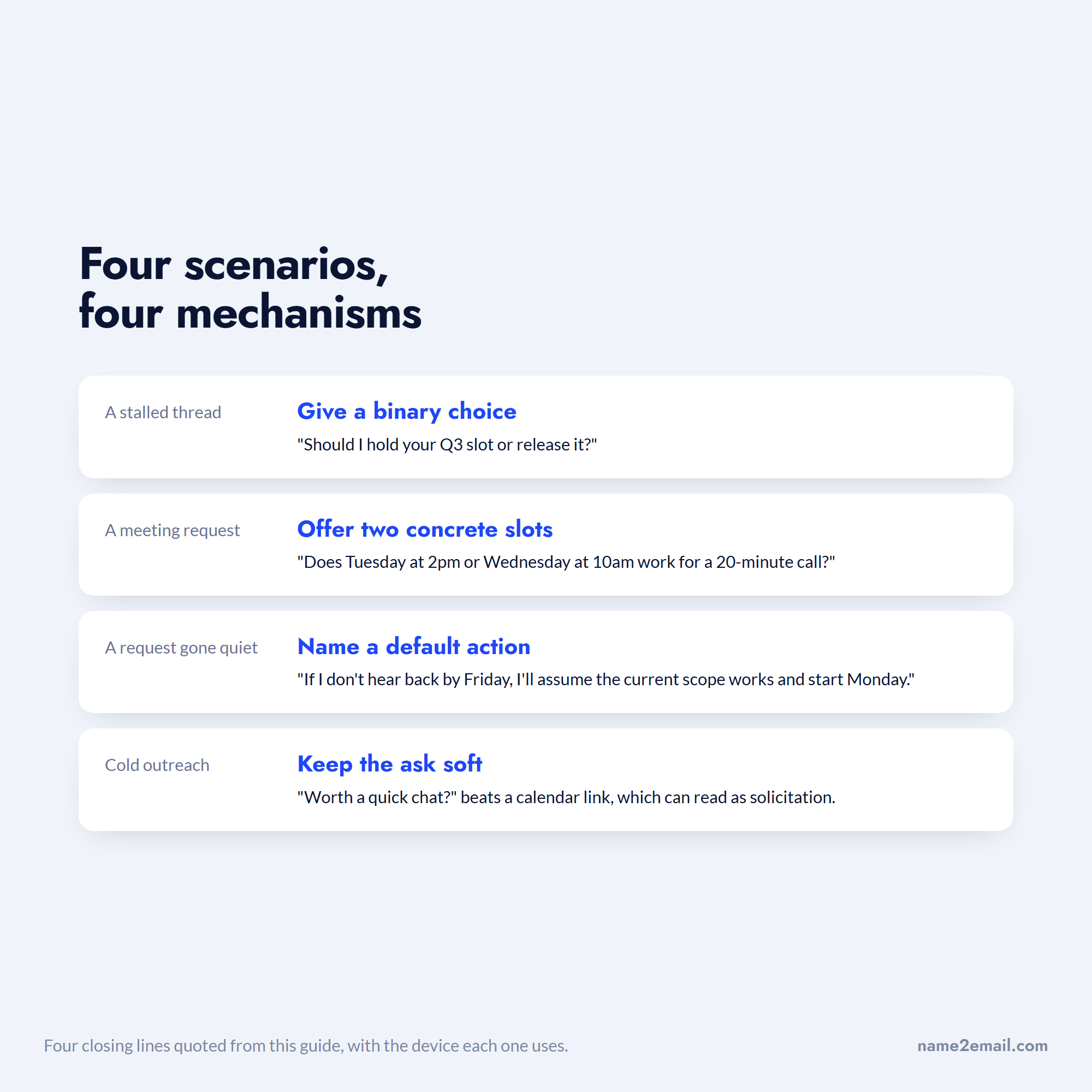
For cold outreach, a soft ask usually beats a hard one. Sales practitioners on Reddit who've sent hundreds of thousands of emails argue the first email's job is to open a conversation, not book a meeting. Low-key lines like "Worth a quick chat?" or "Is this relevant to your team?" outperform a hard "Book a call here" with a calendar link, which can read as solicitation.
So a cold-email close might be: "If cutting bounce rates is on your radar this quarter, worth a short conversation? Best,". Before you send outreach like that, make sure you have the right address first, which our free guide to find an email address and our roundup of the best email finding tools both walk through.
Ending Phrases That Get a Response
Beyond full templates, a small vocabulary of ending phrases covers most situations. Keep these on hand and adapt them to the specific ask.
- Could you confirm [X] by [date]? (a clear, deadline-bound ask)
- Which option works better for you, A or B? (a low-friction choice)
- Reply "yes" and I'll [next step]. (removes all friction)
- Does [day/time] or [day/time] work for a quick call? (two concrete slots)
- Is [outcome] a priority for you this quarter? (an interest check for cold outreach)
- Thanks in advance for [specific thing]. (gratitude tied to a reasonable ask)
The thread that runs through all of them is clarity plus low effort for the reader. In a discussion on Reddit, salespeople agreed there's no magic-bullet CTA phrase; what earns a reply is an ask that's clear and easy to act on, like offering two specific times instead of "let me know your availability." Pick the phrase that matches your ask, then make it as easy as possible to say yes.
Common Mistakes That Kill Replies
Most emails that go unanswered share a few fixable endings. Spot these in your own drafts and the reply rate climbs on its own.
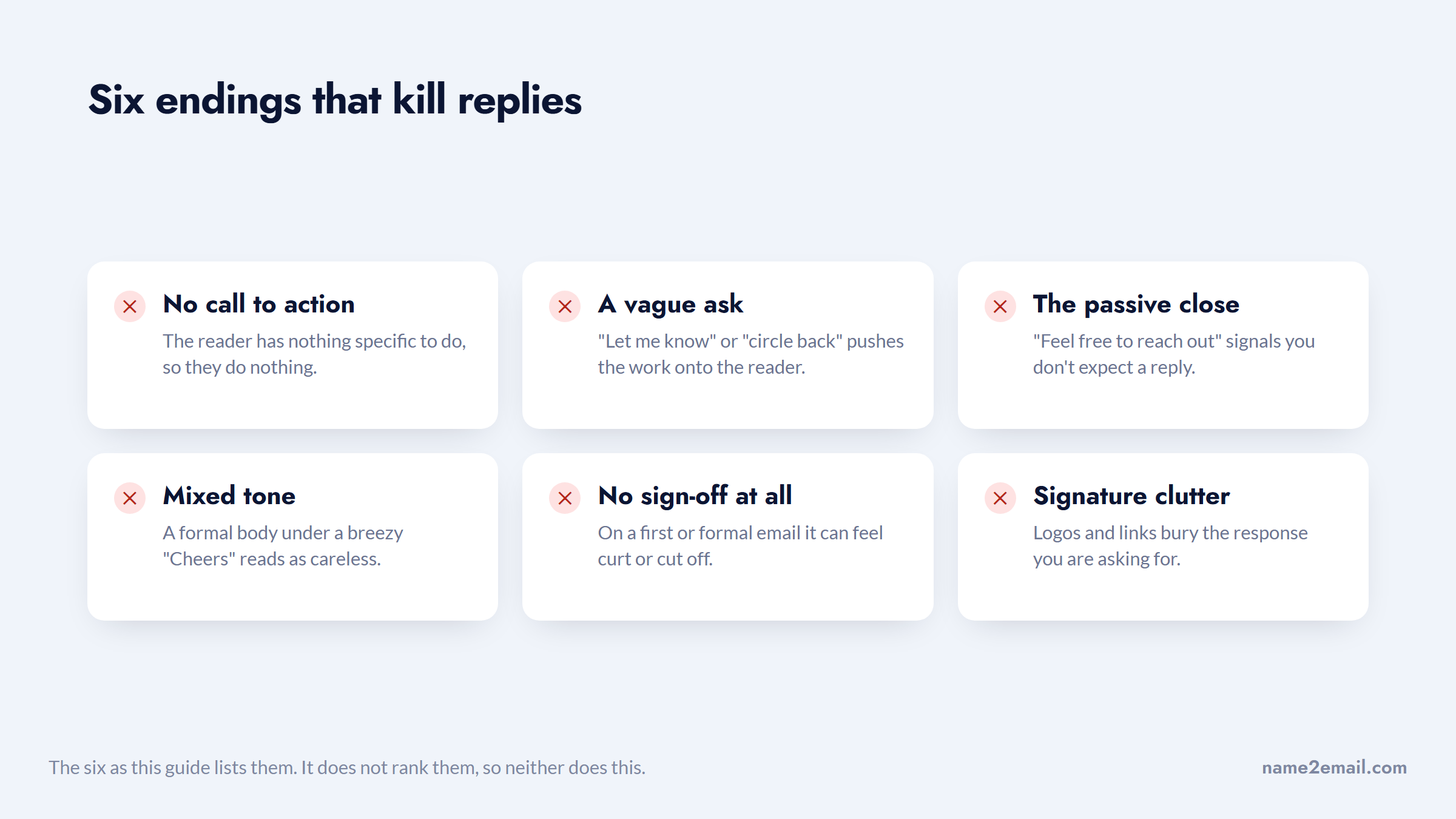
- No call to action, so the reader has nothing specific to do and does nothing.
- A vague ask like "let me know" or "circle back," which pushes the work onto the reader.
- The passive close ("feel free to reach out"), which signals you don't actually expect a reply.
- Mixed tone, such as a formal body under a breezy "Cheers," which reads as careless.
- Dropping the sign-off entirely on a first or formal email, which can feel curt or cut off.
- Signature clutter, where logos and links bury the response you're asking for.
The fix for nearly all of them is the same discipline: end with one clear ask, a fitting sign-off, and a clean signature, in that order of importance. Before you hit send, reread just your last two lines: if they don't say what you want and how to give it, the rest of the email probably won't get read closely enough to matter.
Run a draft against these six and most silent emails explain themselves.
An email that states exactly what you want and makes it easy to give is the one that gets an answer, whatever sign-off sits above your name.
Match the Ending to the Relationship and Industry
The "right" ending shifts with who you're writing to. A closing line and sign-off that land perfectly with a familiar colleague can read as too casual or too pushy with a new client or a senior executive, so read the context before you default.
Formality tracks the relationship and the field. Law, finance, and government lean formal, where "Sincerely" and a full ask fit better than a chatty close. Tech, creative, and startup cultures are more relaxed, where "Best," "Cheers," or a first name alone is normal.
"Cheers" itself splits by geography and industry, fine in the UK, Australia, and casual settings, riskier in US formal contexts, so use it where the culture supports it. And save warm closes like "Warmly" for people you've actually built rapport with, since using them cold can feel presumptuous.
When you can't read the signals, default one notch more formal and keep the ask just as clear. A slightly formal ending rarely offends, and clarity earns replies in every register.
Turn Your Ending Into an Answer
A good email ending is less about the perfect sign-off and more about making the reply obvious and easy. Lead with one clear ask, give it a reason, name the next step, then close with a sign-off that fits and a signature that stays out of the way. Do that and you'll trade silence for answers.
The ending only works if the email reaches the right inbox, though. Add Name2Email to Chrome to surface a real work email as you compose, at no cost, then write the close that earns a reply. It works from public naming patterns instead of a bought database, so corporate domains are its sweet spot and it flags the likeliest address rather than swearing every one is correct.
To confirm an address is real before you send, our guide on how to look up an email address helps, while our picks for the best email outreach tools and best cold email software handle sending at scale once you've found your people, all reachable from our use cases page.
Frequently asked questions
End with one clear call to action, not a vague "let me know." Ask for a specific thing, give a short reason for it, and make it easy to answer, offer two time slots instead of "when are you free," or invite a one-word "yes." Then add a fitting sign-off and a clean signature. A reader who sees exactly what to do, and can do it in seconds, is far likelier to respond.
Ending a professional email well comes down to three parts: a closing line that states your ask or next step, a neutral sign-off like "Best regards" or "Kind regards," and a signature with your name, title, company, and one contact method. Keep the ask specific and the signature uncluttered. Match the formality to the recipient, more formal for first contact or senior people, warmer once you have a relationship.
For a clear ask: "Could you confirm [X] by [date]?" For a low-friction choice: "Which works better, A or B?" For a meeting: "Does Tuesday at 2pm or Wednesday at 10am work?" For cold outreach: "Is [outcome] a priority this quarter?" Pair the phrase with a sign-off that fits the relationship. The common thread is a specific ask that's easy to act on.
Yes, "Regards" is professional and safe, though a bare "Regards" can read as slightly cold or neutral to some readers. "Best regards" and "Kind regards" feel a touch warmer while staying professional, which is why they're common defaults. For a reply, though, the sign-off matters less than the closing line above it, so put your energy into a clear ask and use whichever "regards" variant fits your tone.
Ending a business email professionally starts with a specific next step ("I'll send the contract once you confirm the scope"), a professional sign-off such as "Best regards" or "Sincerely," and a complete signature. Keep the tone consistent from greeting to close, avoid casual jargon or emojis in formal contexts, and always include a call to action if you need a response. Clarity and a clean structure read as more professional than any single phrase.

We build Name2Email, the free Chrome extension that finds work emails inside Gmail. We write about outreach, prospecting, and getting more replies.
Connect →