- 1Follow-ups are where most cold email replies come from. Backlinko and Pitchbox found that emailing the same contact again roughly doubles responses.
- 2Three to four touches spread over two to three weeks is the working range. Beyond that, returns fall sharply and complaints rise.
- 3Every follow-up must add something new. A message whose only content is "just checking in" trains people to ignore your address.
- 4No response is the normal outcome, not a signal to send harder. The average outreach email draws an 8.5% reply rate.
Most people write one cold email, get nothing, and conclude cold email does not work.
What actually happened is that they stopped at the point where the results begin. First emails arrive when the recipient is busy, distracted, or in a meeting. Follow-ups arrive on a different day, in a different mood, and that is often the only difference between silence and a reply.
This guide covers how to follow up on a cold email properly: how many times, how far apart, what each message should say, and when to stop. It assumes you have already written a decent first email, and if you have not, our guide on writing a good email covers that groundwork.
We make Name2Email, a free Chrome extension for finding work emails inside Gmail, so our stake here is the address rather than the copy. The sequencing advice below stands on its own.
Why Follow-Ups Carry Cold Outreach
The data on this is unusually clear for a marketing question.
The Backlinko and Pitchbox analysis of 12 million outreach emails found that the average outreach email receives an 8.5% response rate, and that emailing the same contact more than once produces roughly double the responses of a single send.
The second finding is the one that pays for the whole sequence.
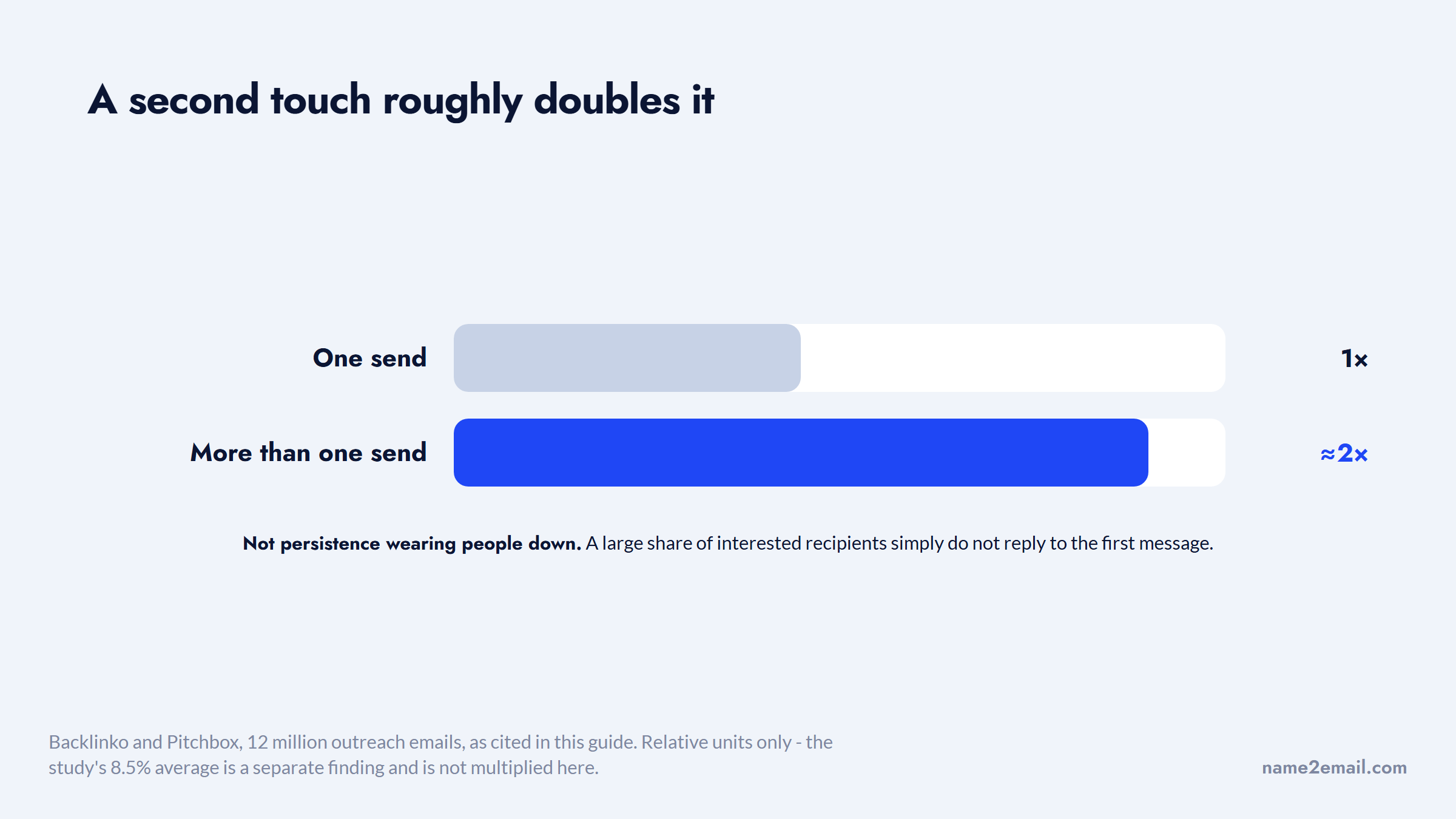
Read that second finding carefully. It does not say persistence wears people down. It says that a large share of interested recipients simply do not reply to the first message, and reaching them again is what converts an existing interest into a conversation.
That distinction matters because it tells you what a follow-up is for. You are not applying pressure. You are catching people who meant to reply and did not.
How Many Follow-Ups, and How Far Apart
There is no universal number, but there is a defensible range and a clear point of diminishing returns.
Touch | Timing | Purpose | Typical length |
|---|---|---|---|
Email 1 | Day 0 | The original ask, with a clear relevance signal | 50 to 125 words |
Follow-up 1 | Day 3 to 4 | Add a new angle or a specific proof point | Under 75 words |
Follow-up 2 | Day 8 to 10 | Change the ask to something smaller | Under 60 words |
Follow-up 3 | Day 16 to 21 | Close the loop and give a clean exit | Under 40 words |
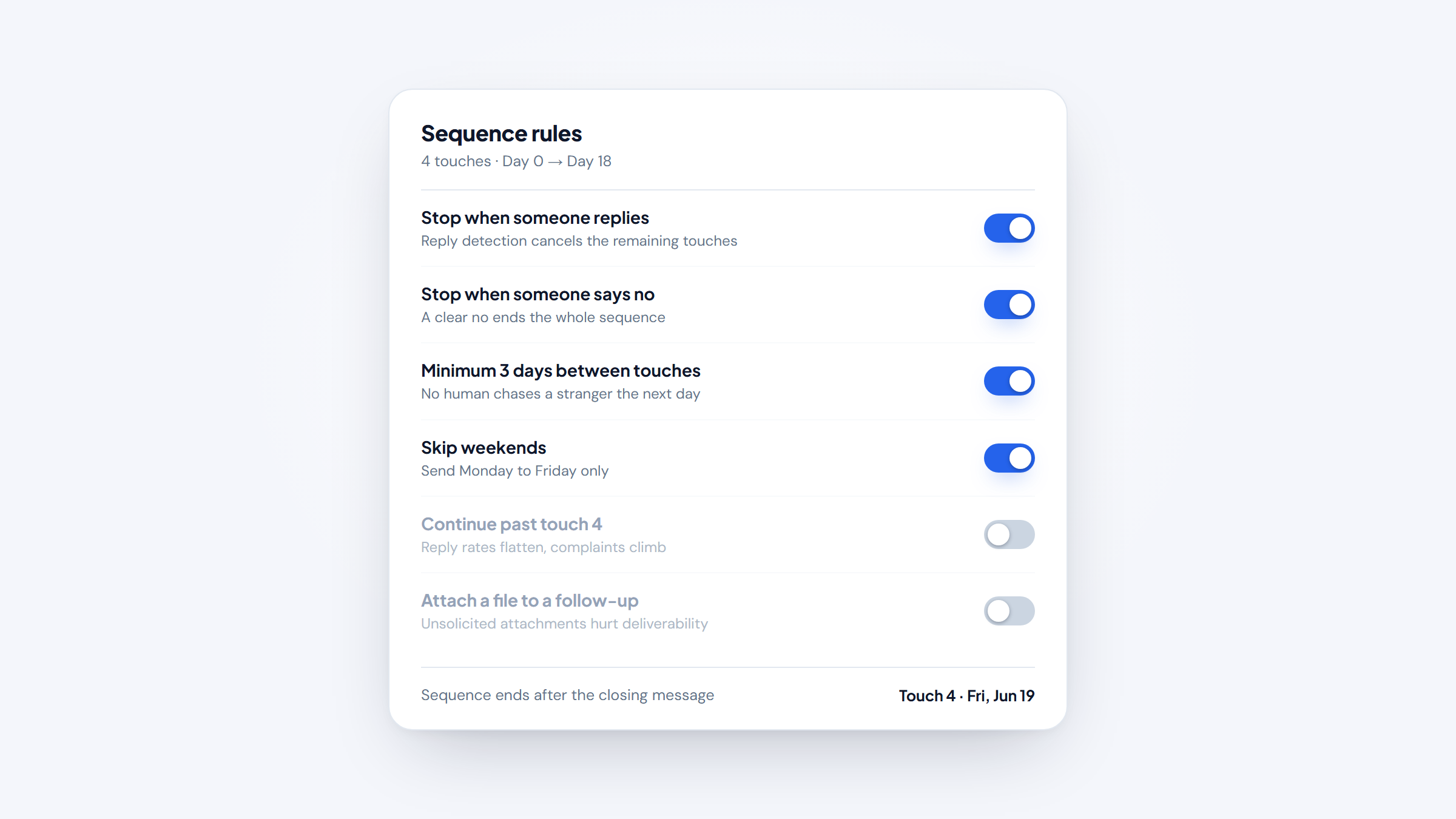
Three to four total touches over two to three weeks is the working range for most B2B outreach. Below that you leave replies on the table; above it, reply rates flatten while spam complaints and unsubscribes climb.
Spacing matters as much as count. Same-day or next-day follow-ups read as automated, because no human chases a stranger that fast. Widening the gap as the sequence progresses feels more natural and gives genuinely busy people time to surface.
Cold Email Follow Up Best Practices, Message by Message
The rule underneath all of this: every message must be able to stand alone as a reason to reply. If its only content is that time has passed, delete it.
Follow-Up 1: Add a New Angle
Do not restate the first email. Approach the same problem from a different side.
If your first message led with a cost problem, lead this one with a speed problem. If the first named a competitor they might benchmark against, this one might name a specific result. A relevant customer example, a short data point, or a link to something genuinely useful all work.
Reference the previous email in half a sentence, not a paragraph. "Following my note on invoice reconciliation" is enough context.
Keep it shorter than the original. Every subsequent message in a sequence should be shorter than the one before it.
Follow-Up 2: Shrink the Ask
By the third touch, the most likely reason for silence is that your request is too expensive in time.
So make it cheaper. If you asked for a call, ask instead whether they are the right person. If you asked for a meeting, ask a single question they can answer in one line.
A yes-or-no question outperforms an open one here, because it costs nothing to answer. "Is this something your team handles, or should I be speaking with someone else?" gets replies from people who will never book a call, and it frequently produces a referral to the right person.
Follow-Up 3: Close the Loop Cleanly
The final message should make it easy to say no and easy to say later.
State that you will stop, without sarcasm or guilt. "I'll leave it here, but if this becomes relevant in the next quarter, I'm easy to find" respects their time and leaves the door open.
Set end to end, the three messages are doing three different jobs, not one job three times.
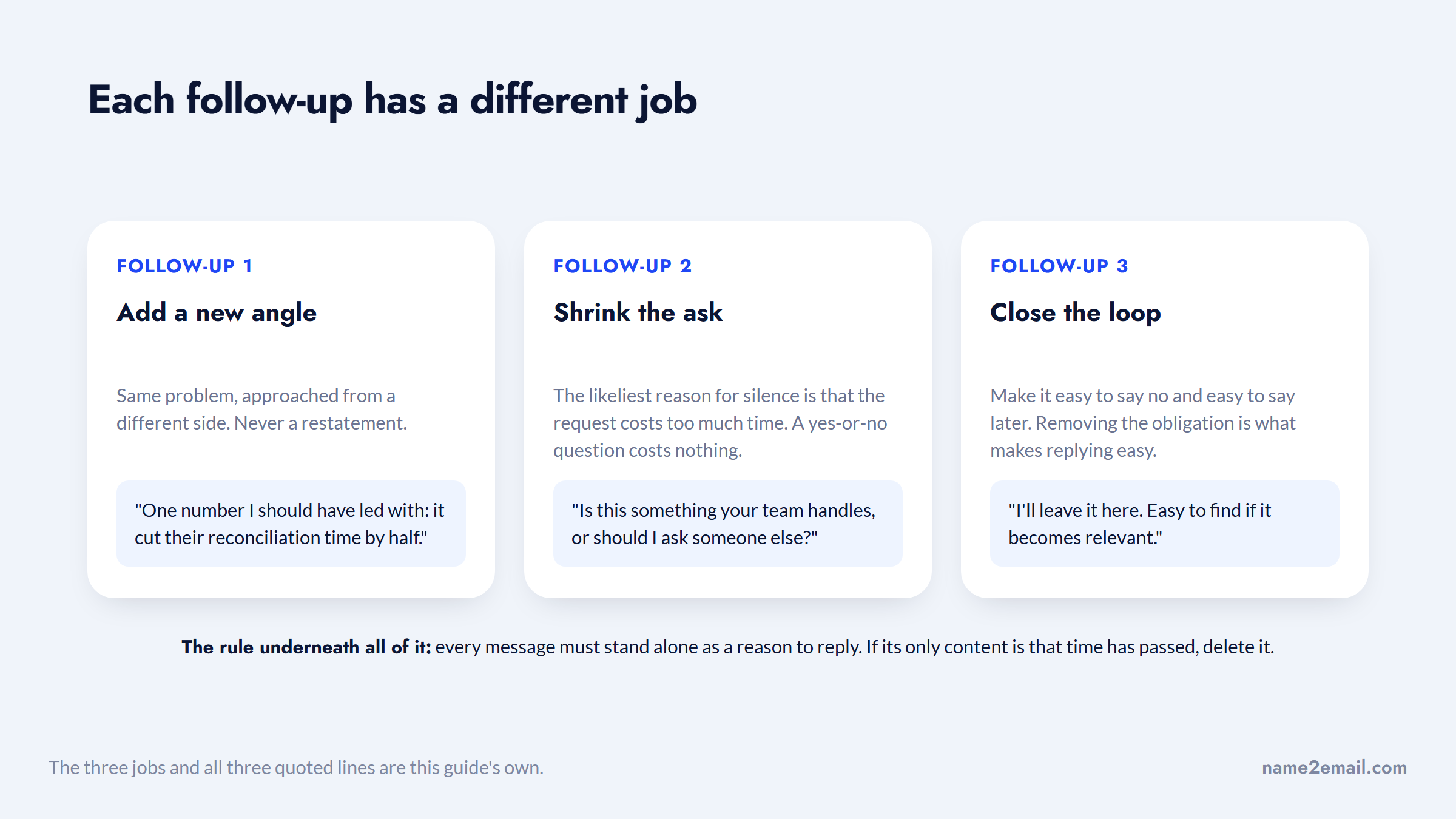
This message reliably produces replies, often from people who did want to talk and had genuinely forgotten. It works because it removes the obligation, and removing obligation is what makes responding easy.
What it must not be is passive-aggressive. "I guess you're not interested" and "bumping this to the top of your inbox" both convert curiosity into irritation.
A Cold Email Follow Up Template for Each Touch
A follow up email after cold email number one should not be a template you paste everywhere, so rather than one cold email follow up template, use these lines as a starting point per touch. Side by side, the difference between a follow-up that earns a reply and one that annoys is usually a single sentence.
Touch | Line that works | Line to delete |
|---|---|---|
Follow-up 1 | "Saw you just opened a Denver office, which is what prompted this." | "Just following up on my email below." |
Follow-up 1 | "One number I should have led with: it cut their reconciliation time by half." | "I wanted to make sure you saw this." |
Follow-up 2 | "Is this something your team handles, or should I ask someone else?" | "Circling back on the below." |
Follow-up 2 | "Happy to send the one-page version instead if that's easier." | "Bumping this to the top of your inbox." |
Follow-up 3 | "I'll leave it here. Easy to find if it becomes relevant." | "I guess you're not interested then." |
Any | A question they can answer in one line | A second copy of the original pitch |
Read the right-hand column aloud and the problem becomes obvious: every one of those lines is about your process rather than their situation.
A Sequence That Worked, With the Caveats
Practitioner examples are useful when you read them as one team's result rather than a formula.
A post in r/coldemail broke down a five-step sequence a B2B SaaS operator ran for a year, targeting agencies listed on a directory and sending around 500 emails a day, which they reported produced $150,000 in closed revenue and $600,000 in pipeline. The structural choice worth borrowing is that their first email did not pitch at all: it asked a qualifying question about how the recipient's business worked. The most useful reply in the thread pushed back on the copy focus entirely, arguing that "cold email only works when list quality is high" and that list sourcing matters more than the sequence. You can read the full breakdown on Reddit, treating both the results and the method as anecdotal.
That commenter is right, and it is the honest frame for this entire article. A well-sequenced follow-up to the wrong person is still the wrong email.
Cold Email Follow Up With No Response: What to Do
Knowing how to follow up on a cold email with no response starts with reading the silence correctly, because misreading it makes things worse.
At an 8.5% average response rate, roughly nine in ten of your emails were always going to go unanswered. That is the baseline, not a failure of your copy.
Before rewriting anything, check the mechanical explanations. Did it deliver, or did it bounce? Is your domain landing in spam? Is the address even correct? A sequence sent to an unverified address produces exactly the same silence as a sequence sent to an uninterested person, and the two require completely different fixes.
Silence looks identical from your side, which is why the diagnosis has to come first.
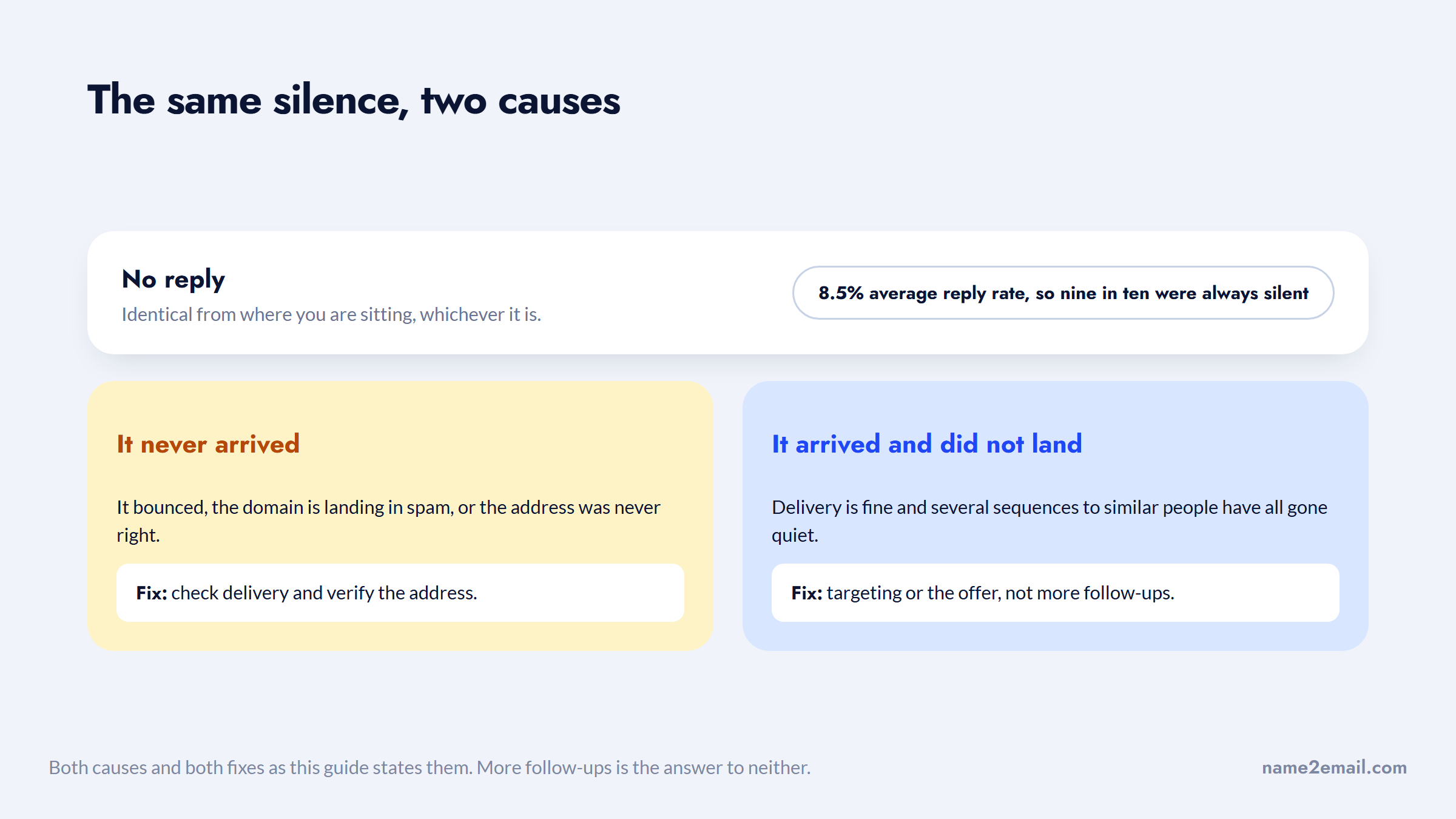
If delivery is fine and several sequences to similar people have all gone quiet, the problem is targeting or offer, not persistence. Sending a fifth and sixth follow-up to a list that is not responding compounds the damage, because spam complaints affect your sender reputation for every future campaign.
Stop after the closing message and move on. You can return to the same contact in a quarter with a genuinely new reason.
Mistakes That Kill Follow-Up Sequences
A few habits do most of the damage.
Sending the same message twice signals automation immediately, and recipients who spot it stop reading everything from your domain.
Following up too fast is the second. A next-day chase after a cold first contact reads as a bot, because a human would not.
Making the reader feel guilty is the third. Guilt produces unsubscribes rather than meetings.
Attaching a document to a follow-up is a quieter one: unsolicited attachments hurt deliverability and rarely get opened by strangers.
Never varying the ask is the last. Repeating a request for 30 minutes three times ignores the possibility that the request itself was the obstacle.
Should Follow-Ups Stay on the Same Thread?
This is the most common tactical question about sequences, and the answer depends on which problem you are solving.
Replying on the original thread keeps the context together, makes the exchange look like a conversation rather than a campaign, and means the recipient can scroll to see what you originally asked. It is the better default for high-value, personally written outreach.
Starting a fresh thread with a new subject line gives you a second chance at the subject, which matters if you suspect the first one was the reason nothing was opened. It also avoids a long quoted chain that signals "this person has emailed me three times."
There is a split that takes most of what both options offer.
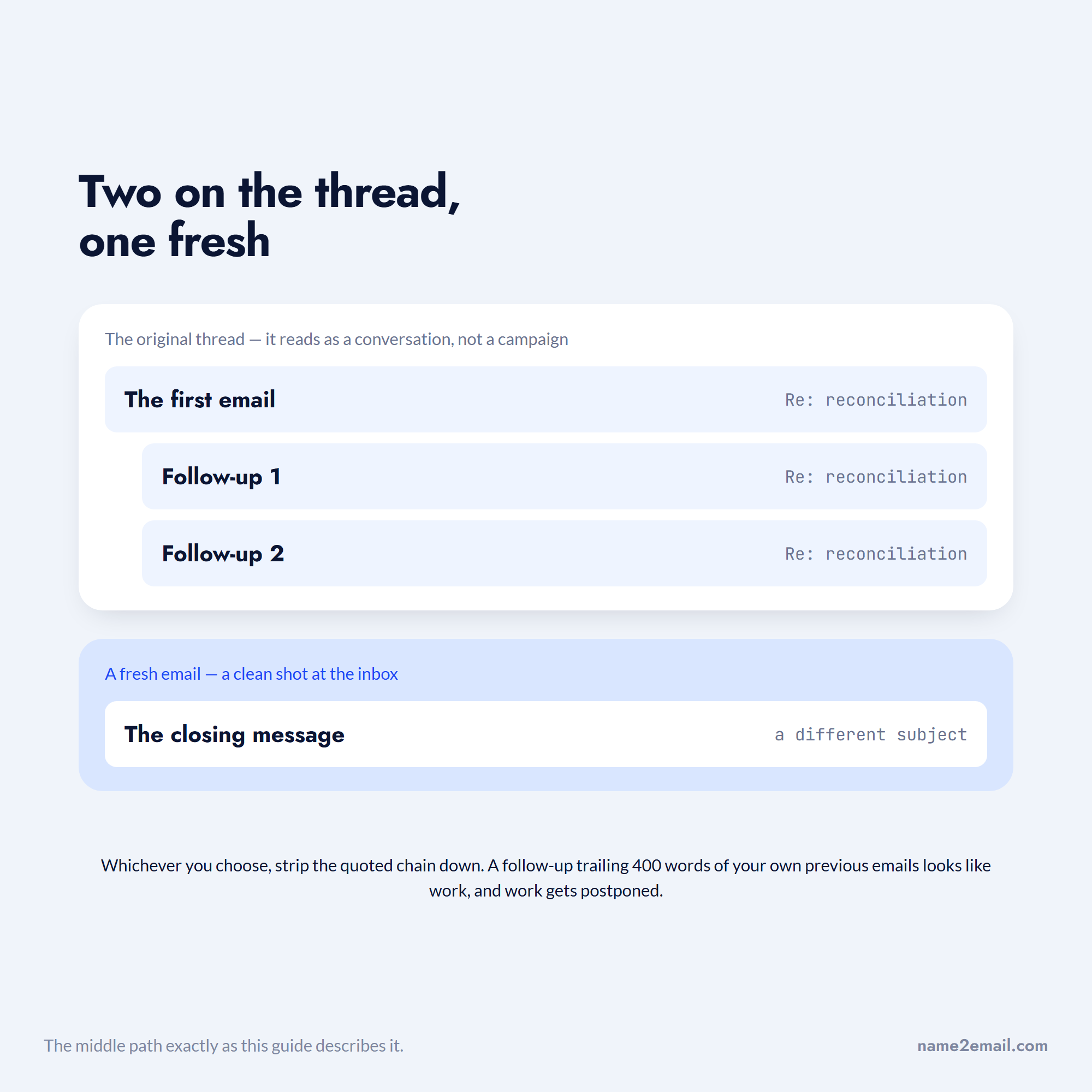
A practical middle path: keep follow-ups one and two on the original thread, then send the final message as a fresh email with a different subject. That way the sequence reads as a conversation while the last attempt gets a clean shot at the inbox.
Whatever you choose, strip the quoted chain down. A follow-up that trails 400 words of your own previous emails underneath it looks like work, and work gets postponed.
Should You Use a Follow-Up Cold Email Generator?
AI tools that generate follow-up sequences are now standard inside most outreach platforms, and they are genuinely useful for structure.
Where they help is drafting the skeleton, varying sentence construction across a sequence so messages do not read as identical, and translating a proven sequence into a new vertical.
A follow-up cold email generator fails on relevance. A generator has no idea that your prospect just announced a funding round, changed roles, or shipped the exact feature your product complements. That specific detail is what makes a cold email land, and it is precisely what generated copy lacks.
There is a broader reason to keep a human in this loop. Gartner predicts that by 2030, 75% of B2B buyers will prefer sales experiences that prioritize human interaction over AI. As generated outreach volume rises, the messages that read as written by a person become more distinctive, not less.
Use a generator for the scaffolding and write the first line yourself.
Automating the Sequence Without Sounding Automated
Once you are sending more than a handful of sequences, doing this manually stops being realistic.
Sequencing platforms handle the timing, stop the sequence automatically when someone replies, and rotate sending across mailboxes to protect deliverability. That last part matters: sending a four-touch sequence to hundreds of contacts from a single unwarmed mailbox is how domains get flagged.
The features that actually matter are reply detection, mailbox warmup, and conditional branching so that someone who opens but does not reply gets a different message from someone who never opened. Our roundups of the best cold email software and email outreach tools compare the platforms on those points, and sales automation tools covers the wider stack.
Whatever you automate, keep the personalization variable that carries the relevance signal filled in by hand for anything high-value.
The Part That Happens Before the Sequence
A follow-up sequence multiplies whatever you point it at, including a wrong address.
If the address is wrong, all four touches bounce, and repeated bounces from one domain do lasting damage to your sender reputation. That is a slow, expensive way to learn that the contact never existed.
Name2Email handles the address side free. Type a name and company domain in Gmail's compose window, we generate the likely formats, populate the "To" field, and you confirm the right one by hovering, because Gmail shows the person's name and photo when it recognizes an address. No credits, no cap, no account.
We are straightforward about the limits. We generate patterns from public naming conventions rather than a scraped database, we work best on corporate domains, and we cannot guarantee every address resolves. For building larger lists, the best email finding tools compares the paid finders, and finding an email address covers the free manual methods.
Putting a Sequence Together This Week
Start with three touches rather than four, and add the fourth only once the first three are working.
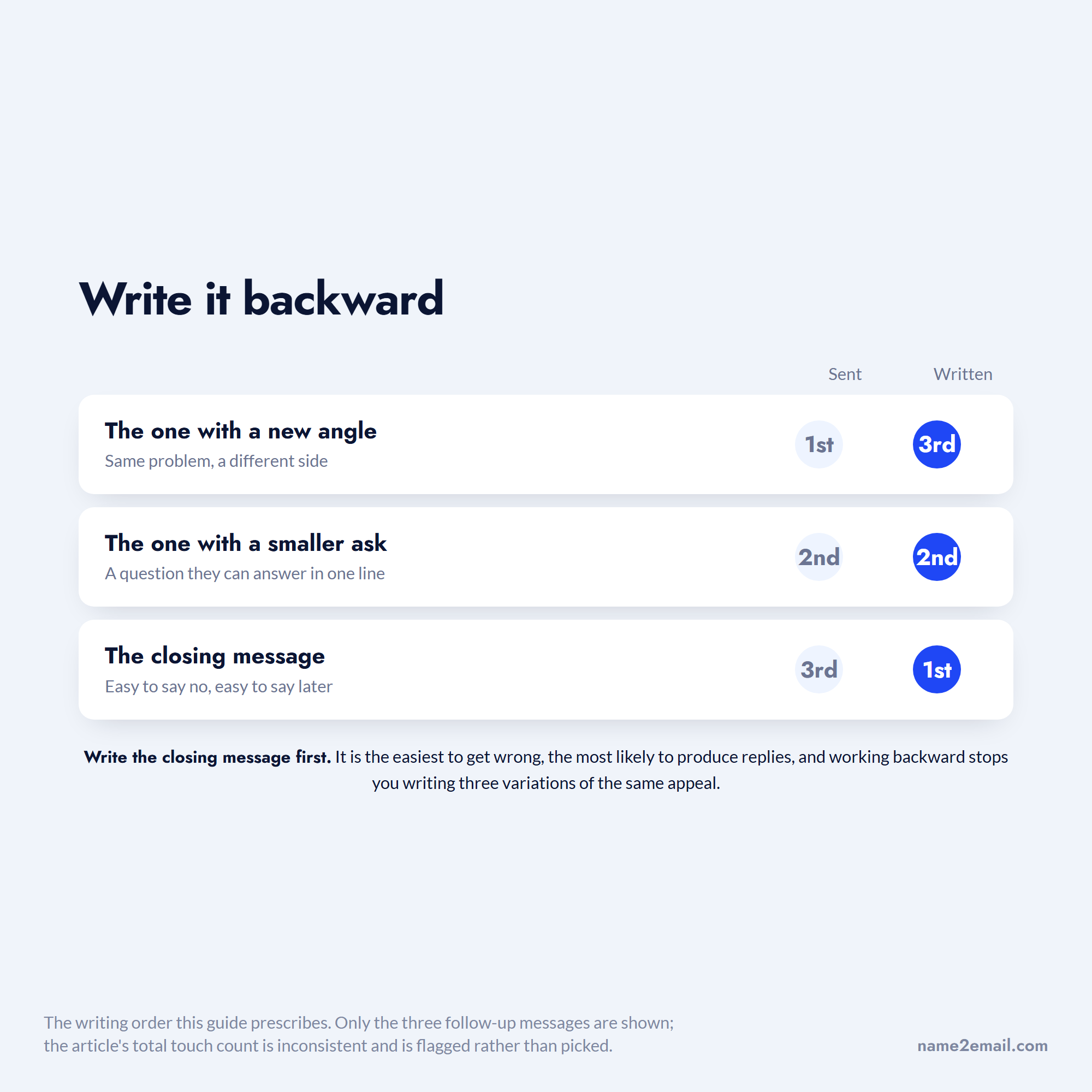
Write the closing message first, because it is the easiest to get wrong and the most likely to produce replies. Then write the middle message with a smaller ask. Then write the second message with a genuinely new angle. Working backward stops you from writing three variations of the same appeal.
The order you write them in is the reverse of the order they go out.
Space them at day 0, day 4, and day 10. Stop when someone replies, and stop the whole sequence when someone says no.
Verify every address before the first send, since a sequence amplifies a bad list four times over. Add Name2Email to Chrome to get addresses free inside Gmail, and see how we compare if you are weighing the alternatives. For the closing lines themselves, how to end an email covers what actually prompts a reply.
Frequently asked questions
Three to four total touches over two to three weeks works for most B2B outreach. Backlinko and Pitchbox found that emailing the same contact more than once roughly doubles responses, so stopping after one message leaves most of your results unclaimed. Past four touches, reply rates flatten while spam complaints and unsubscribes rise, which damages deliverability for future campaigns. Stop after a clean closing message rather than continuing indefinitely.
Wait three to four days after the first email, then eight to ten days, then around two weeks for the final message. Widening the gaps as the sequence progresses reads as more natural and gives genuinely busy people time to surface. Following up the next day is the most common mistake, because no human chases a stranger that fast, so it identifies the message as automated immediately.
Add something the first email did not contain: a different angle on the problem, a specific result, or a smaller request. Reference the original in half a sentence, then make the new point. By the third touch, shrink the ask to a yes-or-no question such as whether they are the right person, which costs nothing to answer and often produces a referral. Never send a message whose only content is that time has passed.
Templates are useful for structure and dangerous for the opening line. Use them to fix the shape of a sequence, the timing, the shrinking ask, and the clean exit, then write the relevance signal yourself for each prospect. The detail that makes a cold email land, a funding round, a new role, a shipped feature, is exactly what a template cannot supply. Sending an unedited template is the fastest way to be identified and ignored.
They work for scaffolding and fail at relevance. AI generators are good at drafting a sequence skeleton and varying sentence construction so messages do not read as identical, which is genuinely useful at volume. What they cannot do is know the specific, current reason this prospect should care right now. Given that Gartner expects 75% of B2B buyers to prefer human-led sales experiences by 2030, use a generator for structure and write the personalized first line yourself.

We build Name2Email, the free Chrome extension that finds work emails inside Gmail. We write about outreach, prospecting, and getting more replies.
Connect →