- 1When CMS audited Medicare Advantage provider directories, it found 48.74% of listed locations carried at least one inaccuracy. Those directories are legally required, so a commercial healthcare file is unlikely to beat them.
- 2The federal NPI registry is free, official, updated daily, and covers every enumerated provider in the country. Almost no buying guide mentions it.
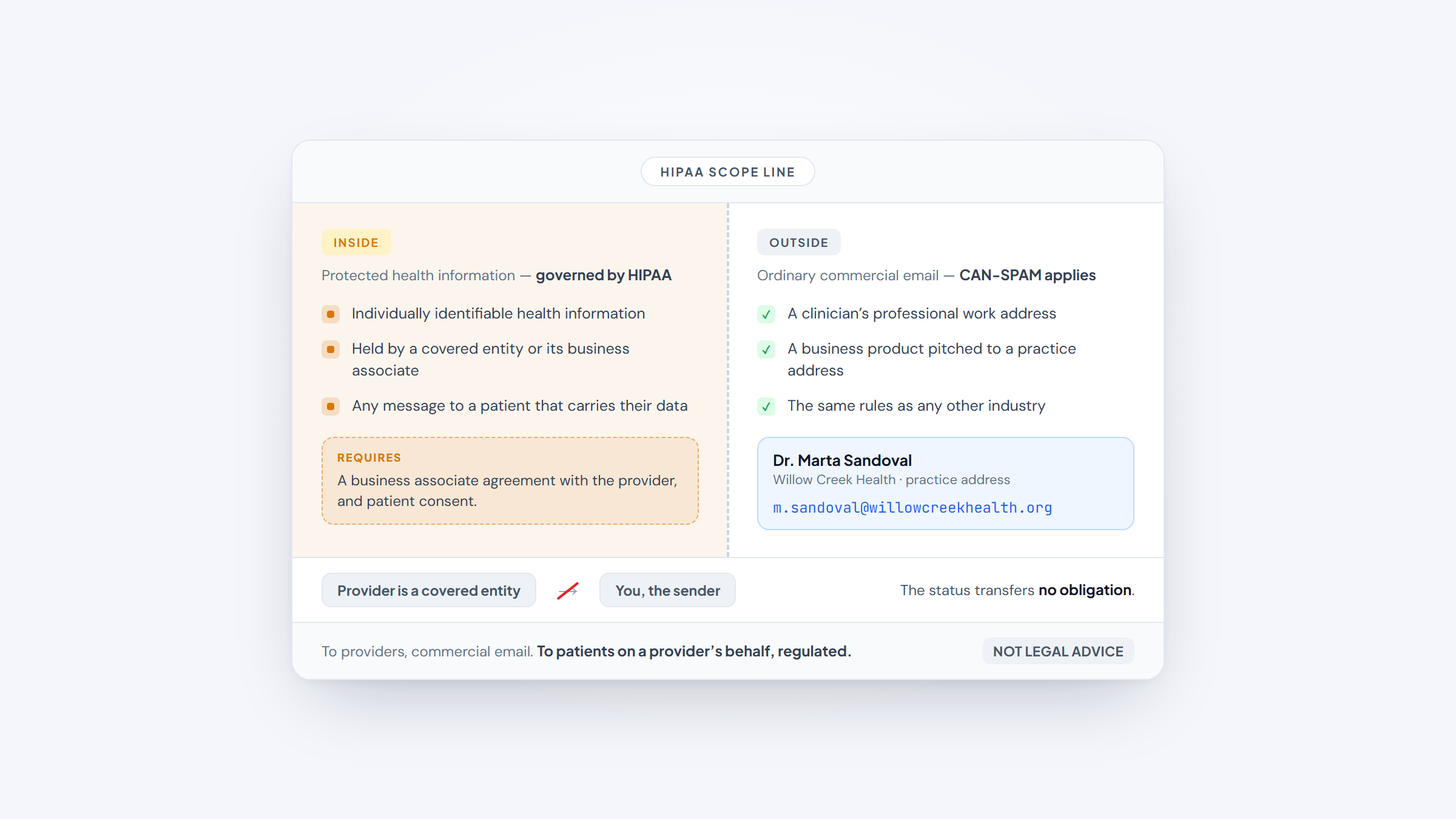
- 3HIPAA governs protected health information, not the existence of a clinician's work email. Business outreach to a provider's professional address is ordinary commercial email.
- 4The registry gives you a verified name, specialty, and practice address. Our free Gmail extension resolves the work address, and we hold no provider data.
Healthcare is the largest and least accurate segment of the B2B contact market, and the two facts are related.
There are more provider records than in almost any other vertical, the population changes constantly as clinicians move practices and change affiliations, and the sheer scale of the data makes verification expensive. What you end up buying is usually a large file of plausible records rather than a small file of true ones.
This guide covers how inaccurate healthcare contact data actually is, according to the regulator that measured it, where provider identity is published for free, what the vendors charge, and where HIPAA genuinely applies. Name2Email is ours, a zero-price Gmail utility for deducing a professional's address from their name and organization. We come in at the address step and sell nothing else.
Decide Which Healthcare You Mean First
"Healthcare" is four different markets wearing one label, and files sold under the single heading blend them badly.
Clinical providers are individual practitioners: physicians, nurses, dentists, therapists, pharmacists. They are enumerated federally, licensed by states, and reachable at practice addresses.
Facilities are organizations: hospitals, clinics, surgery centers, long-term care, home health agencies. A healthcare facilities email list targets these rather than people, so records carry general inboxes, department contacts, and published leadership.
Administrators and executives run the business rather than the care: chief medical officers, practice managers, revenue cycle directors, health system CIOs. They buy most of what is sold into healthcare.
Adjacent industry is everyone selling into the first three: payers, device manufacturers, pharma, health tech. A healthcare industry email list usually means this group, or an undifferentiated blend of all four, which is why the label tells you so little.
Laid out together, only one of the four is where the buying actually happens.
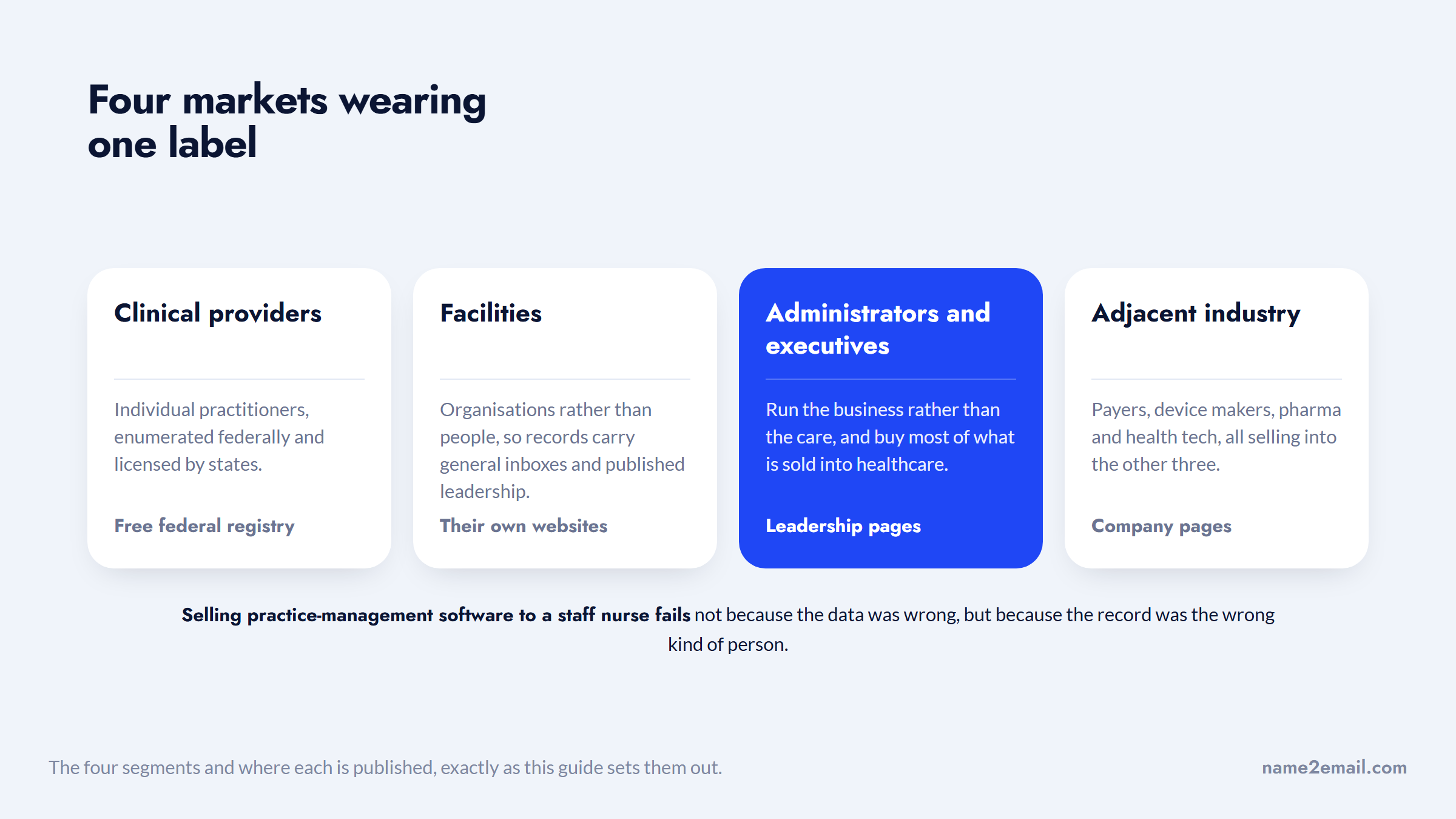
Most disappointing campaigns come from mixing these. Selling practice-management software to a staff nurse fails not because the data was wrong but because the record was the wrong kind of person. Decide which of the four you need before evaluating a single vendor.
The Regulator Measured the Accuracy, and It Is Bad
This is the number that should recalibrate every claim you read on a vendor page.
The Centers for Medicare & Medicaid Services ran its third round of Medicare Advantage provider directory reviews between November 2017 and July 2018, examining 5,602 providers at 10,504 locations across 52 Medicare Advantage organizations. It found that 48.74% of the provider directory locations listed had at least one inaccuracy: the provider was not at the location, the phone number was wrong, or the provider was not accepting new patients when the directory said otherwise.
Individual plan directories ranged from 4.63% to 93.02% inaccurate, and 28 of the 52 organizations fell between 30% and 60%. Inaccuracies serious enough to prevent access to care appeared in 41.75% of all locations.
Both figures come from the same audit, of the same 10,504 locations.
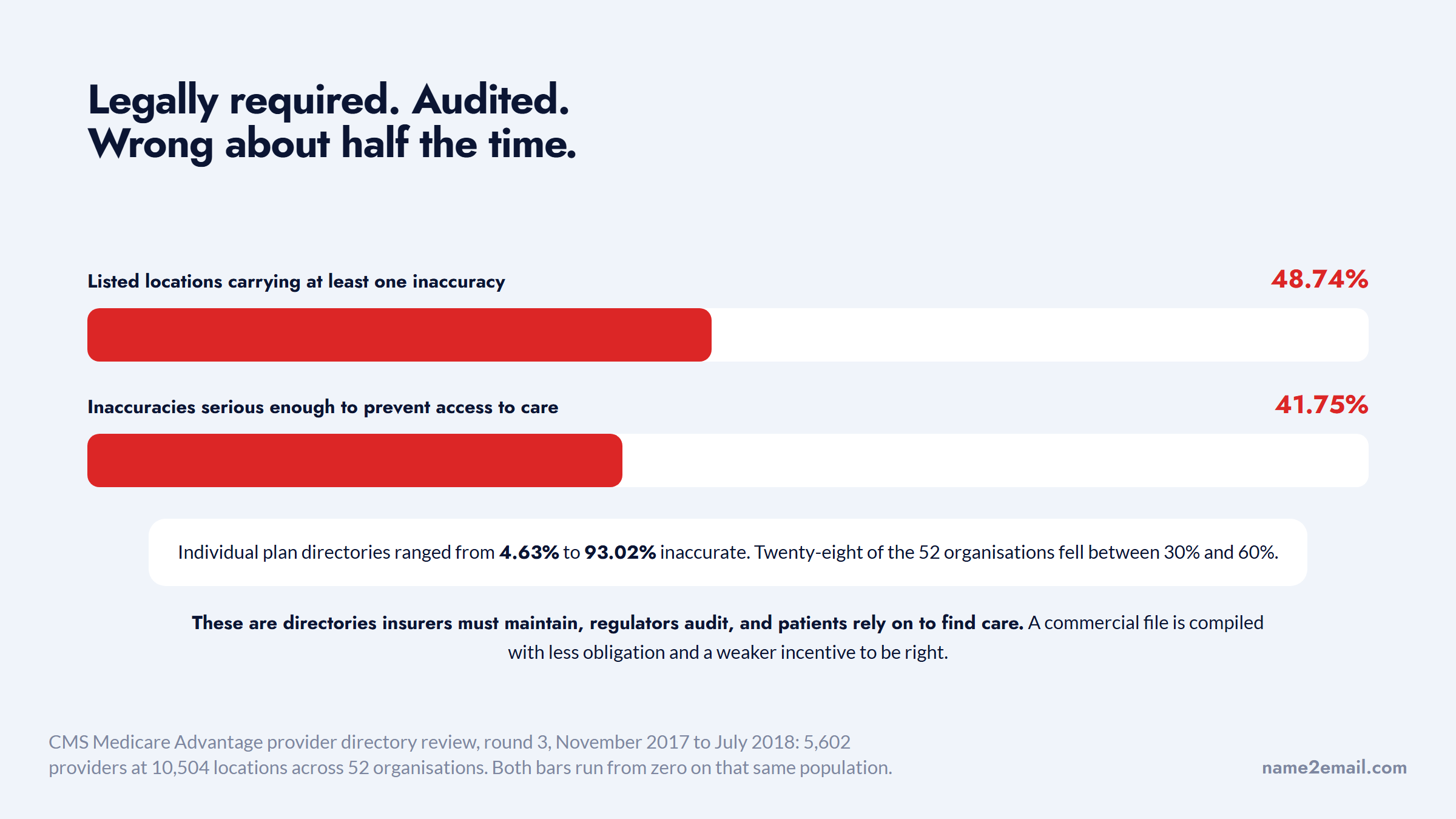
Sit with what that implies. These are directories that insurers are legally obligated to maintain, that regulators audit, that carry compliance penalties, and that patients depend on to find care. They are still wrong about half the time.
A commercial healthcare email list is compiled with less obligation, less audit, and a weaker incentive to be right. When a vendor advertises 95% accuracy on nine million healthcare records, the honest response is to ask what was measured, when, and by whom, because the best-resourced directories in the sector do not achieve it.
The Free Federal Register Nobody Mentions
Every provider who bills insurance in the United States has a National Provider Identifier, and the registry of them is public, free, and maintained by CMS.
Pulling Provider Records From NPPES
The registry is genuinely usable and needs no account, which makes it the best starting point in this guide.
- Search the NPI Registry at the CMS public lookup. You can query by name, organization, specialty taxonomy, city, state, or postal code, with no login and no rate card.
- Filter by taxonomy code rather than free-text specialty. Taxonomy codes are standardized, so filtering on them gives you a clean specialty segment instead of a keyword match on inconsistent job titles.
- Separate individual from organizational records. NPI type 1 is a person, type 2 is an organization, and mixing them is the fastest way to build an unusable file.
- Take the practice location, not the mailing address. The registry carries both, and the mailing address is frequently a billing service in another state.
- Use the full monthly data file for volume. CMS publishes a complete downloadable dataset rather than making you scrape the search, which is the intended route for anything beyond a few hundred records.
What you get is a name, an NPI number, a specialty taxonomy, a practice address, a phone number, and credentials, all from the federal source of record. What you do not get is an email address, because NPPES was built for claims processing rather than marketing.
That single gap is why the vendor market exists. The identity layer is free and authoritative; the contact layer is not.
Three choices inside the registry decide whether what you pull out of it is usable.
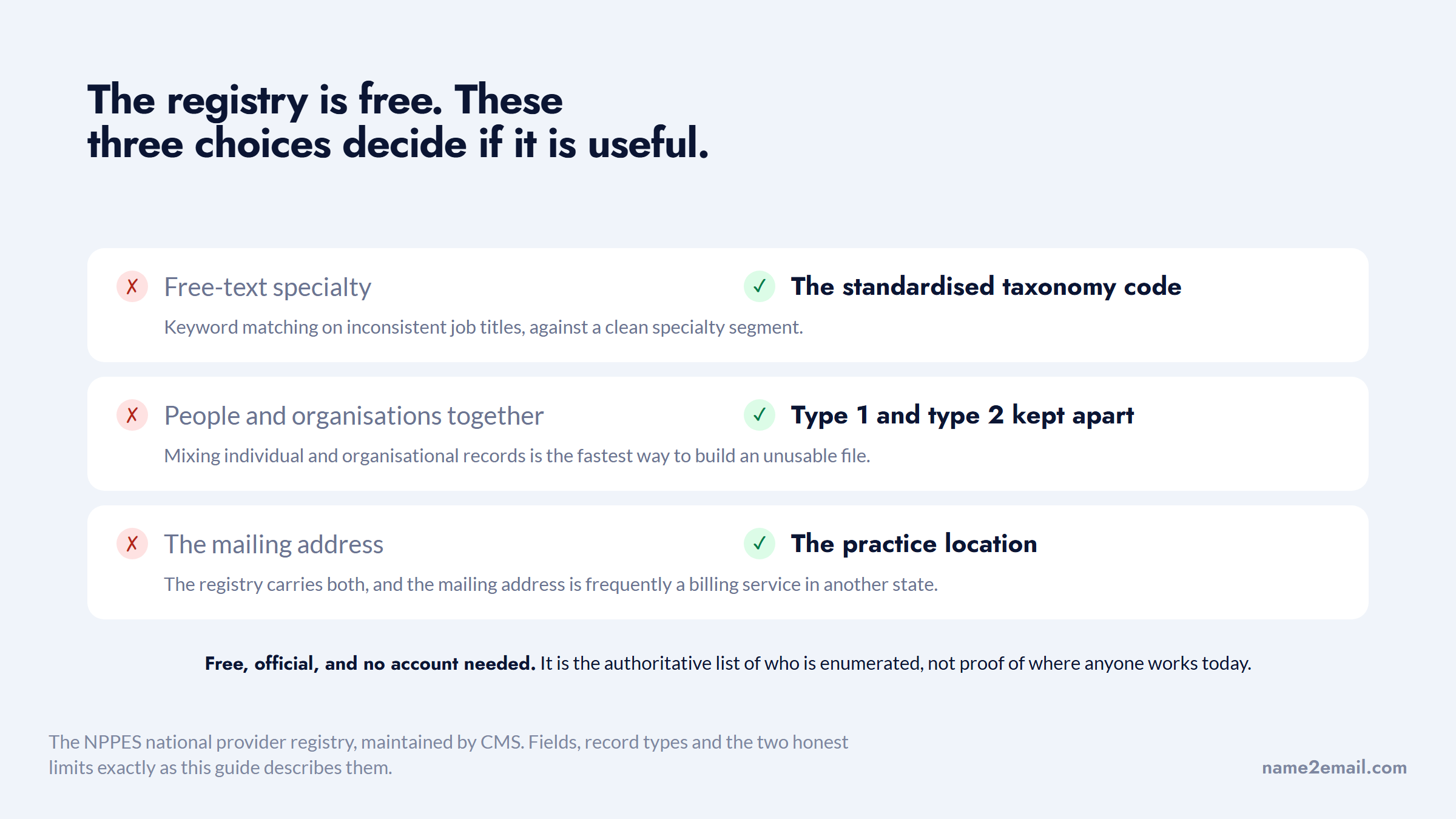
Two honest limits are worth knowing. The registry depends on providers updating their own records, so practice addresses lag reality, and it includes deactivated identifiers alongside active ones in the full file. Treat it as the authoritative list of who is enumerated, not as proof of where someone works today.
State Boards and Facility Leadership Pages
The federal registry covers providers who bill. Two other free sources fill the gaps around it.
State licensing boards publish license status, disciplinary history, and often practice location for every licensed clinician, including those who do not bill insurance. They are also the only practical route to an allied healthcare professionals email list, since therapists, technologists and assistants are licensed at state level. Each state runs its own lookup, which makes national coverage tedious, but for a single-state campaign it is both faster and more current than NPPES.
Facility leadership pages are the route to administrators and executives, who are the actual buyers for most healthcare technology and services. Hospitals and health systems publish their leadership, and larger systems publish departmental directors too. This is the segment NPPES cannot help with at all, because a revenue cycle director has no NPI.
Professional association directories, hospital newsrooms, and conference speaker lists round it out. A health system CIO speaking at a conference has told you their name, their system, their priorities, and their availability, which is more than any purchased record contains.
Where a facility publishes a general inbox and no names, a reverse lookup on that address will sometimes surface the individual behind it.
Size the Market Before Anyone Quotes You
Vendor coverage claims are much easier to judge against the real denominators.
Population | Count | Source |
|---|---|---|
All US hospitals | 6,100 | AHA Fast Facts 2026 |
Community hospitals | 5,121 | AHA Fast Facts 2026 |
Nongovernment not-for-profit community hospitals | 2,984 | AHA Fast Facts 2026 |
Investor-owned for-profit community hospitals | 1,224 | AHA Fast Facts 2026 |
State and local government community hospitals | 913 | AHA Fast Facts 2026 |
The American Hospital Association counts 6,100 hospitals in the United States. That number is small, fixed, and knowable, which has a useful consequence: if you are selling to hospitals rather than to clinicians, you do not need a list vendor at all. Six thousand organizations is a research project, not a data purchase.
Broken down by ownership, the whole hospital market still fits on one screen.
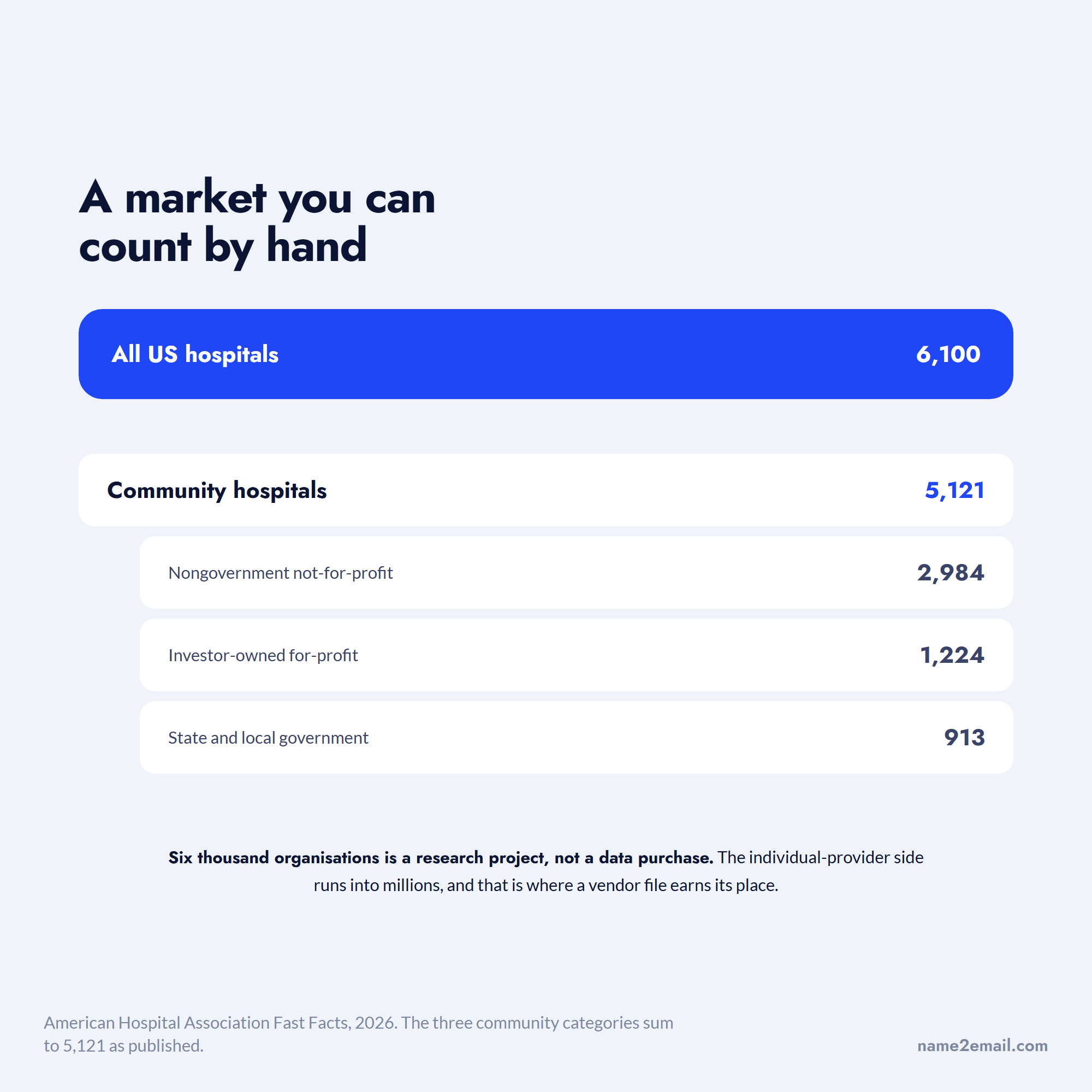
The individual-provider side is far larger, running into millions of enumerated identifiers nationally. That is where vendor files earn their place, and also where the 48.74% accuracy benchmark should shape your expectations.
What Healthcare Data Vendors Charge
This corner of the market is almost entirely quote-driven, more so than any other vertical covered in this cluster.
Vendor | Coverage claimed | Published price | Focus |
|---|---|---|---|
Reply.io | 1B+ contacts, not healthcare-specific | From $59/user/mo, 14-day trial | Outreach platform with bundled data |
InfoCleanse | 9M+ healthcare records | None; quote | Broad healthcare industry |
MedicoReach | Not stated publicly | None; quote | Providers plus campaign execution services |
Ampliz | Not stated publicly | None; quote, 50+ attributes | Physicians, nurses, executives |
LakeB2B | Not stated publicly | None; quote | Healthcare executives and facilities |
TargetNXT | Not stated publicly | None; quote, 25+ free samples | Buying-committee segmentation |
Definitive Healthcare | Facility and provider intelligence | None; quote | Facility-level market intelligence |
Reply.io appears first because it is the only row with a published price, and because honesty requires noting that Reply.io is the maker of Name2Email.
Reply.io is not a healthcare data vendor. Its database is general-purpose, bundled into an outreach subscription, and carries no NPI number, taxonomy code, or practice-setting field, which are the three attributes that make healthcare data useful. For provider targeting, the free federal registry beats it outright.
Every row was confirmed on the provider's own site in September 2026. Not one of the healthcare specialists publishes a rate, which makes cross-vendor comparison impossible without collecting quotes yourself.
Ask three questions of any quote. Which of the four healthcare segments does this file actually cover, since "healthcare" alone tells you nothing. When was each email address last validated, as opposed to when the file was assembled. And what is the replacement policy on bounces, which is the only claim in this category that costs the vendor anything if it is wrong.
Broader vendor-evaluation mechanics, including how to structure a sample test, are covered in our walkthrough of the outreach tools that sit downstream of the purchase.
HIPAA Does Not Mean What Most Guides Say
This causes more confusion than any other topic in healthcare marketing, and getting it wrong in either direction is costly.
HIPAA protects individually identifiable health information held by covered entities and their business associates. It governs patient data. It does not make a clinician's professional email address confidential, and it does not prohibit vendors from emailing providers about business products.
Emailing a physician at their practice address about scheduling software is ordinary B2B outreach governed by CAN-SPAM, exactly like emailing an accountant about tax software. The provider's own status as a covered entity does not transfer any obligation to you.
Where HIPAA does bite is patient communication. A thread in r/msp about running an email blast for a medical practice drew a useful practitioner distinction: keep protected health information out of the message and ordinary email tooling is fine, but the moment you want to send PHI you need a business associate agreement with the provider and patient consent. That is one anecdotal exchange rather than legal advice, and anyone handling patient data should take proper counsel.
The boundary is drawn around the content of the message, not around the recipient.
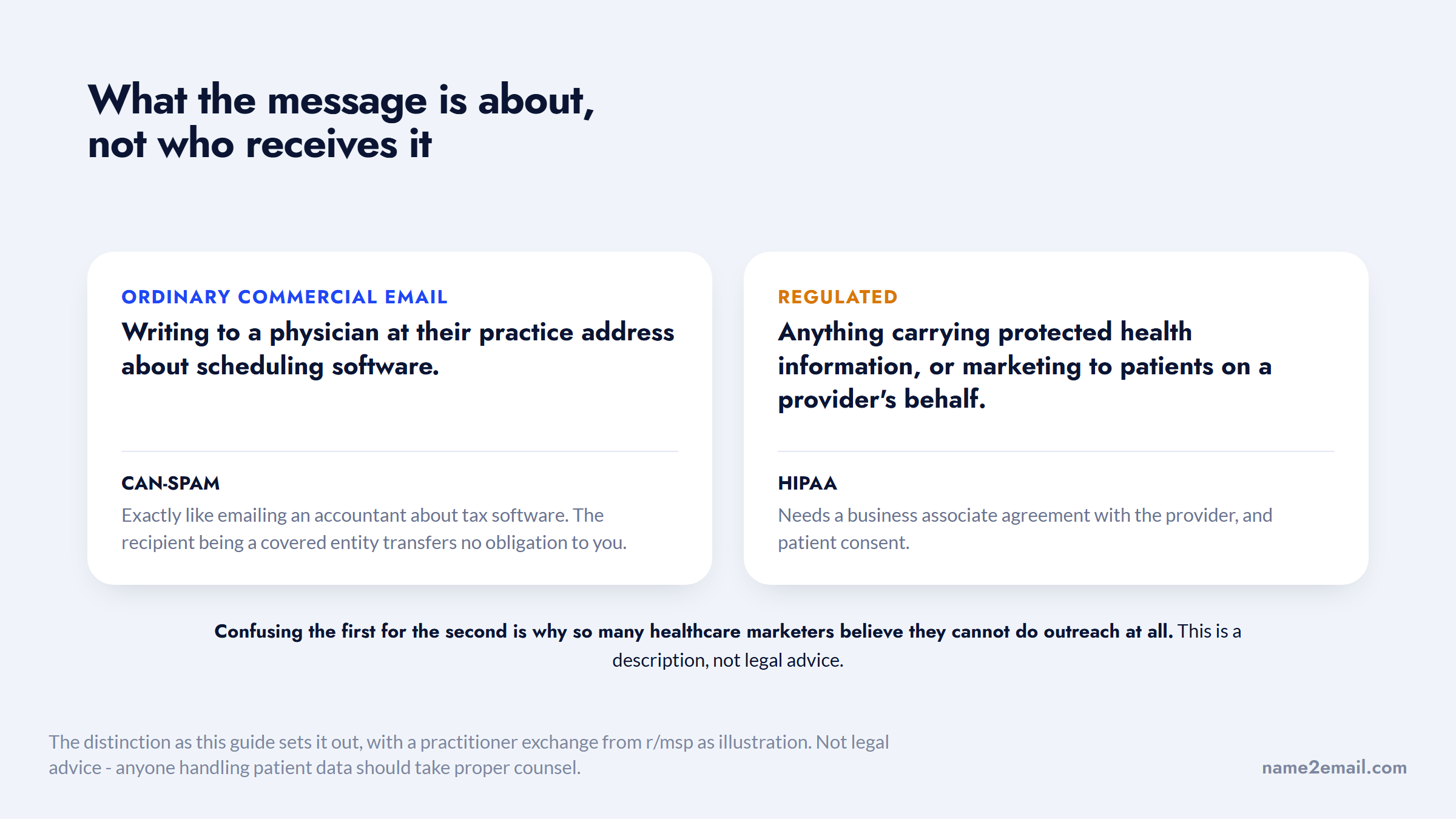
The line to hold is simple. Marketing to providers is commercial email. Marketing to patients on a provider's behalf is regulated. Confusing the first for the second is why so many healthcare marketers believe they cannot do outreach at all.
One mechanic follows from it either way. Provider outreach has to reach each recipient separately, because a visible recipient list in a clinical context reads as a disclosure even when no patient data is involved, and sending to recipients individually is a different operation from a marketing blast.
From an NPI Record to a Work Address
The registry hands you a verified name, a specialty, and a practice, and stops there. Bridging that gap is the actual work.
Start with the practice or facility domain, which is usually on the organization's website even when the provider's address is not. Larger systems apply a single convention across thousands of staff, so establishing the pattern once solves every subsequent provider at that organization.
This is where our extension fits. Feed it a clinician and their organization's domain, and the candidate formats drop into the To field; hovering reveals which one Gmail already associates with a real person. It costs nothing, has no lookup cap, and needs no signup.
Two things we are not, said plainly. We do not maintain or sell a provider database, and nothing about us touches patient information. We build candidate addresses from public naming conventions and confirm them through Gmail, we are most reliable on organizational domains, and some addresses will not resolve at all.
Small independent practices are the hard case, since a two-physician office often runs everything through one shared inbox and has no individual addresses to find. Large systems are the easy case, and they are also where the budget is. You can see the teams doing this across health tech sales, recruiting, and clinical research.
Segment on Setting, Not Just Specialty
Specialty is the obvious axis and rarely the most useful one. Practice setting predicts buying behavior far better.
Setting | Who decides | What they buy | Where to find them |
|---|---|---|---|
Health system or large hospital | Committee, IT and clinical leadership | Enterprise platforms, long cycles | Leadership pages, conference agendas |
Independent group practice | Practice manager or managing partner | Practice management, billing, staffing | NPPES, practice websites |
Solo practice | The clinician | Low-cost tools, fast decisions | State board lookups, NPPES |
Home health and hospice agency | Agency director or owner | Scheduling, compliance, workforce | State licensure lists, CMS agency data |
Payer or health plan | Procurement and clinical policy | Analytics, networks, care management | Company leadership pages |
A cardiologist in a 4,000-physician system and a cardiologist running a solo practice share a specialty and share no buying process whatsoever. Any file that segments only on specialty has thrown away the more predictive variable, so add setting yourself from the organizational NPI record.
Which setting actually responds is an empirical question rather than a judgment call, and per-segment email tracking on opens and replies answers it within a week.
Verify, Then Send Slowly
Healthcare domains punish sloppy sending harder than most, because health systems run strict filtering and many providers sit behind institutional mail gateways.
Verify the whole file rather than sampling it, and do it close to the send. Given how much of this data is assembled from patterns and how poorly even regulated directories perform, an unverified healthcare file is the highest-bounce-risk send in B2B. Doing that check inside Gmail before you send is covered in verifying an email address.
Warm large organizational domains gradually. Sending 800 messages into one health system in an afternoon is how you get the whole domain blocking you, which costs you every provider there rather than the ones that bounced.
Send individually rather than in visible groups. Providers share institutional inboxes and referral relationships, and a message that exposes a list of recipients reads as a data breach even when it is not.
Bounce rate on the first few hundred records tells you whether the rest of the file is worth sending at all, and it is cheaper to learn that at 300 records than at 30,000.
Small, Verified, and Segmented Beats Large
The healthcare data market sells volume because volume is what it has. The regulator's own audit says volume is not what it should be selling.
If you are targeting facilities, there are 6,100 hospitals and you can research the relevant ones directly. If you are targeting providers, the federal registry gives you authoritative identity for free and leaves you one solvable problem. If you are targeting administrators, they are on leadership pages and conference agendas, not in a clinician file.
In all three cases the winning list is a few hundred records you assembled and checked, not a few million you licensed. Start with one specialty in one state, or one health system, resolve the addresses, verify them, and send carefully. For the resolving part, install Name2Email and finish the job in the compose window, or watch how it works before committing an afternoon to it.
Frequently asked questions
No free file of deliverable provider email addresses exists, but the identity layer underneath one is free. The CMS NPI registry publishes every enumerated provider in the country with name, specialty taxonomy, credentials, and practice address, searchable without an account and downloadable in full. State licensing boards add clinicians who do not bill insurance. You assemble the roster at no cost and resolve the addresses yourself.
No. HIPAA governs protected health information held by covered entities and their business associates, not the business email addresses of clinicians. Emailing a physician at their practice address about a product is commercial email under CAN-SPAM, with the same rules as any other industry. HIPAA becomes relevant only when patient information is involved, which requires a business associate agreement and appropriate consent.
Treat advertised accuracy figures skeptically. CMS audited Medicare Advantage provider directories, which are legally mandated and regulator-reviewed, and found 48.74% of listed locations had at least one inaccuracy. Commercial files are compiled with fewer obligations and weaker verification incentives, so buy a sample, send to a few hundred records, and measure your own bounce rate before committing.
A healthcare professionals email list targets clinicians, so records are individual practitioners with specialties, credentials, and NPI numbers. A healthcare executives email list targets the administrative and business side: chief medical officers, CIOs, revenue cycle directors, practice managers. Executives buy most healthcare technology and services, so the second is usually the commercially relevant file even though the first is larger and more heavily marketed.
Start with the CMS registry filtered on the home health taxonomy codes, which returns both agencies and individual practitioners, then add state licensure lists, since these agencies are licensed at state level and those registers stay current. Agency directors and owners are the decision makers rather than visiting clinicians, so target organizational records and find the named leader on the agency's own site. That is also why a home healthcare nurses email list rarely converts: the nurses deliver the care, but they do not sign for software.

We build Name2Email, the free Chrome extension that finds work emails inside Gmail. We write about outreach, prospecting, and getting more replies.
Connect →