- 1General and operations managers held about 3.6 million US jobs in 2025 at a median wage of $105,770, which makes this the largest management occupation in the country and the least specific job title you can target.
- 2The three vendors that publish a general manager count range from 385,000 to 1,595,462, and the largest of those is a worldwide figure. Even read generously it covers under 45% of the US population alone, so this is one of the rare audiences where the files are too small rather than too big.
- 3Retail trade and professional services each employ 12% of general and operations managers, ahead of construction, wholesale and manufacturing at 7% each. Hotels are where the title is famous, not where most of these people work.
- 4Most single-site managers sit behind a role-based address such as gm@ or manager@, so the real sourcing job is building a list of locations and then finding the named person at each one.
Almost every guide to buying contact data warns you that vendors exaggerate. On this audience, the opposite is true, and it changes the whole approach.
A general managers email list is not one audience. It is a label stretched across a hotel manager who signs off on a linen contract, a car dealership GM running a profit and loss statement worth tens of millions, a retail store manager who cannot approve a $200 subscription, and a software company's GM of a business unit who behaves like a divisional president. The words are identical and the buying power is not remotely comparable.
That is why the vendor files come up short. There are far more of these managers than any database has bothered to collect, and the ones collected are sorted by a title that tells you almost nothing.
This guide covers how big the real population is, how to decode what the title means in each industry, why locations rather than companies are the right unit to source, and how to get from a site to a named person's address. We publish Name2Email, a free browser tool for the last step. We do not sell lists or contact data of any kind.
What the Title Actually Covers
Start with the size of the thing, because it explains why every list you can buy feels thin.
The Bureau of Labor Statistics tracks this role as general and operations managers, and its Occupational Outlook Handbook counts about 3.6 million of them working in the US in 2025, at a median wage of $105,770. For scale, that is more than twice the combined total of every licensed lawyer and every practicing dentist in the country.
The government's definition is refreshingly blunt about why the title is vague. General and operations managers, it says, oversee activities too diverse to be classified into one area of management. The job is defined by what it is not.
That vagueness is the whole problem with the audience. A title that means "runs things here" is applied by a corner store and by a Fortune 500 division, and no database can separate those two for you using the title alone.
The Same Two Words, Five Different Jobs
The useful move is to stop treating general managers as one audience and start treating the industry as the primary filter.
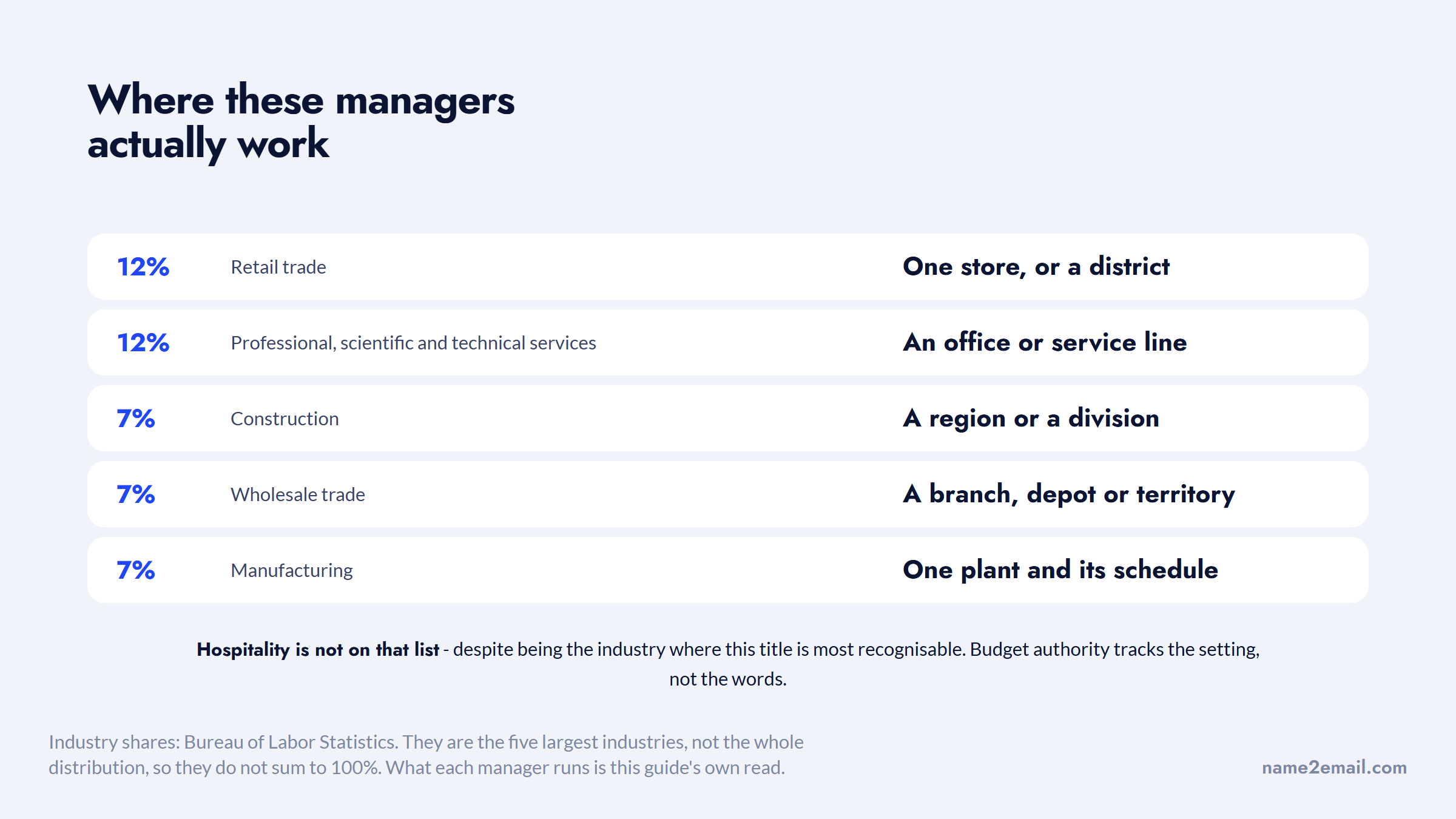
BLS publishes where these managers actually work, and the distribution is not what most people assume. Retail trade and professional, scientific and technical services each account for 12% of the total, with construction, wholesale trade and manufacturing at 7% apiece. Hospitality does not make that list, despite being the industry where the title is most recognizable.
The table below pairs those published shares with what the role tends to control in each setting. The first two columns come from BLS; the third is our own read of the job, not a government classification.
Industry | Share of the 3.6 million | What that manager usually runs |
|---|---|---|
Retail trade | 12% | One store, or a district of several |
Professional, scientific and technical services | 12% | An office, practice or service line |
Construction | 7% | A regional operation or a division |
Wholesale trade | 7% | A branch, depot or sales territory |
Manufacturing | 7% | A single plant and its production schedule |
Budget authority tracks the setting rather than the title. A plant GM and a dealership GM typically own a full profit and loss statement and can sign meaningful contracts. A retail store GM usually cannot buy anything that is not already on an approved corporate list, because procurement sits at head office.
The industry mix is the surprise, and what is missing from it is the bigger one.
Decide which of these you are selling to before you source a single record. Getting this wrong is the most expensive mistake available on this audience, because the list will look perfect and convert at nothing.
Why the Vendor Counts Land Under the Population
We read six vendor pages selling a general manager email list in September 2026 and checked every figure in the page body rather than the title tag. Three publish a count, three do not.
ContactOut is the largest at 1,595,462 verified general manager contacts across the US and globally, stated twice in its page copy. BookYourData shows a labeled "Total Verified Pool" of 329,695 with a 97% deliverability guarantee, priced per build from $499. Blue Mail Media claims 385,000 or more general manager emails out of a 500 million contact database.
Vendor | Published GM count | Published price | Worth knowing |
|---|---|---|---|
Reply.io | None | From $59 per user per month, 14-day trial, no free plan | Its database is bundled in the platform and never sold as a file |
ContactOut | 1,595,462, US and global | Not published on the page | Its CEO list shows 15,433,264 against 468,981 CFOs, a ratio worth questioning |
BookYourData | 329,695 total verified pool | Quoted per build, from $499 | The count sits under an explicit label rather than in the title |
Blue Mail Media | 385,000+ | Quote only | Claims USPS-verified and CASS-certified records |
Scott's Directories | None | Quote only | A Canadian database, ranking on a US query |
Span Global Services | None | Quote only | Its page title reads "Accountants Mailing Lists," its body is about general managers |
Now put those three published numbers against 3.6 million. The biggest covers under 45% of the US population, the smallest around 11%, and they sit fourfold apart from each other for what is supposedly the same job.
Put all three against the population and the shortfall is the whole story.
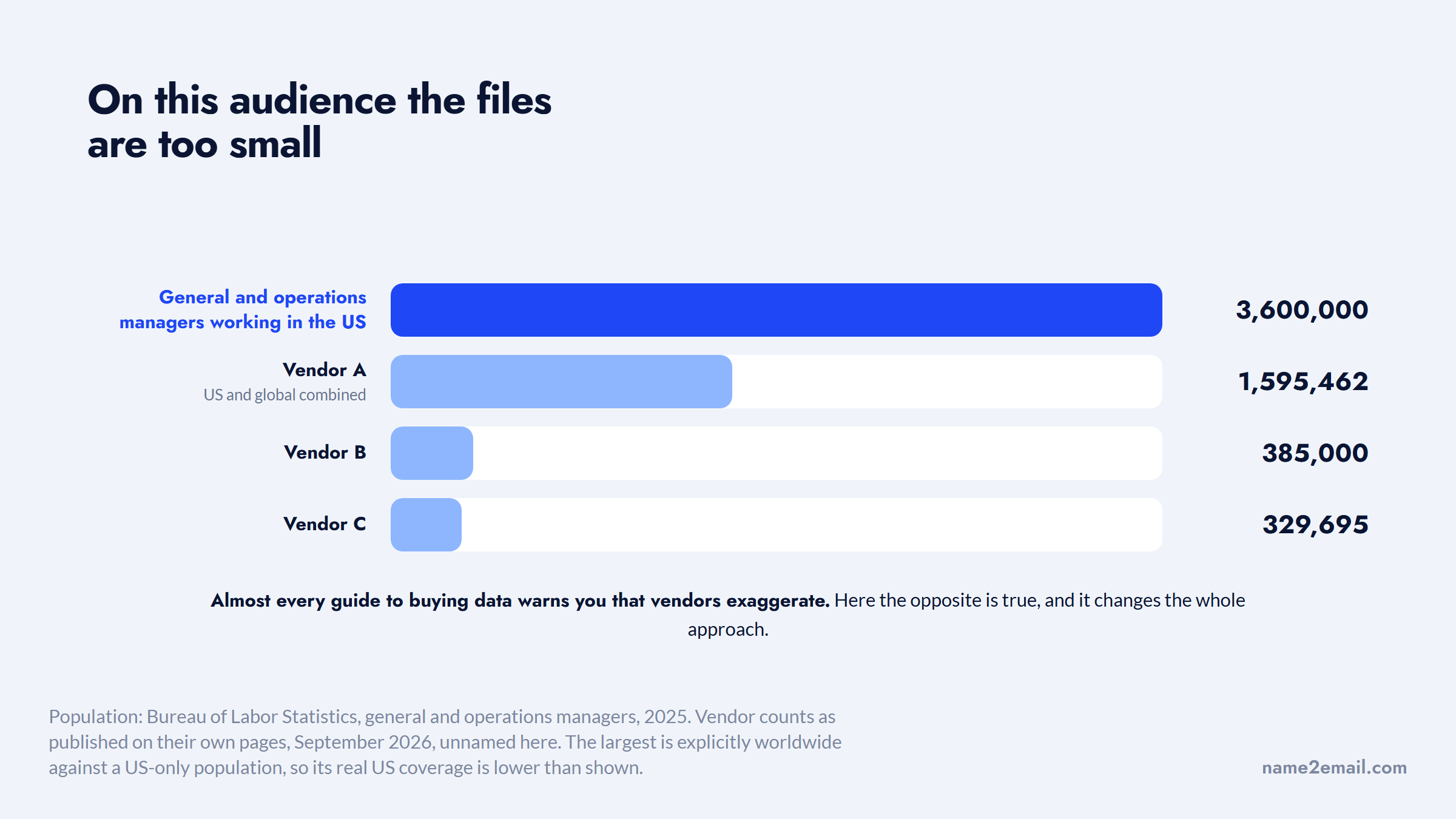
That comparison is generous to the vendors, because ContactOut's 1,595,462 is explicitly a worldwide figure while the 3.6 million is US-only. Its actual US coverage is lower than 45%, and the page does not break the two apart.
Two entries also fail a basic quality read. Scott's Directories publishes no general manager figure at all: the 900,000 companies and 6.1 million contacts in its header are the whole database, and the "Proudly Canadian" badge and English and French toggle make clear it is a Canadian file appearing on an American query. Span Global Services serves a page whose title tag belongs to its accountants and CPA product entirely.
None of this makes buying wrong, and a bought file can be a reasonable starting point for a segment you cannot reach otherwise. It does mean you should expect to do the industry sorting yourself, and it is worth reading up on list hygiene and maintenance before you commit to keeping one.
Step 1: Pick the Industry Before Anything Else
Every good general managers email list starts with a decision that has nothing to do with contact data.
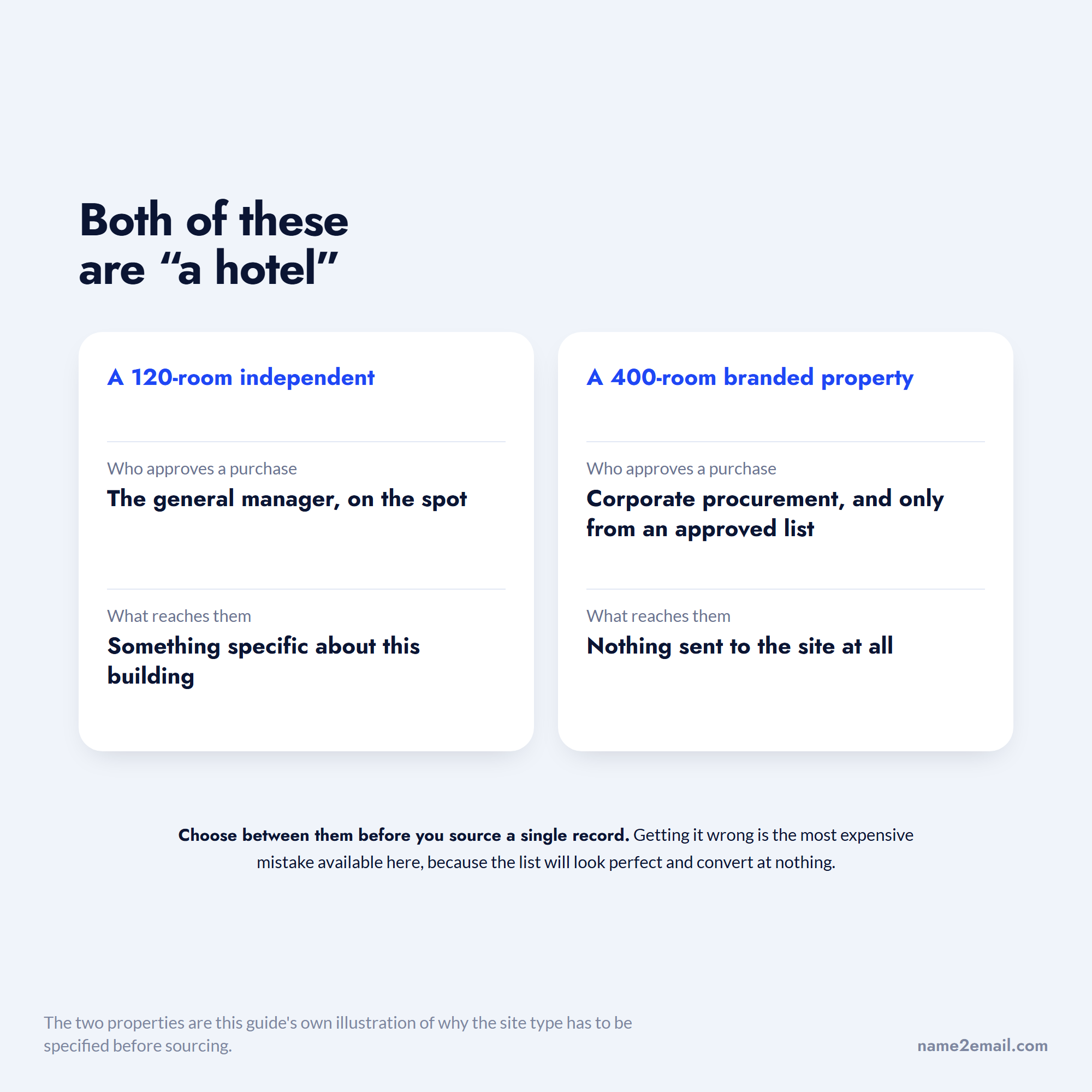
Name the industry and the site type you sell to, then describe the location you want in physical terms. A 120-room independent hotel is a different buyer from a 400-room branded property with a corporate procurement team, and both are called a hotel.
Side by side, the two properties do not even share an approver.
The next decision is a size threshold that matches your price point. If your product costs $500 a month, a single-site operator with eight staff cannot approve it, and you want either multi-site operators or a franchisee running several locations.
Write the definition down as a specification. Screening tools help you fill the list once you know what you are looking for, and the wider category of company research platforms is worth understanding before you pay for one, but no tool can make this decision for you.
Step 2: Source Locations, Not Companies
This is the step that separates a general managers email list that works from one that quietly targets head office.
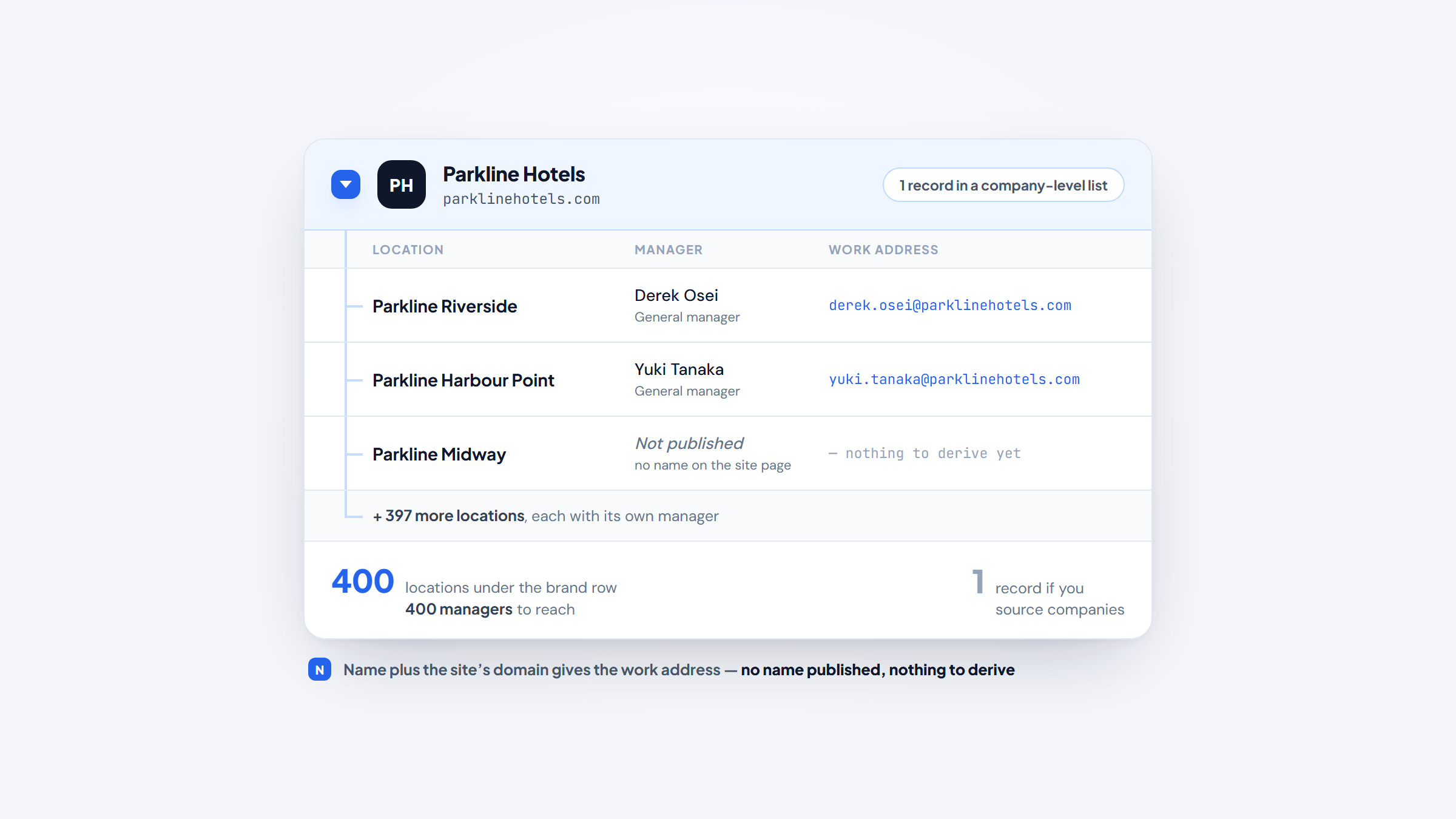
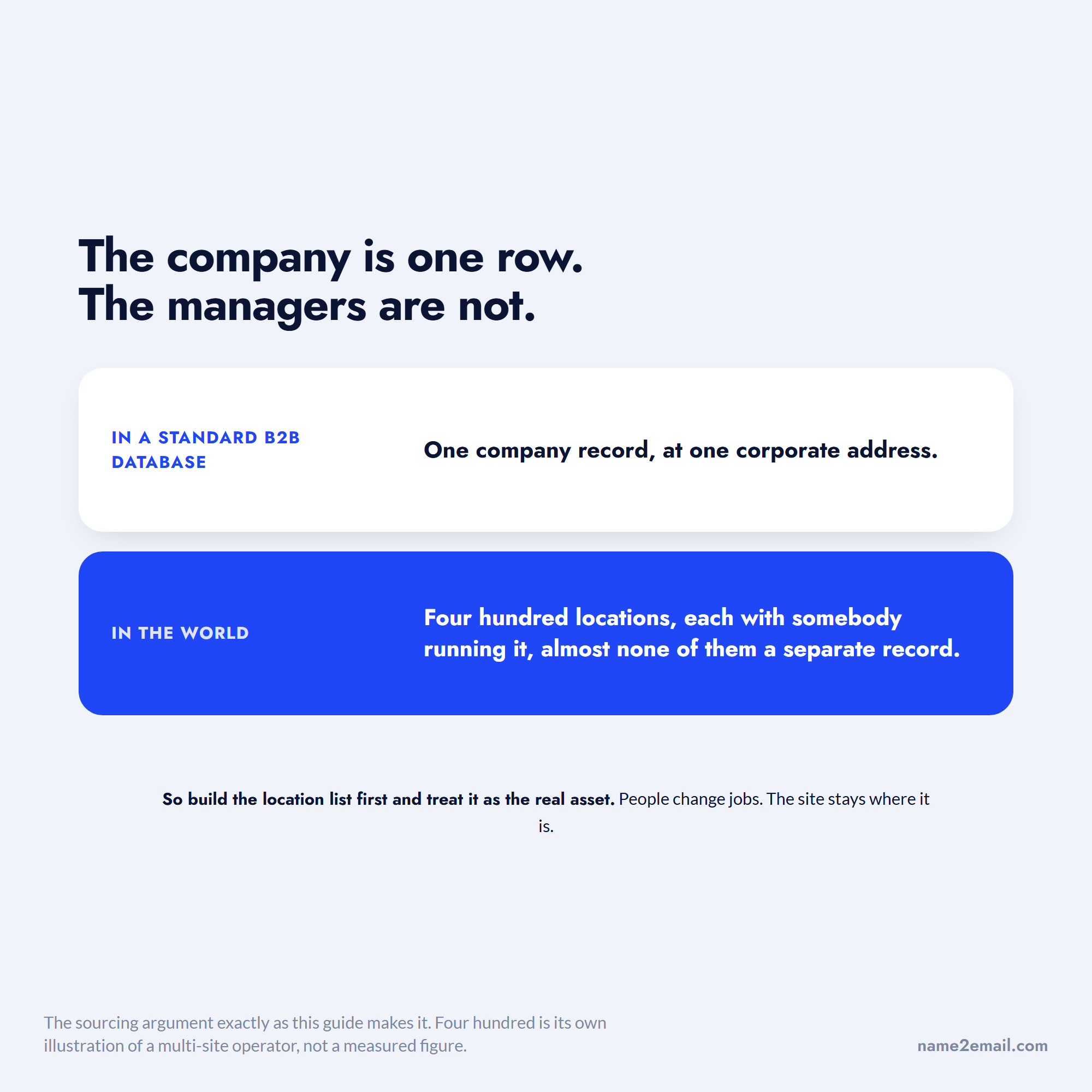
A general manager belongs to a site. The corporate entity might have one address in a database and 400 actual locations in the world, each with its own manager, and a company-level list gives you the one and misses the 400. Flip the unit of sourcing and the problem disappears.
One row in a database, against every site that actually has someone running it.
Franchise and multi-site operators are where this pays off most. The International Franchise Association's 2026 economic outlook projects US franchise establishments growing from 832,521 to 845,000 units this year, employing close to 8.9 million people. Every one of those units has someone running it, and almost none of them appear as separate records in a standard B2B database.
Brand store locators are the single best free source, because a chain publishes every location it operates and keeps it current for customers. Franchise disclosure documents list franchisees by name and territory. Local business registries, chamber of commerce directories and industry association member lists all give you sites rather than corporate parents. Mapping data covers the rest.
Build the location list first and treat it as the real asset. People change jobs; the site stays where it is.
Step 3: Get the Manager's Name
With a list of locations, the job becomes finding out who runs each one, and this is more tractable than it sounds.
Sites publish their own leadership more often than corporate directories do, which is why GM email addresses are easier to reach through the location than through head office. A hotel names its GM in press coverage and on its own team page. A dealership lists the management team. A plant manager appears in local business journal announcements and in permit filings. Where to look, roughly in order of hit rate:
- The location's own website team or about page
- Local business journal and trade press appointment notices
- LinkedIn, filtered by company and location rather than title alone
- Franchise association member directories
- Chamber of commerce and local business association listings
- Industry award and conference speaker listings
A phone call to the site is still the fastest method for a single high-value target, and it is entirely legitimate to ask reception who manages the location. Treat that as a tool for your best fifty accounts rather than your whole list.
Step 4: The Role-Based Address Problem
Here is the honest complication that separates this audience from an executive list, and it is worth naming before you build anything.
A thread in r/smallbusiness captures it exactly. Someone starting an IT services business asked how to reach hotel GMs, the replies suggested calling and asking for the decision maker, and a follow-up in the thread asked whether writing to info@hotel.com would do instead. That is one anecdote, and it is also the exact shape of the problem: at a single site, the published address is very often a shared one.
Shared GM email addresses are read by whoever staffs the front desk that day, and a cold email arriving there competes with booking requests and supplier invoices. It is not useless, but it converts far worse than a named address, and you should plan around that difference rather than discover it after a send.
The two kinds of address reach two different people and cost two different amounts of work.
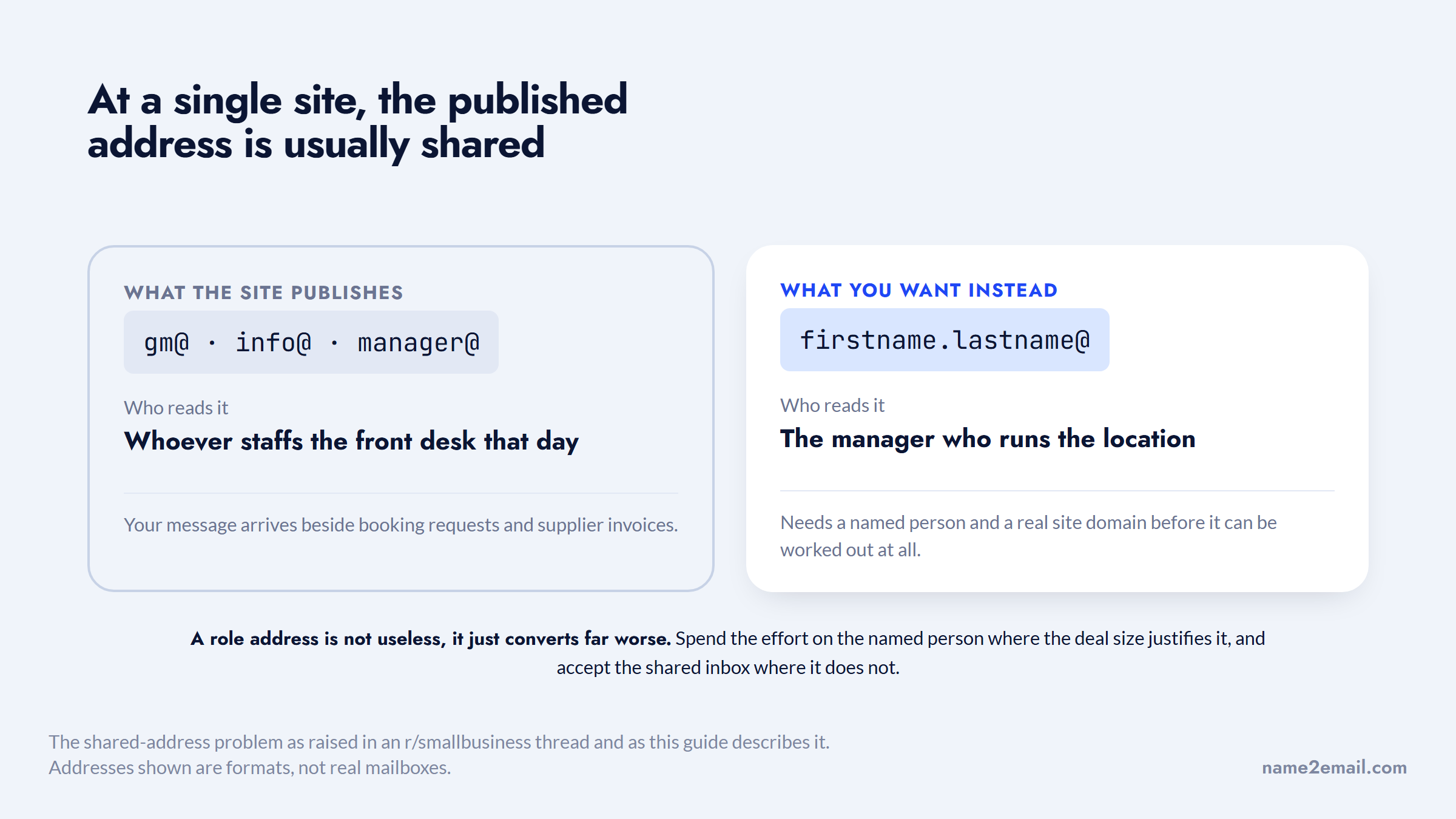
The practical rule is to spend your effort on the named person where the deal size justifies it, and accept the role address where it does not. A pattern-based finder needs a named person on a company domain, which is exactly the difference from a database that decides whether the next step works for a given record.
Step 5: Turn the Name Into a Work Address
Once you have a manager's name and the location's domain, the address is a solvable problem.
Our extension covers this step and nothing else. Install it, open Gmail, and put the manager's name beside the site's domain in the To field; the most probable formats appear as options, and Gmail's own contact recognition tells you which one is real by attaching a photo and a name to the address it knows.
The boundary is worth stating before you rely on it. We infer an address from how a given domain conventionally builds one, so a branded chain property gives us plenty to work with and an independent operator running the business off a personal mailbox gives us very little. No individual result is guaranteed.
Nothing here is metered. There is no signup, no card and no per-record charge, which is what makes it practical to grind through several hundred sites in an afternoon, and the five-step loop is identical whether you run it once or four hundred times.
Step 6: Verify Before You Send
Sampling matters more here than on most audiences, because the industry mix inside a purchased general managers email list is invisible until you look.
Pull 25 records at random from the general manager contact list and check each against the location's own website. You are answering four questions:
- Does this person still manage this specific site?
- Is this the industry and site type you defined in step one?
- Is the address personal or a shared role account?
- Does the domain match the site rather than a former parent company?
Count the failures and treat the result as your real quality figure. On this audience the useful number is not just the bounce rate but the share of records that turn out to be the wrong kind of manager entirely, which is what a title-sorted file hides.
Deliverability is a separate matter from accuracy, and the free tools in the email finding category vary a lot in how they handle it. Whichever you use, verify a sample rather than the whole file, then decide.
What Gets a Reply From Someone Running a Site
The person you are writing to is on the floor, not at a desk, and reads email between operational interruptions. Everything follows from that.
Be concrete about the site rather than the company. Referencing their specific location, its size, a recent renovation or a local pressure they are visibly dealing with beats anything about their corporate parent. It also proves instantly that you are not running a template across 40,000 records.
Keep the ask small and operationally framed. A general manager thinks in staffing, cost per unit, downtime, customer complaints and the monthly number, so lead with one of those rather than a feature. The basic mechanics of writing a good email matter more on this audience than on any desk-bound one, because a message that takes thirty seconds to parse simply will not get parsed.
Timing is worth respecting too. Monday mornings and Friday afternoons are the worst moments to reach anyone running a live operation.
Keeping a Location List Current
Site managers move often, and in hospitality and retail they move very often, so plan for maintenance from the start.
Structure the general manager contact list so the location is the permanent record and the person is a field on it. When a manager leaves, you update one field rather than losing the account, which is the entire structural advantage of sourcing locations first.
Set a review cadence by tier: quarterly for accounts you are actively working, annually for the rest. Bounces, auto-replies naming a successor and a reply from a different person are all triggers to update immediately. Running the check in reverse and looking up an address you already hold is often the fastest way to find out whether the manager behind it has changed.
Because finding a replacement manager's address costs nothing, a personnel change is a two-minute repair rather than a reason to repurchase. You can add Name2Email to Chrome free and find the next manager's address without leaving Gmail.
Frequently asked questions
It is a contact file of people whose job title is general manager, usually meaning the person running a single site or business unit. The label covers a very wide range: hotel and dealership GMs typically control a full profit and loss statement, while a retail store GM often cannot approve independent spending. Because the title is applied so broadly, an industry filter matters far more than the title itself.
The Bureau of Labor Statistics counted about 3.6 million general and operations managers in 2025, making it the largest management occupation in the country. Retail and professional services employ the biggest shares at 12% apiece, and three more industries sit at 7%. That population is far larger than any commercial database covers.
Because the population is enormous and site-level managers are poorly captured by company-centric databases. The three vendors we checked that publish a count range from 385,000 to about 1.6 million against a 3.6 million population, so even the largest covers under 45%. This is the reverse of most audiences, where vendor claims tend to exceed the real population.
Use the named personal address wherever the deal size justifies finding it, since shared inboxes like gm@ or info@ are usually monitored by front-desk staff alongside customer inquiries. A role address is a reasonable fallback for lower-value targets. Build your list so the named person is a field you can fill in later rather than a requirement upfront.
Start with the name, which a location's own website, a franchise directory or the local trade press will usually give you at no cost. With the name and the site's domain, the address can be derived from the format that domain normally uses. Our Chrome extension performs that derivation in Gmail, free and unmetered, though a manager on a personal mailbox rather than a branded domain will often come up empty.

We build Name2Email, the free Chrome extension that finds work emails inside Gmail. We write about outreach, prospecting, and getting more replies.
Connect →