- 1Email marketing leads are people who opted in and now expect to hear from you. A purchased list is a different thing, and it behaves like one.
- 2Most of the result is decided before the send: capture the address with a specific offer, segment it, and keep a cadence you can actually sustain.
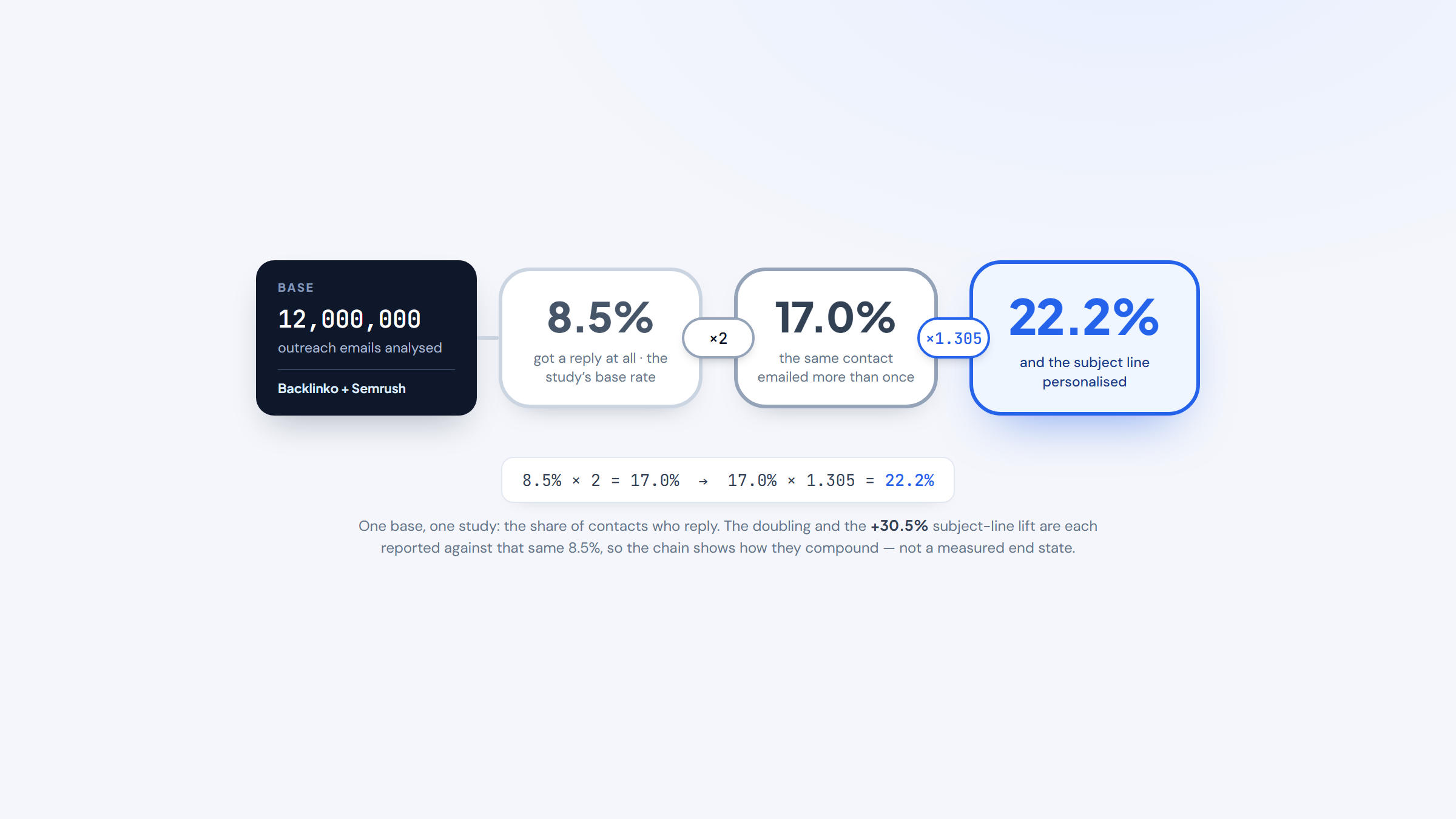
- 3Nurture is where subscribers become pipeline. Follow-ups roughly double responses, and a personalized subject line lifts them by 30.5% (Backlinko's study of 12 million outreach emails).
- 4Name2Email is a free finder that turns a prospect's name into a work address inside Gmail. It is not an email marketing platform, and it runs no campaigns.
Email is the channel everyone calls dead and the channel that keeps paying. Litmus measures an average return of $36 for every $1 spent, higher than any other channel. The catch is that the return comes from a list of people who asked to hear from you, not from a file you bought on a Friday afternoon.
This guide walks the whole path. It covers what email marketing leads are, how to generate leads through email marketing, how to grow and segment the list, and how to nurture subscribers into pipeline. It ends on the step most guides skip: turning a name and a company into a real, working inbox address.
What Email Marketing Leads Really Means
An email marketing lead is a person who gave you an address and a reason to use it. They downloaded the checklist, joined the webinar, or signed up for the newsletter. That permission is the asset, and it is the part you cannot copy from someone else's file.
The confusion starts because "lead" describes two different things. One is a subscriber who opted in. The other is a stranger whose address you scraped or bought, with no relationship and often no idea you exist. Only the first is email lead generation in any useful sense. The second is cold outreach in a costume, and it brings its own problems, which is why we file it under a different guide on how to buy email lists.
Keep the two apart in your reporting as well. An opted-in subscriber costs you an offer and some time. A purchased contact costs money per record and usually a knock to sender reputation. Blending them into one "leads" number hides which half is actually working.
Why Email Still Earns the Ask
Email survives because it is cheap to send, easy to personalize, and owned by you rather than rented from an ad platform. The economics are lopsided in a way most channels cannot match. Litmus research puts the average return at $36 for every $1 spent, and the spend is often a small monthly tool bill rather than a media budget.
The trade-off is speed. Email compounds slowly and decays slowly. A search ad can produce leads this afternoon and stop the moment you cut spend. An email list keeps producing after the campaign that built it is over, which is why the channel behaves less like advertising and more like an asset.
That gap is also why email marketing for lead generation rewards patience over bursts. The comparison below is the honest version, and it is why email should sit alongside paid channels rather than replace them.
Channel | Cost model | What you own | Time to first lead |
|---|---|---|---|
Email marketing | Tool subscription, near-zero per send | The list and the relationship | Weeks, then compounds |
Paid ads | Spend per click or impression | Nothing; traffic stops with spend | Hours |
Organic search and content | Time and production cost | The pages, not the audience | Months |
Cold email | Tool cost plus data cost per record | Nothing; each send is a new ask | Days |
Email and cold outreach are the pair people confuse most. Both use an inbox, and only one has permission behind it. We built Name2Email for the cold side of that line. Our work is finding a person's address rather than running a campaign, which you can see on our features page.
The Capture Layer: Turning Offers into Subscribers
Capture decides whether email marketing to generate leads works or stalls. A specific offer is what makes the channel reliable rather than random, because a generic "subscribe to our newsletter" box converts a fraction of what a targeted download converts.
The offer is the whole game. Pick the format that matches how your buyer already thinks about the problem, then make the exchange obvious on the page.
- A checklist or template that saves an afternoon of work.
- A short guide that answers one narrow question in full.
- A calculator or spreadsheet that produces a number the reader wants.
- A recorded webinar or demo for a considered B2B purchase.
- A discount or early access for a consumer product.
Once the offer exists, the mechanics are short. Put the form on a dedicated landing page rather than the homepage, ask for the email address first and everything else second, and tell the reader exactly what they will get and when. Every extra field costs conversions, so add a job title or company only when you will actually use it to segment.
The signup moment also sets up the relationship. A form that promises a weekly teardown should produce a weekly teardown. Under-deliver after the opt-in and the subscriber checks out before you ever get to nurture them. The welcome sequence is email marketing for lead nurturing in its purest form, delivered before a lead has a chance to go cold.
Treat lead gen email marketing as a loop rather than an event: offer, opt-in, welcome, measure, refine. Each turn of the loop teaches you which offer attracts buyers instead of freebie collectors.
Build the List Without Borrowing Trouble
A list you own is worth more than a list you rent, and the difference shows up the first time a provider changes its rules. Building your own means collecting consent, recording where it came from, and keeping the record clean.
Consent is the foundation of generating leads for email marketing that survive a deliverability change. US law treats commercial email as opt-out, so the baseline there is a working unsubscribe and a truthful sender. Across the European Union and the United Kingdom, opt-in consent is the stronger footing for marketing mail, and it is the version that crosses borders without friction. A double opt-in, where the subscriber confirms from their inbox, costs a little signup volume and buys a cleaner list.
Clean records matter as much as consent. Duplicates, dead domains, and role addresses each remove a slice of your email marketing leads list every month, and list hygiene is a discipline of its own. That tooling is the territory of email list management software. This article stays on the lead-generation process; the software that cleans and stores the list lives there.
One honest note before the list gets big. Not every lead arrives through a form. When you already know the person and the company and only the address is missing, that is the gap we built Name2Email for, and we come back to it at the end.
Segment Before You Write a Single Line
One list is never one audience. A webinar attendee, a newsletter reader, and a demo request sit at different distances from a purchase, and a single send to all three treats them as if they were the same person.
Segment on behavior first, not demographics. What someone downloaded, which page they visited, and whether they have replied all tell you more than a job title. A simple two-way split is enough to start: people who engaged in the last 30 days, and people who did not. Send differently to each, and watch the second group to decide when someone belongs on a re-engagement track.
Segmentation also protects deliverability. Mailbox providers judge you on how your audience behaves. Sending high-frequency offers to people who stopped opening trains those providers to route you to spam. A smaller engaged segment sent consistently beats a full-list blast every time, and it is where email marketing to generate leads stops depending on luck.
The Welcome Sequence Sets the Tone
The welcome sequence is the highest-value email you will ever send, because attention peaks right after the opt-in. Most lists waste it with one generic confirmation and then silence.
Write the sequence as a short arc. Confirm the subscription, deliver the thing you promised, set expectations for what comes next, and offer an easy first action. Four emails over the first ten days is a workable shape for most businesses.
The writing carries this sequence more than the design does. Short sentences, one idea per email, a subject line that earns the open. That craft is worth getting right, and our guide on writing a good email covers the structure from subject line to sign-off.
The table below shows one version of the arc. Treat it as a starting shape rather than a template to copy, because your offer and your buyer will pull it in different directions.
Timing | Its job | Example angle | |
|---|---|---|---|
1. Confirm | Immediately | Deliver the offer, confirm consent | "Here is your checklist, plus how to use it" |
2. Context | Day 2 | Explain the problem you solve | The one mistake the checklist prevents |
3. Proof | Day 5 | Show a result | A short before-and-after from a customer |
4. Ask | Day 9 | Invite the next step | A reply, a demo, or one specific question |
A good welcome sequence ends with a question rather than a pitch, because a reply is the strongest signal a new subscriber can send. That reply also tells you which offer actually attracts buyers rather than freebie collectors.
Nurture Mechanics: Cadence, Follow-Ups, and Personalization
Nurture is email marketing for lead nurturing run as a system rather than as occasional blasts. It is not a single campaign but the rhythm that carries subscribers between campaigns, and it means a defined cadence, a reason to keep sending, and a plan for the people who reply.
The biggest lever is the follow-up. Backlinko and Semrush analyzed 12 million outreach emails and found that only 8.5% get a response at all, but emailing the same contact more than once roughly doubled responses. Personalizing the subject line lifted response rates by 30.5%, and personalizing the body by 32.7%. The lesson holds for opted-in marketing mail too: the second and third touch do most of the work, and personalization is not decoration.
Cadence is a promise, and breaking it costs you the list. Pick a rhythm you can hold, whether that is weekly or twice a month, and keep it. The follow-up mechanics for colder outreach live in their own playbook, which our guide to cold email follow up covers in detail, because the two motions share a calendar but not a tone.
Turn Subscribers into Pipeline
A subscriber becomes pipeline when someone acts and a person on your team responds. Everything before that is audience-building. The handoff is where most email programs quietly leak value.
Score leads on behavior you can observe, not on a hunch. A webinar attendance, three visits to a pricing page, or a reply to a nurture email are all stronger signals than a checklist downloaded six months ago. When a score crosses a threshold, route the lead to a human with the context attached, so the first message is not a generic check-in.
This is where the finder earns its place. A form gives you an email address and usually little else. A raised hand gives you a name, a company, and a reason to reach out, and it often gives you no address at all. We built Name2Email for that exact gap, and our use cases are the roles that hit it most: founders, SDRs, recruiters, and anyone doing one-to-one outreach rather than one-to-many.
In email marketing B2B lead generation, the gap widens because the buying committee is rarely one person. The same is true of the wider practice of generating leads for email marketing: behind every record sits a person you may have to find. You may know the name of the operations lead and still have nothing to type into the To field. Resolving that one contact can be the difference between a sequence that stalls and one that starts.
Cost per Lead in Email Marketing
Cost per lead sounds like a paid-media metric, but it applies to email too, and working it out tells you which of your capture channels actually pays. The formula is simple: total spend on the campaign or the period, divided by the number of qualified leads it produced.
The number people get wrong is the denominator. A subscriber is not a lead until they show intent. Count every opt-in as a lead and your cost per lead looks wonderful while your pipeline does not. Count the people who took a step toward buying and the figure gets honest.
That is why any cost per lead email marketing figure needs one worked example rather than a table of averages. One campaign spent $400 on an offer and its promotion, and returned 200 subscribers, of whom 8 replied or booked a call.
Input | Value |
|---|---|
Campaign spend | $400 |
New subscribers | 200 |
Cost per subscriber | $2.00 |
Subscribers who booked or replied | 8 |
Cost per qualified lead | $50.00 |
The $2.00 per subscriber looks like a bargain. The $50.00 per qualified lead is the figure you can compare against a paid channel, and it is the one to track. Neither is good or bad on its own. What matters is whether the money returns more here than elsewhere, which is why cost per lead email marketing benchmarks only mean something against your own alternatives.
The Last Mile: A Subscriber Is Not a Prospect
Sooner or later the list runs out of people who already opted in, and you need to reach someone specific. You know their name and where they work. You do not have their address. That gap is the last mile of lead generation, and it is the one we built our free tool to close. Practitioners describe the same wall: in a thread on r/LeadGeneration, marketers trade ways to generate leads without buying data, and the recurring answer is manual research plus a finder rather than another export limit.
Name2Email is a free Chrome extension, and it lives where you already work: inside Gmail. Type a prospect's name and their company's domain into a new message, and we build the likely address formats for you, from first.last to a bare first name, and drop them straight into the To field. Gmail itself does the confirming, since it reveals the contact's name and photo once it recognizes a real address. You install it, and that is the whole setup: no account, no credit card, and no cap on lookups. That is the point: no per-lead cost and no paywall in the middle of your outreach.
We are honest about the limits, because the alternative wastes your time. We work from public naming conventions rather than a stored database, so we are strongest on corporate domains and weaker on personal addresses. We cannot guarantee every address, and we do not verify or validate deliverability. If you need verified, ready-made records instead of one address at a time, that is a different category of tool, and our best email finding tools roundup covers it.
What we do not do is send. Name2Email is a finder rather than an email marketing platform. It runs no campaigns of its own, and it sits at the front of the workflow, turning a name into an address you can write to; the sending and sequencing stay wherever you already run them. That boundary is what keeps the tool honest: we help you start a conversation, not manage a broadcast.
Measure the Numbers That Actually Move
Most email dashboards show a dozen metrics and only a few change a decision. Watch deliverability, open rate, click-through rate, and the conversion from click to lead, and treat the rest as diagnostics you reach for when one of the four moves the wrong way.
The ranges below are the common working benchmarks cited across email-marketing reporting, and they are guides rather than rules. A low open rate in a niche B2B list is normal, and a 2% click-through rate on a small, well-targeted list can still produce a healthy pipeline.
Metric | Healthy range | What a miss usually means |
|---|---|---|
Deliverability | 85% to 95% | List hygiene or sending reputation |
Open rate | 17% to 28% | Subject line, sender name, or list quality |
Click-through rate | 2% to 5% | Offer relevance or call to action |
Bounce rate | Under 2% | Stale or invalid addresses |
The discipline is to pick one number per week, change one thing, and measure again. A click-through rate that moves from 2% to 3% across a list of thousands beats a redesign nobody tested. Lead gen email marketing is a loop, and the loop only turns if you measure the turn.
Start With Permission, End With the Address
Email marketing for lead generation follows a sequence you control: capture with a specific offer, grow the list on consent, segment it, nurture it, and hand the real signals to a human. Get that order right and the channel pays for years.
One step no automation covers is turning a name into an address when the person never filled in a form. How to generate leads through email marketing when the list runs dry comes down to one move: finding the right inbox. When you reach that point, Add to Chrome and let us turn that name into a working address without leaving Gmail. It is free, unlimited, and built for the moment the list ends and the outreach begins.
Frequently asked questions
Email marketing leads are people who gave you permission to contact them, usually in exchange for something useful. They differ from cold contacts, who have no relationship with you and no expectation of hearing from you. That permission is what makes the lead usable, and it is what a bought or scraped record never has.
Start with one specific offer on a dedicated landing page, collect the address, and confirm it with a double opt-in. Then send a welcome sequence that delivers the promise, and keep a cadence you can hold. Reach someone who never opted in by finding their work email directly and writing a personal first message.
There is no universal number, because it depends on your offer and your market. Calculate your own by dividing total campaign spend by the number of subscribers who showed intent, not by every opt-in. Compare that figure against what the same money returns on a paid channel, and improve whichever is weaker.
Nurturing keeps a lead warm between the first opt-in and a buying decision. A defined cadence with follow-ups does most of the work, since extra touches roughly double response rates. Segment so each message stays relevant, and hand the strongest signals to a human rather than letting an automated sequence run forever.
Yes, for two reasons. The channel returns about $36 for every $1 spent, and email remains one of the channels B2B buyers use most for vendor contact. The work has moved, not disappeared: capture permission carefully, keep the list clean, and personalize the follow-up, because generic blasts are what stopped working.

We build Name2Email, the free Chrome extension that finds work emails inside Gmail. We write about outreach, prospecting, and getting more replies.
Connect →