- 1The American Dental Association counts 205,088 professionally active dentists in the US, while vendor pages advertise between 129,000 and 216,000 dentist records for that same population, and only one of them says how many carry an email address: 70,000.
- 2A dentist is rarely the person who reads the inbox. Only a third of dentists practice solo, and roughly one in six is affiliated with a dental support organization that makes buying decisions somewhere other than the operatory.
- 3State dental boards, the ADA's public directory and practice websites give you names and domains for free, which is most of a list.
- 4We built Name2Email to close the last step: you have the practice and the person, and you still need their actual work address.
Search "dentist email list" and you get fourteen landing pages promising verified dental contacts and almost no one explaining how dental practices actually buy. That gap matters, because the thing most of those pages sell you is a spreadsheet of practitioners, and the person who decides whether your product enters the office is usually not a practitioner.
This guide takes the other route. It shows you where dentist names and practice domains are published for free, how to read the vendor counts honestly, and how to turn a practice listing into a named person you can write to.
What a Dentist Email List Actually Contains
Almost every commercial dentist email address list is built around the individual license holder. You get a name, a credential, a practice address, sometimes a specialty and an NPI number, and one email address attached to that person.
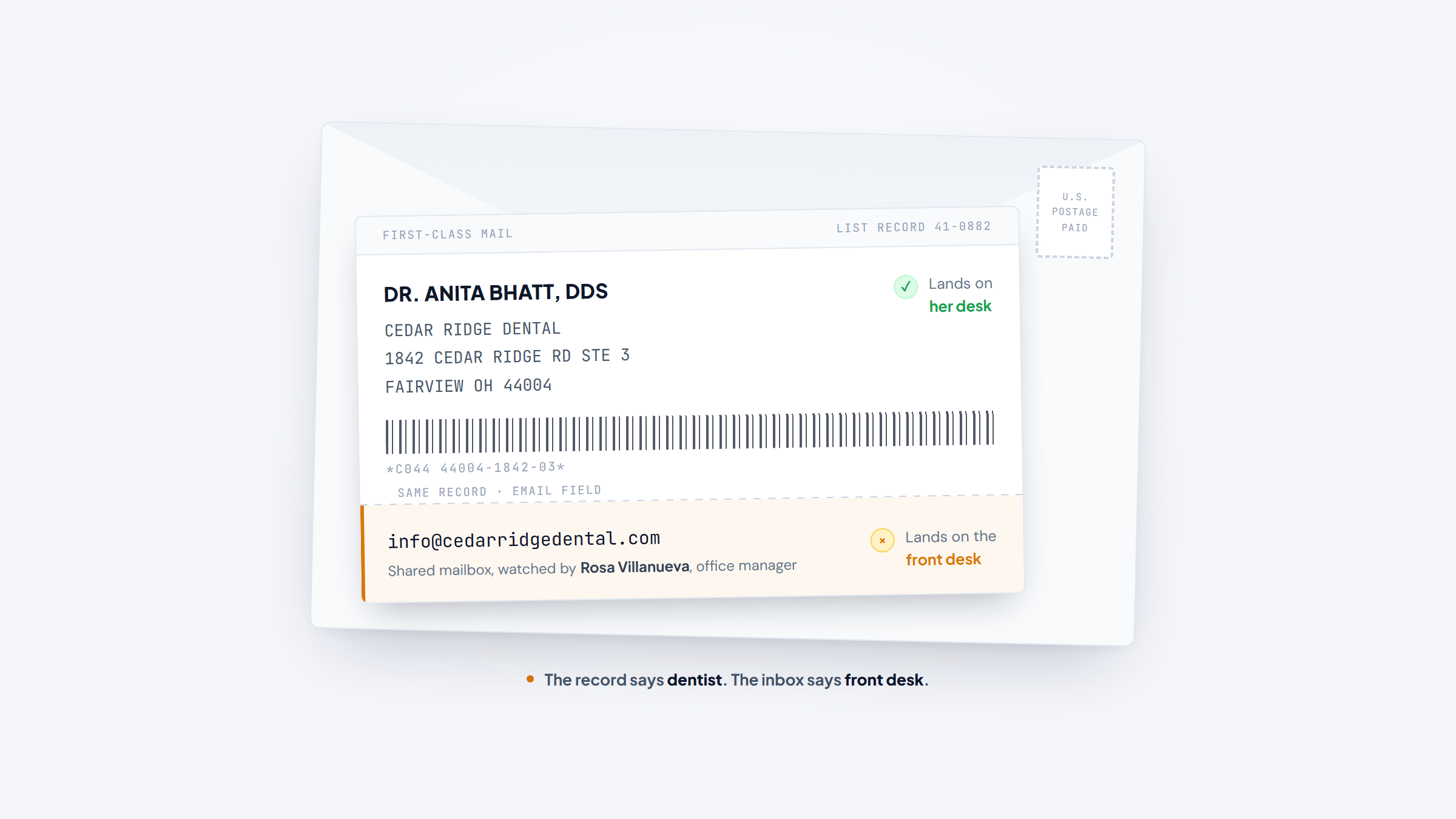
That structure is inherited from direct mail, where a letter addressed to Dr. Chen at a street address lands on Dr. Chen's desk. Email does not work that way. The address on the record is frequently a shared practice mailbox, and the person watching it is a receptionist or an office manager.
What you bought and who opens it are two different people, and the file cannot tell you so.
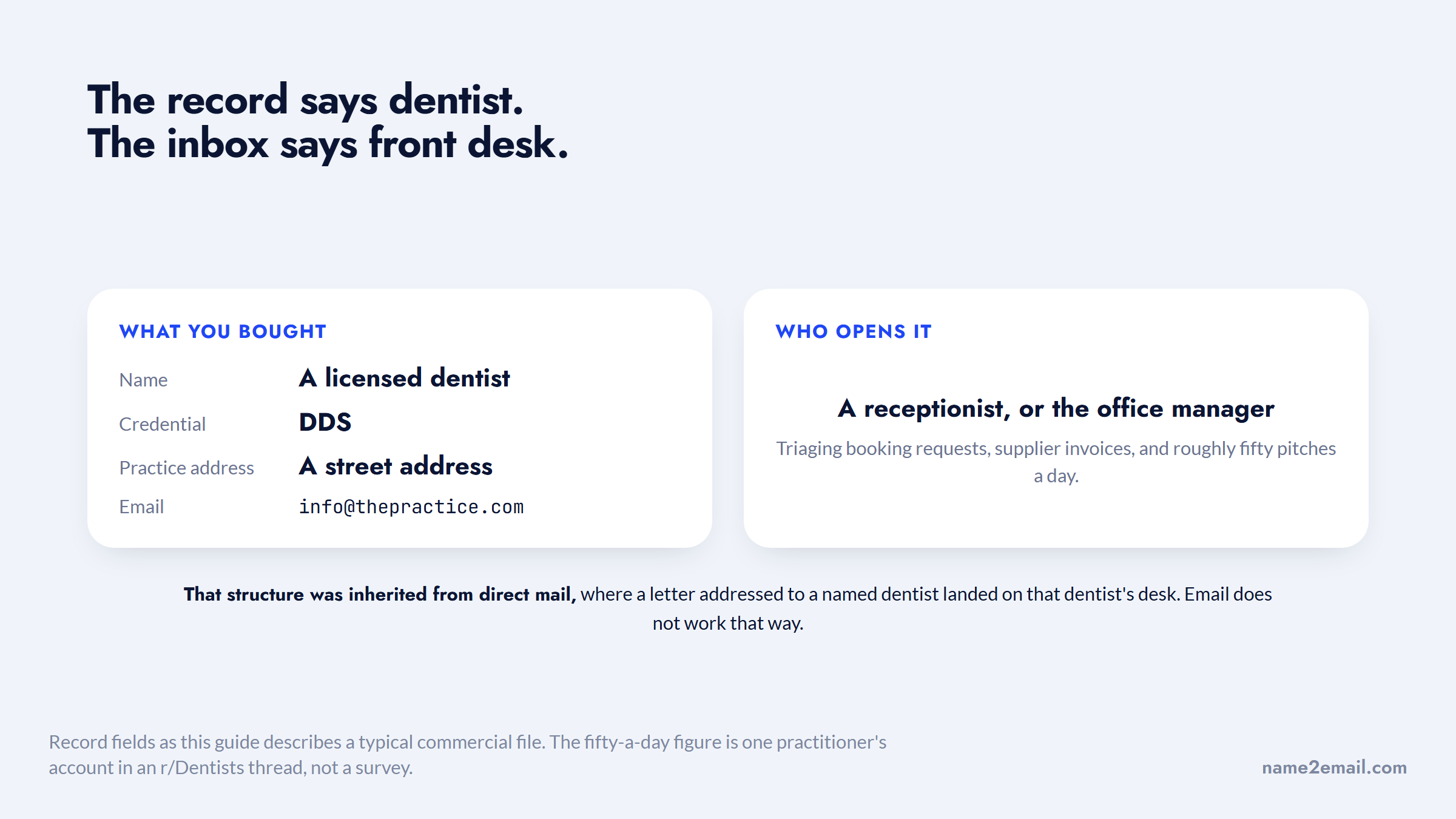
So the record says "dentist" and the inbox says "front desk." Every decision further down this page follows from that mismatch.
The Vendor Counts Do Not Reconcile
The ADA's Health Policy Institute puts the US dentist workforce at 205,088 professionally active dentists as of 2025, or 60.0 per 100,000 people. That is the number of people actually practicing, and it is the figure every vendor claim should be read against.
One caveat before the table, because our own numbers below cross it. A file can legitimately exceed 205,088 records without inventing anybody, since a compiled directory also carries retired and inactive licensees, dentists who have left clinical work, and duplicate entries for the same person at two practices. What it cannot do is give you more than about 205,000 dentists you could actually sell to.
Here is what the market advertises against that ceiling, with each figure read off the vendor's own page rather than its search-result title.
Provider | Published dentist count | Scope | Published price | What the page does not tell you |
|---|---|---|---|---|
Reply.io | None for dentists | Global, all industries | From $59/user/mo | Its 1B+ contact database is bundled inside the sales platform and is not sold as a standalone dental file |
MMS Lists | 216,000 dentists, 70,000 with an email address | US | Quote only | Sourced from compiled directories, so freshness depends on the underlying directory |
MedicoLeads | 154,000+ US, 214,000+ global | US and global stated separately | Quote only | Last refreshed August 2026; the larger number is the worldwide file |
InfoGlobalData | 129,000+ verified dentist email contacts | US | Quote only | No published breakdown by specialty or practice size |
iInfoTanks | None in the page body | Not stated | Quote only | Its page title advertises 234,000+ NPI contacts, a figure that appears nowhere in the page itself |
Hippo Direct | None published | US | Quote only | Directs you to email a named rep for current counts |
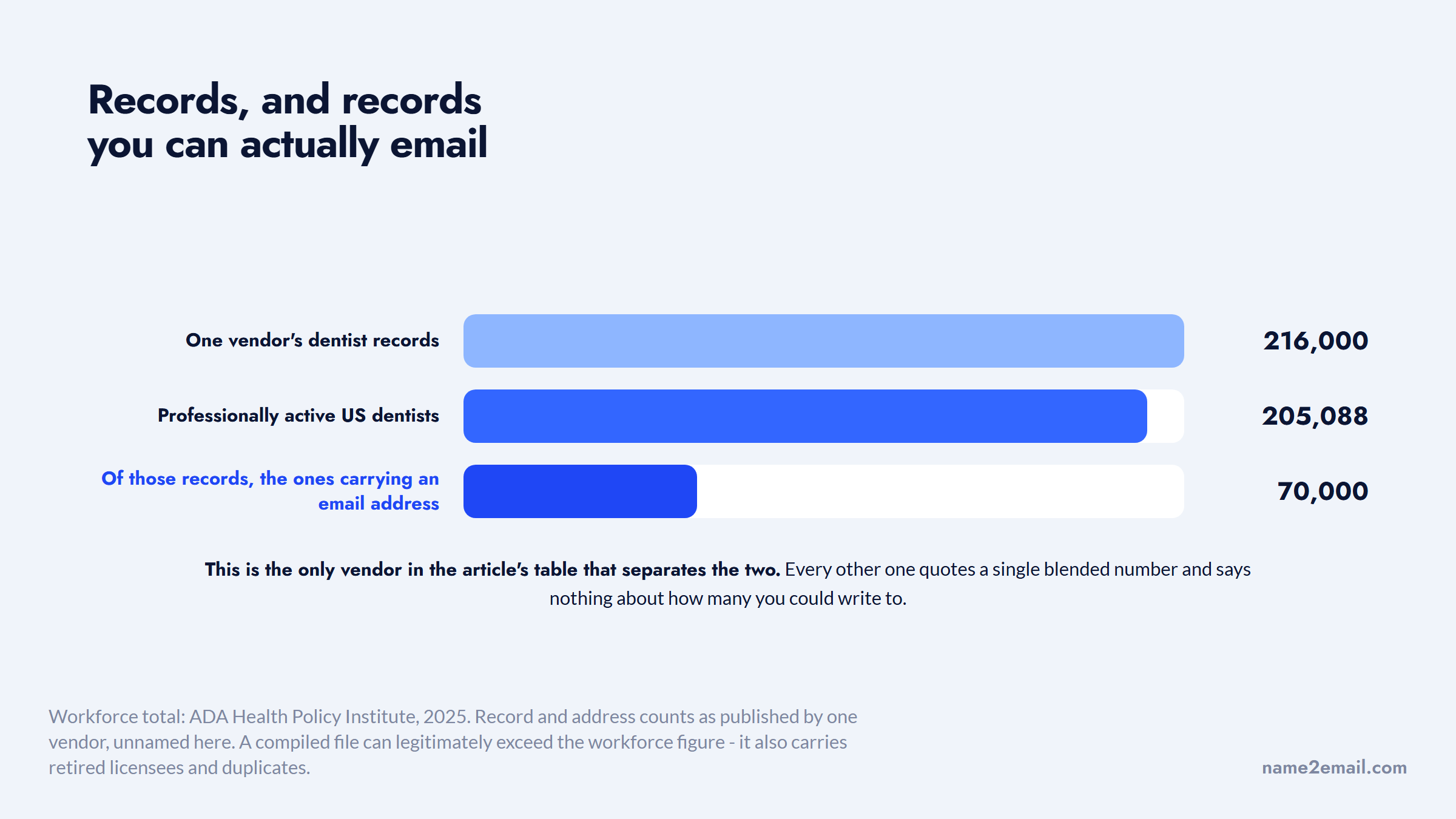
Two things jump out. MMS Lists is the only vendor here that separates the count of dentists it holds from the count that carries a deliverable email address, and the gap is enormous: 216,000 records, 70,000 addresses. Every other provider quotes a single blended number.
On one scale the gap between what a file holds and what you could write to is stark.
The second is that MedicoLeads' widely quoted 214,000 figure is its global file. Its US count is 154,000. Comparing the global number against an American population figure is not a like-for-like comparison, and it is the sort of mistake a roundup makes when it reads a title tag instead of a page.
Reply.io, which is the company that built our extension, sits at the top of that table for a different reason than the others: it sells outreach software with a contact database attached, not a dental file. We would rather say that plainly than let its size imply a dentist count it does not publish.
Who Actually Opens the Email
One dentist on the r/Dentists subreddit described their inbox as an absolute graveyard of cold emails from marketing agencies, arriving at roughly fifty a day and deleted on reflex. That is one practitioner's account rather than a survey, but it matches what the vendor market implies: if six providers are selling the same 200,000 addresses to everyone, those addresses are saturated.
The practical read is not "email does not work on dentists." It is that a generic pitch to a shared practice mailbox competes with fifty others, while a specific message to a named office manager competes with almost none.
Practice Structure Decides Who You Should Target
The ADA publishes a yearly breakdown of how dentists are distributed across practice sizes and ownership models, and it changes the targeting question completely.
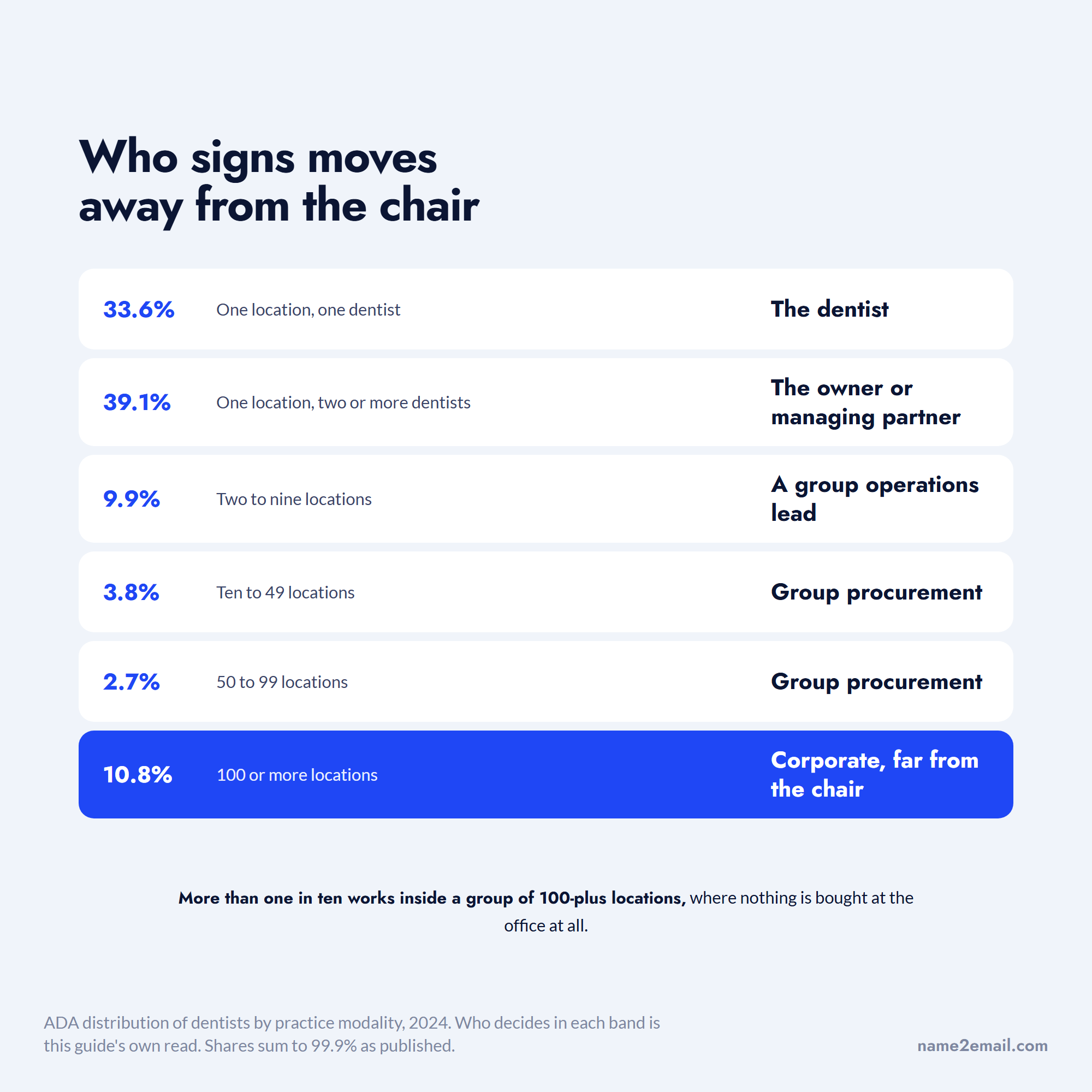
Practice modality | Share of US dentists (2024) | Who typically decides on a purchase |
|---|---|---|
One location, one dentist | 33.6% | The dentist, often with the office manager |
One location, two or more dentists | 39.1% | Practice owner or managing partner |
Two to nine locations | 9.9% | A regional or group operations lead |
Ten to 49 locations | 3.8% | Group procurement |
50 to 99 locations | 2.7% | Group procurement |
100 or more locations | 10.8% | Corporate, usually far from the chair |
Just over a third of American dentists work alone. Another 39% share a single location with colleagues, which usually means a practice owner and one or more associates who cannot sign for anything. And more than one in ten works inside a practice group with 100 or more locations, where nothing is bought at the office at all.
Read down the practice sizes and the buyer walks steadily further from the chair.
Layer ownership on top and it sharpens further. The ADA puts DSO affiliation at 16.1% of dentists overall, but at 26.5% for those within ten years of dental school and 9.1% for those more than 25 years out. A list of young dentists skews heavily toward people whose supplier decisions are made by a corporate parent, which is worth knowing before you pay per record for them.
Free Sources That Name Dentists and Practices
Nearly everything a commercial file contains is published somewhere for free, because dentistry is a licensed profession and licensure records are public.
Source | What it gives you | Cost | Refresh | Main limit |
|---|---|---|---|---|
State dental board licensee lookup | Name, license number, status, city, sometimes practice address | Free | Continuous | One state at a time, formats vary wildly |
ADA Find-a-Dentist | Name, practice name, address, specialty | Free | Ongoing | Covers ADA members, not every licensee |
NPPES NPI registry | Name, taxonomy code, practice address, organizational NPI | Free | Weekly | Addresses go stale, no email field |
Google Maps and practice websites | Practice name, domain, staff pages, office manager names | Free | Live | Manual, one practice at a time |
State and local dental societies | Member rosters, event attendee lists | Free or member-only | Annual | Coverage varies by region |
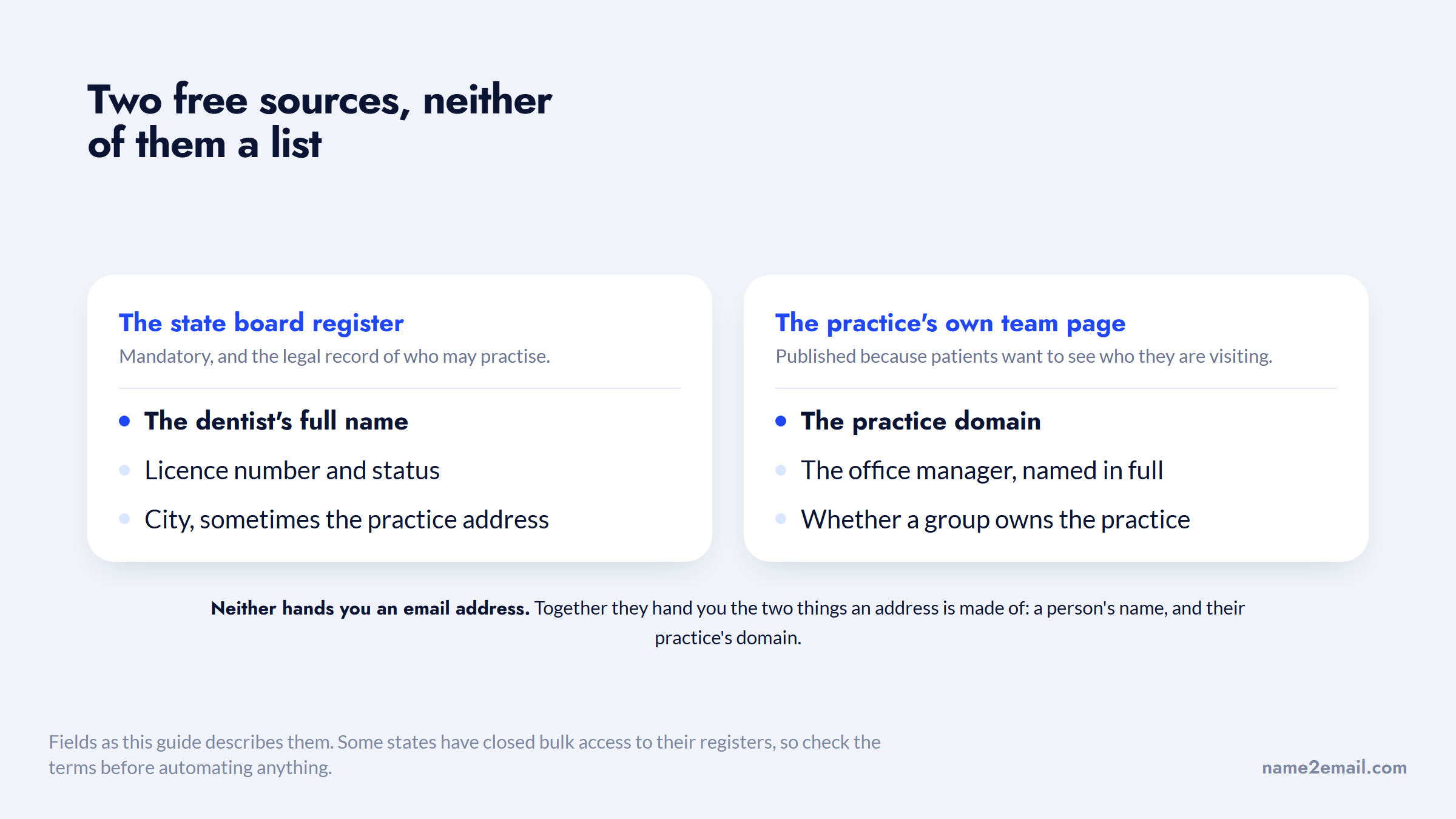
None of these hands you a list of dentist email addresses. What they hand you is the two ingredients an address is made of: a person's name and their practice's domain.
Working a State Board Register
State boards are the highest-yield free source because licensure is mandatory and the register is the legal record of who may practice.
- Find your state's dental board license lookup and search by license type rather than by name, which returns the full active roster instead of one record.
- Filter to active general or specialty licenses and exclude retired, inactive and disciplinary-hold statuses.
- Export or page through the results, capturing name, license number, city and any practice address shown.
- Match each practice address to a business through Google Maps to recover the practice name and website.
- Record the practice domain next to the dentist's name, since that domain is what turns a name into an address.
Some states have closed these registers to bulk access precisely because vendors were scraping them, so check the terms before you automate anything. Where bulk export is not offered, the search interface still works fine for a target county.
Reading a Practice Website
The register gives you the dentist. The practice website gives you the person who answers email, and it is the single most underused source in this category because it cannot be bought in bulk.
Open the practice's own site and go to the team, staff or "meet us" page, which most practices publish because patients want to see who they are visiting. Alongside the dentists you will usually find an office manager, a practice manager or a treatment coordinator named in full, and those are the people who handle vendors.
Between them the register and the team page carry everything an address is built from.
Note the domain while you are there. A practice running its own domain behaves very differently from one using a free mail account, both for deliverability and for whether a name-based address exists at all.
Check the footer and contact page next. Practices that belong to a group often disclose it there in small print, or link to a corporate parent site, which tells you immediately that purchasing sits above the office and saves you a wasted sequence. A practice with several locations listed under one brand is the same signal.
Where the site names a person but publishes only a generic inbox, you have exactly what a pattern-based finder needs: a full name and a domain. Our broader guide to finding an email address covers the other routes when a practice site gives you neither.
Segmenting Before You Build
Building every dentist in America is the wrong goal for almost any product. Supply density varies more than most people expect, which makes geography a real filter rather than a cosmetic one.
The CDC's Health, United States series recorded 60.84 professionally active dentists per 100,000 residents in 2021, but the state spread ran from 41.31 in Alabama and 41.61 in Arkansas up to 109.99 in the District of Columbia and 81.99 in Massachusetts. A territory plan that treats New York, Illinois and North Carolina as equivalent markets is ignoring a difference of that size.
Drawn to scale, the top and bottom of that range are barely the same market.
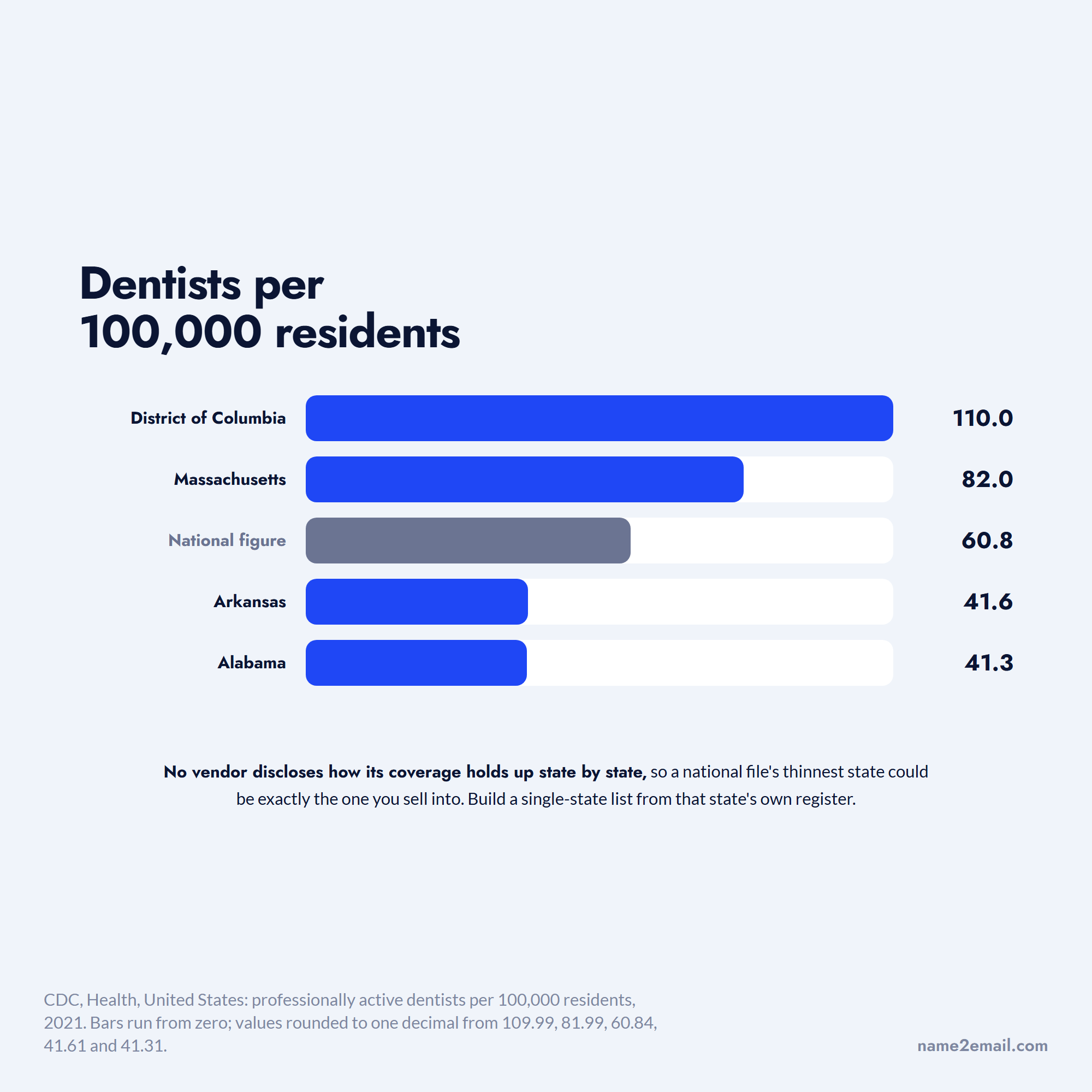
So if you want a dentist email address list of New York or any single state, build it from that state's own board register rather than filtering a national file. No vendor discloses how its coverage holds up state by state, which means a national file's thinnest state could be exactly the one you sell into.
Specialty is the other axis worth using. About 21% of professionally active dentists practice in an ADA-recognized specialty, so a pediatric dentist email list is a fraction of a fraction of the general file, and any vendor quoting you a large pediatric count deserves a follow-up question about how it was derived.
Split by state and specialty at the point of collection rather than afterwards. Doing it early means you can re-verify one segment at a time instead of re-running the whole file, which is the difference between a list you maintain and one you keep replacing, a distinction our roundup of email list management software works through in detail.
Turning a Practice Into a Named Person's Address
At this point you have a practice, a domain and often a named dentist or office manager from the practice's own team page. What you do not have is an email address, and this is the step where most people either guess or reach for a paid finder with a credit meter.
Name2Email is a free Chrome extension, and the whole thing happens in Gmail's compose window. Give it a practice domain and a person's name, and the most likely address formats drop straight into the To field. Hovering over each one tells you which is real, because Gmail attaches a name and photo to addresses it already knows.
What we are not matters as much here. We hold no dental records and sell none, so we cannot hand you 200,000 dentists, and calling us a database would be wrong. The method is inference from public naming conventions, one person at a time, and it works best where a practice runs its own domain rather than a free mail account. Some addresses we will simply get wrong.
Nothing is metered and nothing needs registering, which matters here because a single county of practices can exhaust a paid finder's monthly quota in an afternoon. The five-step sequence, from typing a name to confirming the match, is laid out on our how it works page.
Verifying What You Built
A self-built dental list is fresher than a compiled file, but it still needs checking before it meets a send. Practices merge, associates move and shared mailboxes get retired.
Run the addresses through a verification service before the first campaign, then again on a quarterly cycle, and watch bounce rate by source rather than in aggregate so you can see which of your inputs is decaying. A batch pulled from a state register six months ago behaves very differently from one pulled last week, and blended reporting hides that. If you are choosing a checker, our roundup of email verification tools compares what each one actually tests.
Hold back a seed segment of 200 addresses for the first send and read the result before releasing the rest. A compiled list that bounces at 12% will take your domain reputation with it, and you would rather learn that on 200 records than 20,000.
What Buying Actually Buys You
None of this makes purchased data useless. It makes it a specific tool for a specific job: coverage at national scale, fast, when you can absorb the accuracy cost.
The honest trade is that a vendor file gives you breadth you cannot assemble by hand in a week, and takes back freshness, exclusivity and any real knowledge of provenance. Every dental-list provider in the table above except MMS Lists declines to say how many of its records carry a working address.
None of the five will tell you who else bought the same file last month either, which is the exclusivity problem in one sentence. A compiled dental file is sold repeatedly, so the addresses reaching your sequence have usually already received several others, and that is the real reason the reply rate on purchased dental data sits where it does. The trade-offs of paying for the file anyway are worked through in our guide to buying email lists.
Ask for a free sample from the exact segment you want, not a generic one. Every vendor above offers samples, and 10 records from the Illinois pediatric segment tell you more than any deliverability guarantee on the page. Check the sample for the two things that decide value: whether the email is a named person or a shared practice mailbox, and whether the practice address matches what the practice's own website says today.
Writing to a Dental Practice
The message matters more here than in most B2B categories, because the recipient is triaging fifty pitches and has thirty seconds between patients.
Lead with the practice, not with your product. Name the practice, reference something specific about it, and make the first line about a problem the office actually has rather than a benefit you offer. Keep the ask small and concrete, since a dentist between appointments will not read a 300-word pitch but might answer a one-line question. The structure that survives that triage is the one we work through in our guide to writing a good email.
Time it around the practice day. Dental offices run on appointment blocks, and mid-morning and mid-afternoon sends land while someone is at the desk rather than during the opening rush.
Start With the Register, Not the Invoice
The fastest honest path to a dentist email list is to pick one state, pull the active license register, match a few hundred practices to their domains, and find the addresses one at a time. You will end up with a smaller list than any vendor sells you and a much better one, because you will know where every record came from and roughly when it was true.
Keeping it alive is the other half of the job. A dental list decays through practice sales, DSO acquisitions and staff turnover rather than through people leaving the profession, and those events show up on the practice's own website long before they show up in a compiled file.
Prospecting across many domains at no cost per lead is among the use cases that shaped the extension.
Add Name2Email to Chrome when you reach that step. It costs nothing, needs no account, and the lookups never run out.
Frequently asked questions
Get the practice domain first, from the practice website or a Google Maps listing, then take a name from the team page or your state dental board register. Those two inputs narrow the address to a few candidates, and hovering over each inside Gmail settles which is live. Working outward from the practice beats searching for the dentist by name, because practices publish domains and individuals rarely publish addresses.
Not as a downloadable dentist email address list, no. What is free is the underlying data: state dental board registers, the ADA's public directory, the NPPES registry and practice websites all publish names, practices and domains at no cost. Assembling those into a list costs time rather than money, and the result is fresher than anything sold as a "free dentist email list," which is usually a lead magnet for a paid file.
Because they are counting different things and rarely say so. The ADA counts 205,088 professionally active US dentists, while vendor pages advertise between 129,000 and 216,000 records, and some published figures are worldwide rather than American. MMS Lists is the clearest example of what the gap means: it holds 216,000 dentist records and 70,000 email addresses among them, so a headline record count says almost nothing about how many people you can actually reach.
It depends on practice size, which is why the modality breakdown is worth checking first. In a solo practice the dentist is usually the buyer. In a multi-dentist single location it is normally the owner or managing partner. Above roughly ten locations, and in any DSO-affiliated group, purchasing sits at a corporate level and the office manager is a router rather than a decision maker, so a message addressed to the practice will not reach anyone with authority.
Faster than the profession changes, because the churn is in practices rather than practitioners. Dentists rarely leave the field, but practices are sold, absorbed into groups and rebranded constantly, and each of those events can retire a domain and every address on it. Quarterly re-verification is a reasonable floor, with a fresh pull of your state register once a year to catch new licenses and lapsed ones.

We build Name2Email, the free Chrome extension that finds work emails inside Gmail. We write about outreach, prospecting, and getting more replies.
Connect →