- 1No register, no regulator and no filing requirement lists Chief Revenue Officers, so no vendor count can be checked against anything. The phrase appeared in 307 SEC 8-K filings in the year to August 2026, against a "chief financial officer" query that runs past EDGAR's 10,000-result ceiling.
- 2Only 21,041 US firms employ 500 people or more, out of 6,395,635 employer firms. Below that line the revenue number usually belongs to a founder or a VP of Sales, not a CRO.
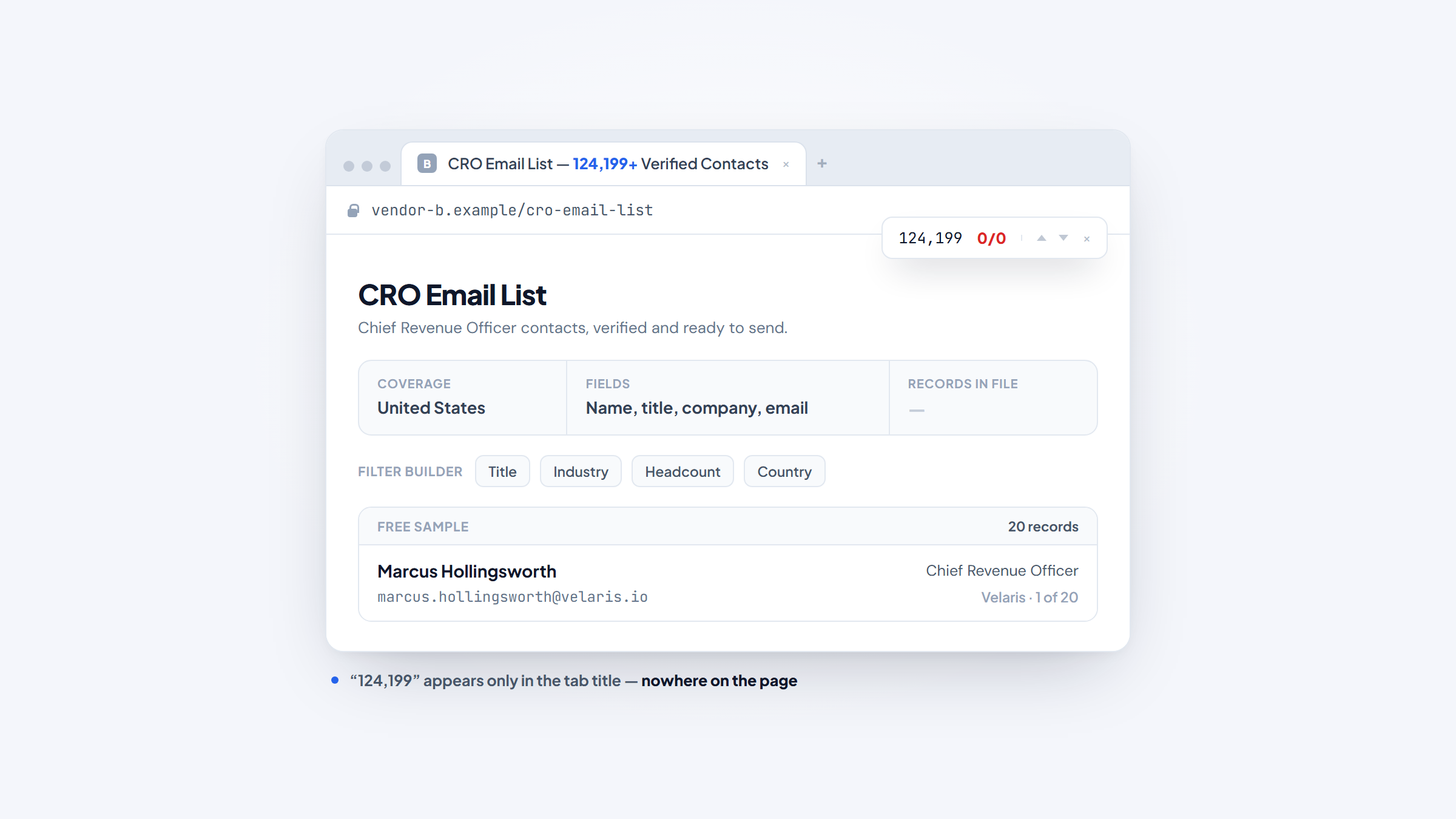
- 3Five of the six vendors we checked publish no CRO count at all. UpLead is the exception at 8,719 verified CROs nationwide for $1,799, and one competitor's title tag claims 124,199 while its page body claims nothing.
- 4Four different things share the acronym, and one page ranking on the first result page for this term is selling Chief Risk Officers. Sample any file before you send to it.
There is a straightforward test for whether a contact list can be trusted, and the CRO email list fails it.
For most audiences you can check a vendor's claim against something official. Lawyers are counted by the bar. Doctors sit in a federal registry. Chief financial officers are named in filings within days of appointment, because the law requires it. When a vendor claims a number, reality is standing right there to contradict it.
Nobody counts Chief Revenue Officers. The title is not statutory, not licensed and not tracked by any professional body, which means a vendor can print any figure it likes and no one on earth can prove it wrong. That single fact should change how you build this list.
This guide covers what the absence of a register implies, how to size the real population yourself, what the vendors publish when you read their pages carefully, and the verification loop that has to replace the missing authority.
We publish Name2Email, a free browser tool that turns a name and a company domain into a work address. We are not a list builder and we sell no contact data, so our interest here is the last step only.
Four Different Things Share This Acronym
Before you buy a chief revenue officer email list, decide which CRO you mean, because the search results do not agree with each other.
Run the query and you get pages selling Chief Revenue Officers, pages selling Chief Risk Officers, and pages selling contacts at Contract Research Organizations and Clinical Research Organizations in the pharmaceutical industry. Three entirely separate audiences, one three-letter string. Marketing teams sometimes add a fourth reading, conversion rate optimization, though no vendor appears to sell a list under that meaning.
Only three of the four are actually sold to anyone, and the fourth is worth knowing about anyway.
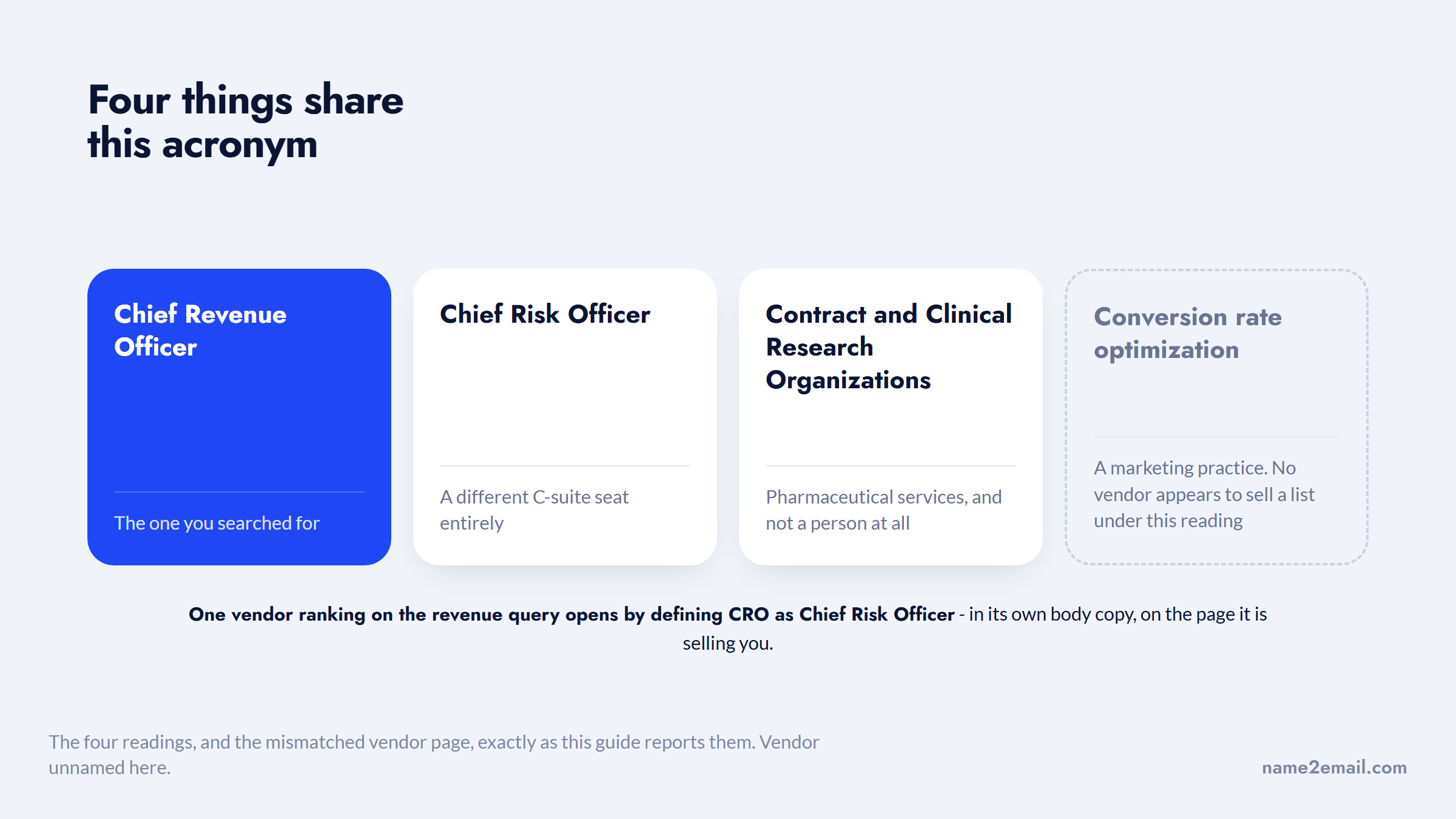
This matters more than a naming quibble, because the confusion reaches inside the products. DataCaptive ranks on the first page of results for the CRO list query, and the body copy on that page opens by defining CRO as Chief Risk Officer. The page is not mislabeled in some subtle way; it is selling a different C-suite role to everyone who arrives from the revenue query.
Point To Business Services shows a related tell. Its menu of industry-specific slices of the same CRO mailing list includes a row for a "Food and Beverage CFO List," a finance product sitting inside a revenue-officer catalog. Neither of these is proof that a file is bad, but both tell you the pages are assembled from templates rather than curated, and templates are where the wrong records get in.
Why Nobody Can Tell You How Many CROs Exist
The Chief Revenue Officer is not an officer in the legal sense, and that is the root of the problem.
Public companies must disclose changes involving the principal executive officer, the principal financial officer and the principal accounting officer. A Chief Revenue Officer is usually none of those, so appointing one triggers no disclosure obligation. The seat can be filled, renamed or abolished without a single public document recording it.
You can watch the gap in the government's own archive. Using EDGAR full text search across 8-K filings from September 2025 through August 2026, the exact phrase "chief revenue officer" appears in 307 filings. "Chief information officer" returns 291 and "chief marketing officer" 362. The same query for "chief financial officer" does not return a number at all: it runs past the 10,000-result ceiling where the counter stops.
Side by side, three of those seats are comparable and the fourth simply runs off the end.
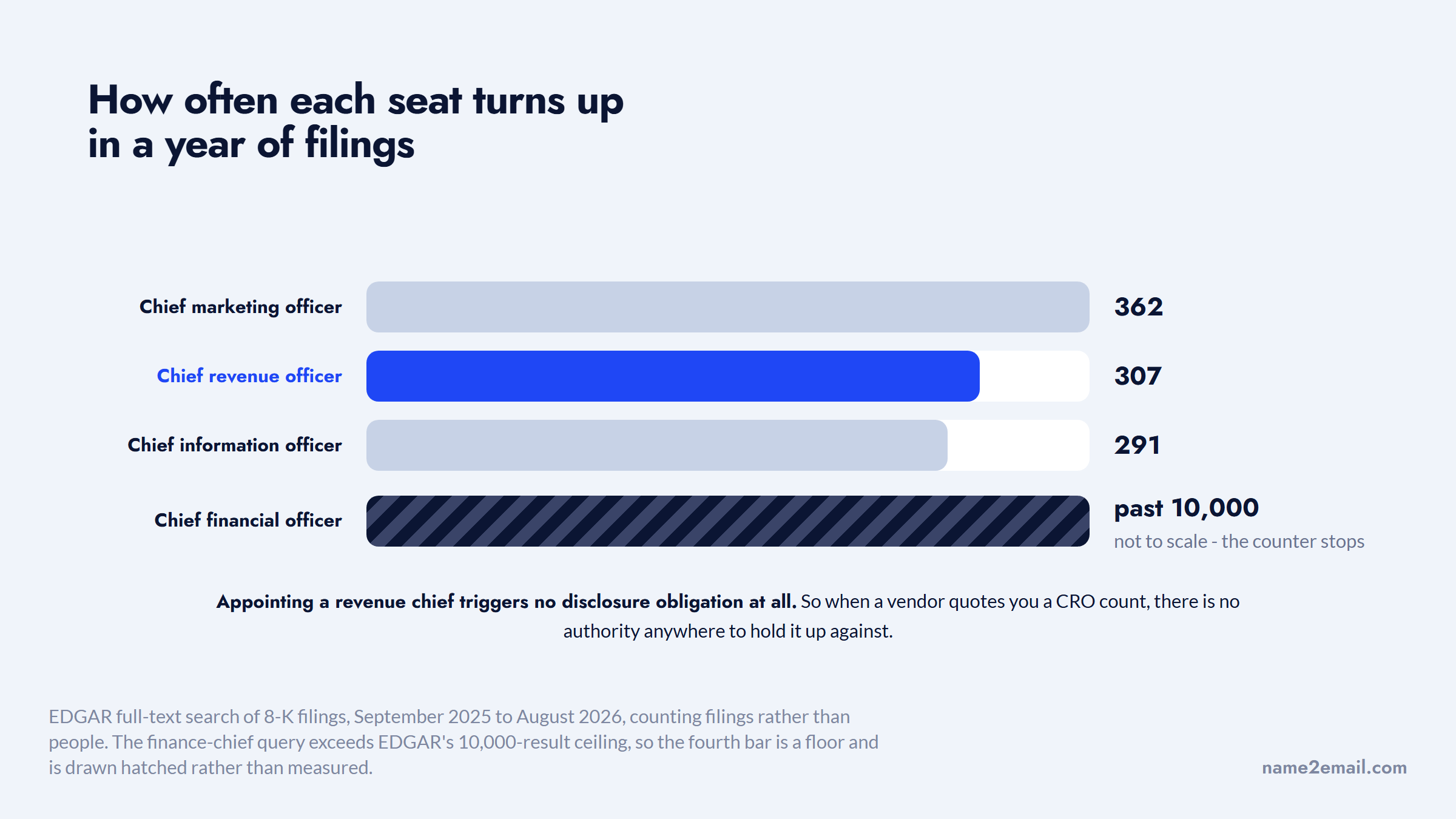
The EDGAR counts measure filings rather than people, and a phrase can appear for reasons other than an appointment. The ratio is still the point. The finance chief is documented so relentlessly that the search engine gives up counting, while the revenue chief barely registers.
So when a vendor tells you it holds 124,199 verified CRO contacts, there is no authority you can hold that up against. That is not a reason to assume the number is invented. It is a reason to stop treating any vendor figure as evidence and to build your own estimate instead.
How Many Companies Are Even Large Enough
You can bound the population from the other end, by counting the companies rather than the people.
The Census Bureau's Statistics of U.S. Businesses counts 6,395,635 US employer firms, of which 6,374,594 have fewer than 500 employees. That leaves 21,041 firms at 500 employees or more. Those 21,041 firms are one third of one percent of American businesses, and they employ about 54% of everyone working at a US employer firm.
Split by headcount, the bands where a revenue chief plausibly exists are startlingly small.
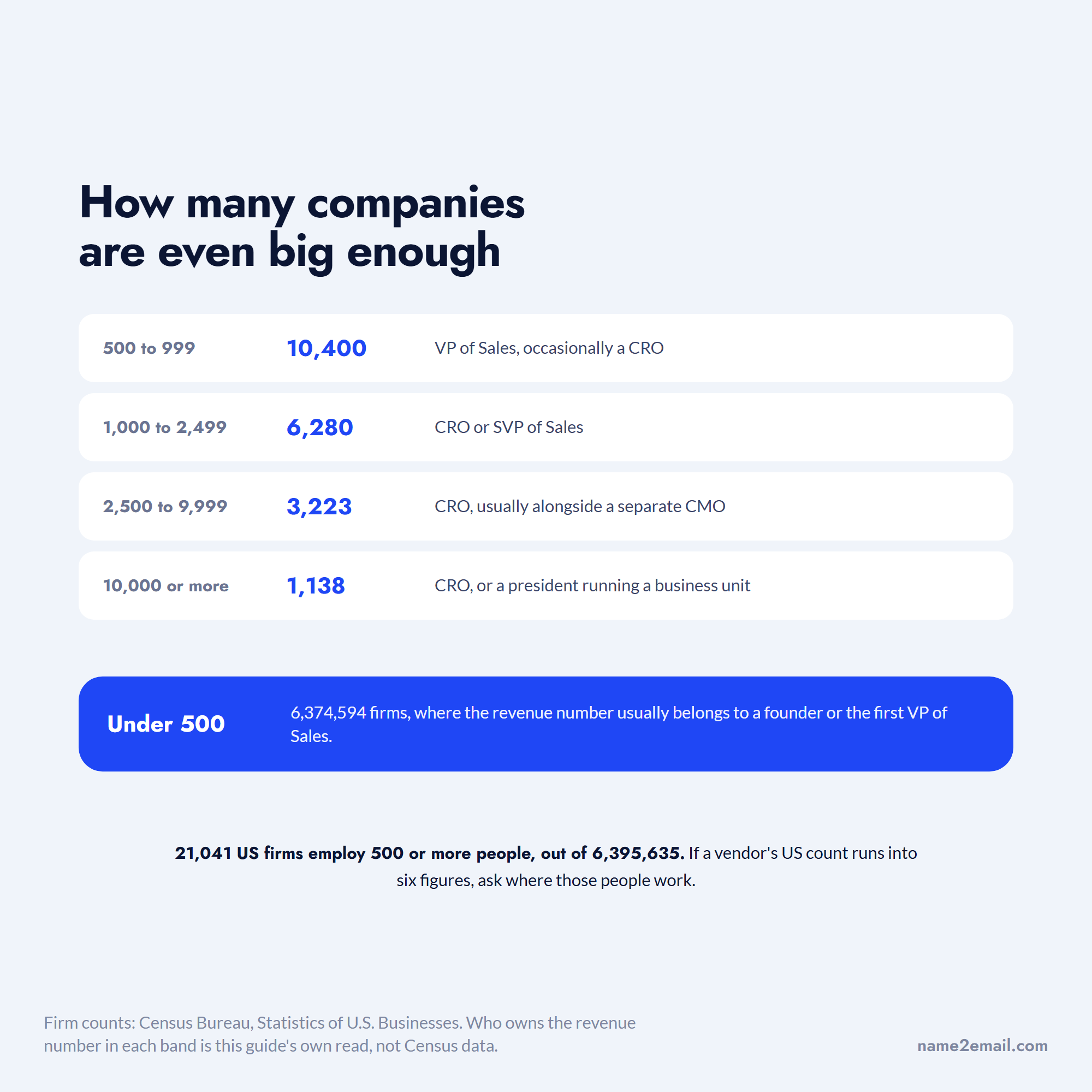
A dedicated revenue chief is a role you create when sales, marketing and customer success have grown too big for one person to run informally. That happens well above the small-business line and well below the Fortune 500. The table below pairs the Census firm counts with our own read of who typically carries the number at each size; the left column is government data, the right column is our judgment rather than anything the Census publishes.
Company size | US firms | Who usually owns the revenue number |
|---|---|---|
Under 500 employees | 6,374,594 | A founder, or the first VP of Sales |
500 to 999 | 10,400 | VP of Sales, occasionally a CRO |
1,000 to 2,499 | 6,280 | CRO or SVP of Sales |
2,500 to 9,999 | 3,223 | CRO, usually alongside a separate CMO |
10,000 or more | 1,138 | CRO, or a president running a business unit |
Venture-funded software companies distort this, because a 120-person startup with $40 million raised will happily appoint a CRO. Treat the size bands as a sanity check rather than a filter: if a vendor's US count runs into six figures, ask which companies those people are supposed to work at.
What the CRO List Vendors Actually Publish
Six vendors sell a CRO email list on the first page of results, and we read all six pages in full in September 2026, checking every number against the page body rather than the title tag or the search snippet.
The results were lopsided. Five of the six publish no CRO count anywhere on the page. UpLead is the single exception and is unusually specific: 8,719 verified CROs across all 50 states for $1,799 as a one-time purchase, with per-state packages from $99, a database refreshed in July 2026 and counts it says are refreshed monthly.
Vendor | Published CRO count | Published price | Worth knowing |
|---|---|---|---|
Reply.io | None | From $59 per user per month, 14-day trial, no free plan | Its contact database is bundled inside the platform, never sold as a standalone file |
UpLead | 8,719 nationwide | $1,799 one time; state packs from $99 | The only body-confirmed national figure in this set |
Prospeo | None in the page body | Not published | Its title tag claims 124,199+; that number appears nowhere in the body |
InfoGlobalData | None | Quote only | Publishes exact counts for 15 other C-suite lists, and none for the CRO |
DataCaptive | None | Quote only | Its page body defines CRO as Chief Risk Officer |
Point To Business Services | None | Quote only | Claims 95%+ deliverability; its CRO industry menu contains a CFO list |
Two entries deserve a closer look. Prospeo's page title promises 124,199+ verified contacts, and the string appears exactly once in the page we fetched, in the title itself. The body offers a sample of 20 records and a filter builder. Set that against UpLead's 8,719 and you have a fourteenfold spread for the same country and the same job.
InfoGlobalData, which markets its file as a CRO mailing list, is the more revealing case, because it clearly can count when it wants to. Its own sidebar publishes precise totals for fifteen sibling C-suite lists, including 61,732 CFOs, 46,921 CIOs, 43,059 CMOs and 32,192 CTOs.
The sidebar is precise about every neighbouring title, which makes one blank row conspicuous.
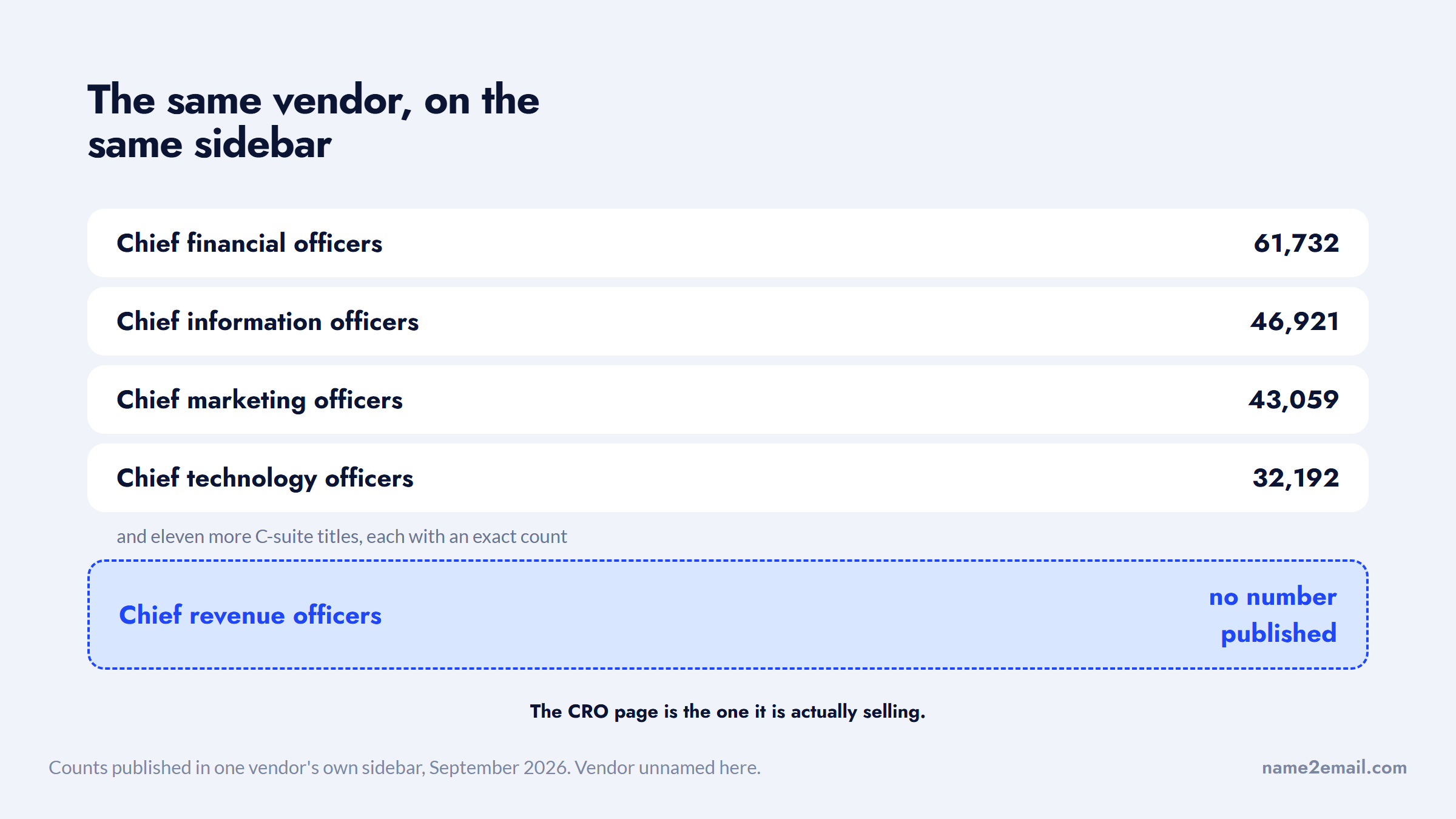
For the CRO, the page it is actually selling, there is no number. A vendor that quantifies every neighboring title and goes quiet on this one is telling you something about how solid the underlying data is.
Reply.io, which also builds our extension, publishes no CRO figure either, and we would rather say that plainly than pretend otherwise. The two market models behind all six of these vendors, and the legal position on buying contact data, decide more about whether a purchase is sane than any individual count does.
Step 1: Define the Company Before the Title
Every reliable CRO email list gets built company-first, and the reason is now obvious: companies are countable and CROs are not.
Start with the firmographics you can actually verify. Industry, headcount band, revenue range, geography, funding stage, and whether the company sells through a sales team at all. A company with no quota-carrying reps has no revenue chief no matter what a database says.
The second question is whose budget you are actually selling into. Revenue leaders buy sales technology, forecasting tools, agency services, data and enablement. If your product lands in a different budget, the CRO is the wrong target, and a sharp list of one hundred beats a vague list of ten thousand.
Write the profile down before you open any tool. It becomes the specification you test the finished list against, and without it every count looks equally plausible.
Founders, SDRs and agency teams all build this list from scratch, and the profile is what separates a hundred well-chosen accounts from a bulk purchase, the kind of one-at-a-time outreach our extension was built around.
Step 2: Build the Company List From Public Signals
With a profile in hand, the company list comes together from sources that cost nothing and update themselves.
Job boards are the strongest single signal. A company hiring account executives, sales engineers or a revenue operations manager has a revenue organization big enough to need a leader, and the posting usually names the reporting line. Funding announcements work similarly, since a Series B is typically the moment a company decides it needs a revenue chief.
Conference exhibitor lists, industry association directories and review-site category pages all give you clean, current company names in a defined segment. So does a competitor's public customer page. None of this requires a subscription, and all of it reflects the current state of the market rather than a snapshot taken whenever a database was last refreshed.
Paid platforms speed this up rather than replacing the thinking, and the category is crowded enough that it is worth understanding what sales intelligence platforms actually do before you commit to a seat. Whatever you use, the output at this stage is a list of companies, not people.
Step 3: Find Whoever Owns Revenue, Whatever They Are Called
Here is where title filtering quietly loses you half the market: the same job carries a different name at almost every company.
A thread in r/startups makes the point better than any vendor page. A co-founder handling sales, marketing, account management, legal and accounting asked what to call the role, and the replies proposed Chief Revenue Officer, Director of Sales, VP of Sales, Head of Growth, Head of Revenue and Head of Business Development.
That is anecdotal, and it is one thread. But six suggested titles for one unchanged job is a fair picture of how loose this vocabulary gets below the enterprise line.
The practical consequence is that filtering a database on "Chief Revenue Officer" returns the subset of companies that happen to use that exact phrase, not the set of people who own revenue. When you check each target company yourself, look for whichever of these holds the number:
- Chief Revenue Officer
- Chief Commercial Officer
- VP or SVP of Sales
- VP of Revenue or Head of Revenue
- Chief Growth Officer
- Head of Go-to-Market
- President, when the company has no separate sales leader
The company's own site settles it faster than any database. Leadership pages, press releases and conference speaker bios name the person and the current title, and they are updated by people who care about being right.
Getting from that name to a working address is a separate craft, and the method you choose depends on how many accounts you are working through, since several approaches hold up at very different volumes.
Step 4: Turn the Name Into a Work Address
At this point you have a company and a person. What you do not have is an address, and that gap is where most self-built lists stall.
This is the step we built for. Name2Email is a free Chrome extension that works inside Gmail: type the person's name and their company domain in the compose window, and it generates the likely address patterns for that domain and drops them into the To field. Hovering over a suggestion lets Gmail's own contact recognition confirm the right one, since a recognized address surfaces the person's name and photo.
We would rather set the expectations honestly than oversell it. The approach is pattern-based, using public naming conventions rather than a scraped database, so it works best on corporate domains and it cannot guarantee every address. Executives at large companies are usually the easy case, because big organizations run consistent patterns.
There is no account, no credit card and no monthly cap, which matters when you are working through a few hundred companies one at a time, and the five-step sequence takes roughly as long to learn as sending one email.
Step 5: Verify a Sample Before You Trust Anything
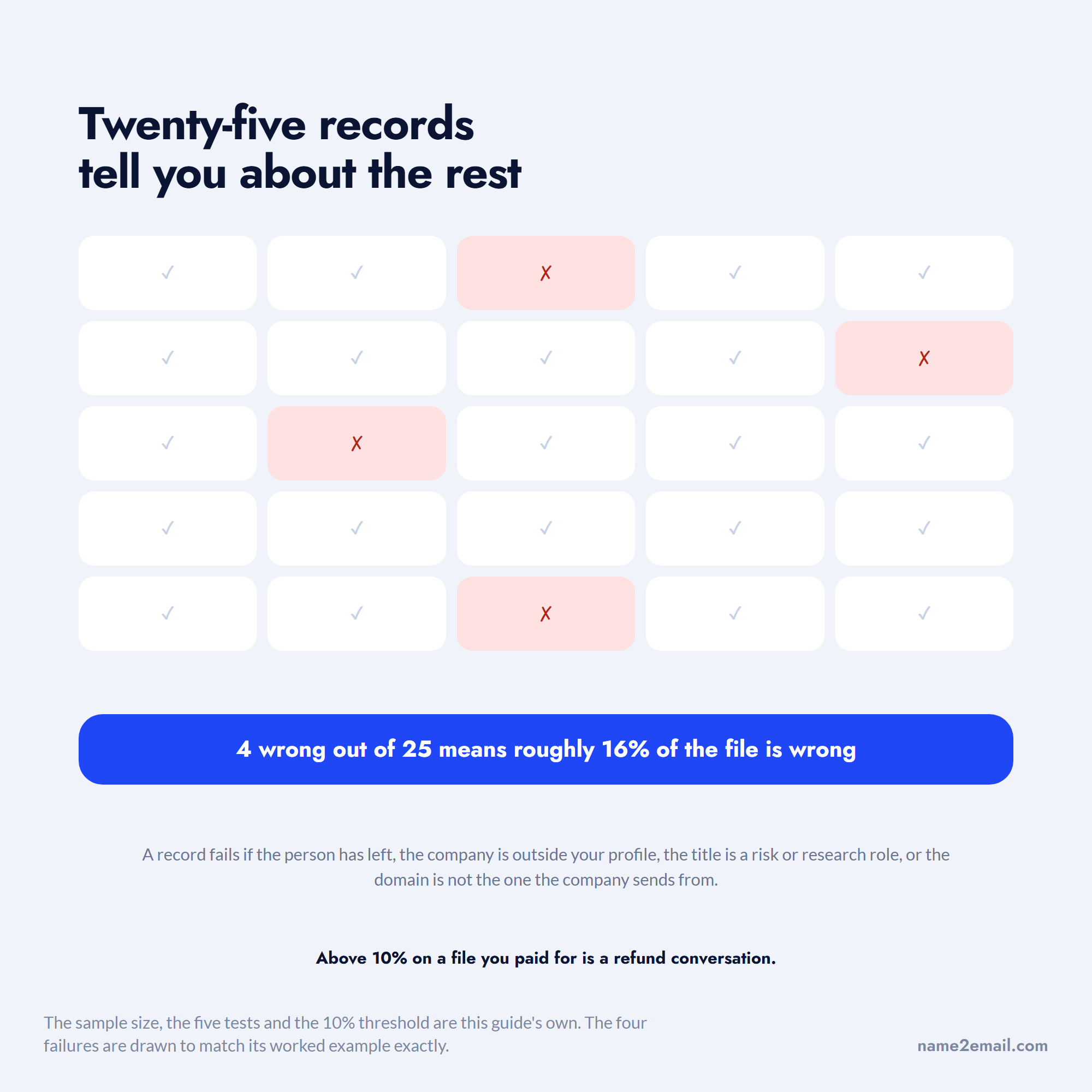
Whether you built the list or bought it, the missing register has to be replaced by your own spot check. Twenty-five records is enough to expose most problems.
Pull the sample at random rather than from the top of the CRO contact list, then confirm each record against the company's own website or the person's public profile. You are testing five things:
- The person still holds that job at that company today.
- The company is genuinely inside your size and industry profile.
- The title is a revenue role, not a risk, research or medical one.
- The email domain matches the company's real sending domain.
- The address format matches the pattern the rest of the company uses.
Count the failures and extrapolate. If four of twenty-five are wrong, the file is roughly 16% bad, and that is the number to argue with a vendor about or to budget cleanup time against. Anything above 10% on a file you paid for is worth a refund conversation.
Twenty-five records is a small enough sample to check by hand and a big enough one to trust.
Deliverability is a separate question from accuracy, and a correct address can still bounce for reasons that have nothing to do with whether you got the person right, which is why verifying an address belongs before the send rather than after it.
What Actually Gets a Reply From a Revenue Chief
The person you are writing to spends their day being sold to by people selling exactly what you sell. Assume they can identify a template in under two seconds, because they can.
Lead with a number that belongs to their business, not yours. A revenue leader responds to pipeline coverage, win rates, ramp time for new reps, churn in a specific segment and forecast accuracy. They do not respond to a paragraph about your funding round or your feature list.
Keep it short enough to read on a phone between meetings, make the ask small and specific, and skip the fake familiarity entirely. Sequencing decides more outcomes than the opening line does, and disciplined follow-up is where most self-built lists are actually won or lost.
One more thing worth saying: if the company is small enough that the founder still owns revenue, write to the founder. Insisting on a CRO title at a 60-person company means writing to nobody.
Keeping the List From Going Stale
A CRO email list decays for a reason that has nothing to do with data quality: executives move, and this seat moves more than most.
Set a refresh cadence rather than rebuilding from scratch. Re-check the leadership page for every account you are actively working once a quarter, and re-check the rest twice a year. A bounce, an out-of-office naming a successor, or a reply from someone else on the team are all signals to update the record immediately rather than at the next scheduled sweep.
Track where each record came from and when you last confirmed it. A CRO contact list with a verification date on every row lets you decide what to trust; one without a date is guesswork wearing a spreadsheet.
Because the same tool that finds an address also finds the replacement's address, a personnel change costs a minute rather than a purchase. That is the practical argument for a build-it-yourself list: it repairs itself. You can add Name2Email to Chrome for free and find the next revenue chief's address without leaving your inbox.
Frequently asked questions
It is a contact file of Chief Revenue Officers, the executives who own the combined sales, marketing and customer success number at a company. Be careful with the acronym: some vendors sell Chief Risk Officer data under the same three letters, and in the pharmaceutical sector CRO usually means Contract Research Organization. Check which one a file contains before you buy it, because the pages themselves are not always clear.
Nobody knows, and that is the honest answer. No licensing body, professional association or regulator counts them, and the role rarely triggers an SEC disclosure. The only hard published figure we found was UpLead's 8,719 verified CROs nationwide. For context, Census data counts 21,041 US firms with 500 or more employees, which is roughly the population where a dedicated revenue chief becomes common.
Build your own chief revenue officer email list if the target set is under a few thousand companies, because the sourcing is public and the result stays current. Buying makes more sense at genuine scale or when you need international coverage fast. Either way, sample twenty-five records and verify them against company websites before you send anything, since no external authority exists to check a vendor's claims for you.
Because nothing forces them to agree. Different vendors include different titles, different countries and different freshness standards under the same label, and no register exists to reconcile them against. We found one vendor claiming 124,199 contacts in its page title with no figure in the page body at all, and another publishing exact counts for fifteen other C-suite roles while leaving the CRO blank.
Get the name first from the company's own leadership page, press releases or conference listings, which are free and current. Then generate the likely address from the name and the company domain. Our free Chrome extension does that inside Gmail with unlimited lookups and no account, and it works best on corporate domains. It is pattern-based rather than a database, so treat it as a fast way to a probable address that Gmail then helps you confirm.

We build Name2Email, the free Chrome extension that finds work emails inside Gmail. We write about outreach, prospecting, and getting more replies.
Connect →