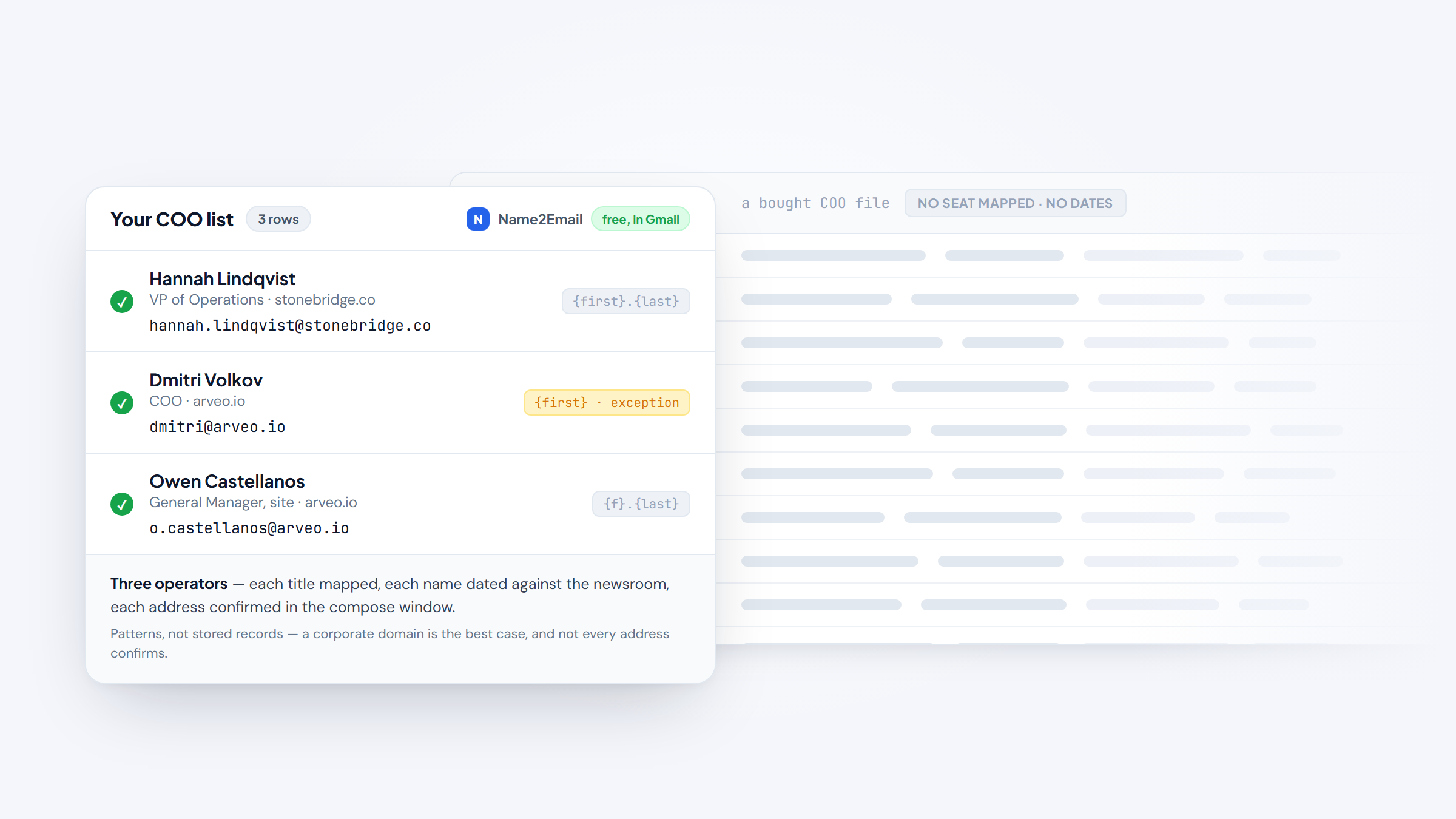
- 1The COO is the least standardized seat in the C-suite, so a COO list starts as a title-mapping exercise, not an address hunt.
- 2The operations job hides under at least five titles, and which one a company uses depends on its industry and its headcount.
- 3COOs hold the shortest tenure of any S&P 500 C-suite role, at 3.3 years, so a bought file starts going stale immediately.
- 4You can name the right operator for free from the company's own disclosures, then confirm the address before you write.
If you searched for a COO email list, you already know the awkward part. You can find the company and the domain, and you still cannot tell which human owns operations there.
Part of the reason is that the COO is the least fixed seat in the executive suite. A company can create it, rename it or dissolve it without a public announcement, and the same work shows up as COO at one firm, VP of Operations at another, and General Manager at a third. A vendor file that counts rows will not tell you any of that.
So treat the list as a mapping problem. Work out what the operations seat is called at each company, confirm who holds it now, and only then build the address.
This guide sets out the mapping by company size and industry, the free sources that name the operator, the market price of a ready-made file, and the one step where our extension earns its place: turning a confirmed name into a confirmed address.
The COO Title Is the Only C-Suite Seat With No Fixed Job
Every other executive seat has a job description the market agrees on. Finance owns the numbers, marketing owns demand, and legal owns risk. Operations owns whatever the top team has not already assigned.
Bridgespan found the same thing when it studied the role: "The most salient characteristic of the chief operating officer (COO) job seems to be its variety." Its team surveyed 23 COOs and interviewed 16 more for that research, and none of the 16 described their job or their relationship with the top executive in the same terms.
The variability shows up in the wildest places. In an r/startups discussion on what a COO actually does, the original poster had watched the seat filled by a chief of product at one company, the head of legal at another, and a former consultant at a third.
A widely upvoted reply put it simply: "There isn't a clearly defined role for COO. It can be anything from running the whole company to just wearing one hat like product or legal."
That is why this list is harder than it looks. You are not searching one title. You are searching whichever title the company chose, and guessing wrong sends the message to a desk that cannot act on it.
Build a Title Map Before You Build Anything Else
The first deliverable is not an address. It is a short list of the titles that could mean "the operator" at the company you are targeting.
Somewhere on the operations chair you will find one of these. Use them as search terms, not as a ranking.
- Chief Operating Officer, the formal second-in-command, most common once a company has a real management layer.
- VP or Director of Operations, the same remit under a smaller title at firms below roughly 200 staff.
- Chief Administrative Officer, the operations seat at banks, health systems and public bodies.
- General Manager, the operator for a single site, region or business unit, frequent in mining and retail.
- Chief of Staff, the founder's stand-in, which often absorbs the COO's coordination work at a startup.
- Head of Business Operations, a newer label for the same work at software companies.
Two of those can be live at once, especially at a company that runs both a corporate center and field sites. When that happens, decide which layer owns your problem before you spend time on an address. When the site-level operator is the one you need, the same mapping logic drives the general managers email list.
The Same Operation Job, Four Different Company Sizes
Headcount changes who holds the seat, what it controls and who screens the inbox. A company of 12 and a company of 12,000 both have an operator, and you reach them in opposite ways.
Headcount | The operations seat | What it controls | Your first contact |
|---|---|---|---|
Under 20 | The founder, wearing operations as a second hat | Everything, informally | The founder, directly |
20 to 150 | Head of Operations or a site General Manager | Process, tools, vendors | That person, or the role inbox |
150 to 1,200 | VP of Operations | Teams, budget, systems | An assistant, or a routed ask |
Over 1,200 | COO, sometimes with regional COOs below | The whole operating model | A chief of staff, EA or function |
At the small end you are often talking to the buyer, so a specific note to that person is a fair first move. At the large end you are talking to an org chart, which means the address matters less than the route into it.
Know the band before you buy anything, too. A file priced by volume will not tell you whether it holds a VP of Operations or a true COO, and for this seat that difference decides whether the record is useful. The same trap catches buyers of other executive seats, which is the case the CIO list guide starts from when a title vanishes below a certain size.
Read the Industry Before the Title
Industry bends the operations title further than size does, and the hospital and mining phrases people type are the two clearest cases. In both, the seat you want may sit one rung below the title you searched.
Sector | What the operations seat is called | Who reports up through it | Where to look first |
|---|---|---|---|
Hospitals and health systems | COO at the hospital, COO at the parent system | Nursing and clinical operations, support services | System leadership page |
Mining and heavy industry | Corporate COO; site General Manager or Mine Manager | Production, maintenance, safety, logistics | Company officers page |
Software and startups | COO, or Head of Business Operations | Product, people, finance, legal | About page, funding press |
Retail and hospitality | COO, or Regional and District Manager | Store and site operations | Leadership page |
Nonprofits | COO, the executive director's copilot | Programs, finance, IT, administration | Annual report, leadership page |
Hospital systems run two operator layers at once. A hospital COO runs that building, while a system COO sits above the hospital operators at the parent organization.
Nursing and clinical operations commonly report up through the COO line, so a message aimed at a hospital COO lands nearer to clinical delivery than a generic operations pitch expects. The fact that vendors sell a hospital COO file separately from a general one tells you the sub-segment behaves differently.
Mining splits the corporate from the site. The corporate COO runs the business, while the person running a mine or plant usually carries the title General Manager or Mine Manager instead. Mining companies also publish an officers and senior management page as standard, so the corporate seat is easy to name and the site-level operator is the one that needs a step of digging.
The CFO seat is the opposite case, because filings name its holder on a fixed schedule and the record barely moves, a contrast the CFO list guide builds its method around.
Confirm the Seat Is Still Occupied
Title mapping gets you a name. The seat's turnover decides whether that name is current, and here the COO is the outlier in the whole C-suite.
Spencer Stuart puts average COO tenure in the S&P 500 at 3.3 years, the shortest of any C-suite role it tracks, against 7.6 years for CEOs. And 80% of COOs are promoted from inside, with only 12% having held the role before. Read those together and the picture is a person who is often new to the job and one step from the CEO chair.
Three free checks confirm the current holder: the company's leadership page, the newsroom for an appointment or exit release, and the person's LinkedIn profile for a live employer line. When the three line up, the name is safe to use.
Where the Operator's Name Is Published
For most companies the name is public already. What changes is how fast each source goes stale and how much it tells you.
Where | What you get | How fast it ages |
|---|---|---|
Leadership or About page | The named operator and the wider team | Refreshed with the site |
Officers and senior management page | Named operators at public, mining and listed firms | Fixed at the last filing or update |
Newsroom and press releases | Appointments, promotions and departures | Same week as the change |
Annual report or proxy | Officers named to investors | Fixed at the filing date |
LinkedIn company People tab | Whoever lists the title right now | Only as fresh as the profile |
Conference agendas and trade press | The operator speaking, plus the employer | Event-dependent |
Private companies rarely announce a reshuffle, so for them the About page and LinkedIn are often all you get. For a public company, the officers page plus its filing date is the fastest single check.
Naming the operator is the job our extension speeds up at the other end of the pipeline. Once a name is confirmed, the question becomes whether a guessed address is real, and a finder that lives in Gmail answers it without a second research tab.
Write Past the Gatekeeper
How guarded the inbox is follows the title you mapped. The founder-operator at a small firm replies in person. The COO at a large firm sits behind an assistant, a chief of staff, or a function that owns communications.
Treat the assistant as the reader, not an obstacle. Give one concrete reason the message fits the operator's remit, name the trigger you noticed, and close by asking them to pass it along if they are not the owner. That question is cheap and frequently earns a referral.
Where a company runs a site layer, aim at the layer that owns your problem. A fleet or maintenance pitch belongs to the site General Manager first, and a finance-adjacent operations question may belong to the Chief Administrative Officer instead. Sending to the mapped title is what stops a good list from producing zero replies.
Build a Candidate Address from the Domain Pattern
A confirmed name plus a company domain is enough to build a strong guess, because most companies reuse one format across the org. The format is a convention, not a guarantee, so a guess stays a guess until it confirms.
Work through the formats below and stop at the first one that confirms.
- first.last@domain.com, the default at most mid-size and large companies.
- f.last@domain.com, still common in finance, law and consulting.
- first@domain.com, usual at small firms and second only to the above.
- firstlast@domain.com, no separator, worth a try when the first three fail.
- last@domain.com, occasional at owner-led firms.
A single address you can confirm at the domain hands you the format for everyone else there. Borrow it and apply it to the operator's name.
Operations leaders are also the group most likely to sit on an exception format. A company sometimes keeps one senior person on first@domain while the rest of the org runs on first.last, so do not assume the default holds for the operator you mapped just because it fits the domain. When the standard formats fail, people widen the net with a broader set of email finding tools.
Confirm Each Address Before You Send
A guess and a confirmed address look identical in a spreadsheet and behave very differently in an inbox. A bad guess bounces, and a run of bounces teaches the mailbox providers that you mail addresses nobody owns.
Gmail gives you a free confirmation step. Put the candidate in a new message's To: field and hover it: a known contact shows a name and a photo, while a blank card means the format is off and the next one is worth testing, a confirmation move the how it works page shows in about a minute.
Run this check on every candidate before you send.
- Hover the address and look for a name and photo to appear.
- Confirm the name is the operator you mapped, not a same-name stranger.
- Check the domain belongs to the company, not a personal inbox.
- Move to the next format when the hover card stays blank.
- Switch to a bulk verifier once you are checking more than a handful.
For a single outreach that check is enough, and it is the part our extension automates inside the compose window. At any real volume, a dedicated verifier replaces the manual hover.
What a Ready-Made COO File Costs
Vendors do sell COO files, and their published counts disagree by an order of magnitude. Since no register lists COOs, none of the numbers can be checked against a census. What matters is the price and what each vendor actually claims.
Vendor | Entry price | COO count published | Qualifier |
|---|---|---|---|
Reply.io | $59/user/mo | None for COO | 1B+ contacts inside the platform, not a file |
InfoGlobalData | Quote-only | 32,418+ | Lowest figure in the set |
Avention Media | Quote-only | 96,600 (vendor-stated) | Split by industry and region |
UpLead | File from $399 one-time (subscription from $99/mo) | 68,779 US and 128,362 worldwide | Title tag says 387,096 |
TargetNXT | Quote-only | 125,000+ total, 65,000+ US | Dated 03-SEP-2026 |
Cognism | Quote-only | None for COO | Sells an explainer, not a number |
Reply.io is the team that builds Name2Email, so the first row is disclosed rather than slipped in. Its contact database lives inside the platform and is not offered as a standalone purchase, it runs on a 14-day trial with no free tier, and its delivery statistics are its own.
The two published counts that bracket the market, InfoGlobalData's 32,418 and TargetNXT's 125,000, describe the same title at the same time, which is a gap of about four times. That is your cue to read the page rather than the headline, and UpLead proves why: its title tag advertises 387,096 contacts, while the text on the same page says 68,779 in the US and 128,362 worldwide.
Ask for a sample if one is offered. A sample is the only part of a vendor claim you can test against names you already trust, and if you are weighing a purchase against building your own, the compliance side is its own decision set out in buying email lists.
Why COO Records Rot Faster Than Any Other
A COO file is perishable in a way most B2B data is not, and the tenure number explains it. At 3.3 years of average tenure in the S&P 500, the seat changes hands about twice as often as the CEO's.
There is a second, quieter cause. When a COO is promoted from inside, which happens 80% of the time, the person often keeps the address and even the title they arrived with, so a file can name the right human under the wrong label for months.
So compare refresh behavior rather than row counts. TargetNXT dates its records, Avention splits them by industry and region, and a plain CSV carries no freshness marker at all. The useful question for any vendor is how it learns that a seat changed hands.
The Whole Method in Seven Moves
Here is the full sequence, ordered the way it saves you the most wasted work.
- Pick your industry and headcount band, then write down the titles that fit the operations seat there.
- Take one company and match those titles to a named person on its leadership or officers page.
- Date that name by checking the newsroom and the person's LinkedIn against the page.
- Decide who screens the inbox, an assistant, a chief of staff or a site manager.
- Find one known address at the domain, infer the format, and build two or three candidates.
- Hover each candidate in Gmail and keep the one that surfaces a name and photo.
- Write to the mapped person or their gatekeeper with one specific reason for the message.
The order is the point. Mapped title first, dated name second, confirmed address last, and a COO list stops filling up with operators who left last quarter.
Keep the List as Small as the Seat Is Variable
A COO email list is not a file, because the seat it targets is not standard. It is a title matched to a real operator, a name checked for freshness, and an address confirmed before you write.
Keep those three in order and the list stays tight and accurate. The company's own disclosures do the naming, the industry and headcount tell you which title to chase, and a confirmation step keeps guesswork out of your sending.
Name2Email is the free Chrome extension we built at Reply.io, and it sits in Gmail to handle that last step. Type the name and the domain, and it offers likely formats in the To: field; rest on one and a name and photo confirm it, with no new tab and no credits.
Our guesses come from public naming conventions rather than stored records, so a corporate domain is the best case and we cannot promise every address will confirm. It is a finder, not a database, and we are not a list builder, so it works one person at a time, the operator you just mapped. Add to Chrome and check the next operations leader you plan to email.
Frequently asked questions
No one can hand you a free, complete COO list, and a vendor claiming one deserves a second look. The realistic free route is the one this guide describes: map the operations title per company, pull the name from its leadership or officers page, and build the address yourself. InfoGlobalData and TargetNXT both offer a small sample on request, and our extension confirms addresses in Gmail for nothing.
They come from the company's own disclosures rather than a directory. Start with the leadership page, add the officers page for a listed, mining or public company, and confirm the appointment in the newsroom. People ask where can I find a COO email list expecting a download; there is none, because no register tracks this seat the way a licensing board tracks a profession. Once a name is confirmed, finding the address is mechanical.
The title exists at two levels, and a hospital COO email list has to pick one. The hospital COO runs a single building, while the system COO at the parent organization sits above the hospital operators. Because nursing and clinical operations often report up through the COO line, a healthcare message aimed here lands close to clinical delivery. Decide between a single facility and a multi-site system before you build, since the two lists reach different people.
The corporate and site titles separate. A mining company COO email list starts at the corporate level, but the person running an individual mine or plant usually carries the title General Manager or Mine Manager, not COO. Mining firms publish an officers and senior management page as standard, so the corporate seat is straightforward and the site operator needs the extra step. Search both titles before deciding the company has no operations leader.
The shelf life differs more than the outreach. A CEO list leans on press and filings because that seat is the most visible and the most screened, while a COO list leans on working out which title the operations seat carries. The COO seat also turns over about twice as fast, 3.3 years against the CEO's 7.6 in Spencer Stuart's S&P 500 data, so plan to refresh a COO file more often.

We build Name2Email, the free Chrome extension that finds work emails inside Gmail. We write about outreach, prospecting, and getting more replies.
Connect →