- 1Five vendors selling the same universe disagree by roughly 18x on companies (50,000 to 880,000) and 21x on contacts (620,000 to 13 million), which tells you nobody agrees who counts as an AWS user.
- 2AWS runs 29% of a cloud infrastructure market worth $106.9 billion a quarter, so "uses AWS" describes a huge share of the economy rather than a segment you can sell to.
- 3The technographic tools that detect Shopify or HubSpot read front-end markup, and AWS is infrastructure, so it hides behind CDNs and gets missed or over-reported.
- 4AWS publishes the sources you actually want for free: a partner directory, a marketplace, thousands of named customer stories, and an IP range file listing 10,538 prefixes across 43 regions.
Every result on the first page for "aws users email list" is a vendor selling you a file, and their numbers do not agree with each other by an order of magnitude. That is not a data-quality problem to shop around. It is a definition problem, and it means the file you buy answers a question you did not ask.
This guide starts from what AWS itself publishes, which is far more than most people building these lists realize, and shows how to turn it into a targeted list of companies and named people.
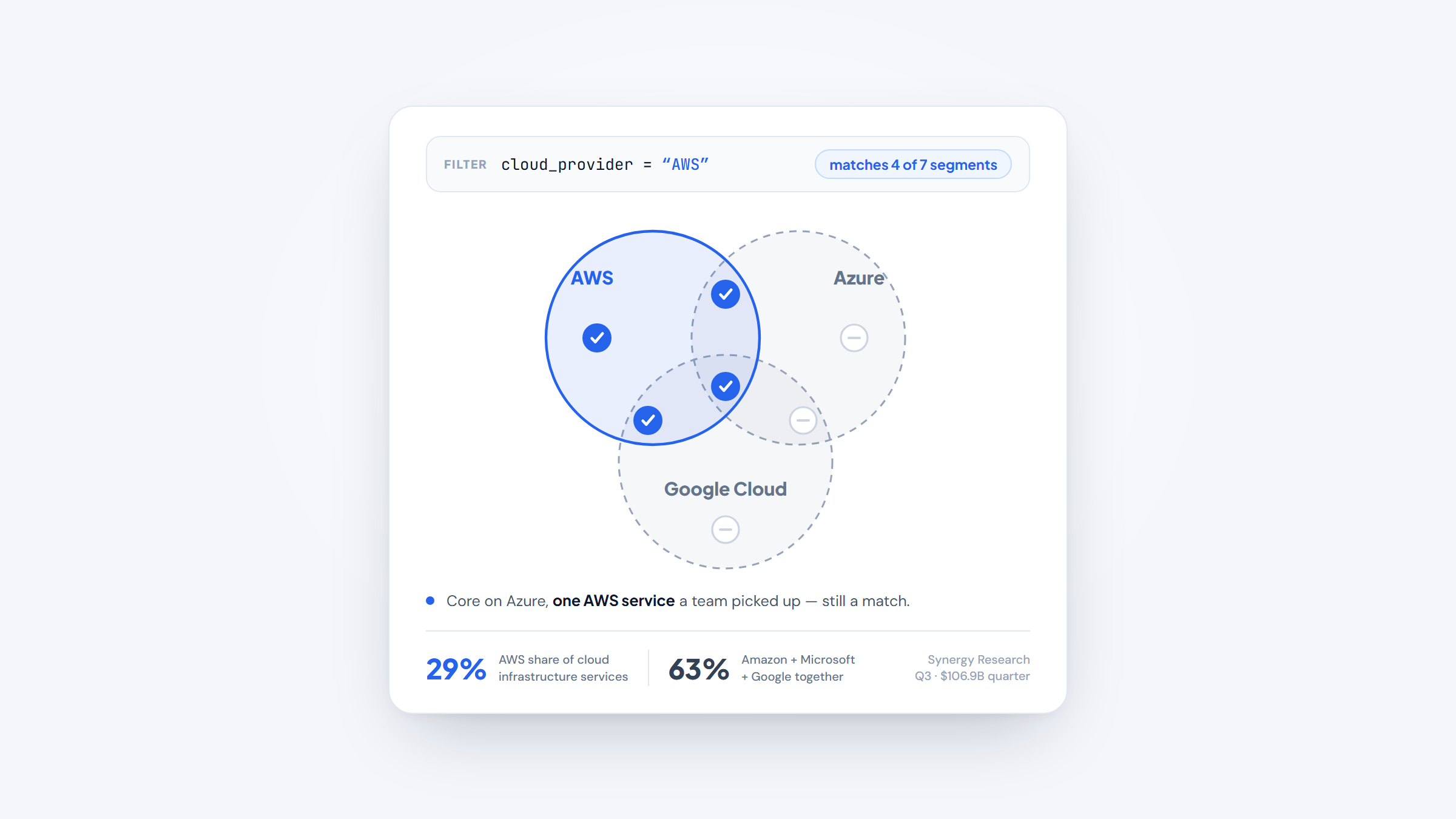
"Uses AWS" Describes a Third of the Market
Synergy Research Group put Amazon at 29% of worldwide cloud infrastructure services in Q3, in a market worth $106.9 billion that quarter and $390 billion on a trailing twelve-month basis. Amazon, Microsoft and Google together held 63%.
Think about what that means for an AWS users email list. AWS is not a niche technology whose adopters form a natural audience, the way a warehouse management system or a specific CRM does. It is closer to asking for a list of companies that use electricity.
Three companies with nothing in common carry the same flag in every file on the market.
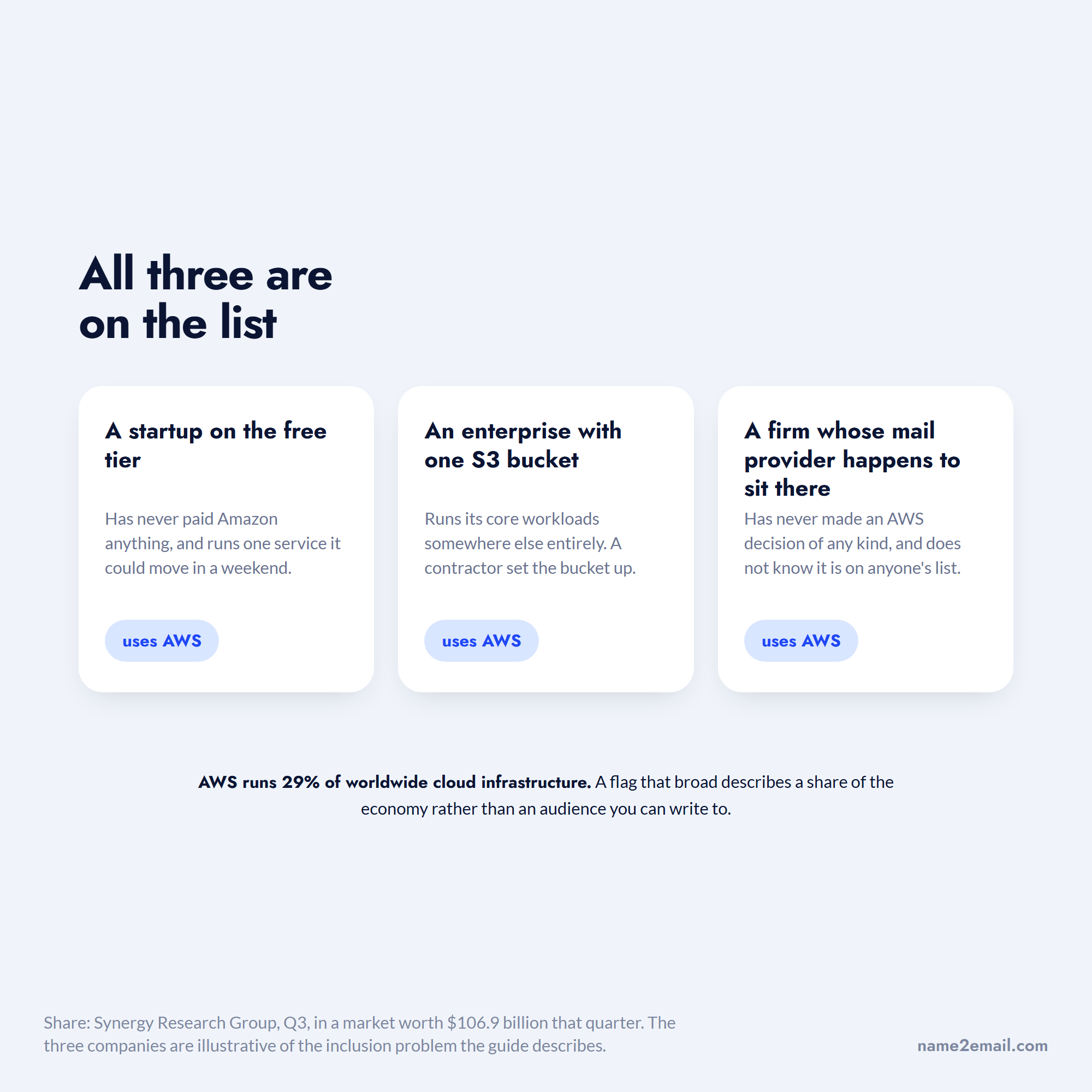
Any startup on a free tier, any enterprise running one S3 bucket, and any company whose email provider happens to sit on AWS lands in somebody's list of companies that use AWS. That is precisely how you get five vendors quoting wildly different totals for the same country.
What the Vendors Claim
Here is every AWS-specific figure these providers publish for their AWS users mailing list products, read off their own pages, with one figure recovered by screenshot because the page renders it in JavaScript and text scraping returns nothing.
Provider | Companies claimed | Contacts claimed | Published price | Stated freshness |
|---|---|---|---|---|
Reply.io | No AWS install-base count | 1B+ across all industries, bundled | From $59/user/mo | Continuous, platform-wide |
Span Global Services | 835,169 | 5,830,648 | Quote only | "Database last verified: September 2026," updated every 30 days |
ReachStream | 618,000+ | 13,000,000+ | Free plan, then paid tiers | Not stated |
TargetNXT | 880,000+ | 7,000,000+ total, 4,000,000+ US | Quote only | Not stated, 98.5% accuracy SLA claimed |
Data Marketers Group | 50,000+ | 620,000+ | Quote only | Not stated |
Thomson Data | Not published | Not published | Quote only | Cites AWS market data from 2022 |
Among the five list vendors, company counts run from 50,000 to 880,000, a spread of about 18 times, and contact counts run from 620,000 to 13 million, a spread of about 21 times. Every one of those five files claims to describe companies using Amazon Web Services.
Put the four published company counts on one scale and the spread stops being an abstraction.
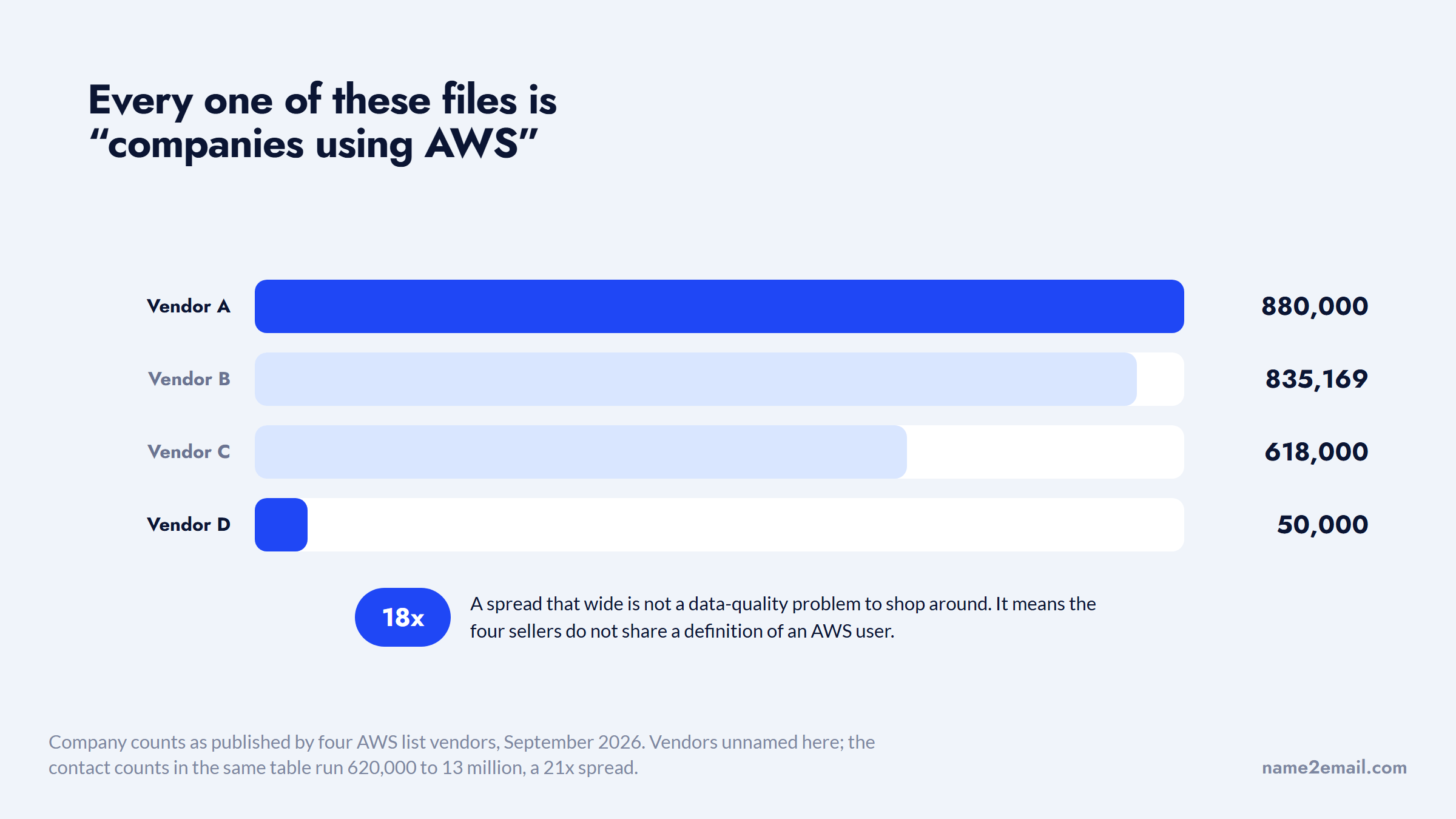
A spread that wide is not a reason to pick the biggest number, it is a reason to ask each vendor what its inclusion rule is before comparing anything, a habit our guide to buying email lists applies across the whole category.
ReachStream offers the only genuinely free entry point among the five list vendors, a plan including 200 email views and 100 export credits a month. That is enough to test whether its definition of an AWS user matches yours before you pay anything, which no other provider here lets you do.
Reply.io appears first because it is the company that built our extension. It is also the one row publishing no AWS count at all, since its database sits inside an outreach platform rather than being sold as an install-base file.
Thomson Data is worth a separate note. Its page still describes AWS as holding "a 33% share of the $180 billion market" as of 2022, against a market that Synergy now measures at $390 billion a year with Amazon nearer 29%. A vendor selling freshness while quoting four-year-old market data is telling you something about its refresh cycle.
Multicloud Makes the Label Weaker Every Year
Even a perfectly accurate list of companies using AWS would be a blunt instrument now, because most companies are not on one cloud.
The Flexera 2026 report on the state of the cloud, based on 753 cloud decision-makers, found 73% of organizations running hybrid cloud, combining public and private environments, with multicloud adoption still rising and often arriving unintentionally through mergers and siloed teams. Among large enterprises, 76% now spend more than $5 million a month on public cloud.
So a company on your AWS list may run its core workloads on Azure and use AWS for one service a team picked up three years ago. If you are selling cost optimization, that company is a poor fit. If you are selling migration tooling, it might be your best one. The label alone cannot tell you which, and no vendor's file carries the field that would.
Why Detection Tools Miss Infrastructure
The technographic tools most people reach for first are the wrong instrument here, and it is worth understanding why rather than blaming the data.
Tools like BuiltWith and Wappalyzer work by reading what a website hands the browser: script tags, meta generators, cookie names, response headers. That works beautifully for anything with a front-end fingerprint, which is why they are reliable on ecommerce platforms, analytics, chat widgets and marketing automation.
AWS leaves almost none of that. Compute, storage and databases run behind the page rather than in it, and a site fronted by Cloudflare or Akamai shows the CDN rather than the origin. The result cuts both ways: real AWS customers get missed because nothing in the markup announces them, and companies get tagged as AWS users because one asset loads from an S3 bucket that a contractor set up.
That is a genuinely different failure from the one affecting most technology lists, where the problem is that data goes stale. Here the detection is structurally blind, and refreshing it more often does not help. Our roundup of data enrichment tools covers what these platforms do well, which is a lot, just not this.
AWS Publishes Better Sources Than Anyone Sells
The useful move is to stop looking for third-party detection and go to the party with perfect information. AWS publishes an unusual amount, because its partner ecosystem and its marketing both depend on visibility.
AWS-owned source | What it gives you | Cost | Precision |
|---|---|---|---|
AWS Partner Solutions Finder | Named partner firms, competencies, service validations, regions | Free | Very high, partners self-certify and AWS validates |
AWS Marketplace | Vendors selling to AWS customers, product categories, pricing models | Free | High for sellers, indirect for buyers |
AWS customer case studies | Named companies, the services they run, the problem solved, often named staff | Free | Highest available, AWS confirmed each one |
ip-ranges.json | 10,538 IPv4 and 6,333 IPv6 prefixes across 43 regions and 27 services | Free | Definitive for what is AWS-owned address space |
Certification and community directories | Named individuals with AWS credentials at named employers | Free | High for people, partial for companies |
Not one of these is a mailing list, and that is the point. They give you verified companies and, in the case studies and community programs, verified people, which is the expensive half of a list to get right. Turning that raw material into a working shortlist is a job in itself, and our roundup of company research tools covers the platforms that do it.
Mining the Case Studies
AWS's customer stories are the single most underused prospecting asset in this category. Each one names a company, describes the workload, lists the specific services in use, and frequently quotes a named engineer or executive with their title.
The case studies are one of five things AWS gives away that no vendor can sell you.
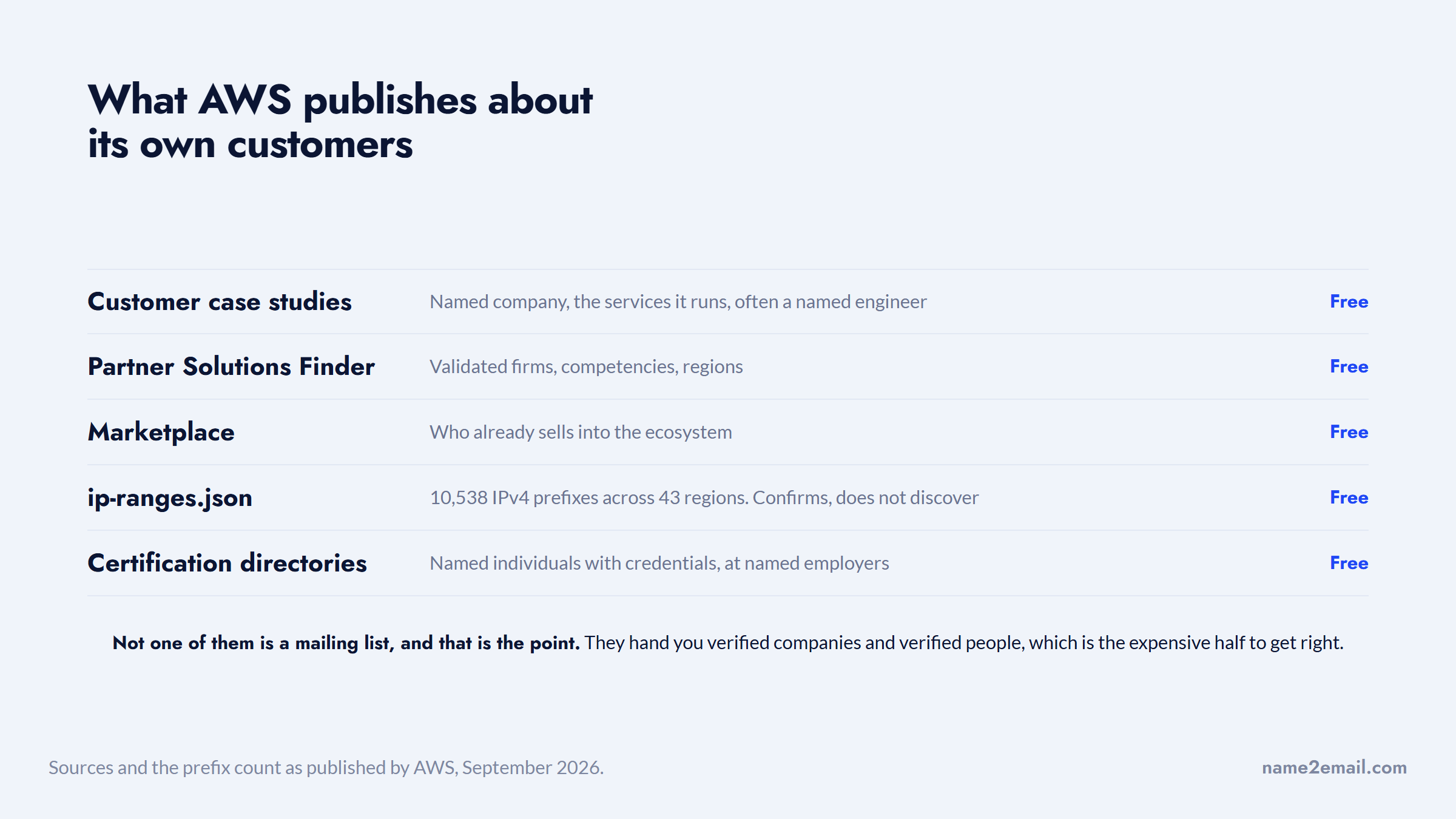
Filter the case study library by industry, region and service to match your product. A company that published a story about migrating to Amazon Aurora is telling you its database stack, its timeline and often the person who ran the project, which is more qualification than any purchased record carries. And unlike a compiled file, the company agreed to be named.
Using the Partner Directory
The Partner Solutions Finder lists firms that have gone through AWS validation, filterable by competency, service, industry and geography. If you sell to companies that implement AWS rather than companies that run it, this is the entire market in one searchable place.
Partner status also tells you about budget and commitment in a way no install-base flag does. Achieving a competency requires certified staff and reference customers, so a listed partner is verifiably doing real AWS work rather than having a dormant account.
Reading the IP Ranges
AWS publishes its full address space as a JSON file that updates constantly, and it is the only definitive answer to whether a given endpoint sits on AWS. The current file carries 10,538 IPv4 prefixes and 6,333 IPv6 prefixes across 43 regions and 27 services.
Resolve a company's domain and mail records, check the resulting addresses against those prefixes, and you get a factual answer rather than an inference. Two caveats keep it honest. Anything sitting behind Cloudflare or Akamai will resolve to the CDN rather than the origin, and a match on a marketing site tells you where the website lives rather than where the business runs. Use it to confirm, not to discover.
Segment by Workload, Not by Vendor
Once you have companies, the field that matters is what they run, because that is what your product attaches to. A segmented AWS users email list beats a complete one every time.
- Companies that published a case study naming a service you integrate with
- AWS Marketplace sellers, who are already sold on buying through the platform
- Firms holding a partner competency in your product's category
- Organizations hiring for named AWS services, which signals a live project rather than a legacy footprint
- Companies whose mail or application endpoints resolve into AWS address space
Any one of these beats a generic install-base flag, because each carries a reason the company would care. A list of 200 companies that ran a database migration last year is worth more than 200,000 records tagged "uses AWS."
Sourcing signals decay at very different rates, which is worth knowing before you build a refresh schedule around them. A published case study records something that happened and stays true indefinitely, while a partner competency is renewed on a cycle and lapses visibly.
The four sourcing signals split cleanly into ones that keep and ones that spoil.
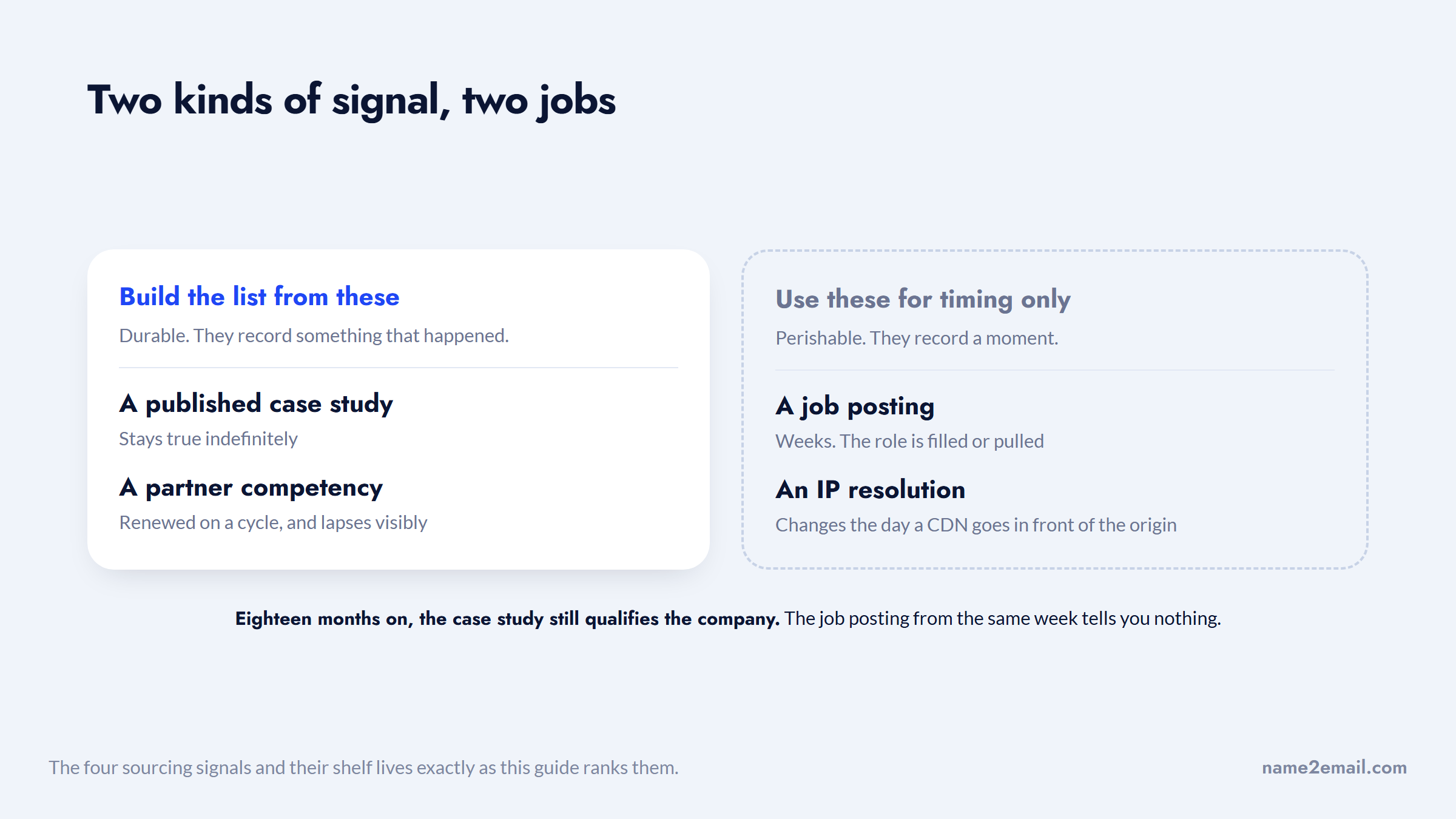
The perishable ones are different in kind. A job posting has a shelf life of weeks, since the role either gets filled or gets pulled, and an IP resolution can change the day someone puts a CDN in front of their origin, without anything about the business changing at all.
Build your list from the durable signals and use the perishable ones for timing rather than qualification. A company that published a migration case study eighteen months ago is still a valid target; a company that posted for a cloud architect eighteen months ago tells you nothing today.
Reaching the Buyer, Not the Builder
The last structural thing to know is that engineers rarely buy. On r/aws, a thread asking whether anyone actually uses AWS Marketplace drew a blunt top reply on Reddit: people hardly ever, corporations and enterprise all the time. Others in the thread explained that Marketplace purchases appear on the existing AWS bill and can save months of vendor approval, legal review and procurement, while drawing down the company's committed spend agreement.
Both are individual accounts rather than a survey, and together they describe a real buying mechanic. In a large organization the person who wants your product is an engineer, the person who can approve it is in procurement, and the path of least resistance runs through a billing relationship the company already has.
Three different parties, and only one of them already has a paying relationship with you.
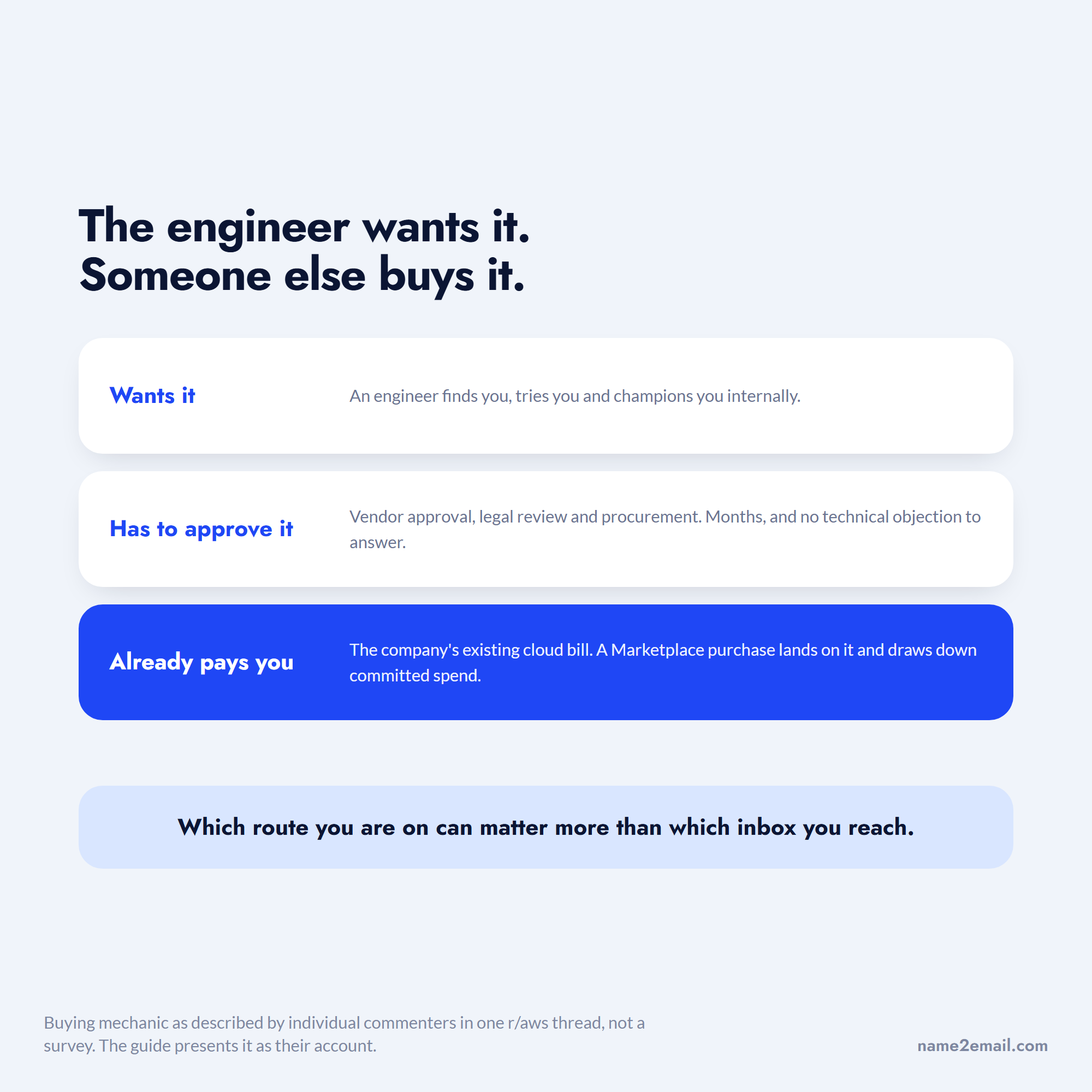
That changes your targeting more than any data field. If you sell to enterprises, listing on Marketplace may matter more than finding the right inbox, and your message to the engineer should mention that buying through it is possible. Mapping the rest of that buying committee, once you know which company you are working, is what the platforms in our roundup of sales intelligence tools are for.
Turning a Company Into a Named Person
At this point you have a company, a domain and often a named person from a case study, a conference session or a partner page. The missing piece is that person's work address.
Name2Email is a free Chrome extension that solves the last step without leaving the inbox. Public naming conventions are predictable enough that a domain plus a full name narrows the answer to a handful of candidates, and those candidates land in Gmail's To field so that Gmail's own contact recognition can pick the winner on hover.
Being clear about the limits matters more than the pitch. There is no install-base data here, no record of who runs AWS, nothing to export and nothing to buy. All the extension does is infer probable addresses from published naming conventions, one person at a time; corporate domains are where that inference holds up, which describes nearly every company in this category, and it will still miss some people.
The reason that matters here specifically is cost per attempt. Working through 400 companies from a case study filter is exactly the job that drains a metered finder's monthly allowance, and nothing here is metered or gated behind a signup. Our pricing page is short for that reason.
Keeping the List Accurate
Cloud lists decay through architecture rather than employment. The company stays, the workload moves, and a record tagged "AWS" two years ago may describe a migration that finished on Azure last quarter.
Re-check the underlying signal, not just the email. If your source was a case study, it stays true; if it was an IP resolution or a job posting, re-run it quarterly. Then verify the addresses themselves on the same cycle, since cloud and engineering teams churn faster than most departments, and our comparison of email finding tools covers what each service checks.
Writing to a Cloud Team
Technical audiences reward specificity and punish everything else. Naming the exact service, region or architecture pattern the company published proves you did the work in the first sentence, which is more than almost any other opener manages with this audience.
Skip the cost-savings claim unless you can attach it to something observable. Flexera's respondents put wasted cloud spend at 29%, an industry figure, and quoting it at someone who has never met you is not an insight. Naming the service they wrote a case study about is.
Start From What AWS Already Published
The shortcut everyone reaches for, buying an AWS customer database off the shelf, is the one route that cannot answer the question you care about, because "uses AWS" is not a property that predicts anything on its own. The 18x spread between vendor counts is the market telling you so.
Work the other way instead. Pick a workload your product attaches to, pull the companies AWS itself has named running it, get people from the case studies and partner pages, and find their addresses one at a time.
That is slower for the first hundred companies and far faster after that, because you never have to re-qualify anyone. You also end up able to say why each company is on the list, which is the thing no purchased file can give you at any price.
Add Name2Email to Chrome to keep that last step free while you work a case-study shortlist. Nothing to sign up for and nothing metered, which is why this sits among our published use cases.
Frequently asked questions
AWS publishes a partial list of companies using AWS itself, covering thousands of them. Its published customer case studies name the company and the services in use, its Partner Solutions Finder lists validated partner firms, and its Marketplace shows who sells into the ecosystem. For companies that have not published, you can resolve their domain and check the addresses against AWS's public ip-ranges.json file, though a CDN in front of the origin will hide the answer.
Because no two of them define an AWS user the same way and none publishes its definition. Company counts across five providers run from 50,000 to 835,169 and contact counts from 620,000 to 13 million for the same universe. Some are counting any company with detectable AWS presence, some are counting contacts at companies where one team uses one service, and some do not say. Ask any vendor to define its inclusion rule before comparing counts.
There is no free AWS users mailing list to download, but the free sources behind one are unusually good. The case study library, the Partner Solutions Finder, Marketplace listings and the certification directories are all public, and together they amount to a partial AWS customers list naming real companies and, in several cases, individual people. ReachStream offers a free plan with 200 email views a month if you want to sample a commercial file too.
Both, in that order, and for different reasons. The engineer decides whether your product is worth having and is reachable with a specific technical message. Procurement decides whether it can be bought, and in large organizations the path through AWS Marketplace can matter more than the pitch, because the purchase lands on an existing bill and draws down committed spend rather than triggering a new vendor approval.
Faster than employment data and for a different reason. The contact may still be at the company while the workload has moved to another cloud, so both halves of the record need separate checking. Re-run any inferred signal quarterly, treat AWS-published case studies as durable since they record something that happened, and re-verify addresses on the same quarterly cycle because cloud teams turn over quickly.

We build Name2Email, the free Chrome extension that finds work emails inside Gmail. We write about outreach, prospecting, and getting more replies.
Connect →