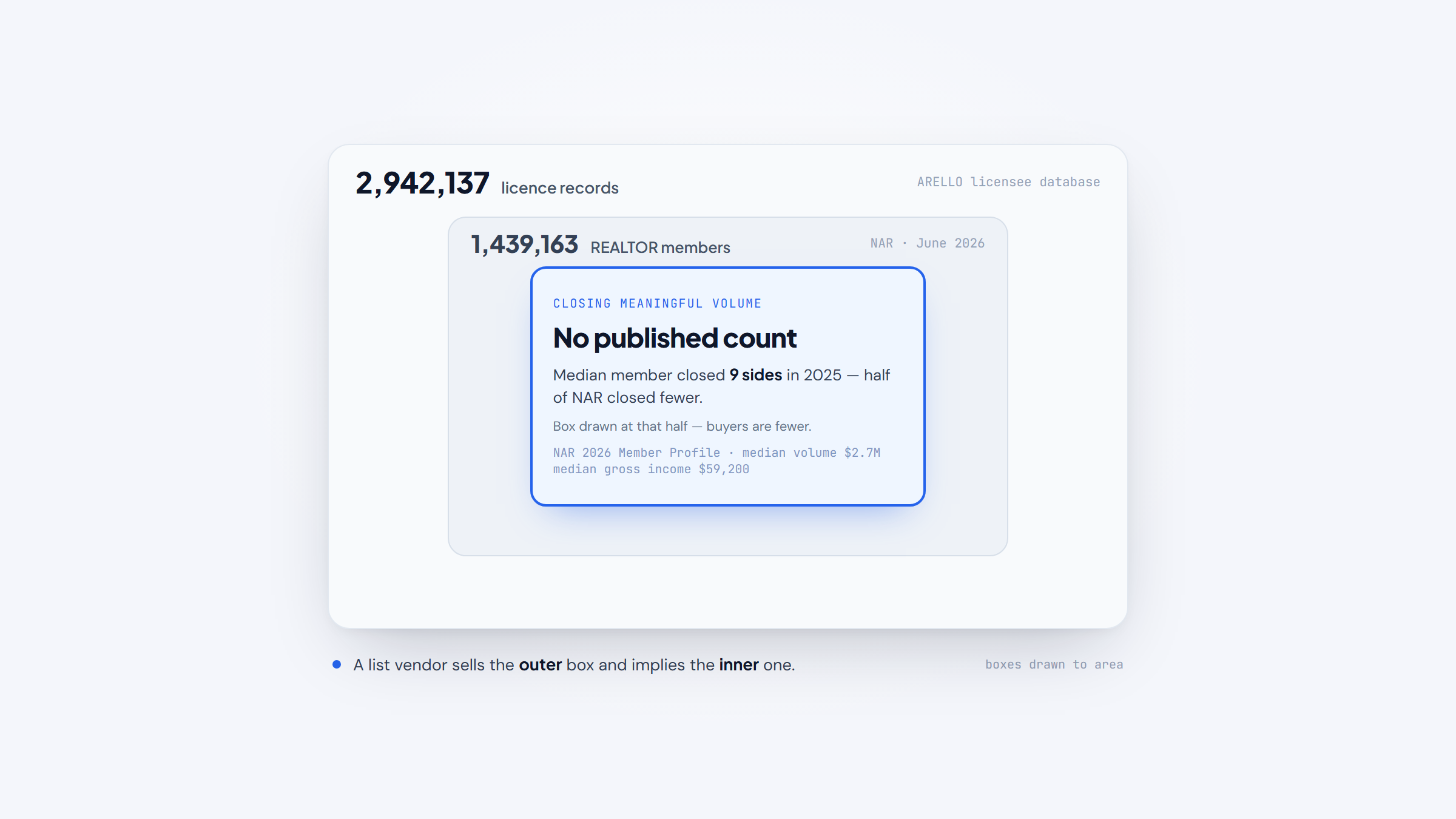
- 1Three different numbers describe this market: 2,942,137 license records, 1,439,163 REALTOR members, and a typical agent who closed nine deals last year. Vendors sell you the first and imply the third.
- 2Two providers publish real per-record pricing, which is rare in this category: $30 per 1,000 contacts and $90 per 10,000. Neither price tells you how many of those people are still selling.
- 3One vendor's comparison table prices a competitor 13 to 33 times above that competitor's own published rate card, so never take a price from a rival's page.
- 4Agents often use personal Gmail or Yahoo addresses rather than a brokerage domain, which is exactly where a pattern-based finder like ours helps least, and we would rather say so.
A real estate agent email list is one of the easiest B2B lists to buy and one of the hardest to make useful. The data is cheap because the underlying register is public, and it is weak for the same reason: everyone selling to agents bought the same file.
This guide works the problem from the other end. It separates the three populations hiding behind the phrase "real estate agent," shows where the free registers are and how to filter them down to people who actually close deals, and is honest about the one thing that makes agent addresses harder to find than most.
Licensed, Member, Active: Three Different Populations
The word "agent" covers three groups that differ by more than a million people, and the difference decides whether your campaign works.
Population | Count | Source | What it means for outreach |
|---|---|---|---|
Holders of a real estate license | 2,942,137 license records | ARELLO licensee database | The widest possible universe, including inactive and lapsed holders |
REALTOR members | 1,439,163 | National Association of REALTORS, June 2026 | Dues-paying members bound by the NAR code of ethics |
Agents closing meaningful volume | Typical member: 9 transaction sides in 2025 | NAR 2026 Member Profile | The group with budget, and far smaller than either number above |
ARELLO, the association of state license-law regulators, gives its licensee verification service access to 2,942,137 license records supplied directly by participating jurisdictions. That is the pool a "2.3 million verified agents" file is drawn from.
NAR's own reporting puts membership at 1,439,163 as of June 2026, down slightly from 1,463,352 a year earlier. So roughly half of all license holders are not REALTOR members at all.
Each step down the list is a smaller group than the one a vendor quoted you.
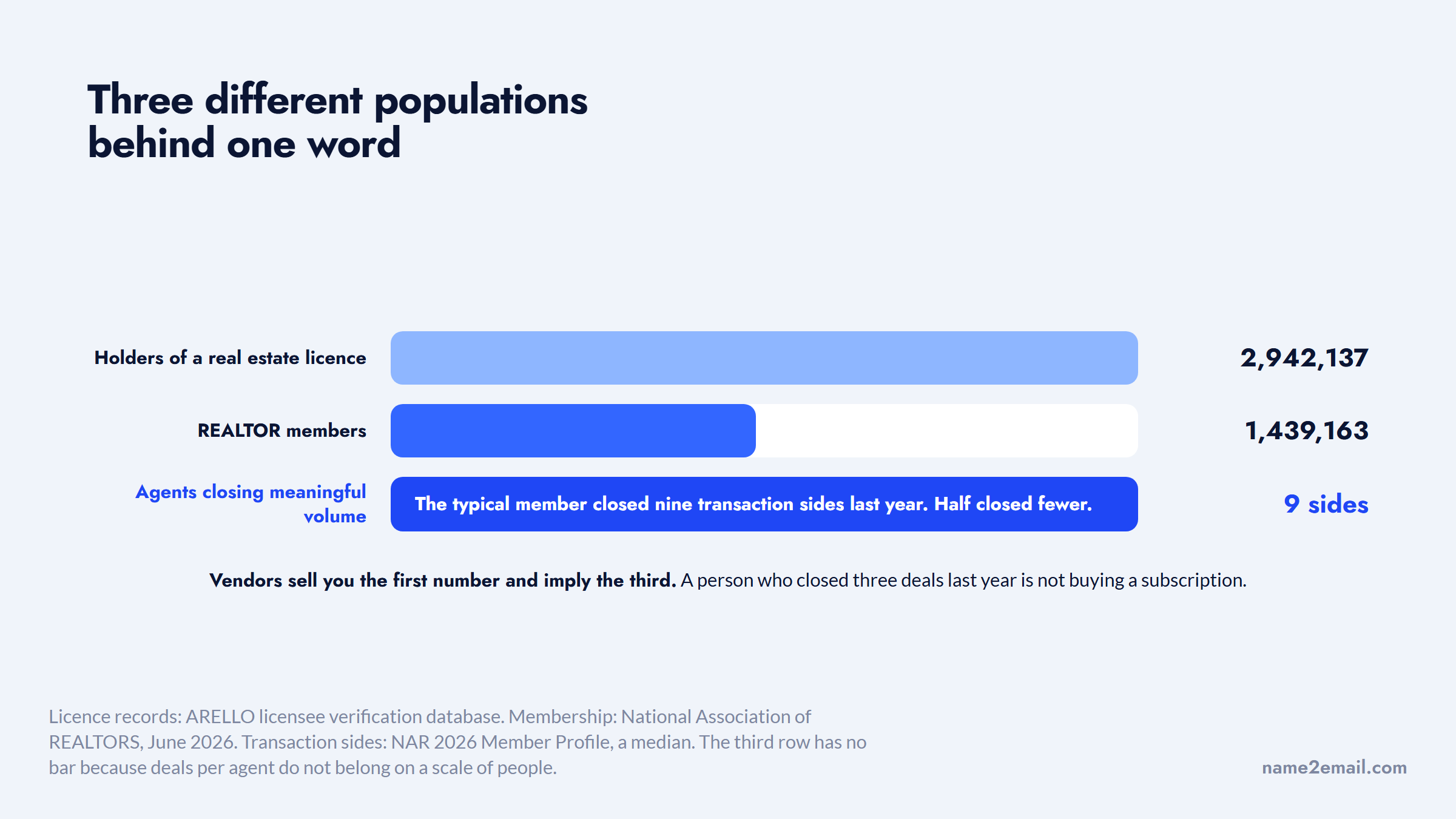
The 2026 Member Profile narrows it a third time. The typical individual agent completed nine transaction sides in 2025, with a median sales volume of $2.7 million and median gross income of $59,200. That is the median, which means half of NAR's membership closed fewer than nine deals, and a person who closed three deals last year is not buying a $400-a-month subscription.
What the Vendors Sell and What They Charge
This is an unusually transparent corner of the list market. Most B2B data providers hide behind "request a quote," but several of the agent specialists publish a rate card, which makes them checkable.
Provider | Published volume claim | Published price | Freshness model | The gap worth noting |
|---|---|---|---|---|
Reply.io | No realtor-specific count | From $59/user/mo | Continuous, platform-wide | Its 1B+ database is bundled inside the outreach platform and never sold as a standalone realtor file |
RealtyOutreach | 2,286,032 contacts, 1,707,486 licensed realtors | $30 per 1,000, down to $260 per 20,000 | Compiled, periodically refreshed | Its "licensed Realtors" figure exceeds NAR's entire membership |
LeadsDeposit | 10,000-contact bundle | $90 per 10,000 | Compiled | Publishes no total database size or refresh date |
Scrap.io | 282,035 US real estate agencies | From $35/mo annual, about $0.005 per contact | Live extraction from Google Maps | Indexes agencies, not individual agents |
real-estate-agent-lists.com | 2,270,848 agents with verified email and cell phone | Sample-gated | Compiled | Publishes no verification date or method |
Salesgenie | Not published for this list | No public rate; its pricing page returns a 404 | Compiled | Quote only |
RealtyOutreach's rate card is the most detailed in the category, running from $3.96 for 66 leads to $260.00 for 20,000, which works out at $0.013 per contact at the top volume. Prices that low change the question from whether you can afford the file to whether the file is worth loading, which is the trade our guide to buying email lists works through.
Reply.io is in this table for contrast rather than competition. It is the company behind our extension, it sells outreach software rather than a realtor file, and we would rather state that plainly than let its database size read as a realtor count.
Two claims in that table are worth holding up to the population figures above. RealtyOutreach lists 1,707,486 "licensed Realtors," which is 268,000 more people than NAR has members, and REALTOR is a membership term rather than a synonym for licensee. Its own page also reports 2,286,032 total contacts and 2,286,032 email addresses, identical figures for two fields that are almost never identical in a real database.
A Competitor's Price Table Is Not a Price
Here is the most useful thing you can learn about this market in one comparison, and you can verify it in two browser tabs.
Scrap.io publishes a price-per-lead table on its real estate page that lists RealtyOutreach at $2,000 to $5,000 per 10,000 leads and Salesgenie at $3,000 to $8,000. RealtyOutreach's own published rate for 10,000 leads is $150.00.
That is an overstatement of between 13 and 33 times, on a figure the competitor publishes openly on its own site. Scrap.io's own pricing, roughly $0.005 per contact from $35 a month, is genuinely cheap, and the comparison did not need the inflation.
Drawn as a multiple, the size of the overstatement is hard to argue with.
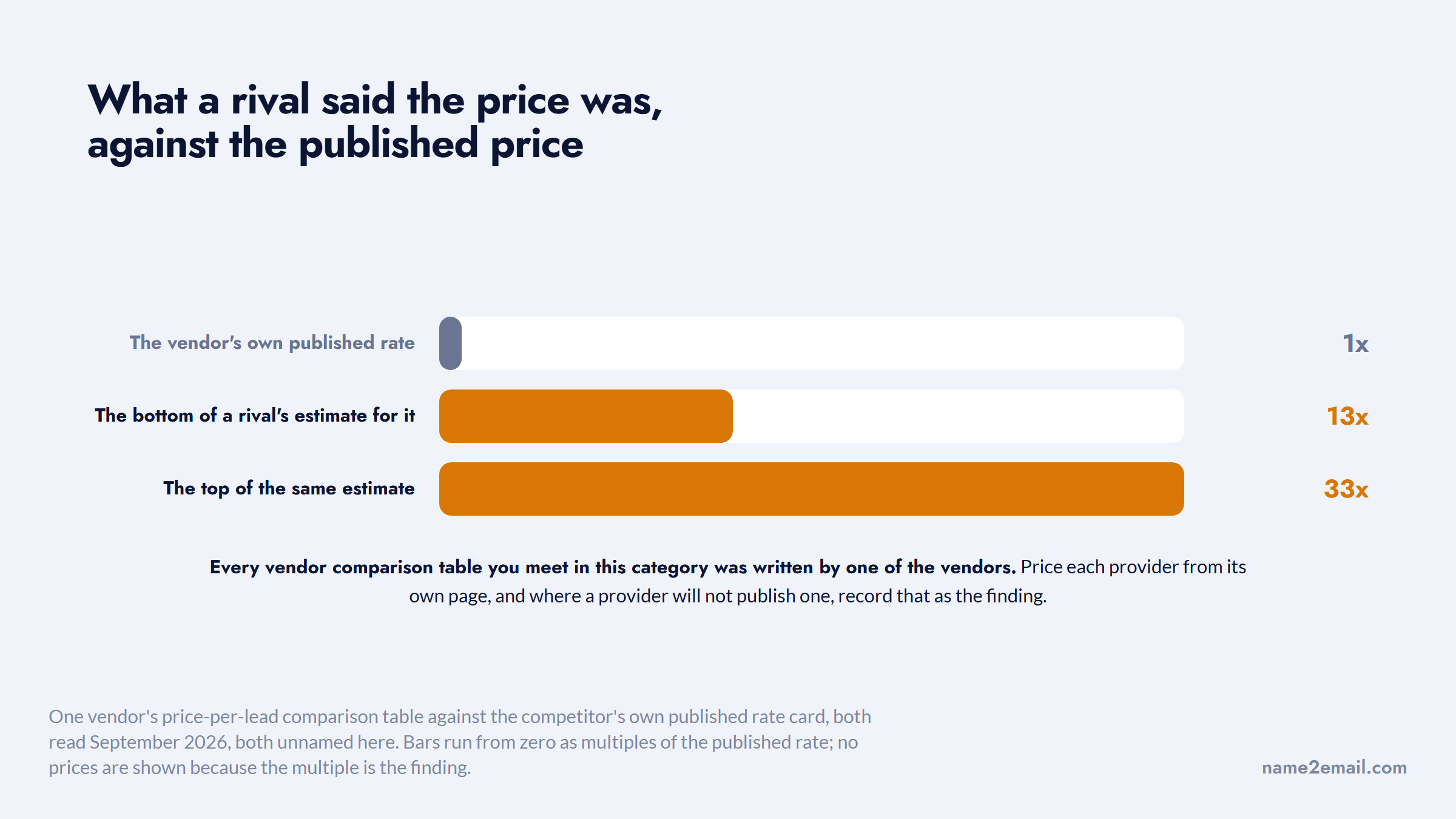
The lesson generalizes well beyond these two companies. Every vendor comparison table you meet in this category was written by one of the vendors. Price each provider from its own page, and if a provider will not publish a price, record that as the finding rather than filling the gap with a rival's guess.
Filtering for Agents Who Actually Sell
Volume is the wrong target for a real estate agent email list, and it is the one thing every vendor optimizes for. A file of 2.2 million agents contains roughly 1.5 million people who did not close enough business last year to buy anything.
One fact makes a record; two corroborating ones make a prospect.
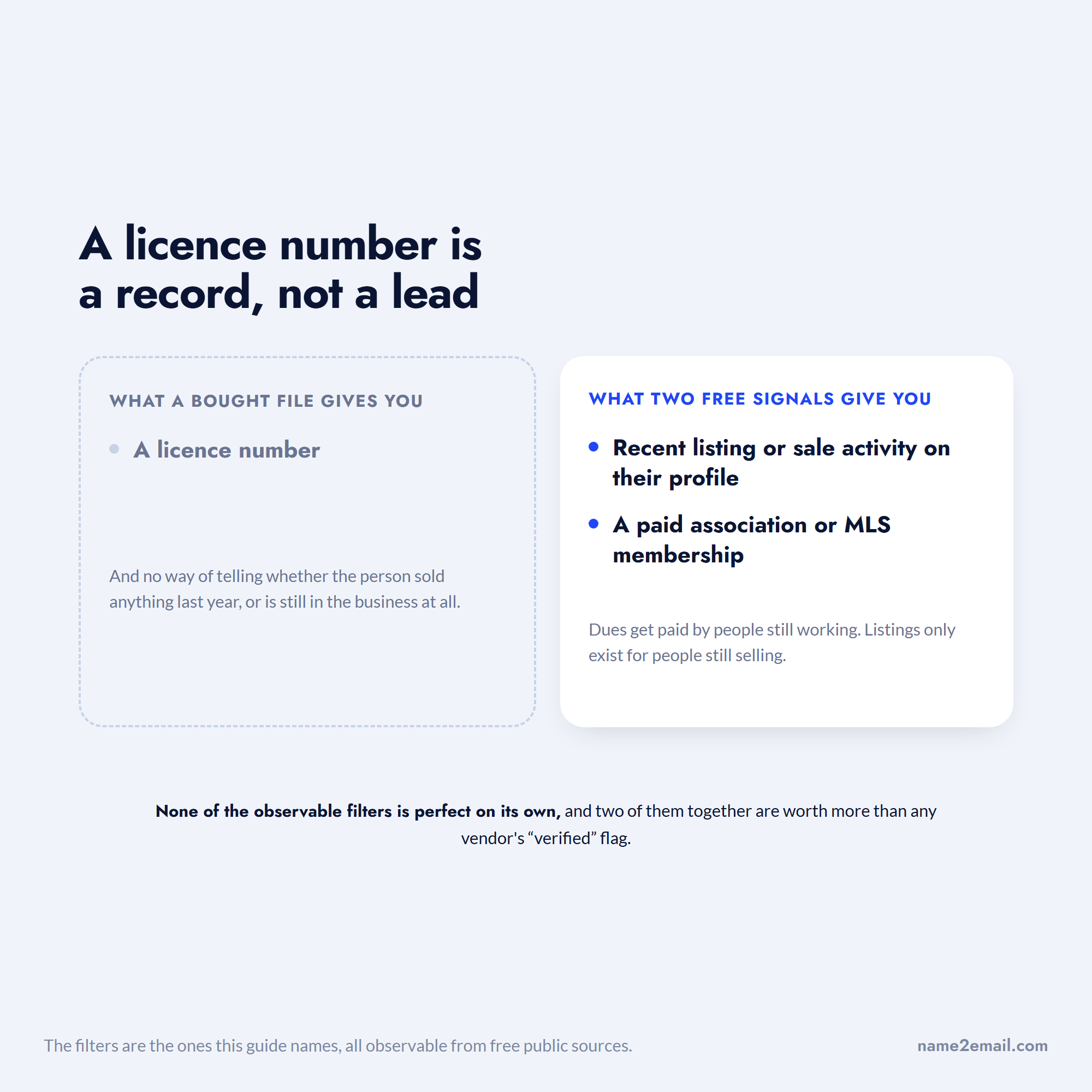
The filters that actually separate producers from license holders are all observable from public data:
- Recent listing or sale activity on the agent's brokerage or portal profile, which we weight above everything else here
- Membership in a local association or MLS, since dues indicate someone still working
- A brokerage domain rather than a free mail account, which correlates with being at a firm that invests in its agents
- A team page listing them among active agents rather than an alumni or archive page
- A professional designation or specialty certification, which agents stop renewing when they leave the business
None of these is perfect on its own, and two together are worth more than any vendor's "verified" flag. An agent with three active listings and an association membership is a real prospect; a license number with neither is a record.
The Free Registers, and Why Some Closed
Real estate licensing is a state function, and most states publish a searchable register of who holds a license. That is the same source the compiled files are built from, which is why the compiled files are cheap.
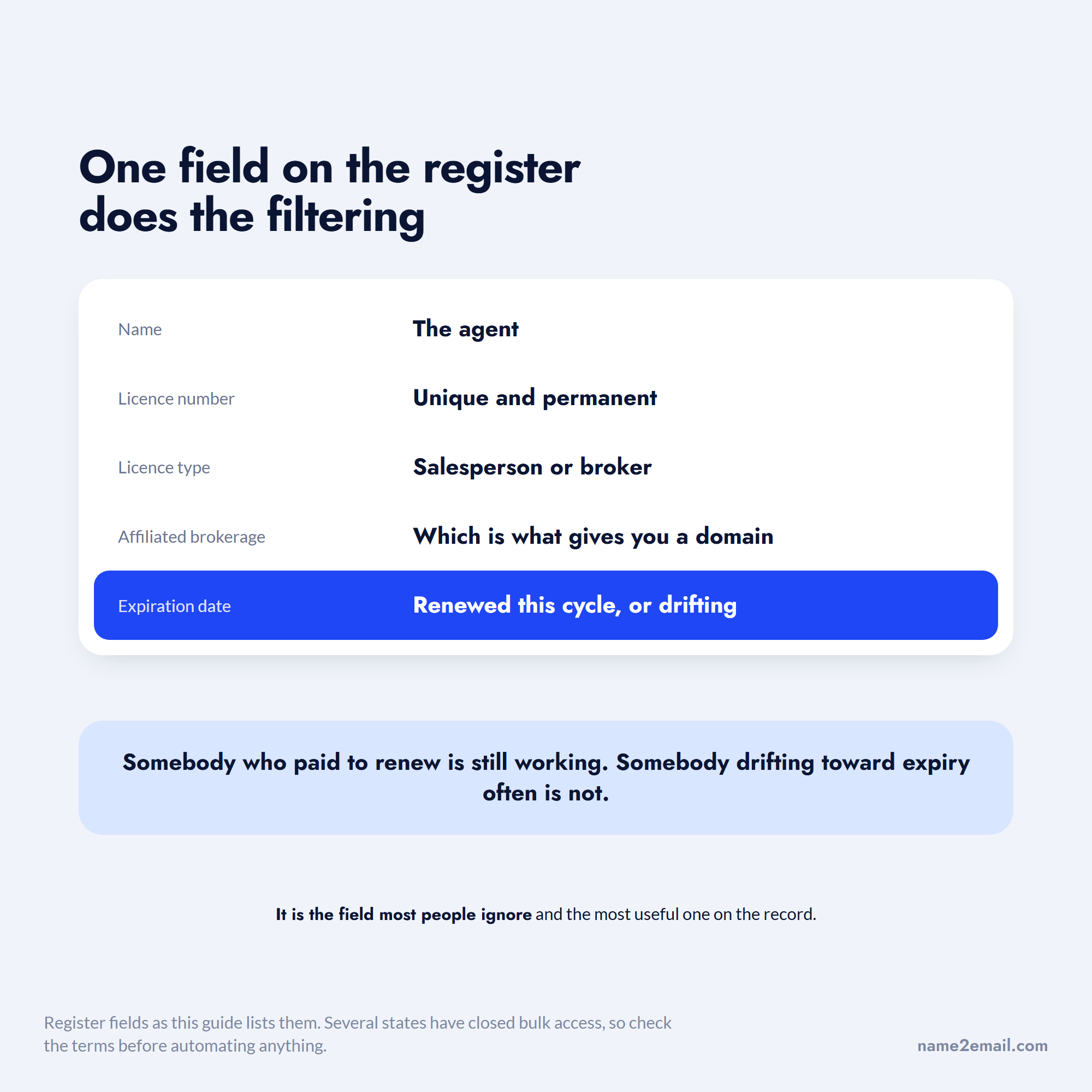
The register carries five fields, and the last one does most of the filtering.
One agent on r/realtors, asked where to get agent email lists, answered that in North Carolina you can download directly from the state real estate commission website. Another said Texas offered the same thing online until it was withdrawn, and added that they were glad it was gone because the spam dropped. Both are individual accounts rather than a survey, but together they describe the state of play accurately: availability varies by jurisdiction and it has been tightening.
Working a State License Register
The process is the same in every state even though the interfaces are not, and the whole thing takes an afternoon for one jurisdiction.
- Find your state's real estate commission or department of licensing and open its licensee search or public records page.
- Look for a bulk download or public records request option before using the search form, since several states still publish a full roster as a downloadable file.
- Filter to active salesperson and broker licenses, excluding inactive, expired and surrendered statuses, which is where most of the dead weight sits.
- Capture name, license number, license type, expiration date and affiliated brokerage, since the brokerage is what gives you a domain.
- Cross-check a sample of 20 records against the brokerage's own agent roster to see how far behind the register runs.
The expiration date is the field most people ignore and the most useful one on the record. A license renewed within the last cycle belongs to someone who paid to keep working; one drifting toward expiry often does not.
Brokerage Rosters and Association Directories
The register gives you a person and a firm. The brokerage website gives you the domain, the current roster and, frequently, the agent's own contact details published deliberately because agents want to be reachable by clients.
Local and state REALTOR association directories are the other route, and they have a property the registers lack: membership is voluntary and paid, so appearing in one is itself an activity filter. National franchise sites carry office-level rosters that update when agents move, which is the churn a compiled file misses.
The four free routes differ enough that it is worth knowing which one answers which question.
Free source | What it gives you | Activity signal | Main limit |
|---|---|---|---|
State license register | Name, license number and status, expiration date, affiliated firm | Renewal date only | No email, and several states have closed bulk access |
Brokerage website roster | Current agents, firm domain, often direct contact details | Strong, rosters drop departed agents | One firm at a time |
Local or state association directory | Members in good standing, specialty designations | Strong, membership is paid annually | Members only, and some directories are gated |
Portal agent profiles | Recent listings, sales history, review counts | Strongest, shows actual transactions | Coverage skews to agents who pay for placement |
Used together they cover each other's gaps: the register proves the license, the roster gives the domain, and the portal profile proves the person is still selling.
Work brokerage by brokerage rather than agent by agent. Fifty agents at one firm share one domain and one naming convention, so the work of figuring out the pattern once pays off fifty times, and it is far faster than treating each agent as a separate research problem.
Grouping by firm also changes how the first send should look. A roster of fifty colleagues who talk to each other is the worst possible audience for an obvious mass mailing, so send to them individually rather than in bulk even when the message is the same.
The Personal Address Problem
Here is the honest complication in this category, and it is specific enough that skipping it would make this guide useless.
A large share of real estate agents run their business from a personal Gmail, Yahoo or Outlook address rather than a brokerage domain. Agents are independent contractors, 86% of them at their firms according to NAR's own 2026 reporting, they change firms often, and they keep the address their past clients already have. Some brokerages issue a domain address that the agent never checks.
That matters for how you build. Pattern-based finding works on corporate domains, where naming conventions are consistent and predictable. It does not work on a free mail provider, where an address can be anything the person chose in 2011, and no tool can derive it from a name. If an agent's public profile lists a Gmail address, that published address is the answer and no lookup is needed.
Two kinds of address, and only one of them can be worked out from a name.
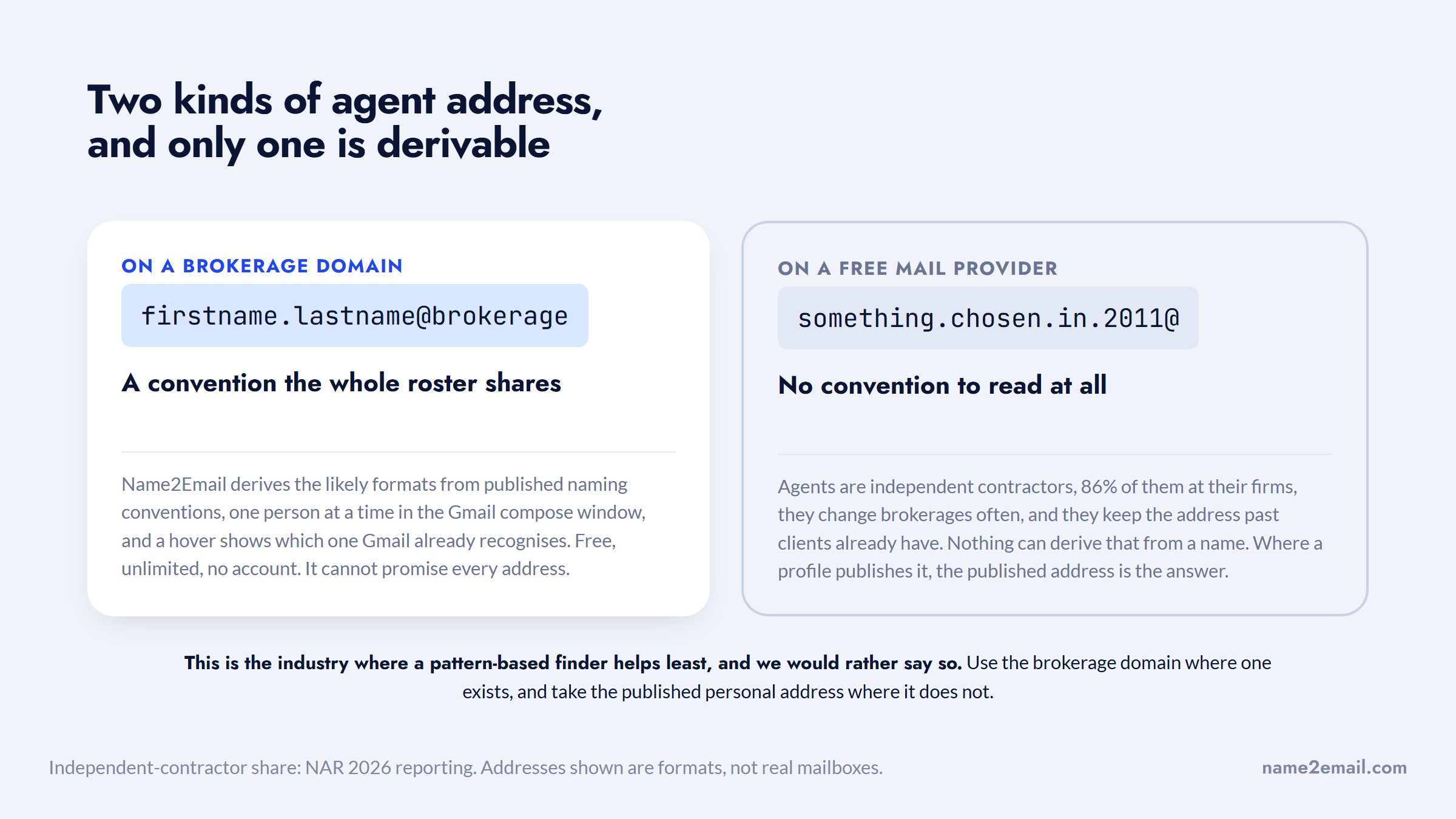
The practical split is to use the brokerage domain where one exists and take the published personal address where it does not. Either way you want to confirm the address exists before it meets a sequence, which is a different job from finding it and the one we cover in looking up an email address.
Finding an Agent's Work Address
When an agent does sit on a brokerage domain, the last step is quick. Name2Email is a free Chrome extension built for exactly that moment: with the brokerage domain and the agent's name typed into a Gmail compose window, it fills the To field with the formats that firm is likely to use, and Gmail's own contact card settles which one belongs to a real person when you hover over it.
We are not a list source, and this is the category where that distinction bites hardest. No real estate records sit behind the extension, nothing is for sale, and there is no database underneath. Inference from public naming conventions is the whole method, one person at a time, and this industry is the one where it helps least, because so many agents work from free mail rather than a brokerage domain. Expect misses.
What the extension removes is the per-lead cost of that last step. Nothing is metered and nothing needs registering, so an entire brokerage roster costs the same as a single lookup, which is the opposite of how paid finders price the identical job. You can see the whole workflow on our features page.
Cleaning the List Before You Send
A real estate agent email list decays through movement rather than attrition. People stay in the industry and change brokerages, and every one of those moves breaks a work address while leaving the person perfectly reachable somewhere else.
Validate before the first send and re-check quarterly, and treat a bounce as a signal to re-look rather than a reason to delete the record. An agent whose brokerage address bounces has usually moved rather than left, so the fix is to find the new firm and rebuild the address. Our comparison of email validation tools covers what each service checks and where the free tiers stop.
Send to a seed segment first. Two hundred addresses will tell you whether a source is sound before you commit the rest of the file, and on compiled agent data that first read is often unpleasant enough to save you a domain.
Writing to Someone Who Gets Forty Vendor Emails a Day
Agents are among the most heavily prospected people in American business. Photographers, lenders, stagers, CRM vendors, lead sellers and coaching programs all target the same list you just built, and the median agent closed nine deals last year, so the money is thinner than the volume of pitches suggests.
Two things separate a message that gets read. Reference something only someone who looked would know, such as a specific listing, a neighborhood they dominate or a recent move to a new firm. And ask for something proportionate to a nine-deal year rather than pitching an enterprise contract to a sole practitioner.
Follow-up is where most agent campaigns are won or lost. Agents are in cars and at showings, so a message that arrives twice carrying new information beats one that arrives five times carrying none, and the sequencing that reflects that is what our guide to the cold email follow up works through.
Build Small, Filter Hard, Then Scale
The version of this that works is unglamorous, and it produces a real estate agent email list you can actually describe. Pick one state, pull the active license register, keep the licenses renewed in the current cycle, group them by brokerage, and find addresses brokerage by brokerage. A few thousand agents you can describe beats two million you cannot.
The reason to do it this way is not purity about buying data. It is that the compiled file is the same file your competitors bought, sold to all of you at $0.013 a record, and the only durable advantage available on a public register is the filtering nobody else bothered to do.
Doing the last step without a credit meter is what makes that filtering affordable, and it is the difference we set out on our comparison page against paid finders.
Add Name2Email to Chrome and stop paying per lookup in a market this cheap to research. No account, no credits, no cap.
Frequently asked questions
Start with the brokerage rather than the person. Take the firm's domain from its website and the agent's full name from the office roster, which gets you a short list of possible addresses that Gmail can confirm on hover. Where an agent works from a personal Gmail or Yahoo account, no tool can derive that, so read their brokerage profile, portal listing and social bios instead.
There is no free downloadable file worth having, but the source data is free. Most state real estate commissions publish a searchable license register, several still allow a bulk download, and brokerage rosters and association directories are open to anyone. What you get free is names, license status and firm affiliation, which is most of a list; the email column is the part you assemble yourself.
Less than almost any other B2B list, because the underlying register is public. RealtyOutreach publishes $30 per 1,000 contacts falling to $260 per 20,000, and LeadsDeposit sells a 10,000-contact bundle for $90. Live extraction from Scrap.io runs about $0.005 per contact on plans from $35 a month. Ignore any price you see for one vendor on another vendor's comparison page, since those figures can be off by more than tenfold.
Buying by state is sensible, but buy the segment rather than the national file filtered down, and check the count against the state's own register. Large states like California, Florida, New York and Texas hold a disproportionate share of the 2.94 million licenses on record, which also makes them the most heavily prospected. A county-level or brokerage-level build in those markets will usually outperform a state file.
Quarterly at minimum, because agents move between brokerages constantly and each move retires a work address. NAR reported membership falling from 1,463,352 to 1,439,163 in a single year, and that net figure hides far more movement than it shows, since agents joining and leaving offset each other. Re-pull your state register annually to catch new licenses and expired ones.

We build Name2Email, the free Chrome extension that finds work emails inside Gmail. We write about outreach, prospecting, and getting more replies.
Connect →