- 1Intent data platforms show which companies are researching a topic right now, drawn from publisher co-ops, review sites, and your own website traffic. They tell you who is in market, not who to email.
- 2Two pricing shapes dominate: review-site and website-visitor tools start around $79 to $299 per month, while enterprise platforms like Bombora, 6sense and Demandbase quote an annual fee and rarely publish a number.
- 3Forrester's guidance on adding a second source is to look for signals that are at least 30 to 40 percent unique from the one you already own, so the overlap does not just confirm what you know.
- 4The last mile intent data misses is the person's work email. Signals surface an account; your team still has to find and reach the human, which is what the free Name2Email extension inside Gmail is for.
Intent data platforms tell you which accounts are researching a problem before those accounts raise a hand. They watch a topic, a competitor, or a category name across a network of publishers, review sites, or your own website, then score each company on how active and how late-stage that research looks.
That self-directed buying is now the default: a Gartner survey of 646 B2B buyers found that 67 percent prefer a rep-free experience. For a sales or marketing team, that is the difference between calling a list and calling the few companies already reading about what you sell.
This roundup covers the intent-signal category specifically: tools whose core product is buying-signal data, not general contact databases or all-in-one sales platforms. It sits next to the broader set of sales intelligence tools, and it helps to know which one you are buying. We ranked ten B2B intent data platforms and flagged where the pricing is real and where it is quote-only.
What Are Intent Data Platforms?
An intent data platform collects behavioral signals that a company is in a buying cycle, then packages them as a score, an alert, or an audience you can act on. The signals arrive from one of three places: publisher co-ops aggregate reading behavior across B2B sites, review sites capture the products and categories buyers compare, and website-visitor tools identify the companies browsing your own pages.
The output is usually account-level, not person-level. You learn that Acme Corp viewed your pricing page three times or researched "sales engagement software" on a tech site last week. You rarely learn which individual read it. Intent data is a prioritization layer that sits on top of your account list.
Two terms come up constantly. Third-party intent is behavior captured off your site, from networks you do not own. First-party intent is behavior on assets you do own: your site, your product, your emails. Most serious programs run both, because first-party signals are the most accurate and third-party signals arrive earliest.
Either way, the signals usually land next to the firmographic profile you keep in a company research tool, which is where you decide whether an active account is worth working.
The Best Intent Data Platforms for 2026
We picked tools buyers can actually evaluate: those with a live product page, a real description of how they collect signals, and pricing you can understand even when the number is quoted. The table compares them at a glance, and ratings weigh data transparency and usefulness for a mid-market team, not brand size.
Tool | Best for | Key features | Main limitation | Pricing (from) | Rating |
|---|---|---|---|---|---|
Reply.io | Bundling intent signals into outbound | 1B+ contact database with intent, multichannel sequences, Jason AI SDR | No free plan, only a 14-day trial | $49/user/mo (annual) | ★★★★★ |
Bombora | Third-party intent at scale | B2B data co-op, Company Surfer, topic taxonomy | Quote-only, no published price | Custom | ★★★★☆ |
6sense | AI account scoring and GTM | Signalverse intent, first and third-party signals, predictive models | Enterprise pricing, long setup | Custom | ★★★★☆ |
Demandbase | Full GTM orchestration | Account intelligence, intent, advertising, engagement | Platform fee plus per-user fee | Custom | ★★★★☆ |
Informa TechTarget Priority Engine | Tech-buyer intent | Purchase intent analytics, tech-media network signals | Quote-only, tech audience only | Custom | ★★★★☆ |
G2 Buyer Intent | Review-site signals | G2, Capterra, Software Advice, GetApp behavior | Signals limited to those four sites | Free / $299/mo | ★★★★☆ |
Intentsify | Activating intent into programs | Third-party plus first-party intent, MCP integration | Pricing quoted, no public tiers | Custom | ★★★★☆ |
Lead Forensics | Identifying anonymous site traffic | Website visitor identification, IP matching | Price scales with traffic, quoted | Custom | ★★★★☆ |
Dreamdata | Attribution tied to intent | B2B data model, journey attribution, Dreamdata AI | Intent is one layer, not the whole product | Free / Custom | ★★★★☆ |
Leadfeeder | Free website intent | Visitor identification, 15,000+ companies use it | Free tier caps at 100 companies a month | Free / $79/mo | ★★★★☆ |
Every tool in that table either sells intent as its main product or bundles it as a first-class feature, so you are comparing like with like rather than a data co-op against a sending tool.
Reply.io
Best for: Bundling intent signals into outbound
Reply.io is an AI sales engagement platform that keeps a contact database, its intent signals, and your outreach in one workspace. The database carries 1B+ contacts with intent, so you can filter on companies showing activity and start a sequence from the same screen. For teams that want one login instead of a data tool plus a sending tool, that consolidation is the appeal.
The database is bundled inside the platform and is not sold as a standalone file. Reply.io reports its own delivery and bounce figures, so treat those as vendor claims rather than independent verification. The company says it has worked with more than 3,000 teams and holds a 4.6 out of 5 rating on G2.
Full disclosure: Reply.io builds Name2Email, the free Gmail extension we make. That is why Name2Email appears in this article, and why we keep its limits in plain sight. Reply.io is in the table because it fits the category, not because we invented a slot.
Key features:
- Real-time B2B database with 1B+ contacts and intent signals
- Multichannel sequences across email, LinkedIn, calls, SMS and WhatsApp
- Jason AI SDR for autonomous prospecting and reply handling
- Mailbox warmup and deliverability tooling built into every tier
- Native CRM sync with HubSpot and Salesforce
- Unified inbox with AI-assisted response handling
Pricing: Email Volume starts at $49 per user per month on annual billing ($59 month to month), Multichannel at $89 on annual billing ($99 monthly), and the AI SDR at $500. The Agency plan starts at $166 per month. There is a 14-day trial and no free plan. Add-ons include LinkedIn automation at $69 per month, Calls and SMS at $29 per user per month, and email validation from $20.
Pros: intent data bundled with sending, genuine multichannel in one sequence, warmup on every plan, an AI SDR upgrade path, strong CRM integrations.
Cons: no free plan, only a 14-day trial, and the multichannel and AI SDR tiers climb fast.
How to start using it:
- Start the 14-day trial and connect your sending mailboxes.
- Import your list or build one from the bundled database using fit filters.
- Filter on intent so the highest-activity accounts surface first.
- Build a multichannel sequence and switch on warmup before you send.
- Work replies from the unified inbox instead of switching apps.
Why it made this list: intent only pays off when the signal turns into outreach. Reply.io closes that loop in one workspace, so a score is not stranded in a dashboard.
Final verdict: the most complete option here if you want intent signals, contact data, and sending under one login. Budget for the jump to Multichannel or the AI SDR tier if you need more than email.
Bombora
Bombora runs the largest B2B intent data co-op, pooling reading behavior from business publishers into Company Surfer topic scores. It is the upstream source many platforms resell, so if a tool advertises third-party intent, Bombora is often behind it. Partners include The Trade Desk, Reddit, Adobe and Apollo.
Key features:
- B2B data co-op spanning thousands of business sites
- Company Surfer for account-level topic scores
- A published intent taxonomy you can map to your categories
- Identity and audience solutions for activation
Pricing: Bombora does not publish a rate card. Every plan is quoted after a call, and the co-op model means cost tracks the number of topics and the account universe you want. Treat the number as a budget conversation rather than a checkout page.
Pros: the widest third-party signal pool, a transparent topic taxonomy, widely resold so integrations are common.
Cons: quote-only pricing with no public anchor, enterprise-grade minimums, and the scores are account-level.
Where it fits: if you want the deepest off-site intent coverage and you have the budget for a custom contract, Bombora is the reference point. Smaller teams will find the minimum spend steep.
Final verdict: the co-op origin story for much of the market, best suited to teams buying intent at scale.
6sense
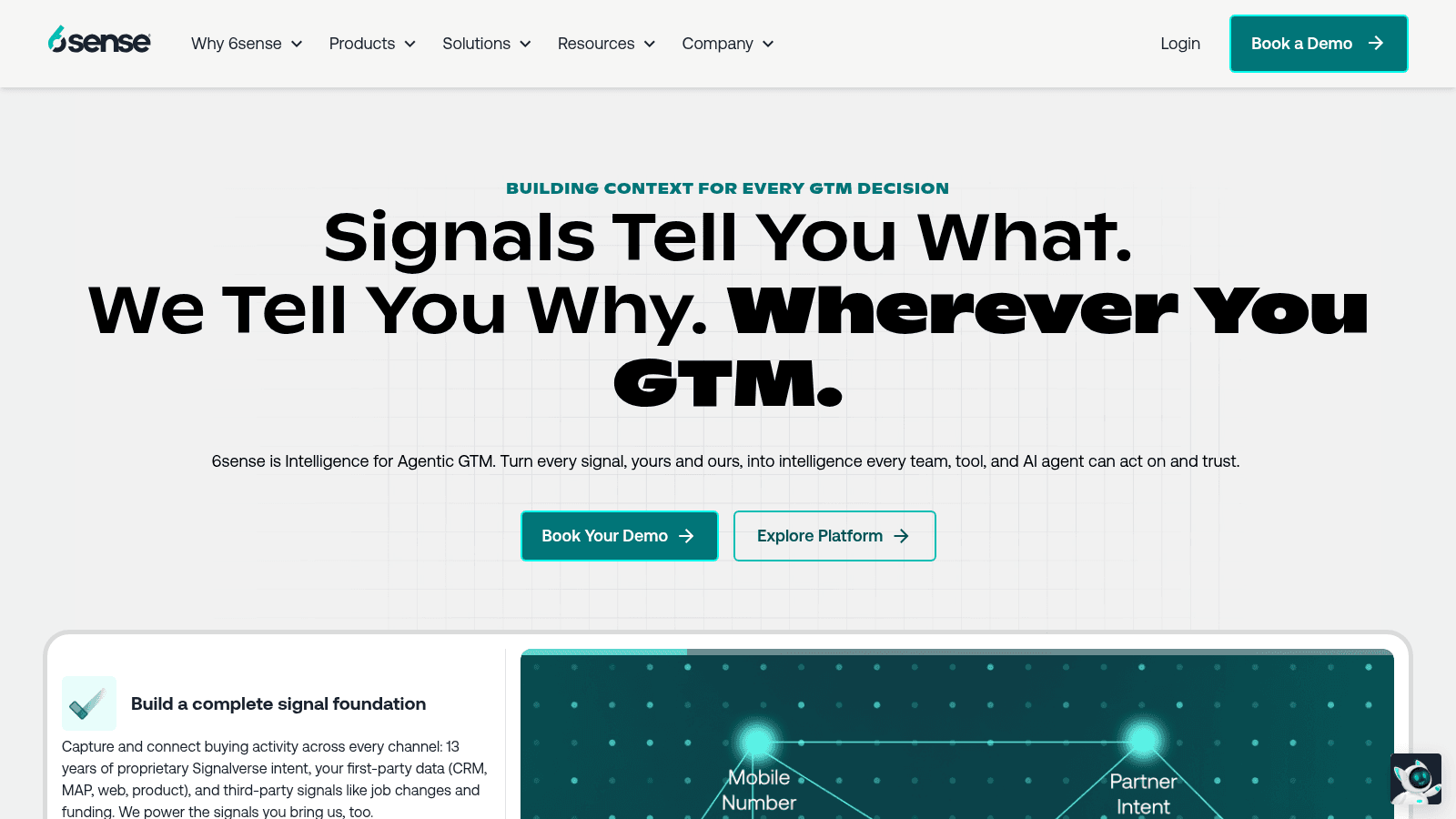
6sense pairs its Signalverse intent network with predictive models that score accounts by buying stage. It blends first-party signals from your CRM, marketing automation and website with third-party intent, then tells you which accounts are early or late in a cycle.
Key features:
- Signalverse network with 13 years of proprietary intent data
- First-party signals from CRM, MAP, web and product
- Predictive models that rank accounts by stage
- GTM intelligence surfaced through an AI assistant
Pricing: 6sense does not publish pricing. Plans are quoted based on the products you take and the size of your account universe, and implementation is a project rather than a self-serve signup.
Pros: strong stage modeling that goes beyond raw intent, deep native CRM integrations, useful for ABM teams.
Cons: enterprise cost and onboarding, no public pricing, and it rewards teams with the headcount to act on the scores.
Where it beats the alternatives: the prediction layer. If your problem is ranking accounts rather than finding signals, 6sense's modeling is the differentiator.
Final verdict: a strong fit for mid-market and enterprise ABM teams that want intent and prediction in one system.
Demandbase
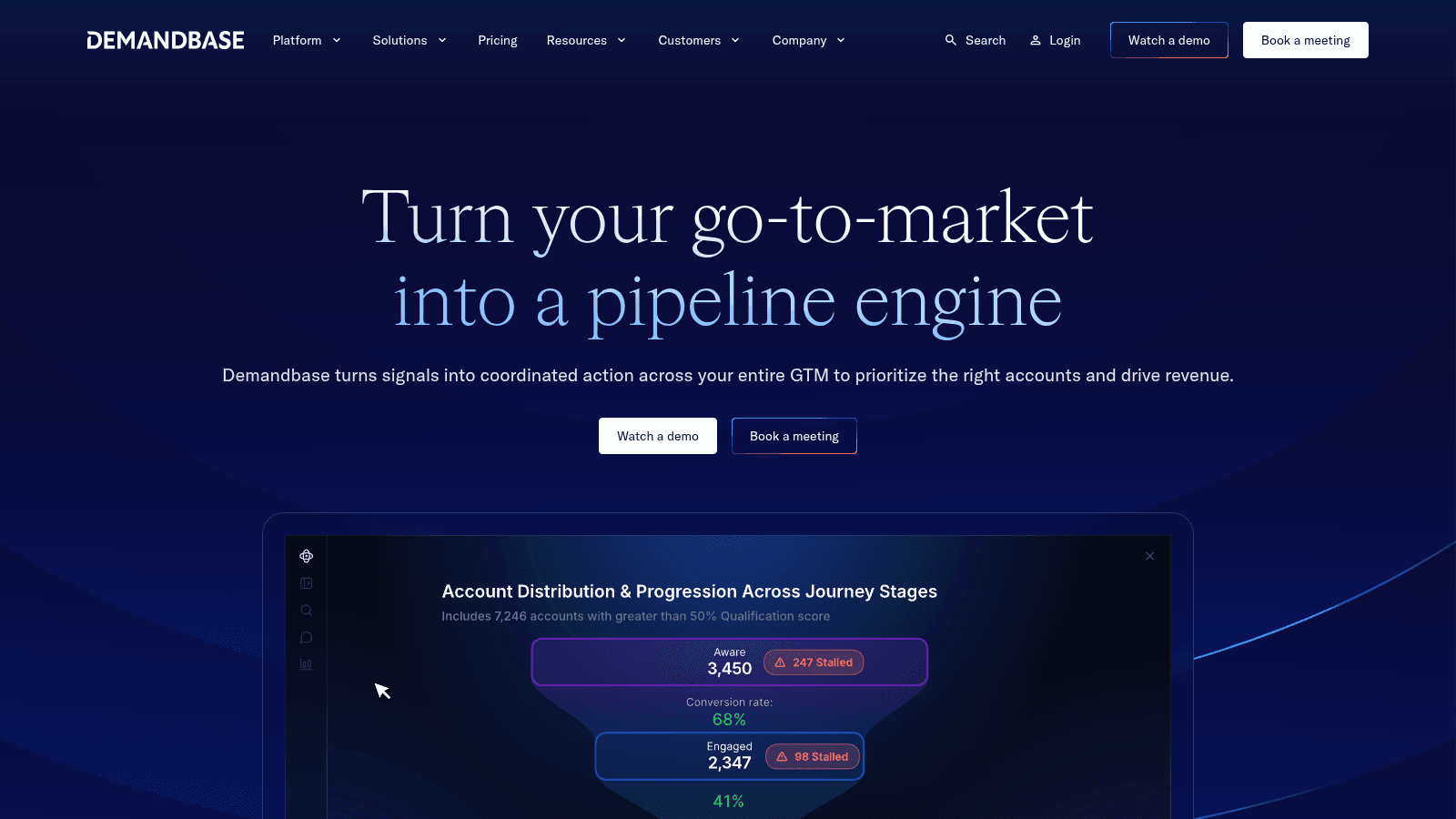
Demandbase is an account-based go-to-market platform that stitches intent data to advertising, personalization, and sales engagement. It collects buying signals across channels and routes them into coordinated actions, so marketing and sales work the same prioritized account list.
Key features:
- Account intelligence combining intent and firmographic data
- Intent-driven advertising and site personalization
- Sales engagement tools tied to the same account scores
- CRM integration for pipeline visibility
Pricing: Demandbase charges a platform fee that covers the software and services, plus a flat fee per user. The company confirms the model on its pricing page and quotes the number after a demo, so there is no self-serve tier.
Pros: intent tied to execution across ads and web, one account view for marketing and sales, strong enterprise fit.
Cons: no public price, a learning curve on the wider feature set, and a platform fee that rewards larger teams.
Why buyers shortlist it: it makes intent actionable inside the ads and the website, not only in a dashboard.
Final verdict: the pick for teams that want to act on intent across marketing channels as well as sales.
Informa TechTarget Priority Engine
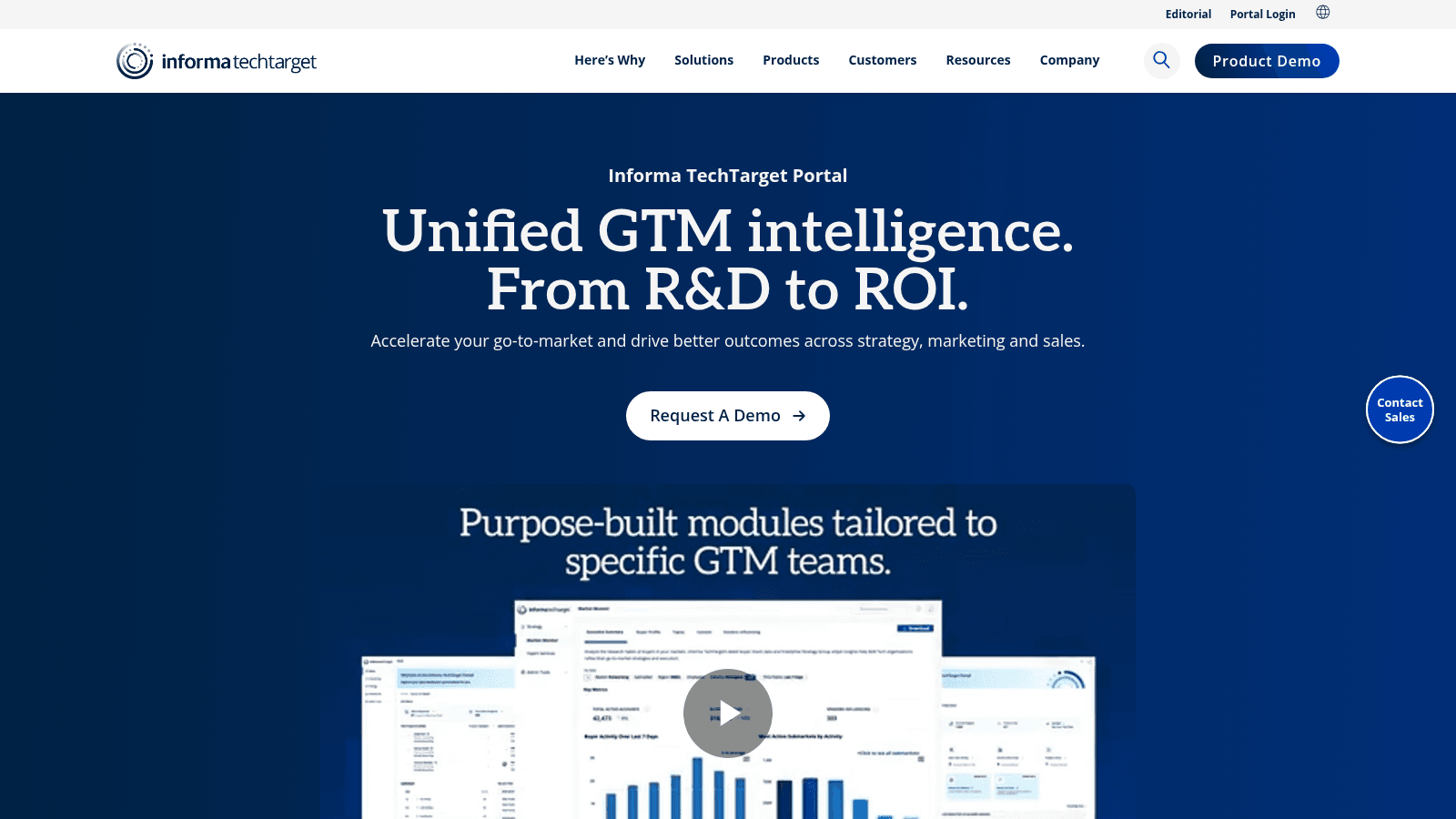
Informa TechTarget Priority Engine draws intent from the reading behavior of technology buyers across the TechTarget and Informa media network. Because the audience is concentrated in enterprise IT, the signals are specific to tech categories and often arrive early, while a buyer is still comparing options.
Key features:
- Purchase intent analytics from a tech-buyer media network
- Account and contact-level intent on technology categories
- Research, advisory and intent insights bundled in some plans
- Content syndication and lead products alongside the data
Pricing: Informa TechTarget quotes Priority Engine pricing. There is no public tier, and contracts usually bundle intent with content or demand products, so compare on the total package rather than a data-only line.
Pros: deep, early signal coverage of enterprise tech buyers, useful contact-level detail, media reach on the same platform.
Cons: quote-only, limited to the technology audience, and often sold inside a wider package.
Its real strength: breadth of early-stage tech research, which suits vendors selling into IT.
Final verdict: a specialist option for tech vendors that want intent from a dedicated buyer network.
G2 Buyer Intent
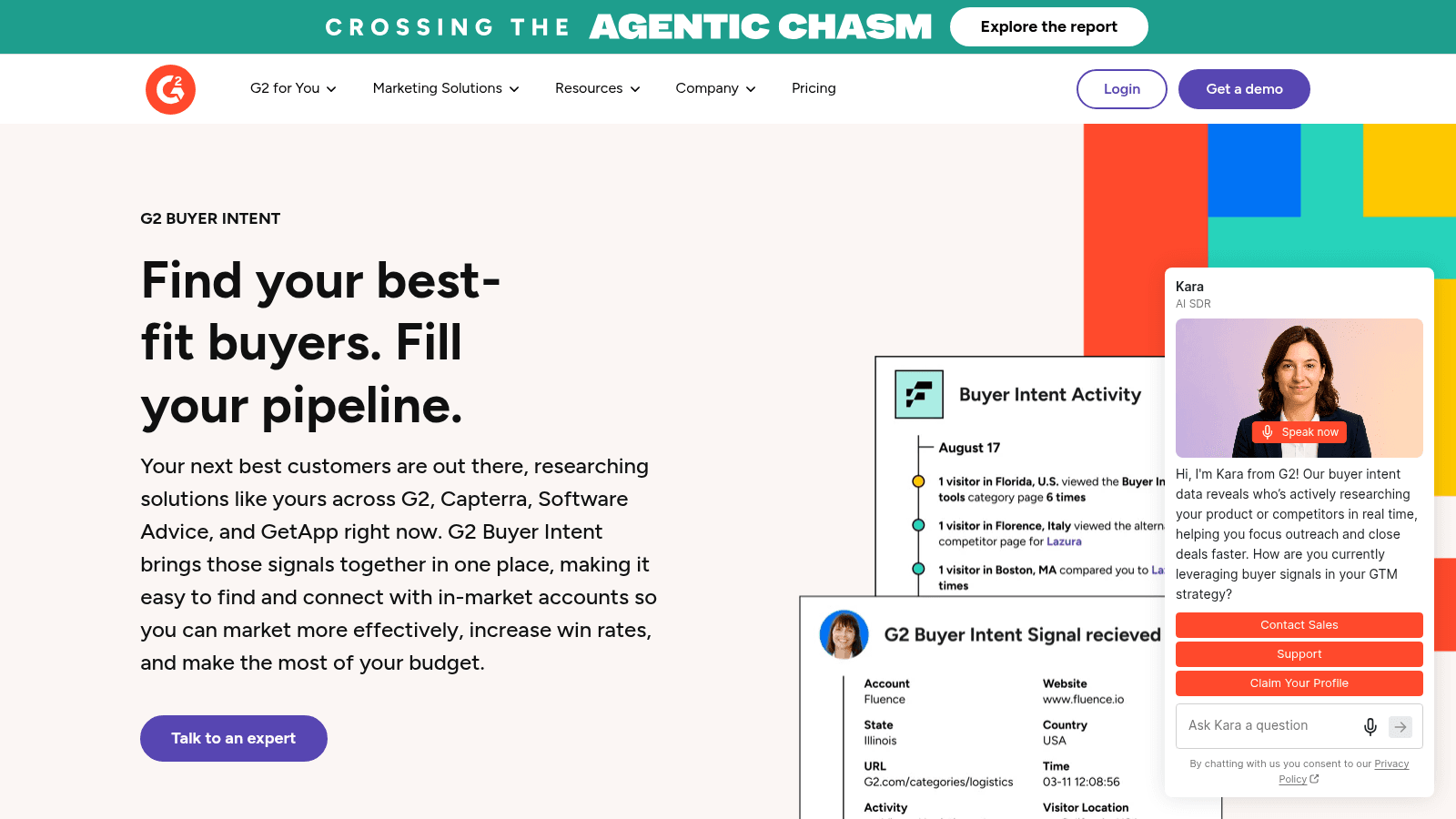
G2 Buyer Intent turns activity on G2, Capterra, Software Advice and GetApp into signals you can act on. When a target account views a category page or compares you to a rival, the platform surfaces it, which makes the data unusually concrete: you can see which competitor page drew the visit.
Key features:
- Intent signals from four software comparison sites
- Account-level activity such as page and comparison views
- A free plan with a retroactive 30-day lookback
- Buyer-intent feeds that push into your CRM or tools
Pricing: G2 publishes a free plan with 3 users, and a Starter plan at $299 per month or $2,999 per year. A Professional tier with more users and visitor data is quoted by sales. The 30-day lookback offer lets you test the signal quality before you commit.
Pros: transparent pricing with a real free tier, signals from sites buyers actually use, and competitive detail you cannot get elsewhere.
Cons: signals are limited to the four G2 sites, so coverage depends on your category, and the free plan is thin for a team.
Why it is worth a trial: it is the easiest intent source to test, and the comparison-page detail is genuinely specific.
Final verdict: the best starting point for SaaS teams that want to see intent working before paying for a co-op.
Intentsify
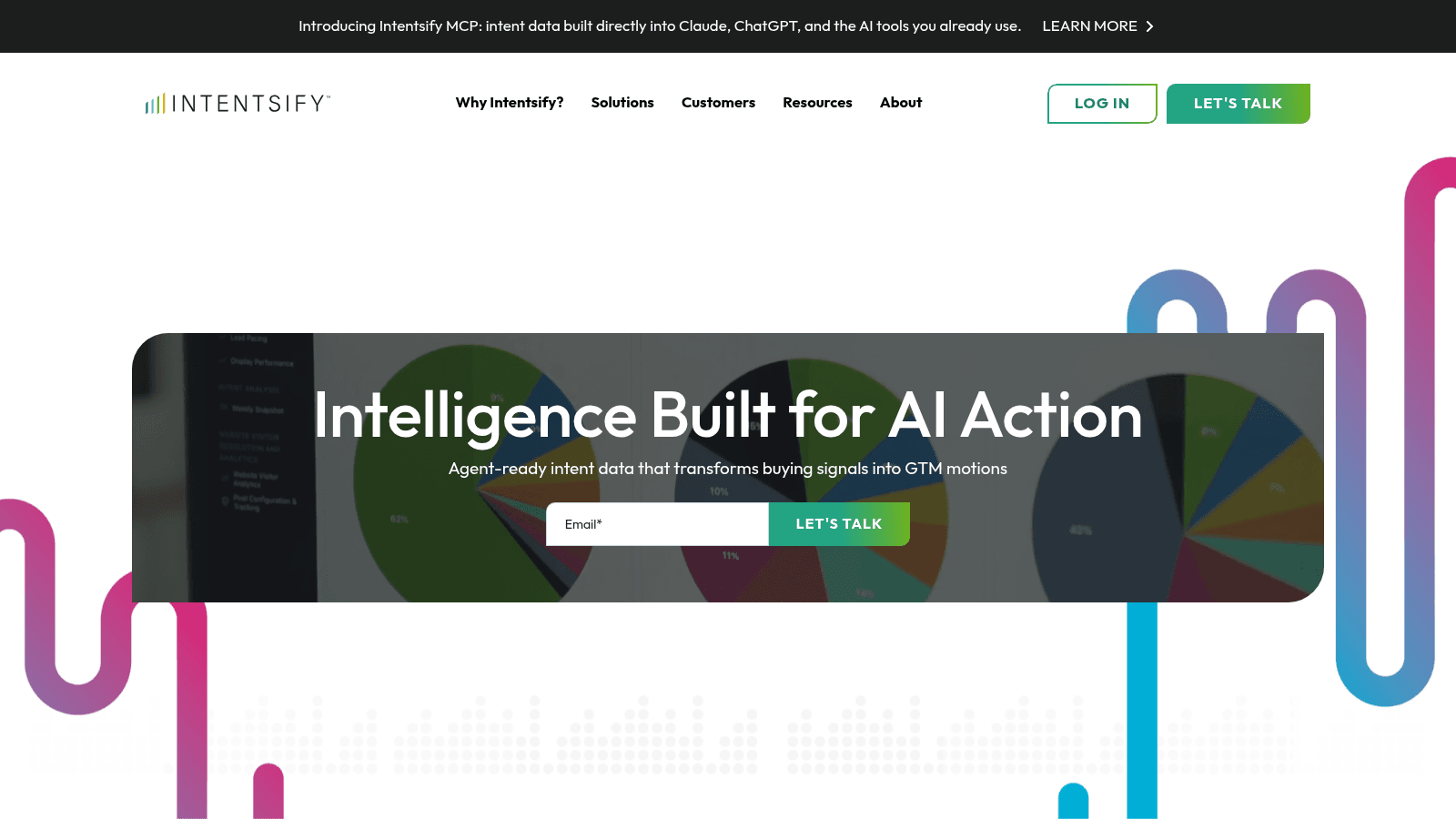
Intentsify sits on top of multiple third-party intent sources and turns them into activated programs. Rather than selling you one feed, it aggregates signals, unifies them, and helps you target the accounts showing activity, including through an MCP integration that pipes intent into AI tools like Claude and ChatGPT.
Key features:
- Aggregation across multiple third-party intent providers
- Intent activation for advertising and demand programs
- First-party intent capture and enrichment
- MCP integration for AI-tool workflows
Pricing: Intentsify quotes pricing by program and data volume. There is no public rate card, and cost depends on how many intent sources you pull from and how you activate the audiences.
Pros: combines several sources so overlap is easier to manage, activation is built in, and the MCP path is unusual.
Cons: quote-only, and the value depends on how well the underlying sources cover your market.
What it is genuinely good at: consolidating intent feeds and putting them to work, which suits teams that already believe in intent but are tired of juggling vendors.
Final verdict: a solid pick for teams that want intent aggregated and activated rather than sold as a bare feed.
Lead Forensics
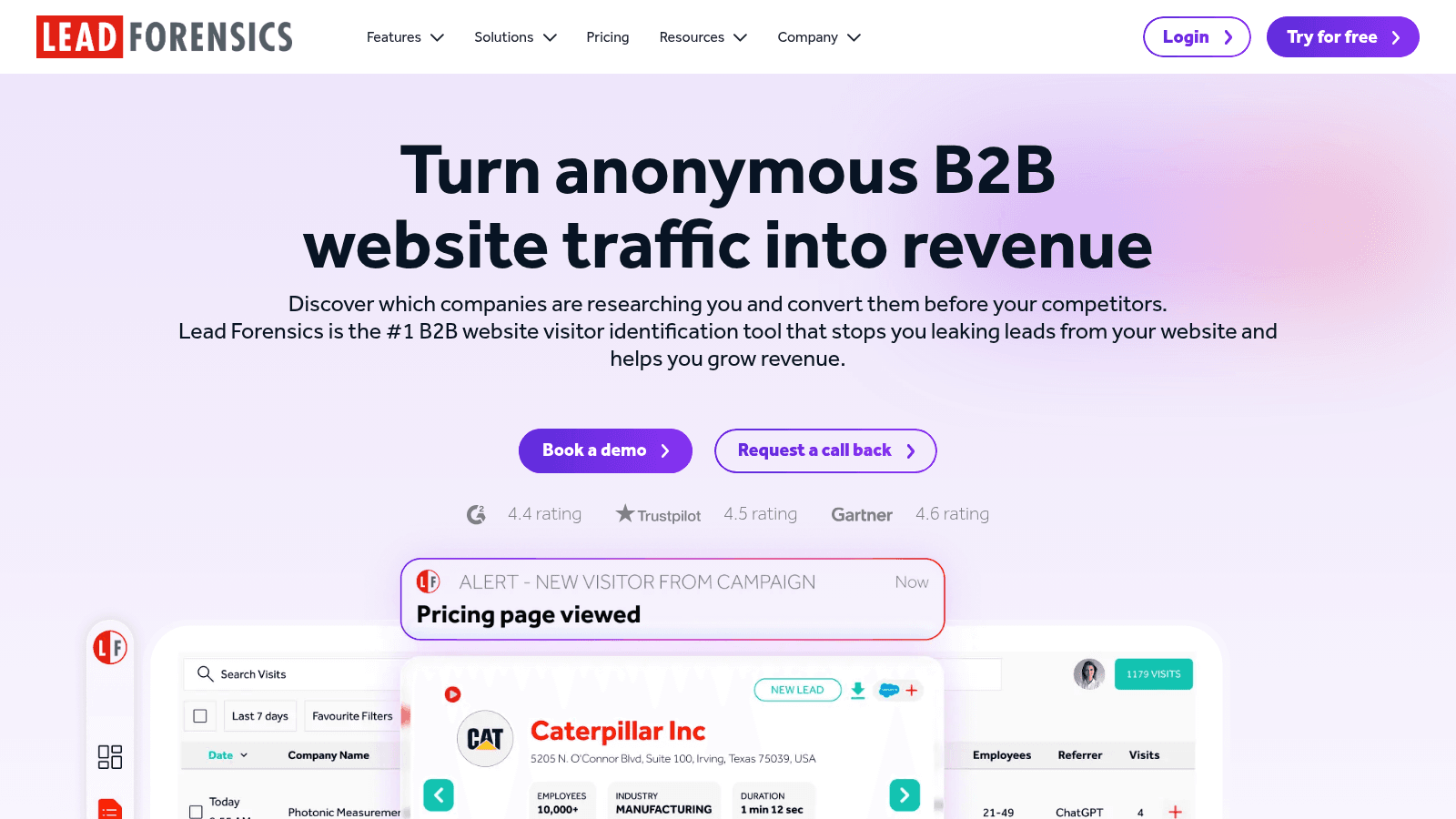
Lead Forensics identifies the companies visiting your website by matching IP addresses to business data, then shows the pages they viewed. It is first-party intent in its purest form: the signal is your own traffic, so the intent is as real as your site's engagement.
Key features:
- Website visitor identification via IP matching
- Page-level view history for each identified company
- Alerts on high-intent pages such as pricing
- Unlimited users on a plan
Pricing: Lead Forensics quotes pricing based on your site traffic and the number of new leads it uncovers. Unlimited users are included, which means the price tracks traffic rather than seats.
Pros: first-party signals straight from your site, page-level detail, and unlimited seats.
Cons: quoted pricing tied to traffic, identifies companies more reliably than individuals, and needs a site with meaningful B2B traffic to be worth it.
Where it beats the alternatives: it only reports companies that already found you, which is the highest-intent audience you have.
Final verdict: a strong addition if your website pulls decent traffic, and a weak one if it does not.
Dreamdata
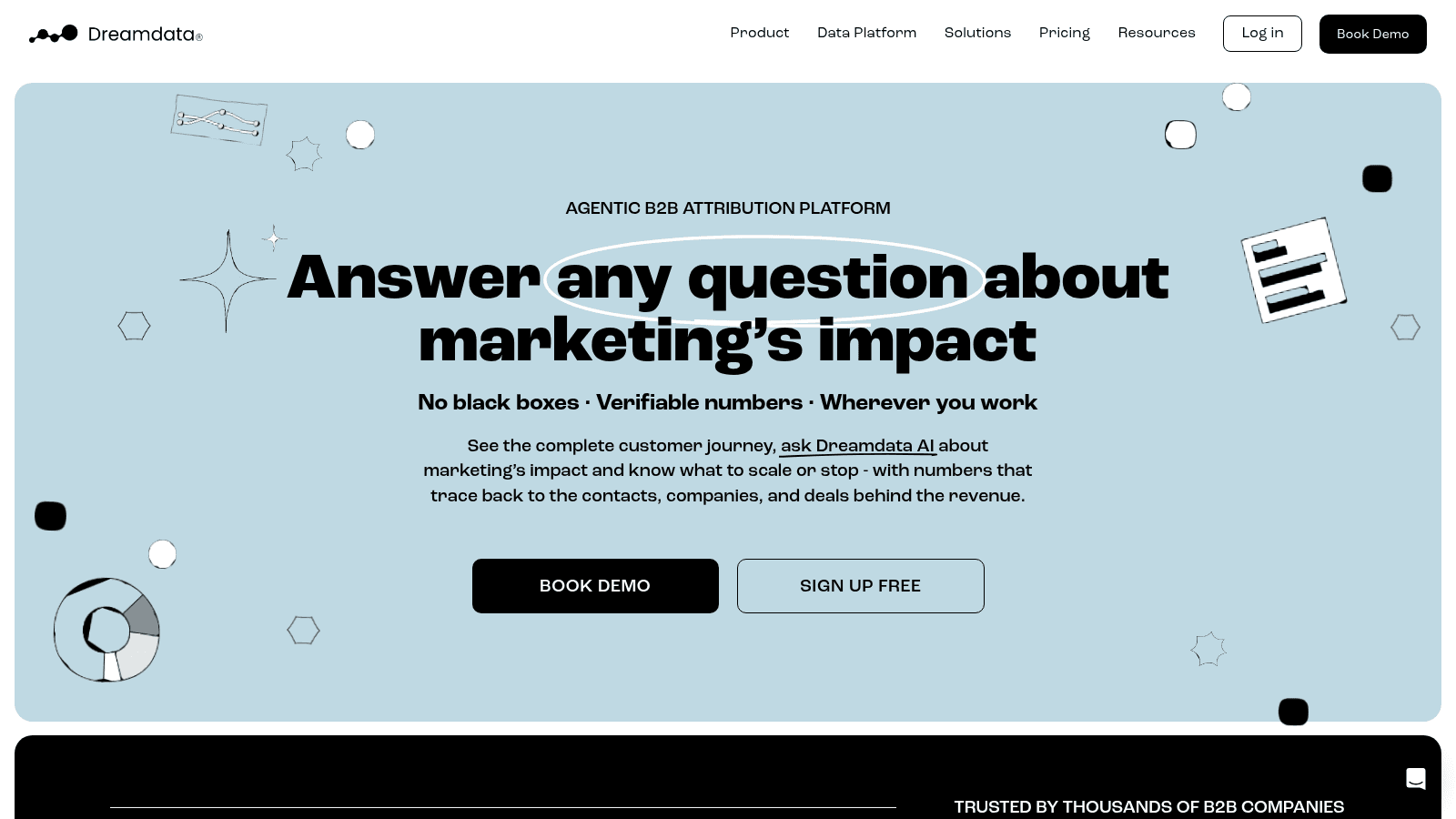
Dreamdata is an agentic B2B attribution platform that traces the customer journey across touchpoints. Intent is one layer inside a larger data model, so you see which companies engaged and how that engagement connects to pipeline and revenue.
Key features:
- A unified B2B data model across ads, web, CRM and product
- Journey attribution that ties touches to revenue
- Dreamdata AI for natural-language questions about impact
- Free tier for testing the model
Pricing: Dreamdata publishes a free plan with a monthly tracked-user cap, and quotes its Attribution and Activation plans by the data you need to model. Free is genuinely usable for a small team; the paid tiers are a conversation.
Pros: attribution linked to intent, a real free tier, and verifiable numbers rather than a score alone.
Cons: intent is one layer rather than the whole platform, paid tiers are quoted, and setup needs clean CRM data.
Its real strength: connecting intent to revenue, which is the question a score alone cannot answer.
Final verdict: the pick for marketing teams that want to prove intent paid off, not just track it.
Leadfeeder
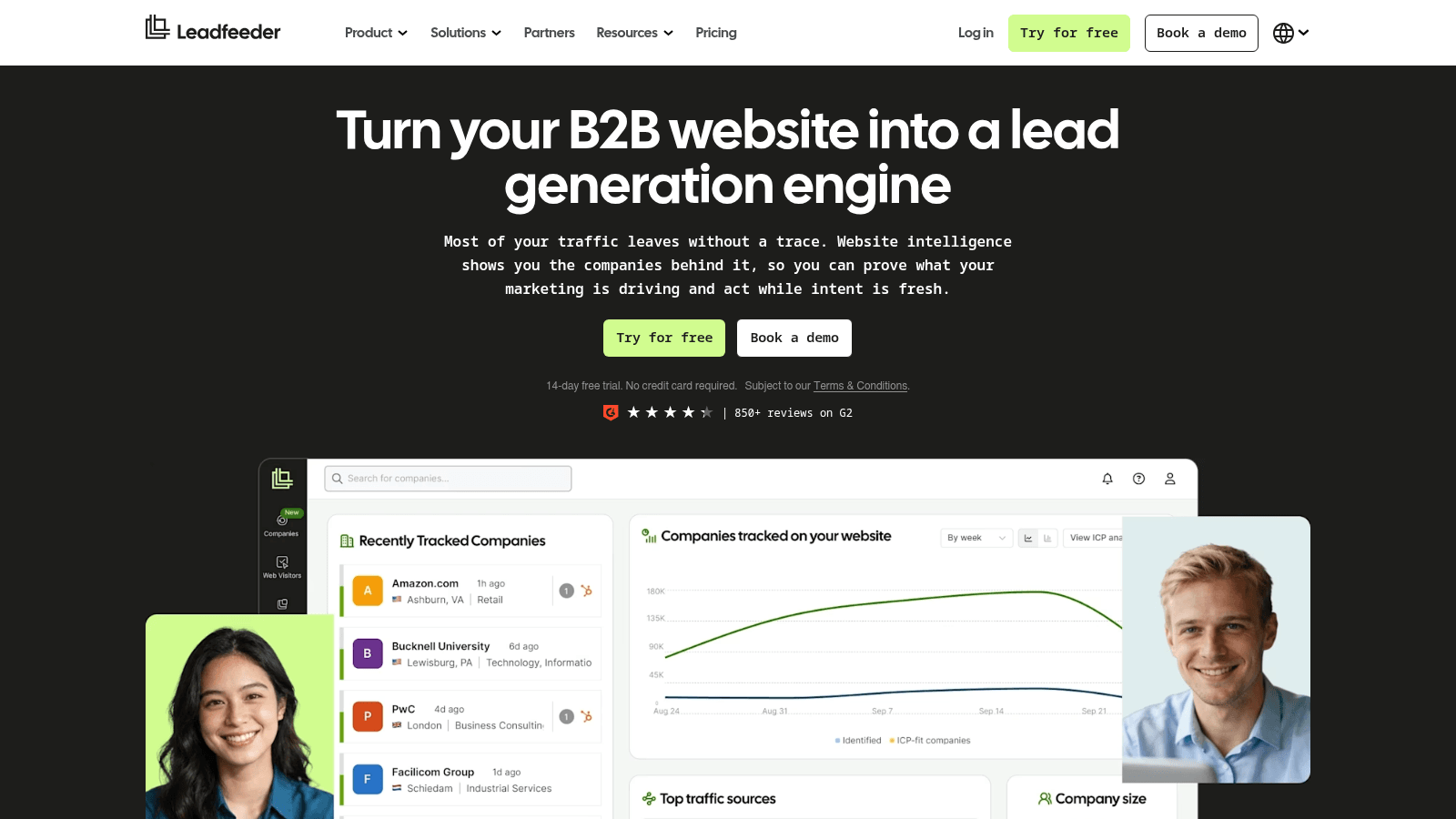
Leadfeeder reveals the companies visiting your website and scores them against your ideal customer profile, so you can act on first-party intent without an enterprise contract. It reports identifying up to 45 percent of companies from website traffic, and a free tier keeps the last 100 companies a month.
Key features:
- Website visitor identification with company data
- ICP filtering so only fit accounts surface
- Free forever tier for the last 100 companies each month
- Integrations that route leads into your CRM
Pricing: The free tier covers the last 100 companies a month. Discover starts at $79 per month billed annually, Activate at $369, and Scale at $599, each with a 14-day trial. The tool says more than 15,000 companies use it.
Pros: a real free tier, fast setup, and clear ICP filtering; good value at the entry level.
Cons: first-party signals only, no third-party network, and the free tier caps at 100 companies.
Why buyers shortlist it: it is the cheapest way to see which companies visit your site and turn that into outreach.
Final verdict: the best low-cost entry into website intent, capped but genuinely useful.
How We Chose These Intent Data Tools
We started from the search results for the category, then kept only tools whose product page describes how they collect signals. A company that mentions "intent" as a feature but cannot explain its data source did not make the cut.
Practitioners are blunt about this gap. In a thread on Reddit, a marketer with 15 years in sales engineering described spending on 6sense, ZoomInfo and Bombora and coming away mostly disappointed with the quality and context of the data.
Another discussion on r/gtmengineering raises the harder question of where the signal actually comes from, with one builder reporting that campaigns run on vendor intent signals performed no differently from ordinary cold outreach. Those threads are anecdotal, but they point at the two things to test before you buy: provenance and real-world lift.
We weighted three things. First, does the vendor explain where the signal comes from, whether a publisher co-op, a review site, or your own traffic. Second, can a buyer understand the pricing, even when it is quoted. Third, does the tool connect to the rest of a workflow, by sending, integrating with a CRM, or activating an audience. We dropped tools whose pricing could not be reached by any method.
What to Look For in Intent Data Software
The difference between useful intent data software and an expensive list of alerts comes down to a few checks you can run before you sign. Ask each vendor the same questions and compare the answers, because the marketing pages rarely volunteer them.
- Ask which sources feed the signal, and whether they are first-party, third-party, or both.
- Ask whether the output is account-level or includes contacts, and how fresh the data is.
- Ask how surging topics are mapped to your categories, and whether you can define your own.
- Ask what the minimum contract is and whether there is a trial or a free tier.
- Ask how signals reach your team, whether by CRM sync, email alert, or ad audience.
- Ask for a sample of accounts in your market so you can check the coverage yourself.
- Ask how overlap with your existing feed is handled, since duplicate signals add little.
Run those questions against two or three vendors and the shortlist narrows itself. The trial matters most, because intent quality is category-specific. When intent is clean, the next step is often to enrich the record before anyone writes to it, which is the job these data enrichment tools cover.
How to Choose the Right Intent Data Platform
The right pick depends less on features than on the problem you are solving. A team with strong website traffic often gets more from a first-party visitor tool than an expensive co-op. A team selling into enterprise IT may want a dedicated tech-buyer network. A team that already owns a signal wants a prediction layer on top.
Start with where your best leads already come from. If they find you, first-party website intent is the cheaper and more accurate route, and the visitor-identification features on the homepage of the first-party tools are the place to start.
If they do not know you yet, third-party intent from a co-op or review site surfaces them early. Forrester's advice on stacking sources, in its guidance on intent providers, is to look for signals at least 30 to 40 percent unique from the one you already have, so a second feed adds coverage rather than noise.
Match the contract to the team that will act on it. A quote-only platform fee only pays off if someone works the accounts every week. If nobody owns the alerts, the cheapest option or the free tier is the honest starting point.
What Intent Data Platforms Cost in 2026
Pricing in this category splits into two worlds. Review-site and website-visitor tools publish tiers you can sign up for today. The co-op and enterprise platforms quote a platform fee that often lands in the tens of thousands per year, and the number depends on your topic count and account universe.
Pricing shape | Typical range | Examples | What drives the number |
|---|---|---|---|
Free tier | $0 | G2 Buyer Intent, Dreamdata, Leadfeeder | User or tracked-company caps |
Self-serve paid | $79 to $299 per month | Leadfeeder, G2 Buyer Intent | Companies tracked or users |
Bundled with a platform | From $49 per user per month | Reply.io | Seats plus data volume |
Quoted platform fee | Custom, often annual | Bombora, 6sense, Demandbase, TechTarget | Topics, accounts, products |
Managed program | Custom, services-led | Lead Forensics, Leadfeeder | Traffic, leads, or services |
The quote-only tools are not hiding a small number; they sell intent inside a larger contract, so the price reflects your account universe and the products you take. Budget for a pilot before a full rollout, and test coverage in your own market rather than trusting a demo dataset.
First-Party vs Third-Party Intent Data
The two signal types answer different questions, and most programs need both. First-party intent is behavior on assets you own: your website, your product, your emails. It is accurate and cheap to start, because the audience already knows you. Its limit is coverage, since it only sees companies that found you.
Third-party intent is behavior captured off your site, through a co-op, a review network, or a media audience. It reaches companies before they contact you, which is the whole point, and it costs more because you are buying a network you do not own. Its limit is precision, because the same account appears in many feeds and the signal can be noisy.
The practical order is to capture first-party intent first, since it is nearly free and highly specific, then add a third-party source to widen coverage. The use cases behind each type differ: first-party suits teams that already get traffic, third-party suits teams chasing accounts that have never heard of them.
Watch overlap when you add the second source, because a feed that mostly repeats what you already see is a feed you are paying twice for.
Is Free Intent Data Worth It?
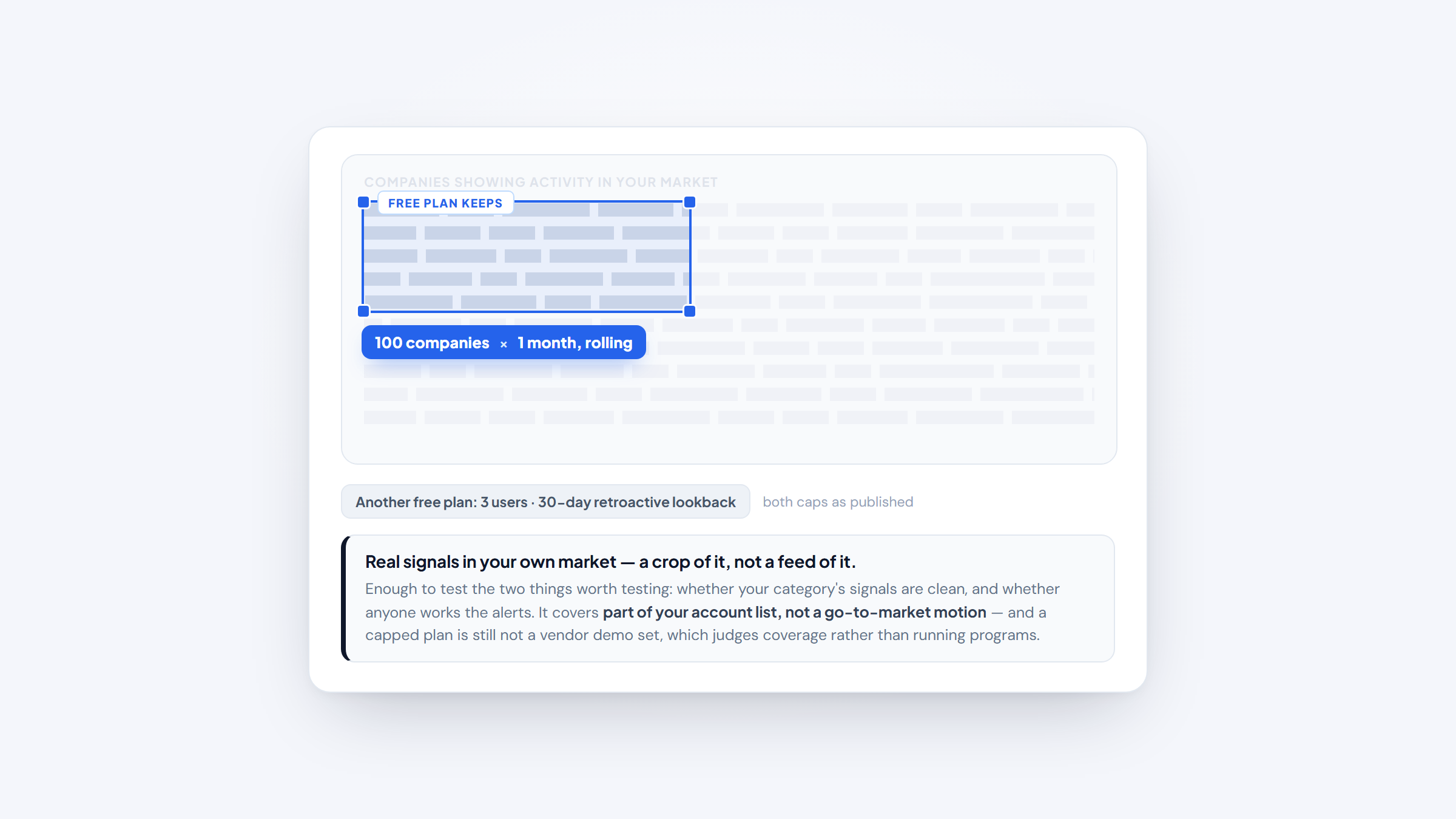
Yes, as a starting point, and the free tiers in this category are unusually useful. Leadfeeder reports the last 100 companies that visited your site each month at no cost, and G2 Buyer Intent offers a free plan with a retroactive 30-day lookback. Both let you see real signals in your own market before you spend anything.
Free intent data has a ceiling. The caps on companies or users mean it suits a small team and part of your account list, not a full go-to-market motion. And a free tier is not the same as a free sample: a demo set helps you judge coverage, not run programs.
Use the free tier to test two things: whether the signals in your category are clean, and whether anyone on the team actually acts on them. If both hold, paying for more coverage is an easy call. If nobody works the alerts, more data will not fix that.
Where Intent Data Still Leaves a Gap
Intent platforms stop at the account. You learn which company is researching, and sometimes which competitor page they viewed, but you rarely get the name and work email of the person you should write to. That last mile is where outreach either starts or stalls, because a signal without a contact is just a score. Even a well-built cold email platform assumes you already have the address to send to.
Once you have the account and a name, you still need that person's work email. The free Name2Email extension handles exactly that step inside Gmail: type a name and the company domain, and it generates the most likely address patterns and populates the To field. You confirm the real one by hovering, since Gmail surfaces the person's name and photo when it recognizes an address.
We built Name2Email to be honest about what it does. It is pattern-based, works best with corporate domains, and cannot guarantee every address. It is not a list builder or a database, so it will not replace an intent platform. What it does is take the company a signal surfaced and help you reach the person, free, inside the inbox you already use.
Picking Your First Intent Data Platform
Start with the signal type that matches where your leads come from. If your website brings in B2B traffic, a first-party visitor tool like Leadfeeder or Lead Forensics gives you accurate intent for little or nothing. If you need to reach companies before they find you, a third-party source such as Bombora, 6sense, or a review-site feed like G2 Buyer Intent is the way in.
Then match the tool to the team that will act on it. A quoted enterprise platform only earns its fee when someone works the accounts every week. Test coverage with a free tier or trial before you sign, and keep the last mile in view: intent tells you who, and you still have to find the person and write to them.
The follow-up cadence only starts once that first address is in the To field.
Add Name2Email to Chrome and find your next prospect's email without leaving Gmail.
Frequently asked questions
An intent data platform collects buying signals that suggest a company is researching a product or category, then packages them as account scores, alerts, or audiences. The signals come from publisher networks, review sites, or your own website traffic.
Review-site and website-visitor tools range from free to about $299 per month, with a real free tier at G2 Buyer Intent, Dreamdata, and Leadfeeder. Co-op and enterprise platforms such as Bombora, 6sense, Demandbase, and Informa TechTarget quote an annual platform fee that is often in the tens of thousands.
Most do not. Intent data platforms return the account showing activity, and sometimes a contact, but not a guaranteed work email for a specific person. You still need a way to find and confirm the address, which is what a free finder like Name2Email does inside Gmail.
First-party intent is behavior on assets you own, such as your website and product, and it is accurate but limited to companies that already found you. Third-party intent captures behavior off your site, so it reaches accounts earlier, but it costs more and needs overlap checks to avoid repeat signals.
Yes as a starting point. Leadfeeder reports the last 100 companies that visited your site each month for free, and G2 Buyer Intent includes a free plan with a 30-day lookback. Use them to test signal quality and whether your team acts on the alerts before you pay for more coverage.

We build Name2Email, the free Chrome extension that finds work emails inside Gmail. We write about outreach, prospecting, and getting more replies.
Connect →